I was listening to the radio on my way to and from work the other day and was confronted with a news story so important that it was carried by at least two different stations at two different times. The story went something sort of like this …
The strongest lightning strike of the year so far in Germany was recorded in Schiffdorf, Lower Saxony with a measured force of 336 000 amperes. In total, Germany has experienced just over a million lightning strikes in 2026, with the most occurring in Bavaria and then in Lower Saxony.
… and immediately raised three important questions:
Who cares?
I know that a lot of people dislike the news nowadays because of all the negative stories but is this really the best they could do to even that out? Really? What can I possibly do with this information other than to bore the shit out of my friends even more than I already do?
Context?
Ok, three hundred thousand and change is unquestionably a big number. Same as with the million lightning strikes in Germany so far this year. Unfortunately, news organizations are usually satisfied with simply rolling out big numbers even when they alone don’t even come close to telling the full story. Simple question: is 300 000 amps a lot when it comes to lightning?
Going online gave a bit more context where the complete news release revealed that 300 000 amps is roughly 16 000x what comes out of a normal German electrical socket. Slightly smaller big number but again still relatively meaningless. We all know that lightning packs a lot more oomph than what our TV needs, but how does this particular strike compare to other ones?
Pretty good as it turns out, with ChatGPT indicating that the average lightning strike has about only 30 000 amps, making this one an order of magnitude stronger than that. Even more impressive is that the magnitude of this strike was close to the apparent theoretical upper limit for lightning in temperate regions. So, as big as the number 300 000 by itself is, just this little bit of extra information makes it that much bigger. Makes me wonder if Schiffdorf still exists. Or, in the context of my first question, if anyone really cares if it does.
(And for those who are interested, the same online story indicates that the million strikes are actually 15% below the 10-year rolling average for Germany. Granted, more context, but badly used context because they forgot the words “so far” and a relatively normal October, essentially the last month in the annual lightning season, would result in 2026 becoming a pretty average year in terms of lightning.)
More context?
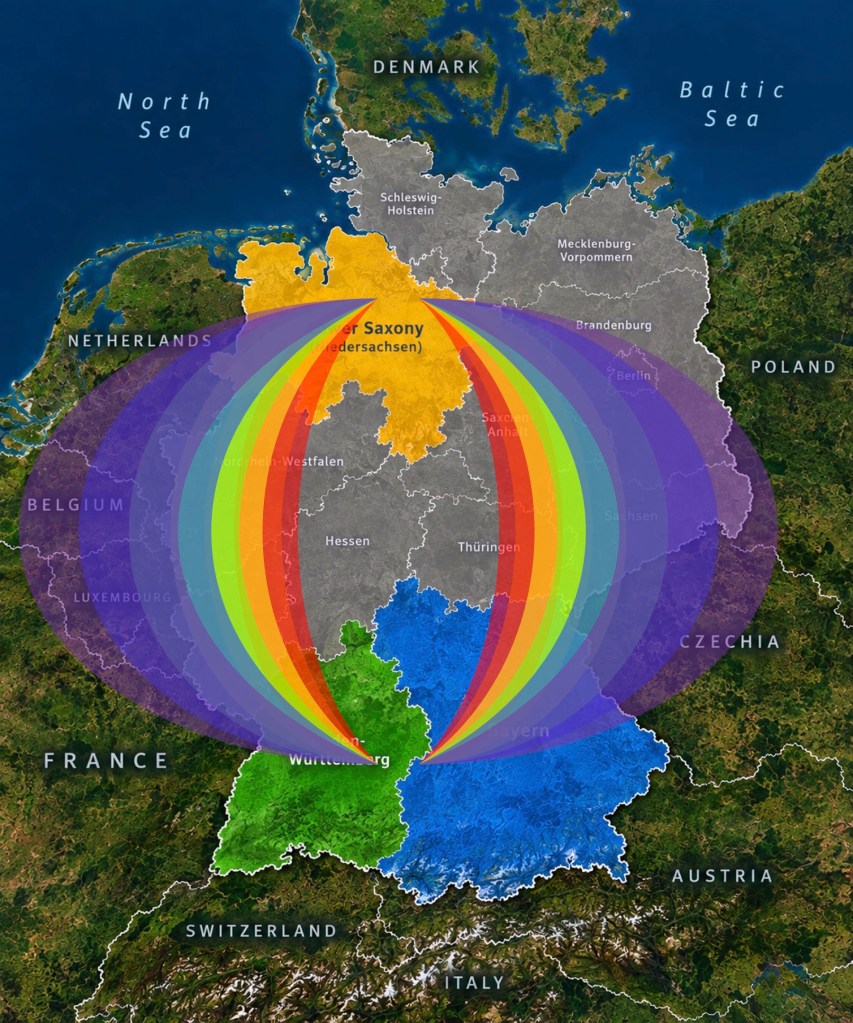
From both the radio and online stories, you would get the feeling that Bavaria and Lower Saxony are particularly prone to lightning, with Baden-Württemberg rounding out the top three. When you consider that Lower Saxony is in the far north of Germany whereas the other two provinces are in the deep south, you might think that this distribution could be caused by something akin to the Earth’s magnetic poles, with Germany acting as some kind of bipolar battery.
Now, Germany might indeed be bipolar, but the real answer could be much more banal: Bavaria, Lower Saxony, and Baden-Württemberg just happen to be the three largest provinces by area. In other words, you would expect them to get more lightning strikes just because of that, all other things being equal. And, indeed, the correlation between lightning strikes and land area for these three provinces, unlike lightning, is amazingly damn straight.
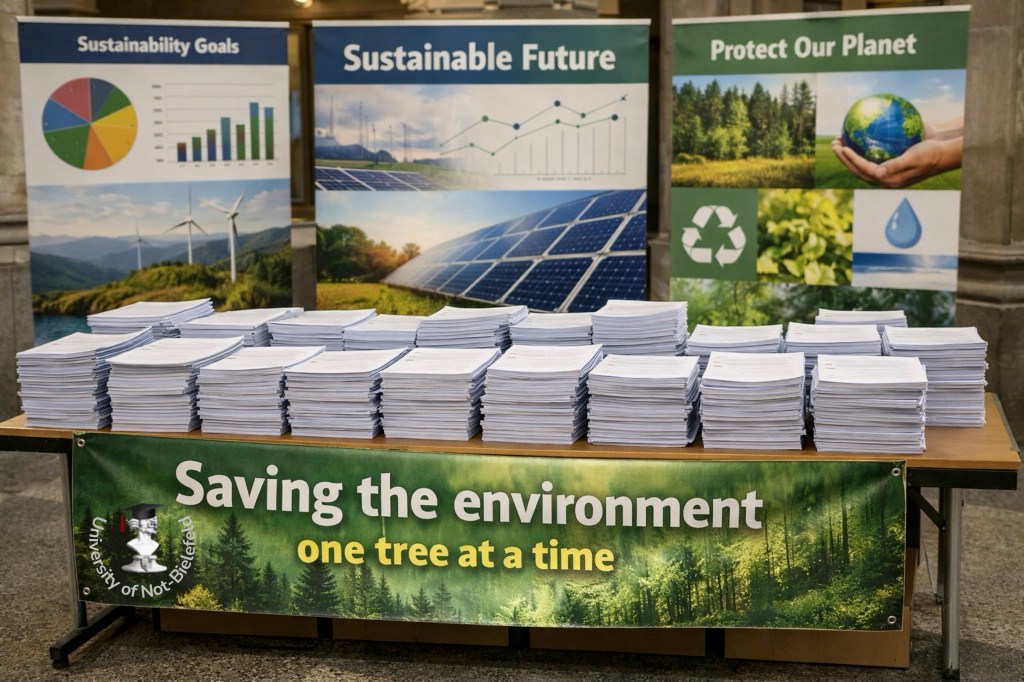
I know that I’ve been picking on the environmental efforts of the University of Not-Bielefeld quite a bit lately, but, unlike Central Admin, they’ve been relatively productive of late. Well, productive in terms of generating content for this blog at least.
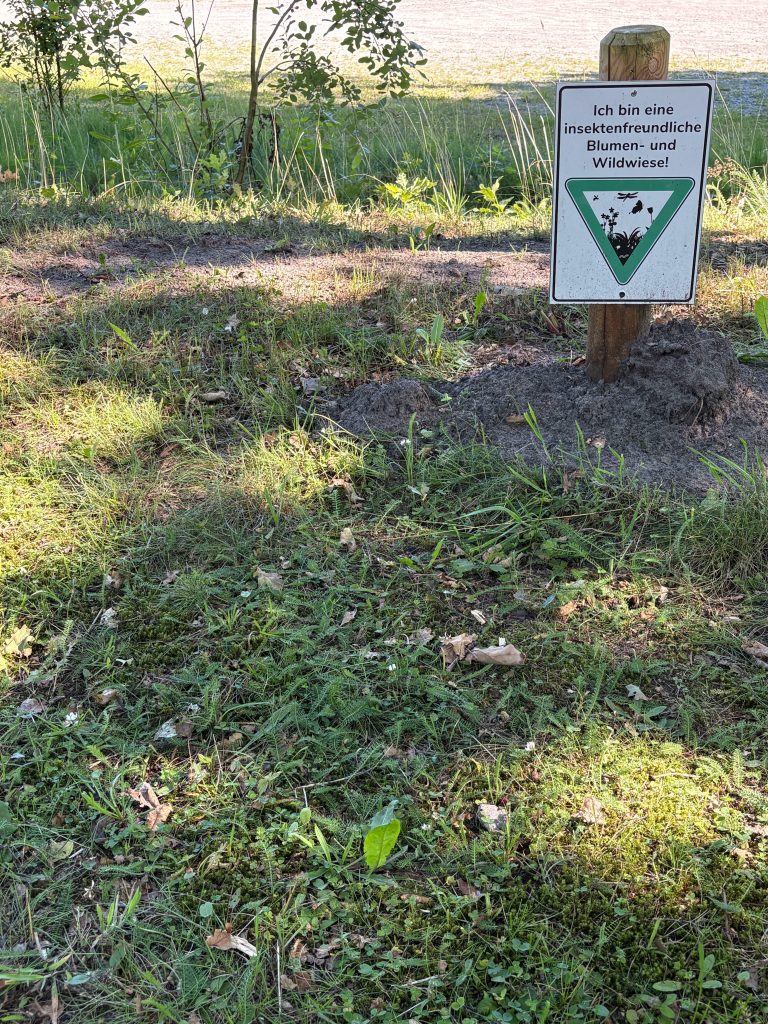
I’ve poked fun at the exact same sign to the right before, pointing out that, among other things, a two-meter wide strip of grass beside a parking lot hardly qualifies as a meadow. But now thanks to some bored University gardeners and their weed-whackers, it doesn’t even qualify as insect-friendly (insektenfreundlich) anymore, much less as a flower meadow (Blumenwiese). I mean seriously. Exactly what kind of insects are they possibly trying to befriend here? Ants? Even ticks will be giving a very hard pass to this very literal brush cut.
Now I don’t really have anything against ants and it’s not as if there aren’t any other bushes or flowers or other wild growth on campus. But why on earth do you explicitly designate a “meadow” as being for insects and then raze it to the ground at the very height of summer? The gardeners have even simply thrown the signs to wallow neglected at the edges of some other meadows, probably because they were getting in the way of the lawnmowers. Remember, this all is basically being overseen by the same people who made a lot of noise about replacing a simple dog meadow on campus with an “ecologically enhanced” Tiny Forest. Well, that dog meadow is looking pretty good in comparison now, isn’t it?
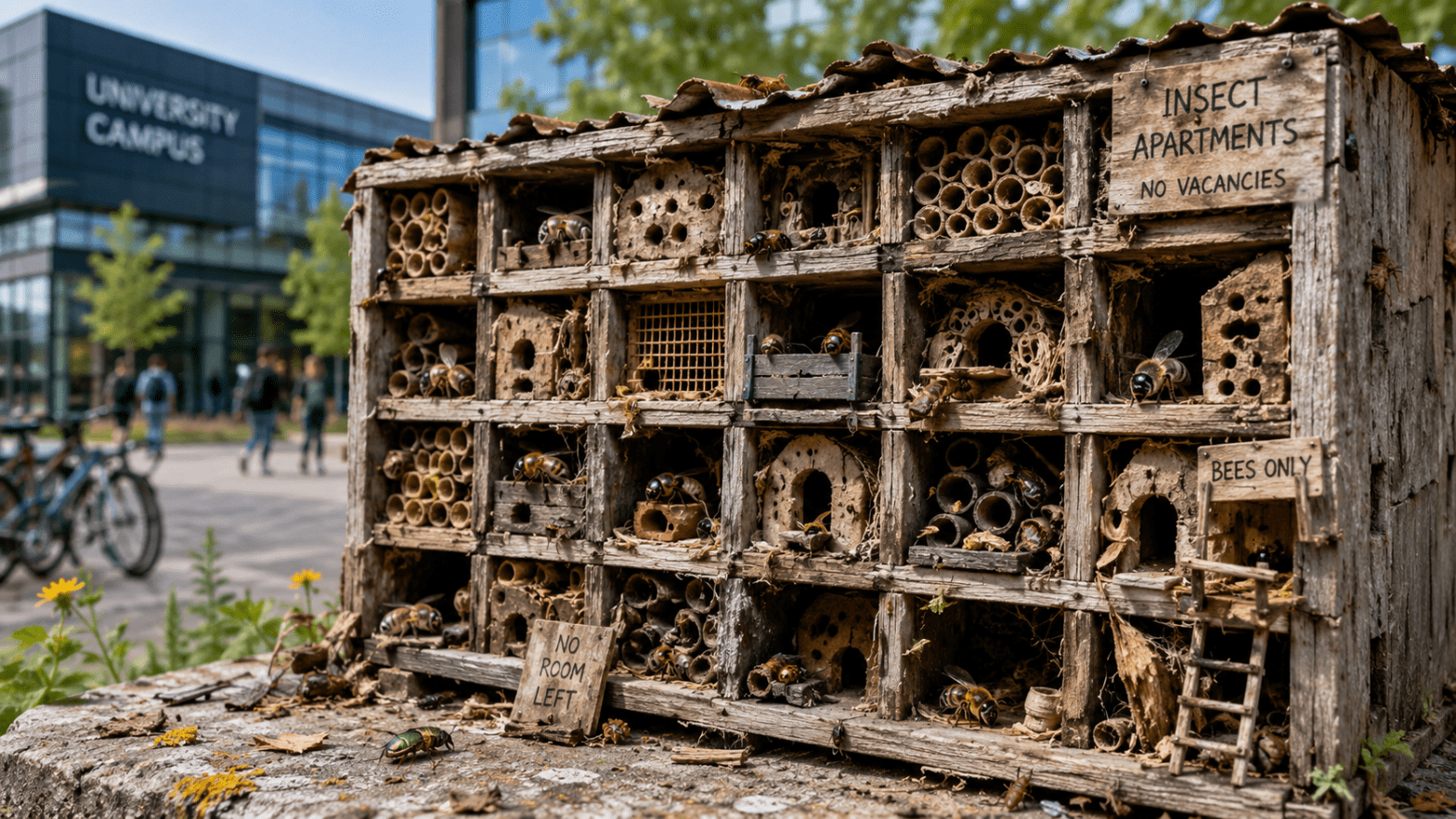
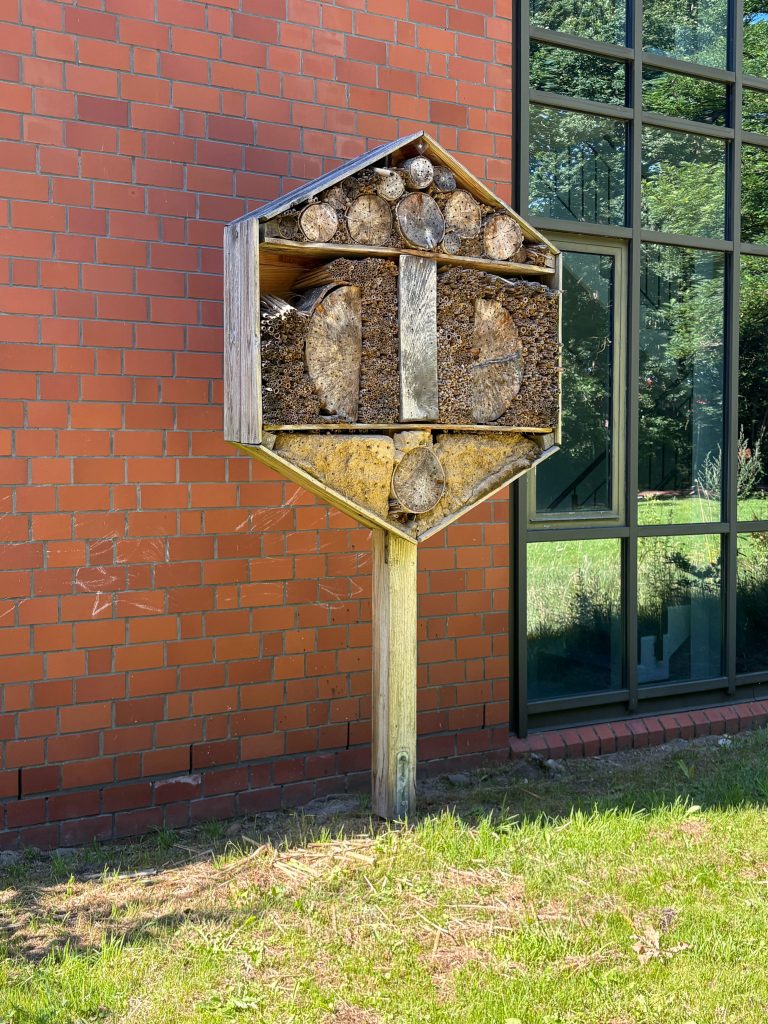
But, even if the potential lack of flowers is creating workplace issues in the local bee population, at least the University of Not-Bielefeld had the foresight to provide housing for these unemployed creatures in the form of bee hotels. Only thing is, no one told the University that the annual upkeep of these hotels is just as important as the opening of their doors. As the photo obviously shows, much of the wood has dried out and shrunk dramatically since this particular hotel opened only a few years ago, leaving lots of gaps and even some huge voids where some of the rooms have fallen to the ground to the left.
Again, it’s not as if this hotel has closed its doors entirely and there are still lots of suites available. But, like so many other of the University’s actions in this area, the focus seems to be more in generating headlines than in actually throwing lifelines. Or just checking off items on some list to be able to say “mission accomplished” five years down the road. In talking about environmental sustainability, shouldn’t sustainability also apply to the projects themselves?
A case in point is the 2026 priority list for the University’s Climate Inaction Fund as decided upon by the “Wi$h List” workshop. (Seriously? C’mon. Who thinks this stuff up and, more importantly, still thinks that it’s clever? And does everything have to have some catchy label nowadays?) Now there are indeed some good things on the list like planting new trees or installing nesting boxes on the campus. But way down at number six on the list (or four places behind yet another education programme on sustainability for university employees), and subject to any funds still being available, was “visibility of repair services”.
Now, to be honest, I have absolutely no idea what that last goal really means. But, taken literally, it does put much more emphasis on simply promoting any repairs instead of actually doing them …
With the summer solstice upon us and daytime temperatures in Not-Bielefeld cresting 30 ºC, the University of Not-Bielefeld, and specifically its Department of Building Management, sent around an e-mail the other day with some tips on how to survive this heat wave.
(Ok, 30 ºC might not sound like that hot to a lot of people but around here it actually is. Even my wife, who comes from Croatia and is spending her first real summer in northern Germany, said that it’s bloody hot. And this is coming from a woman who had never turned on the AC in her top-floor apartment in Zagreb until she met me. In any case, 30 ºC is warm enough around these parts to generate a red warning for heat, thereby making it almost as fundamentally unbearable, if not absolutely life-threatening, as a yellow snow advisory.)
Even if it was well meant for a change, as with most e-mails coming from central admin of the University, this one was not particularly helpful. The tips ranged from the patently obvious (e.g., drink lots, wear light clothing, pull the blinds down, …) to those more importantly absolving the University of any real accountability (e.g., any cooling devices must be bought privately or that the University is not responsible for determining if the workplace is too warm to justify any time off). However, given that the latter class of tips amount to hand washing, it could simply be the way in which central admin cools itself off because, according to the University, this represents another way to beat the heat when done under cold water.
Also, remember that we are again talking about an institute of higher learning here. Therefore, I’m seriously hoping that most of the university community has already learned that rubber boots and thick wool sweaters are not appropriate summer attire. Even in northern Germany.
That being said, even less helpful is that none of this unhelpful information is in the actual e-mail. Instead, the e-mail only provides a link to a webpage where it is all listed. This might or might not be a good thing. On the one hand, the e-mail is short, making it that much easier to determine just how unimportant it really is. On the other hand, the webpage containing all this proprietary information is only available to University members for some bizarre reason, meaning that we have to log in to the system with its even more bizarre implementation of two-factor authentication (2FA) to read it. (For those readers who are also unwilling to click links, the long story short is that University’s IT Department invented 6FA insofar as you have to go through at least six separate webpages to log in to the system.)
Or, in other words, by learning how to cool yourself down, you are actually helping contribute to global warming through needless energy expenditure.
It simply wouldn’t be the University of Not-Bielefeld if there wasn’t another upcoming open forum to further discuss the University’s long-planned “parking space management system”. It’s been more than four years since the University kickstarted its much ballyhooed Environmental Upheaval Plan and what should be a slam-dunk decision to help increase sustainability has turned into a literal no brainer.
The latest e-mail invitation from the President’s Office confirms what I have long suspected: the endless discussion on this topic comes from there apparently being severe pushback from the university community against paying for parking on campus. Now, coming from North America, it never even crossed my mind that there could be such a thing as free parking on campus. Or even that those particular words could appear in that particular order without being preceded by the word “no” or followed by the word “hahahaha”.
And God forbid that I actually attend that meeting to find out firsthand, but you really have to wonder what yet another open forum will bring to the table. The University wants paid parking, the university community doesn’t. Hard to find much wiggle room there. More to the point, when did going green suddenly become so democratic? I don’t recall the University asking for our opinions before they unilaterally imposed their sustainable travel policy for business trips on the community, something costing us either time or money. (But still not really generating a lot of the latter. For all the increased admin the new policy created, its associated climate fund raised just under 35 000 EUR for all of 2025, half of which was a matching amount from the University. This all amounts to less than 0.02% of the University’s annual budget or, when converted into direct environmental benefits, room for four more bikes on campus.)
Of course, there could be a lot more nuance to this entire, endless discussion than I am giving everyone credit for. Perhaps all the talking revolves around whether or not electric cars should be liable to the same parking rates as their gas-guzzling cousins. Or to any whatsoever. This would certainly fit in with the University’s positive attitude regarding e-scooters, with the initial version of the Upheaval Plan foreseeing specialized parking areas for them to prevent them from polluting all the sidewalks on campus. (Sadly, however, foreseeing is something completely different than actually building.)
And, if this nuance is not what’s holding everything up, then I’d be very happy to inject it into the conversation to help move things along …
(At the very least, this would be much more productive than one of the official statements from the University—and I am not making this up—that parking fees, should they be introduced, would likely be of an amount that minimally pays for setting up the entire system as well as covering its day-to-day running costs thereafter. First off, well duh. And, second, doesn’t breaking even pretty much describe what we have right now with free parking?)
Now, for the purposes of disclosure, I must admit to being one of the many here at the University who drives to work each day. And this despite the measly three-kilometer commute. My excuse, however, is my dog. Up until about a year ago, we routinely walked back and forth but time has finally gotten the best of her and at 16 she no longer has all those miles in her. At least sadly not in one go. At the time, and especially in hindsight, those two hours of daily commuting were by far the best parts of my day. It was just the two of us and with all the time in the world to stop and smell the roses along the way. (And the lampposts, and the fences, and that particular blade of grass, and …) It also let me rather smugly avoid taking part in University initiatives like “Bicycle-Commuting Month” because of the increased damage to the environment that I would be causing.
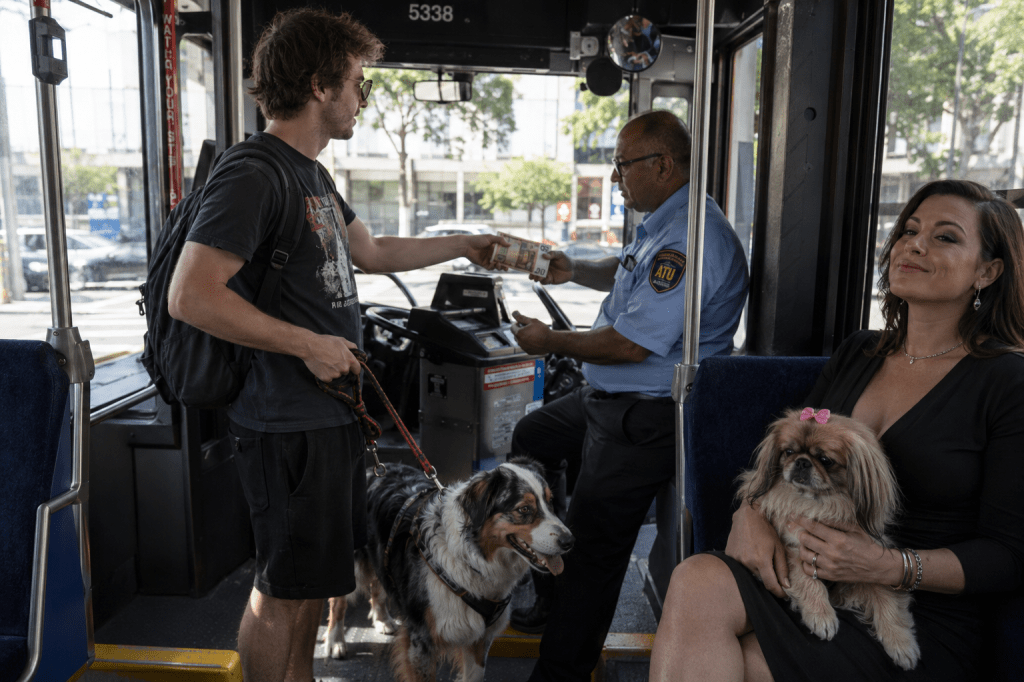
A big part of my decision to now drive to work revolves around the lack of other reasonable options. According to the German automobile club, the ADAC, my car has running costs of about 55 cents a kilometer. (And this estimate includes the currently overinflated gasoline prices deriving from some senseless war in the Persian Gulf.) , This translates to about 3.30 EUR per day or 60 EUR and change per month assuming that there are 220 workdays in a year and I’m at work for all of them. By contrast, bus tickets would set me back nine Euros a day because my dog is too big to count as “luggage” and so requires an extra children’s ticket. (But, despite having her ticket, she still has to remain on the floor, whereas the smaller, “luggage” dogs can be on the seats in their carriers or on their owner’s laps.) There are monthly “job tickets” available, but they cost about 47 EUR and that would just be for me. Even me as a biologist can work out the sums here.
Admittedly, I could bike to work but I have no real possibility to park the required doggie carrier in my apartment building. And leaving my dog at home is about as attractive of an option for me as pulling teeth. Without anaesthetic. By someone from admin.
In the end, what’s striking about all this is how promoting sustainability (or many other activities) usually occurs more through punishing our undesirable behaviour rather than actually directly rewarding what they want us to be doing. For instance, instead of making public transport absolutely more affordable, the chosen solution is to make it the lesser of two budgetary evils by increasing the costs associated with driving. It must be said, however, provincial law is apparently preventing the University of Not-Bielefeld from subsidizing public-transportation costs for its employees.
But then how difficult could it possibly be for the University to lobby the provincial government to allow for something like this? And a provincial government that has included the Green Party for about as long as the University of Not-Bielefeld has had its Upheaval Plan.
With northern Germany now having to deal with an unseasonably warm spring, it’s time to take a last look back at the unseasonably snowy winter that it just endured.
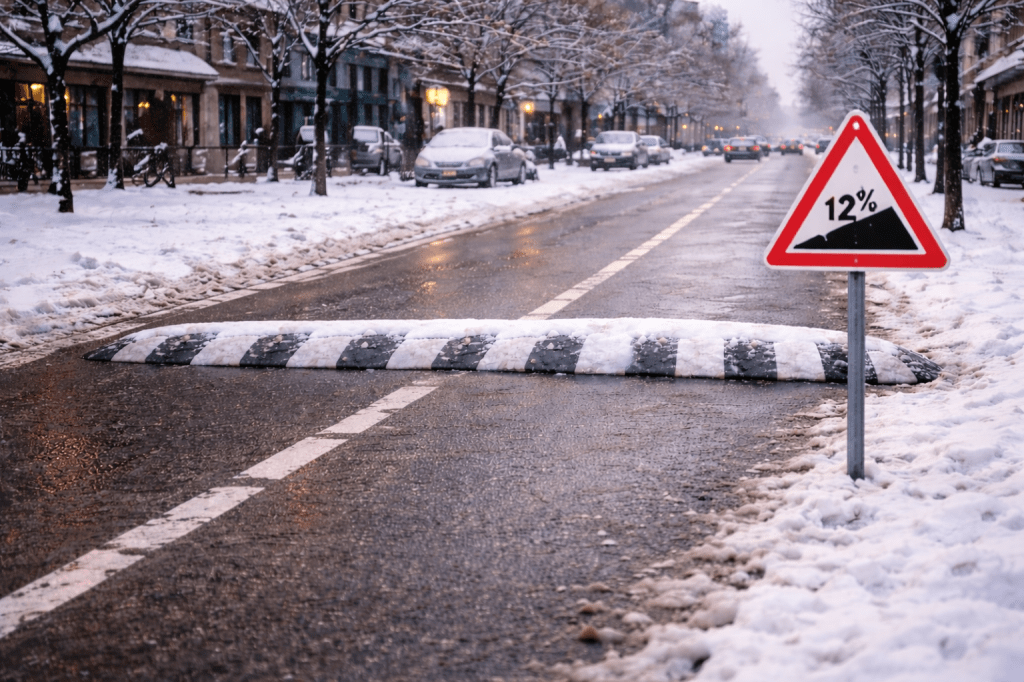
And when it comes to winter, a personal pet peeve of mine is people who don’t clear their cars of snow and ice properly. (Sounds unusually law-abiding (ordnungsgemäß) for me, I know, but it’s these scattered bourgeois ticks of mine that let me enter Germany in the first place.) I just don’t get it. Apart from it being dangerous, it’s not that much work. You could sit freezing in your car doing nothing or you could stand freezing outside doing a little bit of work to keep that little bit warmer. And, let’s be honest, given that it never gets colder than -10 ºC around here, how cold are you really going to get?
Fortunately, German authorities agree with me and driving with obstructed vision is outlawed according to § 23(1) of the federal Roadtrafficordinance (Straßenverkehrsordnung (StVO)). So if the cops catch you with an icy windshield, you’re out a cool 10 EUR, with gusts up to 25 EUR for the even more dangerous snow on the roof. And, if they catch you after you caused an accident because of that windshield, the fine increases super-exponentially to a whopping 35 EUR.
It’s almost as if they’re daring you to break the law, right? The reality, however, is that they are actually encouraging you to do just that because § 30(1) StVO also specifically prohibits unnecessary noise and exhaust emissions. So what counts as necessary emissions in a wintery context? Practically speaking, it seems to be the time that you need to clear the outside of the car. Fair enough. But, the real problem here in Not-Bielefeld is the inside of the windshield. Because of the high humidity in winter, the inside is usually iced up just as solidly as the outside and the slightly concave inner surface of the windshield together with the general lack of room make it impossible to scrape clean. Instead, you have to wait for the cold engine to get warm enough to de-ice it for you. All of which could cost you 80 EUR for the unnecessary noise and emissions.
Except for the accident part of it, all this is probably difficult to enforce, with the cops having to be at just the right place at just the right time and in just the right surly mood. Much less difficult to enforce is my second pet peeve of winter: homeowners who feel that road salt is a better solution against snow than a shovel. Apart from the laziness factor, road salt is also a killer for the environment as well as the paws of my dog. And why should I have to buy booties for her (which she hates) because of your first-world problem? Make a one-time investment in a shovel and we’ll both save some money while enjoying our exercise.
Again, the government is completely with me on this, with the city of Not-Bielefeld stipulating that road salt is only to be used, and then in small amounts only, in extreme weather conditions and then only on particularly dangerous areas like steps or other steep inclines. (Steep inclines? What are they talking about? This is northern Germany. The only reason this place has any sort of third dimension at all is by virtue of the curvature of the Earth.) Otherwise, plain ol’ grit is the order of the day, both with regards to the shovelling as well as to what you should scatter on the sidewalks afterwards. Nevertheless, everyone in the city chucks road salt around like it’s Margarita Monday or Tequila Tuesday for even the lightest dusting of snow on the flattest of sidewalks. Hell, I’ve even seen people do it proactively in case it might snow.
(That being said, I can understand this behaviour given the unflinching timetable of the city of Not-Bielefeld when it comes to snow removal: sidewalks have to be cleared by seven in the morning on weekdays, eight on Saturdays, and nine on Sundays and holidays. And then again by eight in the evening should it continue snowing during the day. (By contrast, the city bylaw where I grew up in Canada gave you a more realistic 24 hours after the last snowfall to clear away the snow.))
But unless there’s an official complaint, the city turns a blind eye to it all. And why not? Everyone else is taking the easy way out already too.
For most of January, Not-Bielefeld and the rest of northern Germany were laid to waste by an extreme and extremely rare weather anomaly known throughout the rest of the world as winter. It was chaos. Planes and trains strayed rarely from the plains. Road salt was as hard to get as the real stuff was historically. People were cold.
And all the suffering was to a large extent so unjustified …
Ok, I hear what you’re thinking: the ex-pat Canadian could cut the northern Germans a little bit of slack here. After all, they aren’t used to snow and cold like you are, right?
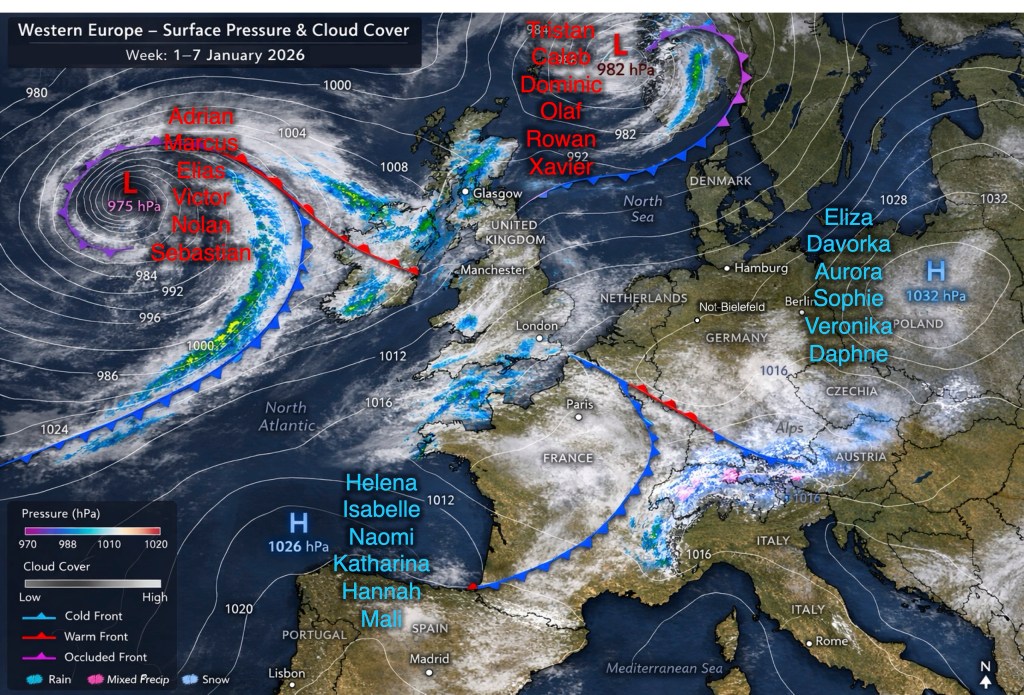
Wrong. Just take a look at our neighbours to the west, the Dutch. Although they are more famous for other things, many people might be surprised to learn that they are world-class speed skaters. And historically so, long before they had things like indoor speed-skating ovals. (Which, for the record, only date to 1986. And given that you can comfortably fit two ice-hockey rinks inside a long-track speed-skating oval, they simply don’t have enough room in Holland to build that many.) Instead, the canals in Holland used to regularly freeze solid in the first half of the 20th century, perfect for their 200-km long speed-skating race, the Elfstedentocht. Which makes it all somewhat surprising that Amsterdam’s Schiphol Airport was essentially out of commission during the first week of January because of a pair of winter storms, first Anna / Tizian and then with Goretti / Elli following closely thereafter before the winds really had any chance to die down.
(The reason for the dual names is because Europe has six different naming systems for winter storms but no system for deciding which name gets priority for any given storm. Gotta hand it to the EU. For all the flack they’ve received for standardizing nearly everything, they can’t agree on what to call the wind. And, to make it even more bizarre, the names for the Central naming system that Germany belongs to are auctioned off—currently 390 or 290 EUR for a high- versus low-pressure system—by the rather inappropriately named Free University of Berlin through the Adopt-a-Vortex scheme to help fund their long-term meteorological observations.)
Now, I’m not necessarily intending to single out Schiphol here. An honourable mention also has to go to the German rail company Deutsche Bahn, a company and a train system that every country in the world (except Germany and possibly Japan and Switzerland as well) would love to have. Although Goretti / Elli also brought the train traffic to a complete standstill in northern Germany and for largely similar reasons, it’s just that I personally experienced the Schiphol shutdown and had to sleep in the airport for two nights en route back to Not-Bielefeld after spending Christmas in Canada.
Anna / Tizian literally crippled Schiphol, semi-officially causing about 60% of all flights to be cancelled outright. Again, I know because my connecting flight to Not-Bielefeld was among them. Twice. My own impression, however, was that the actual cancellation rate, at least for the departures, was way higher than this. 60% means that roughly every other flight was cancelled but you had to look really hard at the departure boards in Schiphol to find any flight that wasn’t. In fact, the only thing running at capacity at Schiphol while I was there were the airport hotels, which were booked solid every day sometime before I officially heard that my only flight option for that day was a no-go. In the end, after an ill-fated prison break to the Amsterdam’s central train station (see below), I finally managed to escape Schiphol for good by taking a 250 EUR Uber ride to Groningen where I then hopped on a Flix bus to Not-Bielefeld.
Schiphol, of course, denied any and all responsibility during the shutdown (“Act of God”) while simultaneously promoting their heroic efforts to help get us home (“working round the clock”) as quickly and as safely as possible (“because your safety is our first priority”). Pound for pound, however, these combined statements contain more shit than the waste-storage tanks of an intercontinental superjumbo overloaded with lactose- and gluten-intolerant passengers who were all mistakenly served cheese pizzas for dinner.
As I’ve mentioned before, invoking our safety is often merely a solid go-to excuse to justify just about anything. Like cutting expenses on safety, which is how much of the trouble began in the first place. How can we possibly complain when they’re looking out for us. (Or, more realistically, our lawyers with our lawsuits.)
As for working around the clock, the only airport employees I saw doing that were the staff at the all-night Starbucks that I was sleeping next to for two nights. The service desks? Completely unstaffed when we finally made it back to the main terminal building at 11 PM after my original flight was cancelled at the last second while we were actually in the plane. And equally empty the next morning at their official opening times of 7 AM. Instead, the agents only started arriving 15 minutes later and huddled in the office for another 15 minutes or so before finally facing the lineup of some 200-plus grumpy passengers. (Ok. Can’t say that I blame them there.)
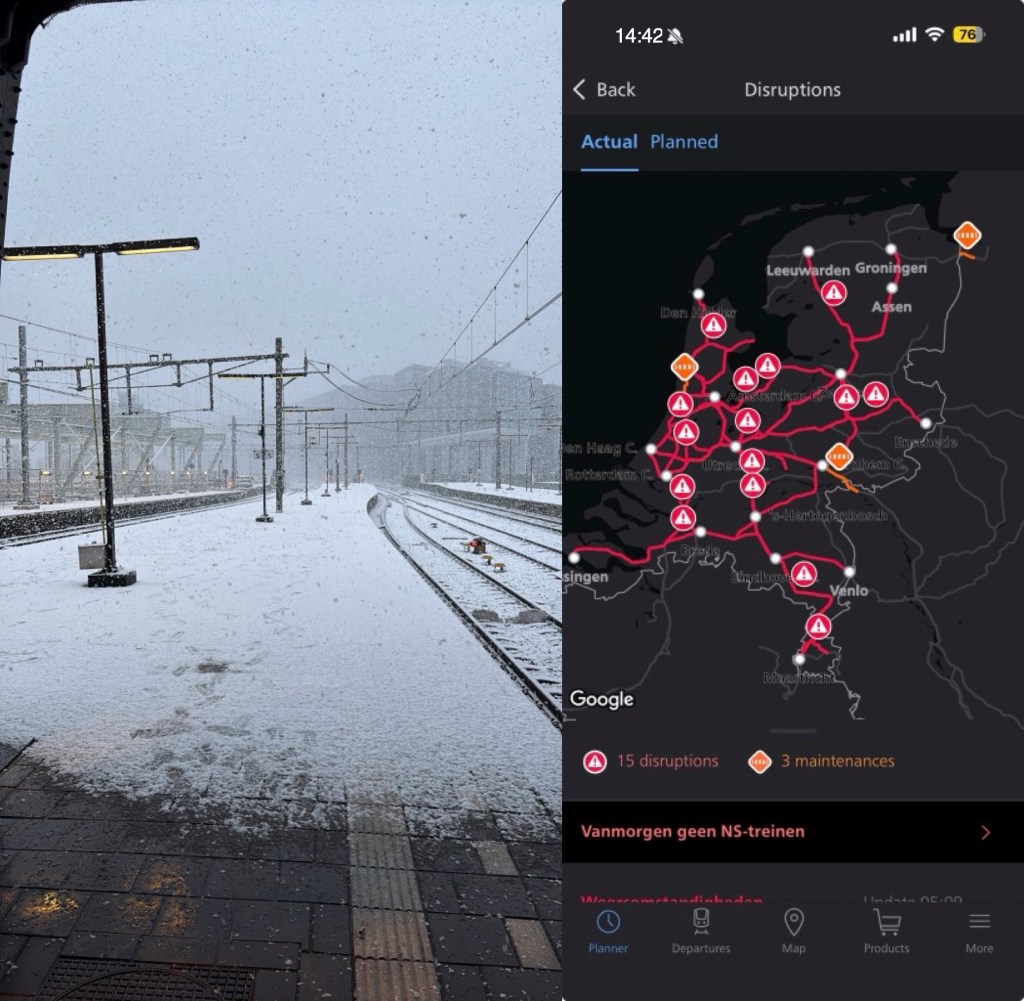
And it took another 90 minutes—or more than two whole days after Schiphol began shutting down—for them to announce that people travelling to Belgium and northern Germany could / should get home using the trains instead because our boarding passes would be recognized as valid tickets for this. (But to be fair, there was that weekend in between. They might have been working around the clock but weekends? Pffft.) Unfortunately, this info was passed on only a mere hour before the entire Dutch train system also shut down nationwide because of the storm. All of which meant that I spent more than a few hours in Amsterdam’s unheated central train station wondering if I’d even be able to make it back to the comparatively comfy confines of Schiphol and possibly even my as-yet-not-cancelled afternoon flight back to Not-Bielefeld. Had they come up with this idea just a half hour sooner, my prison break might have succeeded.
But, safety first, of course. It would have been foolish, if not actionable, to risk a train derailing from the literal meters of accumulated snow, thereby maiming if not outright killing hundreds of innocent people, right? For the record, however, the left-hand picture is one that I happened to snap just a few minutes before nothing went south anymore and sent to my wife with the comment “Pretty”. The right-hand one is how the Dutch rail network looked later that afternoon, all for an amount of snow that wouldn’t make the headlines even if it were seized in the States by ICE agents from all those Venezuelan narcoterrorists. Even the train personnel at the station were as baffled by the decision as anyone else.
That all being said, here are the bits that I really can’t figure out. By all accounts (including my own personal experience), Goretti / Elli was the more severe of the two storms for the Netherlands and northern Germany, yet it was her older sister Anna / Tizian that caused way more disruptions. In fact, on the day of my Uber-assisted escape from Schiphol, my afternoon flight actually took off and landed in Not-Bielefeld only a few hours after I did. And Schiphol also started returning to more-or-less normal service shortly thereafter too.
I also left Canada during a similar yellow snow advisory without any problems (except for that name: a yellow snow advisory?!) and there are lots of airports around the world that regularly see the kind of winter conditions that Schiphol experienced for that one week but continue operating normally. Even the airport in Not-Bielefeld only saw some small delays during the same timeframe. Sure, both of these airports are much smaller than Schiphol is, but if you want to be a world-class airport, it shouldn’t just count under mostly optimal conditions, right?
Finally, the whole of January was an unusually wintery month for northern Germany, with a lot more snow than normal piling up on top of the more usual high winds and occasional freezing rain. Nevertheless, it was really only that first weekend with Goretti / Elli that was problematic for Deutsche Bahn, which somehow otherwise seems to maintain regular train service throughout the winter in more snowy regions of Germany like Bavaria.
Instead, could it be that most of the chaos was linked less to God’s acting ability and more to the general inability of some other three-lettered supreme beings, namely some cost-cutting CEOs and especially CFOs somewhere? For instance, in preparing to hunker down for a second night at Schiphol, I proactively asked if it would be possible to get one of those crappy little blankets they give you on the plane. (Which are outdone in crappiness only by the pillows that come with them, BTW.) Nope, no chance: all the spare ones had been given out in the first days already. Umm, ok. Funny. Didn’t see any of those blankets anywhere in Schiphol and really sort of doubt that everyone took them home with them. And surely there might have been a few extra spare ones from all the planes that hadn’t been going anywhere for days at that point.
Moreover, the post hoc damage assessment indicated that Schiphol started running out of de-icing fluid on about January 6th and this despite the fact that most scheduled departures until then didn’t happen. No question, 85 000 liters of de-icing fluid a day is a lotta liquid, causing Schiphol to quickly use up its season’s supply in just a few days. But given that ChatGPT and Gemini (Google) both indicate that de-icing fluids have a shelf life of about two years or more, what’s to stop Schiphol from having two-season’s worth on hand at any one time in case of emergencies like this? (I mean, apart from the extra costs that they’ll pass down to us anyway?)
Even stranger was that the shortage was only for the fluid used to de-ice the planes. Apparently, Schiphol uses a different type of de-icing fluid for the runways and of which they still had “ample supplies” during the crisis. And don’t even get me started about how my original flight was cancelled with our butts in our seats because there were no pushbacks trucks available to get us to the de-icing station before Not-Bielefeld International Grassstrip closed for the night. You generally don’t need pushback trucks either for de-icing or for planes parked on the open apron as ours was. And how can some snow suddenly cause a shortage of these trucks, ones that are otherwise used all the time in good weather to push planes back from the gates?
But, wanna really go down the ol’ conspiracy-theory rabbithole?
The Schiphol employees most often singled out for working around the clock were the people working the snowplows and de-icing equipment. But this doesn’t make any sense because Schiphol has largely phased out the takeoff and landing of overnight flights (i.e., from midnight to 6 AM) and de-icing a plane is only good for about 30 minutes (= the holdover time). So why bother continually de-icing planes every half hour and clearing runways when nothing is allowed to take off in the first place? The answer is because there are two main types of air traffic. Everything that I’ve said up to now revolves around passenger flights, which is what we normally default to in our thinking. Now, although passenger flights can’t use Schiphol in the wee hours anymore, cargo traffic sure can. And, like with most airports, do. And, even more importantly, did. So perhaps it’s not too surprising to learn that whereas passenger flights were down by 60% (or more) during the shutdown, overall cargo capacity was only knocked back about 14% during the same timeframe. Just saying …
Look, I’m not unsympathetic about all this. With the first snowfall of the season, Canadians regularly smash their cars into everything imaginable until they get used to winter driving again after a few days. Humans will be humans. But Schiphol should just admit that they were too cheap to buy a belt and got caught with their pants down instead of trying to feed us some BS stories about God, heroics, and safety. The actual food we get to eat on the plane is bad enough already.
And if Schiphol wants to gamble that this won’t happen again in the foreseeable future and so not undertake the necessary changes proactively, then that’s fine too. But they should be prepared to pay out compensation with the money they’re saving now (as well as earning from their overpriced everything) instead of shirking responsibility by evoking the apocalypse when it does happen again.
In “researching” my last blog post, I came across two of the worst acronyms that I have perhaps ever seen. (And, remember, I’ve seen TdLL.) Unsurprisingly perhaps, they both derive from the same organization, namely the Netzwerk Nachhaltigkeit Niedersächsischer Hochschulen (Network Sustainability Lower-Saxony Universities; and, yes, the German name is similarly devoid of prepositions and therefore just as stilted as the English one).
The first acronym is that for the organization itself, namely HochNiNa. Sorry, but aren’t the full names and the acronyms supposed to be in the same order or since when did Germany start outsourcing its acronym production to the Middle East? And did the person fall asleep before reaching Netzwerk? You do have to admit, HochNiNaNe is unquestionably that little bit catchier than just HochNiNa. (Even better would be NHoch3, which gets the order going back the way it should be while throwing in a geeky pun on top of it, with hoch being German for “to the power of”.)
The second acronym derives from one of HochNiNa’s major programmes, namely the taxpayer-funded project Standardisierung, Weiterentwicklung und Kommunikation von Treibhausgasbilanzen niedersächsischer Hochschulen (Standardization, further development, and communication of greenhouse-gas balances of higher-education institutions in Lower Saxony). Now, exactly why it takes 210 000 EUR and three years to develop an Excel spreadsheet is beyond me. However, when one of the major milestones you advertise for your project is the addition of two new universities one year into it, you know how low the bar for success is: trivial for the high jump and impossible for the limbo.
Anyway …
If there was ever a name in dire need of an acronym, this is it. This one will put even admin types to sleep. That fitting acronym here, of course, was COUNTS. Much shorter, a lot punchier, and infinitely more memorable insofar as it has almost nothing to do with the name of the programme, either in terms of the subject matter or the letters it uses. In either language. And in either direction. To help everyone along, I’ve highlighted the official derivation of COUNTS in the figure to the left. Now, I can understand that you sometimes have to grab some letters from the middle of the words in the full name to make an acronym work. Like with HochNiNaNe, for example. But then those letters usually either directly follow another, leading one that has already been tapped in the acronym (or at least start an important syllable) and are usually in lower case as well. And you definitely don’t do it for most of the letters in the acronym.
And, seriously, what is the point of so desperately, awkwardly, and almost randomly jerry-rigging a highly generic, English-language acronym for a highly localized German-language programme? Admittedly, SWKTNH doesn’t really have the same zip as, say, HochNiNaNe (or, even better, HoNiNaNe), but it’s still on the same (low) level as TdLL and you can at least tell where it’s coming from. (If not what you should be running from.)
Instead, maybe they should try REASON, which “counts” both as a valid acronym following their apparent method as well as something generally helpful for the future. Even STRETCH is an improvement because it’s at least honest about how they go about generating acronyms.
On the other hand, if the acronym is clearly so important, why not come up with it first and then derive the name of the programme from it (AKA backronyming)? It’s often much easier. For instance, from COUNTS you could get:
COmmunication among UNiversities for Tree-hugging Sustainability,
Coordinating with Other UNiversities for Thermal Savings,
Carbon Overload Ultimately Neuters The Stratosphere,
Concrete Overall Underfoot? Now That Sucks!,
or even
Creating Objectively Uninformative Names This Saturday.
As I’ve mentioned more than too many times in this blog, the University of Not-Bielefeld has taken to increasingly bludgeoning us with its new-found environmental conscience. The latest foray here is in promoting the existence of numerous “sustainability markets” on campus.
Now to those of us lacking spin doctorates, these markets are nothing more than simple, second-hand bazaars where old, unwanted furniture and even lab equipment are offered up for free to whoever needs them among the university community. And they’ve been around since before I joined the University over 15 years ago. True, these markets (regardless of what they’re called) do indeed contribute to sustainability, but it’s primarily of the economic kind. As is the case with universities worldwide, funding is tight at the University of Not-Bielefeld, so anything that still does its job for free is sought after. That it also helps the environment is more thought after.
But nothing like a bit of quick rebranding to provide that veneer of progress, right?
Of course, the environmental movement, like most human endeavours, is not immune to linguistic overkill. For instance, think about just how moronic the word “recycle” actually is. The most common definition of a cycle is that of a repeating series of events, like a life cycle or a sleep cycle or even the lunar cycle. So whereas consumerism, by design of the bottom line, is a cycle (produce, purchase, use, trash), and an increasingly shorter one at that, what happens to the products and the materials that they are made of is not. Instead, it’s only through recycling that they begin to enter something resembling a cycle. But given that the prefix re- also means to repeat, what does it mean exactly to repeat something that is already itself inherently repeating, especially when it wasn’t in the first place? With this kind of logic, women can be happy that they only have menstrual cycles and not menstrual recycles.
But then what do you expect of a word that was coined way back in the 1920s by the oil-refining industry? (Betcha most environmentalists didn’t know that …) Next thing you know, organ transplants are going to be referred to as being both organic and sustainable as well.
Ultimately, however, all this kind of newly-branded sustainability has to be unsustainable and will lead to the downfall of human society faster than AI will. The way I figure it, you can either love the environment or humanity, but not both. Think about it. The more people start buying “sustainable” goods out of the goodness of their ecological hearts, the less demand there will be for new products. That means that less people will be employed to make those products, forcing the rest to buy even more “sustainably” out of the necessity of their empty wallets. And then the whole thing spirals increasingly out of control (also not a cycle) until only Elon Musk has any money left but nothing to spend it on.
Or, in other words, the ecological version of DOGE.
But, back to that veneer …
A few weeks ago, in an e-mail inviting members of the University of Not-Bielefeld to take part in an “information event on potential parking-space management” (or, in plain English, a public meeting about on-campus parking), the urgency of this “event” (originally scheduled for last autumn) was underscored by the surprising, and surprisingly honest, announcement that despite the University’s greenhouse-gas emissions having fallen slightly over the past two years (by 5.3%), they are still 1.3% above the baseline values from 2019. (I had to dig for the actual numbers, which were not in the e-mail. No point in ruining some vague adjectives with hard data.) And this despite the numerous, innovative, and high-impact countermeasures put in place by the University recently: insect meadows, a Tiny Forest, million-Euro bicycle racks, solar panels, and that yet again delayed on-campus parking policy. (Bonus points for those spotting the outlier there.) Someone needs to tell the University that simply amassing a climate fund has much less positive effect on the environment than actually using it.
A chief culprit in the University’s size-14 ecological footprint was identified as “mobility”, which included such environmental evils like day-to-day commuting (28.7% of the total annual footprint), business trips (4.6%), and even semesters abroad (1.5%). How spending semesters abroad even deserves to be mentioned explicitly here is a mystery to me, especially given its meagre contribution toward destroying the planet compared to its important potential of fostering young minds, something that I thought was what universities in general were for.
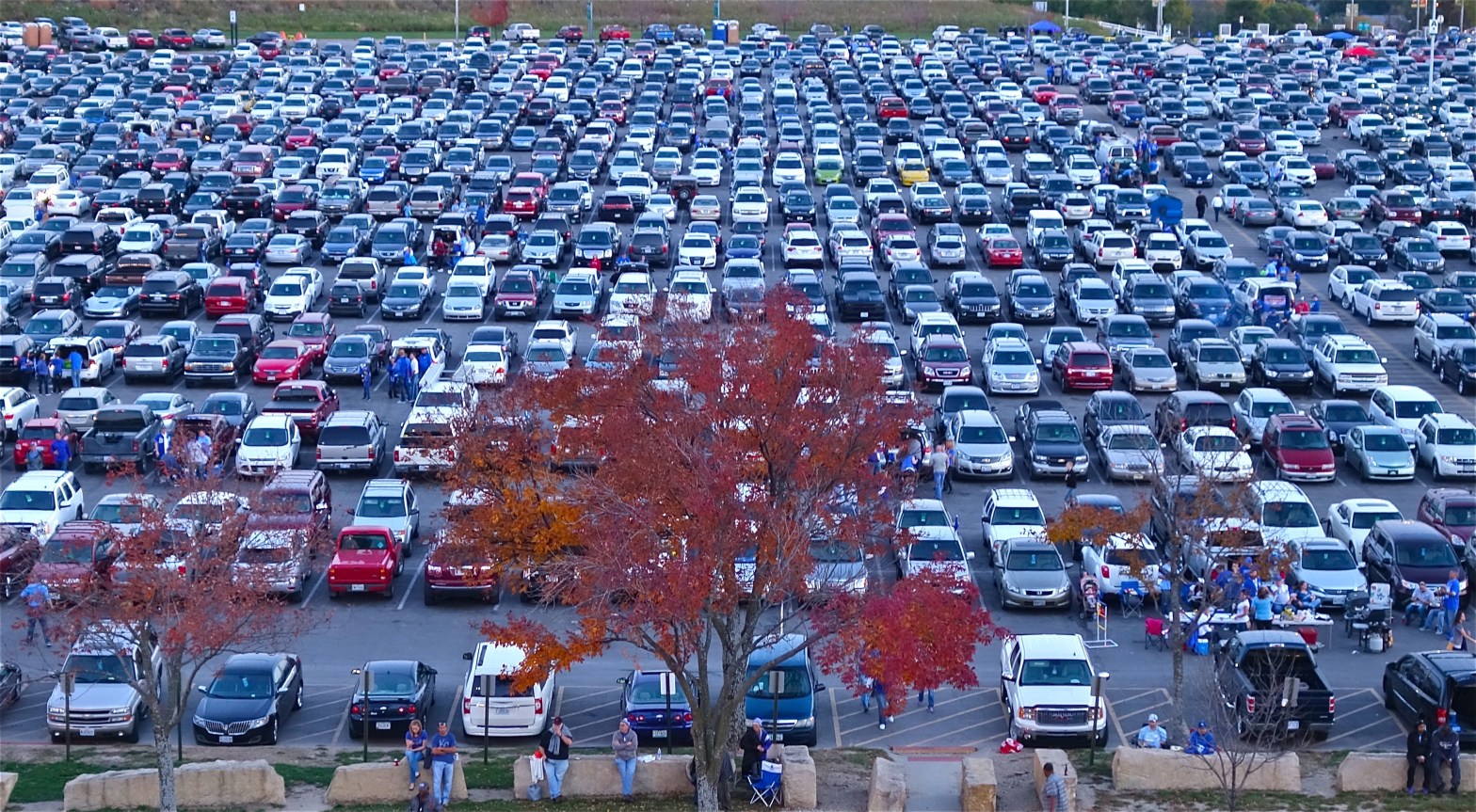
But these data also tend to reveal the true nature of the University’s environmental policy: grab as many headlines as possible while trying not to piss too many people off. (Or spend too much of that climate fund.) Again, take a look at mobility as an example. Four years into its much ballyhooed, 140-page Integriertes Klimaschutzkonzept (Integrated Climate Action Concept) and all the University of Not-Bielefeld has really achieved to green up mobility is to put an eco-tax on the business trips of a small subset of its population. This stands in stark contrast to the enormous amount of foot dragging over commuting, an area that coughs up 6x as much greenhouse gas but where any solution would disadvantage a much greater percentage of the university population. I mean seriously. How difficult can it be to start charging for parking on campus (stick) or to subsidize public-transportation costs (carrot) to encourage university members to seek out more environmentally friendlier ways of getting to work? However, as this ex-pat Canadian learned very quickly, it is much more dangerous to get between a German and their car than between a mama grizzly and her cubs. And thus, even after four years of information events, committee meetings, and plain ol’ plena, every option regarding on-campus parking officially still remains on the table, especially more information events, committee meetings, and plenty of plena. And somehow forgotten in all this is that remaining 63.0% elephant in the building in terms of the environmental costs of running the buildings themselves.
Instead, perhaps the most interesting but completely ignored stat of them all was how the University’s greenhouse-gas emissions hit a low of 68.0% of their 2019 baseline values in 2021. Now there would seem to be a real sustainability solution there worth exploring, doesn’t there? Oh, wait. That was in the middle of the pandemic, wasn’t it?
Like I said, you can either love humanity or the environment. Take your pick …
It’s finally happened! After literally years of being promised that the appropriate signs would be coming “very soon” or told that such signs were not necessary in the first place, the University of Not-Bielefeld finally put up signs on my campus late last year indicating that all dogs must be on a leash.
Ok, signs is a bit of an exaggeration. It’s really just one sign located smack dab in the middle of the campus. Granted, if you only have the resources for a single sign (possibly because the sign budget was exhausted because of the multiple signs they needed to highlight all their insect-friendly meadows or that they don’t clear this particular path in the winter), the middle of the campus is probably the best place to put it. It does mean, however, that many people will unknowingly be walking their dogs illegally for half the campus.
Apart from the actual message that any sign is meant to convey, this sign also includes a meaningless platitude meant to justify its message, something that is becoming increasingly common generally. Apparently doing so reduces annoyance while increasing enlightenment. For instance, signs announcing roadworks in Germany have carried the slogan “We’re building this for you” (Wir bauen für Sie) for decades now. Well, gee, who else would they be doing it for? And, to be honest, who really cares so long as they do some actual building instead of just blocking long stretches of the road for long stretches of time for no apparent reason?
Of course, the granddaddy of all slogans is “Your safety is our primary concern” because you can use that to justify almost anything (cf. Trump vs. Venezuela). The University of Not-Bielefeld, however, saw fit to lay on a warm fuzzy guilt trip with a touch of finger pointing as their justification instead: Für ein rücksichtsvolles Miteinander, which roughly translates out to “To foster coexistence.” But not just any kind of coexistence, of course, but considerate (rücksichtsvolles) coexistence. So I considered it …
… and, once again, was left bewildered as to why all the social unrest in the world today seems to come from dogs and their owners. Live in northern Germany and especially Not-Bielefeld for any length of time and you’ll quickly realize that bicycles, not dogs, are what plague society today because bicycle riders, not unlike dogs, can’t read signs either. Nor can their upscale, lazy, but environmentally holier-than-thou cousins the e-scooter riders. I mean, stop signs or right-of-way signs? Pffft. Although I’ve seen signs warning pedestrians of oncoming bike traffic, before moving to Not-Bielefeld I’ve never seen them within sight of another sign forbidding bike riders from travelling in that oncoming direction.
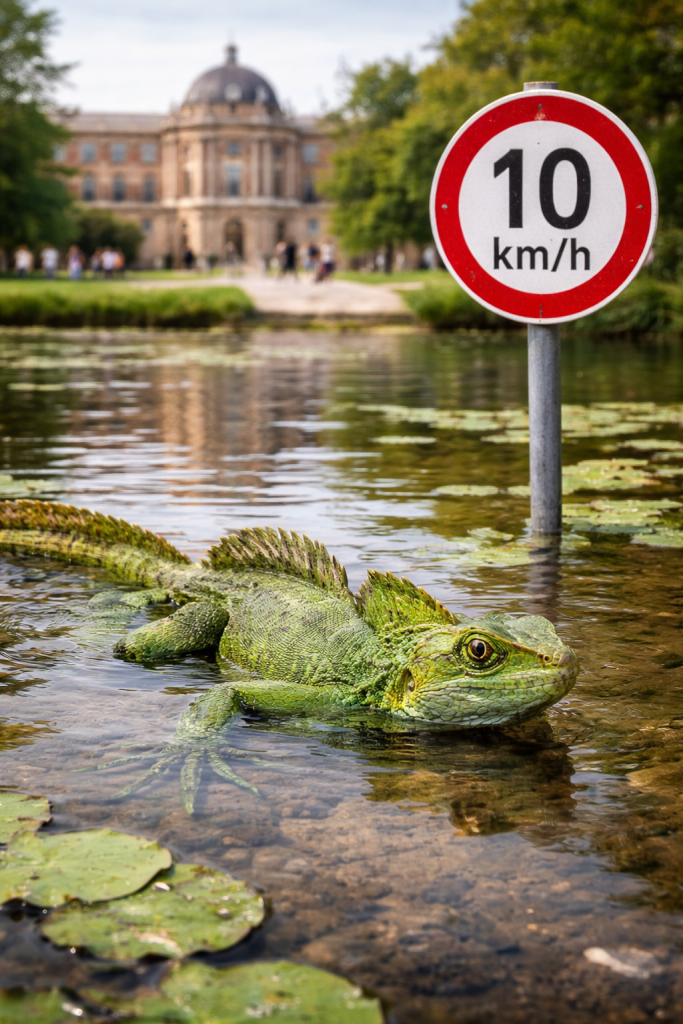
One sign in particular that this bunch can’t read is that there is a universal 10-km/h speed limit on the campus of the University of Not-Bielefeld. For some perspective, here are some examples to illustrate just how fast 10km/h isn’t:
world-class ironman competitors run the marathons at the end of those triathlons at 15 km/h orbetter;
the various species of basilisk (AKA the Jesus Christ lizards) generally hit speeds in excess of 11 km/h to achieve their water-walking miracles; and
without me doing anything, my car putters along at about 10 km/h in first gear all by itself (and 17 in second), meaning that I am (well, should be) continually applying the brakes when I’m on campus although all my driving instincts tell me otherwise.
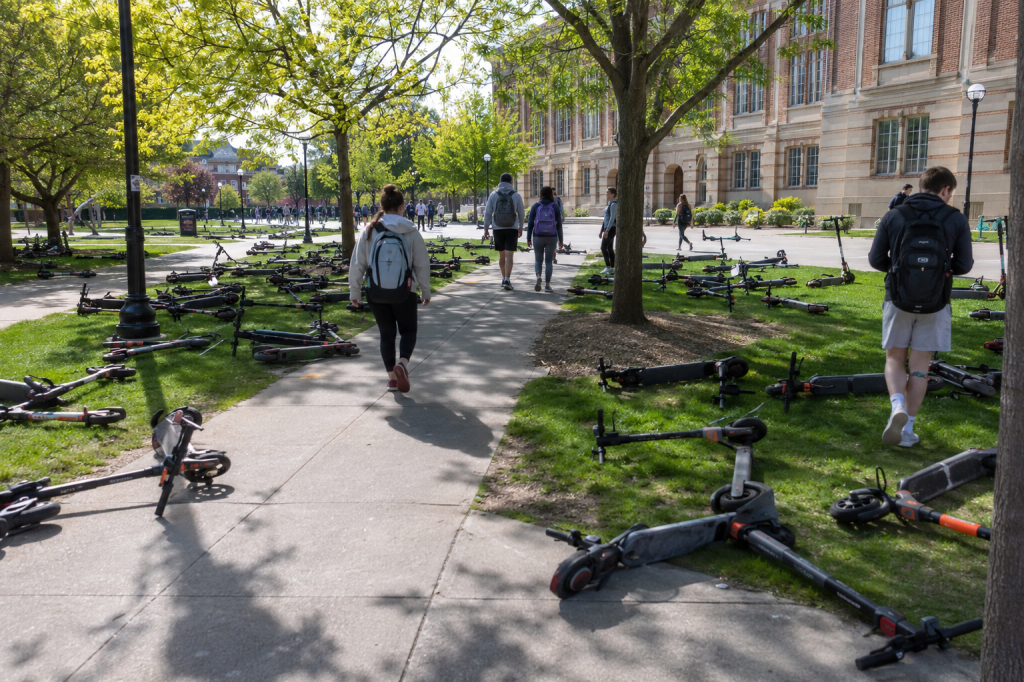
Now, together with their inability to ride and read simultaneously, I think it’s obvious where the bigger threat to campus coexistence lies when you consider that leisurely bike rides are generally considered to start at 10 km/h and that the average speed of entry-level e-scooters starts at 16 km/h. And not just the bigger threat but the more numerous one as well given that the University of Not-Bielefeld provides bike racks for over 4000 bicycles and hundreds of meters of sidewalk to block with unused, idle e-scooters.
At least I walk my single, unleashed dog well under the campus speed limit …
I did a bit of clothes shopping the other day and it was only after I got home that I discovered that one store had cynically charged me an extra 15 cents for the paper bag that they had put my clothes in.
But wait. Why is the store the cynical one here? Shouldn’t I be happy doing my part to help save the environment from unnecessary waste?
Well, for starters, the store never mentioned the surcharge, meaning that they took my contribution to save the planet while also simultaneously advertising their store for granted. I was never really given the choice whether I wanted to help offset my ecological footprint with cash or by renouncing that bag completely. And I never really understood how paying for a bag that used to be “free” suddenly helps the environment so much as the store’s bottom line. Call me skeptical (once you’re finished calling me cynical naturally), but I somehow really doubt that those 15 cents are going directly to Greenpeace. Also, considering that I had just given them over 200 EUR, you think that they could spot the environment the spare change.
And, given that this shopping bag is now essentially a product, is it possible to return it for a refund if I’m unhappy with it? I’m pretty sure that this would be the case with any other bag I bought there. I still have the receipt and reusing the bag would indeed be environmentally friendly, which is what this is all about in the end. (Isn’t it?)
Finally, what right does the fashion industry in particular have to lecture anyone about environmental awareness? After all, we are talking about a segment of the economy where estimates are that anywhere between 80 to 150 billion articles per year are produced and of which 10 to 40% are never sold. (At the risk of being obvious, the reason that these numbers are estimates, and such vague ones at that, is because the fashion industry is not very forthcoming about the real numbers for some strangely unknown reason. To me, this is a clear sign that the real numbers are likely pushing the higher end of the estimated ones.)
Nevertheless, it remains that I am the cynical one for wondering how the end user paying for a bag that prevents five articles of clothing from ending up in a landfill is the vital cog in guaranteeing a future for our children …