Sometimes, you just gotta ask yourself, what the hell?
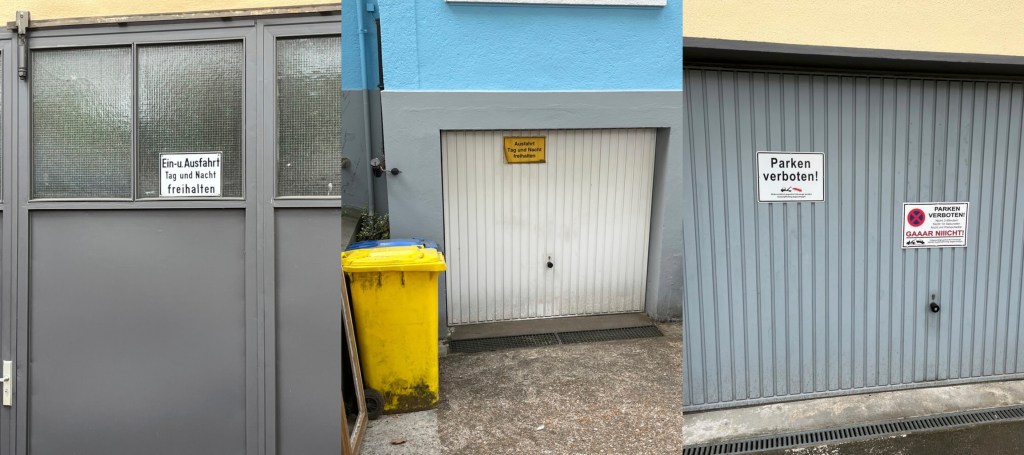
During a recent trip to more southerly German climes (Bonn), I noticed a lot of the following signs while taking a stroll one evening:
Despite their different wordings, shapes, styles, and colours, the basic message in all the signs was identical: don’t block the driveway. My first thought was whether pointing something like this out (explicitly and very repeatedly) was really that necessary. Germans tend to be pretty law-abiding folks, especially when it comes to their cars. (Put it this way, Germans not only understand the concept of right of way, they also tend to adhere to it. Voluntarily.) And basic common sense would seem to dictate that you shouldn’t block a driveway.
But, common sense—or at least parking spaces—would appear to be in short supply in Bonn …
One thing you can say about Germans though, they don’t tend to fart around when it comes to their signs. Take the one above on the left. Not only does the no-parking restriction apply both day (Tag) and night (Nacht), but you’re also not allowed to block either the entrance (Einfahrt) or the exit (Ausfahrt) to the garage, even though both are the exact same thing. (The proper, direction-neutral word would be Auffahrt.)
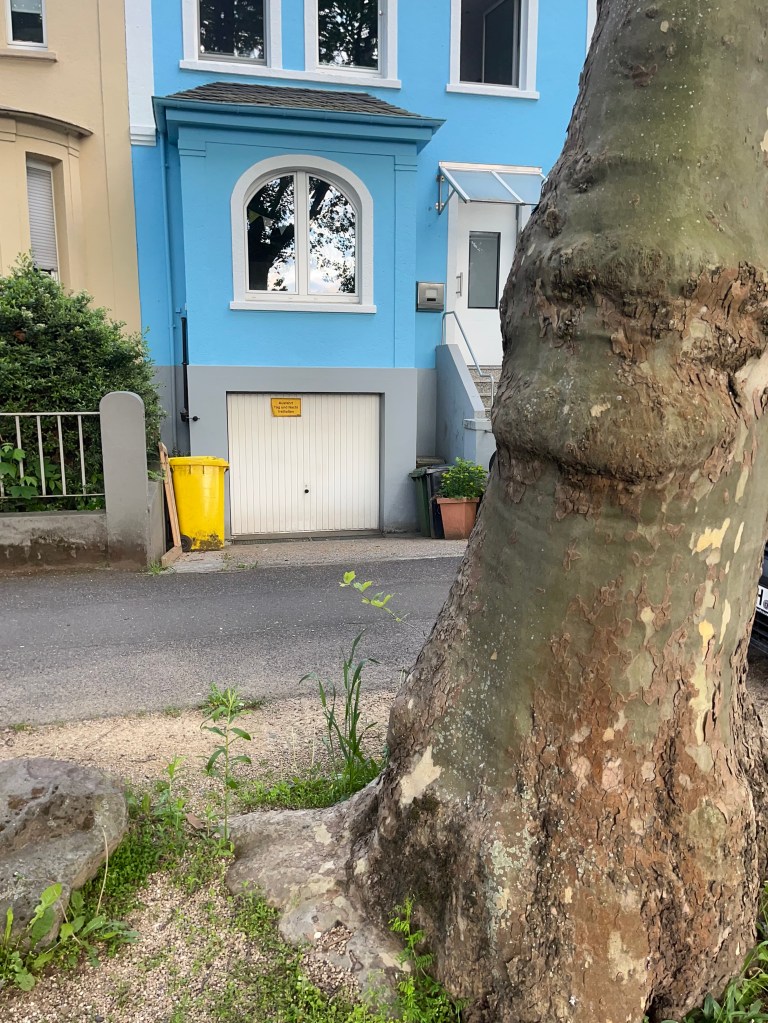
My favourite of all the signs, however, was the one in the middle. Because if you pan back from the garage door, you can see that a very large tree has indeed parked itself right in front of that driveway. Now given that trees, like meadows, are not widely renowned for their reading and writing skills, it is possible to forgive the tree (or perhaps the tree is simply blocking the exit and not the entrance), but you still have to wonder what thought processes, if any, were involved here.
Given that both the sign and the tree are fairly old, it’s obvious that some form of detente has been going on for quite some time now. Decades in fact. Although it’s mum on the age of the sign, ChatGPT guesstimates that the house could be upwards of 100 years old and that the tree, a London Plane, was probably planted sometime after World War II and has at least 60 years worth of rings to its name.
Which all explains the situation quite a bit actually.
Stands to figure that the Brits, who administered northwestern Germany and therefore Bonn after the war, would plant something called London Planes all over the city and then sometimes smack dab in the front of a driveway because they couldn’t read the German sign either.
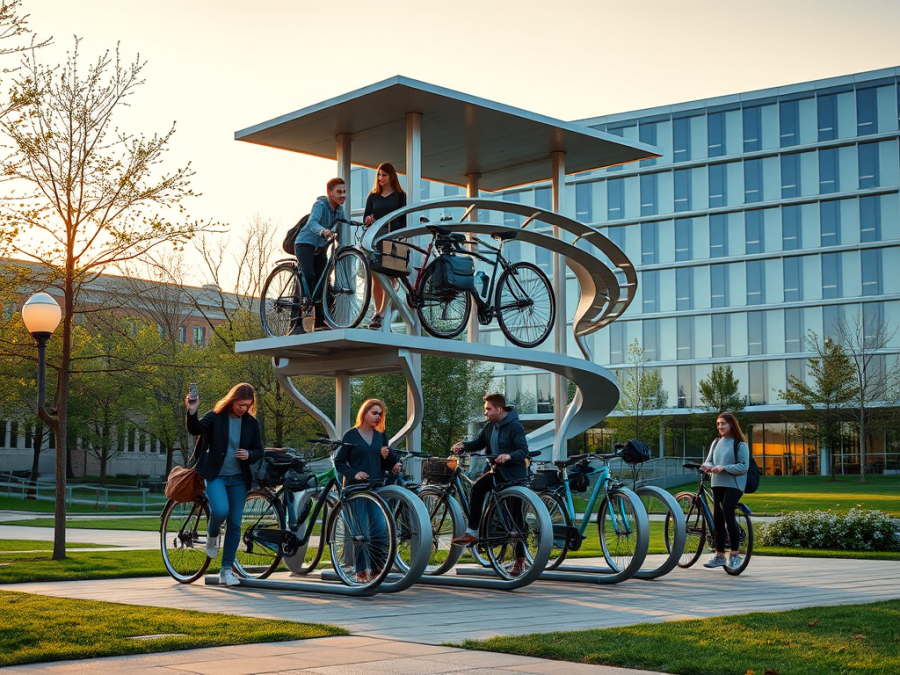
I’ve written previously about how the city of Not-Bielefeld is continuously trying to live up to its reputation as a bicycle-friendly city. Noteworthy efforts here, if only because they miss the mark completely, include the city testing out a gangrene wave for bikes and the University of Not-Bielefeld proudly installing the most expensive bike racks known to mankind.
Part of the problem here is that there is quite literally little room for improvement. Despite its reputation, Not-Bielefeld is not really laid out for bike traffic. (Or even car traffic for that matter, with most of the major roads being a single lane in either direction.) There are very few dedicated bike paths and the few that do exist are designed more to promote bikes as a form of recreation rather than as a form of alternative transportation. Or, in other words, the paths don’t really go where any bike commuters need them to.
Instead, most of the bike routes are simply vaguely divided sidewalks shared with pedestrians and all the potential chaos, ambulance rides, and insurance claims that mixture conjures up. Even that green wave is shared with pedestrians with the additional insanity of oncoming bike and pedestrian traffic on the same 3.5 meter wide stretch of sidewalk.
Therefore, an alternative solution that the city has been increasingly implementing is to declare some streets as “bicycle streets”, where except for the local residents, any car traffic is forbidden. One of the latest of these transformed streets is along a route my dog and I regularly take walking to work.
As potentially good as the idea is in general, there are a lot of weird things about this particular bicycle street. For starters, it’s a residential road that really didn’t see that much traffic beforehand, either from bikes or cars. It also runs parallel to some more major streets a couple of blocks removed on either side of it, one of which is the one where the city of Not-Bielefeld installed that bicycle green wave only a few months later. So, once again, the city is really just burning more money on another bike route that most bike commuters will tend to shun and, given that green wave, the city seems to want them to shun as well.
Moreover, if a bicycle street is really meant to facilitate commuting, it should get the right-of-way at any intersections. And the city proudly did this for this street, but with one major exception, namely the crossing road that leads to the University. So, right at the midway point of the bicycle street, any bike riders have to come to a screeching halt. As does any common sense. Although the city did install the equivalent of a pedestrian crossing where the cyclists can hammer away at their little button like a lab rat thinking that it will get its cheese faster that way too, they forgot to also install a traffic light for them for some reason. Instead, the bike riders have to crane their necks look at the pedestrian lights to know when it’s safe for them to cross. Merely annoying for the cyclist who pushed the button, but a downright gamble for any approaching the intersection. And, like with any pedestrian crossing on any only moderately busy road, it’s more of a nice (after)thought than anything else. As before, the bikes usually cross according to any gaps in the traffic rather than according to what colour light they see, with the end result that the cars are often dutifully waiting at their red lights for all the cyclists that equally dutifully pressed their buttons but nevertheless crossed the road two minutes earlier.
As always, it all makes you wonder how serious the powers at large really are about their environmental initiatives. (Or if they have any concept of reality.) What good is a bicycle street with a stop sign in the middle of it, especially when that intersection presumably leads to a place that the bicycle traffic presumably wants to go in the first place. I mean, they’re giving the right of way to a two-lane road where the speed limit is a miserly 30 km/h and where they specifically set up the street parking as a slalom course as a further traffic-calming measure. By contrast, the city is apparently mulling over the idea of having that green wave dictate the timing of the traffic lights on the road it runs along, thereby effectively giving the bikes the right of way. And that road is indeed a major artery in the city with a 50-km/h speed limit. (However, given that this is Not-Bielefeld, think “rectal” for that artery as opposed to “carotid”.)
On the practical side, how is this bicycle street even vaguely enforceable? Strictly speaking—and we are talking Germany here where strict represents the minimal, if grudgingly accepted, standard—”residents only” means that guests, Amazon, and repairmen can’t come calling anymore. At least not by car. And let’s not even start to think about anyone moving either in or out of a house there. Admittedly it’s understood that “residents only” includes “and associated activities” but then interpretation is not exactly something you want in traffic signs. Otherwise they begin to resemble signs from God, if only because more motorists will be talking to Him sooner than they might have otherwise wanted.
On top of that, although I did say that this street is a residential road, it’s really a mostly residential road that also contains a handful of businesses and some doctors’ offices. How do you even begin to sort out those customers and patients from those people just looking to use the road as an eerily empty shortcut? The cops (hopefully) have better things to do and any automated camera traps will just end up costing the city even more money for setting up the resident database and for all the court hearings from all those customers, patients, and Amazon drivers that were legitimately driving there.
Finally, comes the irony. Despite this now being a bicycle street, the city of Not-Bielefeld is investing major time and money in constructing new street-parking spaces along the road. Makes perfect sense to me: fewer cars obviously require more parking spaces. Or maybe its just some form of compensation to the residents for reducing the amount of annoying car traffic along their street. More to the point: almost all the houses there have driveways. If they didn’t need designated street parking before, why do they suddenly need it now? On top of all this, it’s not really street parking per se (which might inadvertently act to also calm the traffic along the road) but instead the partial bricking over of some front lawns to create the new parking spaces. Or, in other words, sacrificing the environment yet again to foster some environmentally friendly (PR) initiatives.
And then all this for a whole 42 spots, obscurely promoted by the city with the tagline Mehr geht nicht (“more is not possible”). Google Maps shows that there are about 140 properties directly fronting onto the road, with about an equal number behind that but with road access. That makes about one parking spot for every seven properties, a ratio that starts plummeting faster than a midair chicken when you consider that small apartment complexes are found on more than a few of those properties.
In the end, it’s strike three for Not-Bielefeld and its bicycle initiatives. Nearly two and a half years on and with construction of the street parking in full, slo-motion swing, there’s still more car traffic, even apparently legal car traffic, than bike traffic along this road.
On the plus side, it’s still a nice stretch to walk along with my dog …
Last year I wrote about how my private health-insurance company was holding out providing us, its customers, with any form of physical healthcare card, ostensibly with the motivation to save us money because of the cost of developing such a cutting-edge system.
This all, of course, is a load of crap. First off, saving us any money is simply an unintended side effect (but a damn good selling point) of them instead wanting to maximize their profits. Secondly, and as I again wrote before, these same development costs didn’t seem to be at all important when the government made them provide their economy class, statutory health-insurance customers with essentially the same cards nor when they tore down and completely replaced their online system for submitting refund claims after it was in operation for all of a year and a half.
But, let’s skip ahead to this year, 2025, the year when the German healthcare system increasingly shakes off its paper shackles to increasingly, if grudgingly, embrace the digital age.
Pretty darn racy that Jetpack AI …
Among the monumental advances awaiting us was the introduction of personalized, national health-insurance numbers, something that my insurance company has stressed is absolutely crucial for registering any implants I might have or might need. (Because, you know, they couldn’t tie them to my existing personalized, national tax number or my personalized, national pension number.) I mean, they even used bold face in the letter when making this point so it’s gotta be important, right? Makes you wonder how they ever managed to keep track of all my implants way back in those ancient, analog days of just last year.
The really cynical part of the letter though was their non-bold face hyping of how important applying for this “unique digital identity” is so as to be able to use things like electronic prescriptions to their “greatest possible extent”. All this from the same company that in part justifies not giving us healthcare cards, which are essential to use things like electronic prescriptions to any possible extent, by proudly proclaiming just how well their trusted, paper-based system has and is continuing to function.
And then comes the kicker …
After being away in Croatia for a couple of weeks, I came home to a pair of letters from my insurance company. One informed me of my personalized health-insurance number together with the warning that I should keep it in a safe place. (One of these places, of course, could include being encoded on my non-existent healthcare card, something that is in fact the case for all those people fortunate enough to have one.) The other letter was a reminder about how I had not yet applied for this very same health-insurance number and how I would be missing out on all those digital advances as well as potentially delaying any unplanned implant operations. (Um, except possibly for breast implants, what other kind of implants do you normally plan on getting? I’m pretty sure my dad didn’t go out and purposely break his hip as part of some grand plan to get a new one. And even I would be surprised if some admin-type would withhold a much needed emergency implant, thereby keeping a person in severe pain, until all the necessary paperwork was filled out.) Unfortunately, however, this second, reminder letter was written at least a week after the first one, which, to boot, was only vaguely dated as “February 2025”.
Welcome to the bonehead correspondence of the day.
Otherwise, I think I have a good idea how my insurance company can save some money to offset those development costs for my healthcare card …
An addendum: nope, thought it over and the idea really is good, especially since it’s now coming on the end of June and they just sent me another letter reminding me to sign up for my national health-insurance number. Sigh …
In its never-ending quest to be at the bleeding edge of self-promoting lip service, the University of Not-Bielefeld introduced its new environmentally-friendly travel policy at the start of this year. After what must have been countless collective person-hours in at least the high single-digit range, the following was foisted upon University members for all their official business trips:
a ban on plane flights for destinations otherwise reachable within eight hours and within Germany in general and
an obligatory carbon tax on all plane flights to be paid into a dedicated, central university fund.
The irony here is just how environmentally unfriendly such highly innovative stuff like this is. I’m sure that the Earth must’ve stopped spinning when these ideas were first pitched. A carbon tax on plane flights? Wow … Hope that no one was burning the midnight oil coming up with that outside-the-cardboard-box, original idea, especially given how much extra CO2 all that combustion would’ve released. Next time, how about saving all that extracurricular brainstorming for normal working hours when all those bright ideas can be generated using solar power instead of fossil fuels?
Presumably, the members of the responsible think tank also don’t have to walk past the same inspirational sign on campus every day that I do:
It’s not that we need new ideas, but we need to stop having old ideas.
(Although given that ideas can either be new or old and that neither seem to be especially needed, I really have no idea what ol’ Edwin is trying to inspire in anyone here.)
It’s not that being more responsible environmentally is bad—in fact it’s desperately needed—it’s just that its implementation, especially by the University of Not-Bielefeld, more often than not highlights the clash between reality and either idealism or jargon.
For starters, despite the label, the new policy is not environmentally friendly. There is no question that trains and busses have a way smaller carbon footprint than planes do, but that merely makes them friendlier, not friendly as such. Want to know what a truly environmentally-friendly travel policy looks like?
Don’t travel.
If the recent corona pandemic taught us anything, it’s that business trips are often optional luxuries and that many viable alternatives to them exist. But, sadly, human nature has taught us that the pandemic taught us nothing. In the span of only five years, we went from the death of the airline industry as we knew it to a full recovery in terms of passenger numbers and profits. And then some.
And, as is typical for the University of Not-Bielefeld, they are once again explicitly embracing the diversity amongst their academic disciplines by subjecting them all to yet another one-size-fits-all solution.
The new travel policy is unlikely to impact on, say, philosophers to any great degree because they can get into one of their long-winded arguments with anyone, anywhere, and at any time. It’s much different for researchers doing field work. Let’s face it, unless you find peat bogs inherently interesting, there’s not much for anyone from archaeology to ecology to do in northern Germany. More cynically, the University of Not-Bielefeld has been spending the past decade or so trying to grow its international exposure, both with respect to its teaching and its research. So, with its new travel policy, the University is effectively punishing those people who were foolish enough to listen to it in the past.
To its credit, however, the University has recognized this potential inequity from the get-go and already provided a solution in the form of it matching any fees paid into the central fund. Not to put too fine of a point on it, but what??? That just makes the whole pot bigger rather than balancing out who put how much into it. Adding insult to financial injury is that many people will probably also be indirectly paying the associated matching fee because the University takes a cut of any grant money they brought in to fund their trips abroad, with that cut to be used at the University’s discretion.
And, true to form, it gets even worse. The University has also said that it reserves the right to stop paying in the matching fees if it starts serving as an incentive for people to fly more. Again, what??? People are going to actively decide to destroy the environment that little bit faster not because plane travel is usually more convenient but because doing so will help pay for projects to save the environment that little bit slower? Dunno. Seems to me that those people wanting the fund to be as big as possible are also the ones least likely to pay into it.
Based on this example of the matching fund, I’m pretty certain that ol’ Edward would like to change his admonishment against having old ideas to instead just stop having outright stupid ones.
Nevertheless, the University still proudly proclaims these ideas on the webpage describing the policy. What the webpage doesn’t doesn’t actually talk about, however, is telecommuting. That important option, and the fact that it is the one that the University of Not-Bielefeld sees as the default, is instead buried two links away in the invitingly titled Amtliche Mitteilungen zur Richtlinie der Universität für klimafreundliche Dienstreisen (Official Announcement of the Guidelines of the University’s Policy for Environmentally-Friendly Travel). Instead, the webpage mostly presents a map of Europe showing how far away selected cities are together with the non-flying travel time to reach them and, for an even more selected few, the CO2 impact when flying to them. All the cities are put into three broad categories: must-not fly (under eight hours or within Germany), should-not fly (between eight and 12 hours), and could fly (over 12 hours).
One of the cities falling into that last category is Lisbon, which the map helpfully points out is only about 36 hours away if you don’t fly. Obviously, this kind of travel itinerary is only for the really devoted or the really hardcore. I don’t know about anyone else, but I go pretty squirrely after only about six hours traveling in any sort of tin can, which doesn’t even get me to the “should-not” category. And for other people sitting on the fence for a trip in that category, the University is more than willing to help keep their thoughts grounded through levying an additional charge of 50 EUR for flights under 1000 km. (From the text, it seems clear that the 1000 km refers to the one-way distance. What’s not so clear is if you have to pay the extra 50 EUR just for the entire trip or for each leg of it.)
Even more helpfully, the webpage also contains links to several portals for you to purchase your environmentally friendly bus or train tickets. Unhelpfully, however, most of these sites are rather meagre with respect to their offerings. For instance, not a single one could find me a train connection to Lisbon. The best I got was a bus. With two stopovers. And this same portal also showed me that flying would save me 33 hours, one stopover, and 34 EUR in comparison. (One way. Double those savings if you want to come back home.)
Of course, a policy wouldn’t be a real policy unless creates extra paperwork. And the form associated with this one is classic admin stuff. Another completely new form that could have been merged with either of the two already existing ones relating to business trips, ones that were also updated mere days before the new policy came into force. Plus, the new form also requires you to do all the work. Instead of simply entering the distance flown, you have to enter how much kg CO2e the airplane used and then multiply that by the carbon tax (0.055 EUR / kg CO2e) to get how much you owe in total. Thankfully, the University at least provides a link to the Atmosfair website where you can figure out the footprint of your trip.
(No idea if the University actually asked Atmosfair about doing this. Their page is actually designed to for you to financially offset your emissions to support their own environmental projects. Aren’t they gonna love it when all the employees of the University of Not-Bielefeld start using their search engine, their database, and their calculations for free?)
Fortunately, however, doing all the bookwork also gives you the opportunity to cook those same books a little. You’re expected to include all stopovers (which increase the carbon impact), but who’s going to verify if you did? (And if they do check it, then why can’t they enter all the info in the first place themselves?) There are also other variables that you can specify like the type of plane and which class you flew in, but the University webpage explicitly mentions that these are optional. And no wonder considering that the Atmosfair website defaults slightly high for both. Don’t list your class and their calculations average you into something close to premium economy. Don’t specify your plane and you end up having taken something like an Airbus A330-200, either a Boeing 737-500 or 747-400, or an Embraer 170, a collection of aircraft united by all being out of production and also not really being flown that much in Europe. Or, in other words, comparative kerosene guzzlers.
The difference between default and reality can be pretty high. Let’s take London as an example, a destination that falls into the “should-not fly” category. Atmosfair’s calculations default to an impact of 373 kg CO2e or 20.52 EUR for the University’s eco-fund. But specify that you flew economy and in a Boeing 737 MAX 8 (which is the real plane Ryanair flies on that route and the only class Ryanair offers) and those numbers nosedive to 222 kg CO2e and a tax of only 12.21 EUR, a savings of some 40.5%. But what do I know about planes, right? Claim that you flew in an ATR-72—which is a legitimate option for that distance if you can find an airline using it for that route (or at all)—and you can drop your CO2e impact even further to a diminutive 88 kg to only donate the equivalent of a cup of coffee (4.84 EUR) to the University. Even with those extra 50 EUR that you have to pay for flying under 1000 km, it’s still worth it.
(And for those suddenly developing a conscience, I’ll point out that even the University seems to be doing some creative accounting here, with their map putting London at a distance of only 202 kg CO2e …)
Or, for some advanced civil (servant) disobedience, just don’t register the business trip with the university. After all, no trip means no travel restrictions and no carbon tax, right? That I can tell, there are three reasons why we should be letting the university know about our business trips:
because admin wants us to,
to be covered by the university’s (private) healthcare insurance for the trip, and
to get your costs reimbursed.
For those who have been following along, #1 is usually not a good idea and therefore not a valid justification. The same is true for the obvious reason that seems to be missing, namely to inform the university that we’re away. For reasons that I still don’t understand (but don’t dare to question out loud), the University of Not-Bielefeld gives its professors an awful lot of freedom. We have a 40-hour workweek but no one ever enforces it, probably because they’d quickly realize that very few professors only work 40 hours a week. I’ve also never had to apply to go on vacation and, in fact, have never been officially told just how many vacation days per year I have. So if the University doesn’t care when I’m on vacation, does it really care if I’m on a business trip? Not there is not there, right? And, in becoming a civil servant, you’re basically forced to get private healthcare insurance anyway, so #2 falls away for me as well.
That leaves #3. The costs for a lot of my trips, however, are already covered by the other side meaning that there’s no reason for me to submit the claim form and its new ugly sibling, the carbon-tax form. Or, even more cynically for trips like this, I can dutifully register them with the University but, like with not applying for the European A1 certificate (Entsendebescheinigung), similarly forget to submit the carbon-tax form and see if anyone notices.
And, again, it’s all such low-hanging fruit taking potshots at easy targets. (Hmm. Sort of like this blog when you stop to think about it …) Want to see a huge carbon footprint? Take a look in your average molecular lab and see how much plastic waste is generated there each day.
As an example, a simple 5 µL Eppendorf reaction tube has a total impact of about 25 to 35 g CO2e depending on how much of the tube is made from fossil-sourced versus bio-based plastics. Barely worth talking about, right? Especially when you consider we each breathe out about a kilogram of the stuff each day. But, to fill that tube, you need a plastic pipette tip with its 2.2 to 3.1 g CO2e footprint. Again, next to nothing. If you want to sequence a gene, you’ll need at least four of each, one set to extract the DNA, one to increase the quantity of the DNA, and two to sequence both strands of it. There are more steps and more tubes involved than that, but we’re still well under 200 g of CO2e in total, so who cares?
Ok then, let’s scale things up. Normal (Sanger) DNA sequencing is good for about 1000 nucleotides, the individual letters in the DNA. The length of the human genome, however, is roughly 3 200 000 000 letters, requiring about 3.2 million sequencing reactions. And suddenly, those 200 g CO2e turn into 350 to 490 tonnes CO2e. Or about 15 lifetimes of breathing on average. This also all assumes that everything works perfectly the first time around, whereas the reality is that anywhere from 10 to 25% of these reactions need to be redone. (More reality: although the Human Genome Project officially ran from 1990 to 2003, it was only 92% complete when it “ended”. It took them until the summer of 2023 and much more CO2e to finally get that last and very tricky 8% done.) Admittedly, next-generation sequencing has drastically lowered the amount of plastic waste and genomes are becoming stupidly easy and cheap to sequence now, but the footprint of any molecular lab remains monstrously huge.
In the end, despite the University saying exactly the opposite, the policy is inherently punitive. People who have to go off-continent for their work are unduly penalized because the reality is that flying often does present the lowest possible impact in such cases. If you’ve got time to kill and keep a sharp lookout for wayward icebergs, it is indeed possible to go by boat to North America, but cruise ships makes planes look positively green by comparison, with the necessary long-haul flight having only a marginally higher carbon footprint than a city bus. And that’s what this policy should be all about: encouraging people to switch to better alternatives rather than just penalizing them when there aren’t any.
The policy also doesn’t give us the choice to offset our carbon in other ways. Most airlines allow you to do this when buying the ticket and, in fact, Ryanair now has this option switched on by default. It’s not that I have any great love for or trust in the airlines but then I also don’t want the University of Not-Bielefeld to be putting up any more million-Euro bike racks (for a whole 170 bikes!) and going around telling everyone how environmentally responsible (but not fiscally retarded) they are.
And that’s my final gripe (for today): the policy was implemented without the University having any idea about how to spend all the carbon-tax money they are going to raise, estimated to be 120 000 EUR for 2025 (including the matching grant from the President’s Office). It’s far easier for the university community to literally buy into something obligatory like this when it knows that there is some well-thought-out plan behind it.
But no. Despite the University’s climate roadmap now being several years old, all that’s known for this carbon-tax money is that there will be another workshop sometime later in the year to brainstorm ideas on how to use it.
A key, if underappreciated, skill in life is learning when it’s time to let go, be it from life itself or some of your various endeavours while living it. And so, I think that it’s only fitting to do this with The Blog About Fog, especially with this my 100th blog entry.
In helping me reach this decision, AI and ChatGPT in particular were instrumental. While waiting for both the coffee and the motivation to kick in at work this morning, I killed some time by asking ChatGPT what it thought about Not-Bielefeld and the University of Not-Bielefeld. Although both are creations of mine, the idea of Not-Bielefeld at least draws upon the Bielefeld Conspiracy, which holds that the actual German city of Bielefeld does not exist.
And this is pretty much what ChatGPT drew upon when I asked it about Not-Bielefeld. But, its answer to telling me something about the University blew my mind. This is what it came up with:
The University of Not-Bielefeld (UNB) is a prestigious institution dedicated to the study of things that simultaneously exist and do not exist. It is famous for its Department of Applied Non-Existence, where scholars rigorously research paradoxes, conspiracy theories, and the metaphysics of absence.
🔍 Key Faculties & Research Areas
Faculty of Quantum Sociology
Investigates the social behavior of entities that may or may not exist.
Offers a master’s program in Schrödingerian Public Relations.
Institute for Fictional Geography
Specializes in mapping places that people swear exist but can’t quite locate.
Publishes the annual Atlas of Non-Places.
School of Conspiratorial Studies
Offers courses on Advanced Bielefeld Conspiracy Theories and The Psychology of Mass Doubt.
Regular guest lectures by individuals who may or may not be real.
Department of Theoretical Tourism
Focuses on vacations to locations that aren’t supposed to exist.
Organizes field trips that no one can prove actually happened.
Center for Uncertain Mathematics
Develops proofs for numbers that exist only in hypothetical realities.
Pioneered the Imaginary Bus Schedule, which always arrives but never at the expected time.
🎓 Campus Life
The university library contains books that only appear when you’re not looking for them.
The student ID cards are valid both everywhere and nowhere, making discounts at real-world stores hit-or-miss.
The cafeteria serves dishes that people remember tasting but cannot accurately describe.
Would you like to enroll, or are you already an alumnus without realizing it? 🤔😆
From start to finish, that’s one damn fine hallucination. And all without so much of a wink of an AI from ChatGPT hinting it to be so. More pragmatically, when generative AI is both cleverer and funnier than you are (and scores better with Jetpack’s Write Brief writing guide on top of it), it’s a clear sign that it’s time to go.
Yeah, right. Don’t you worry. Just starting to roll up my sleeves here …
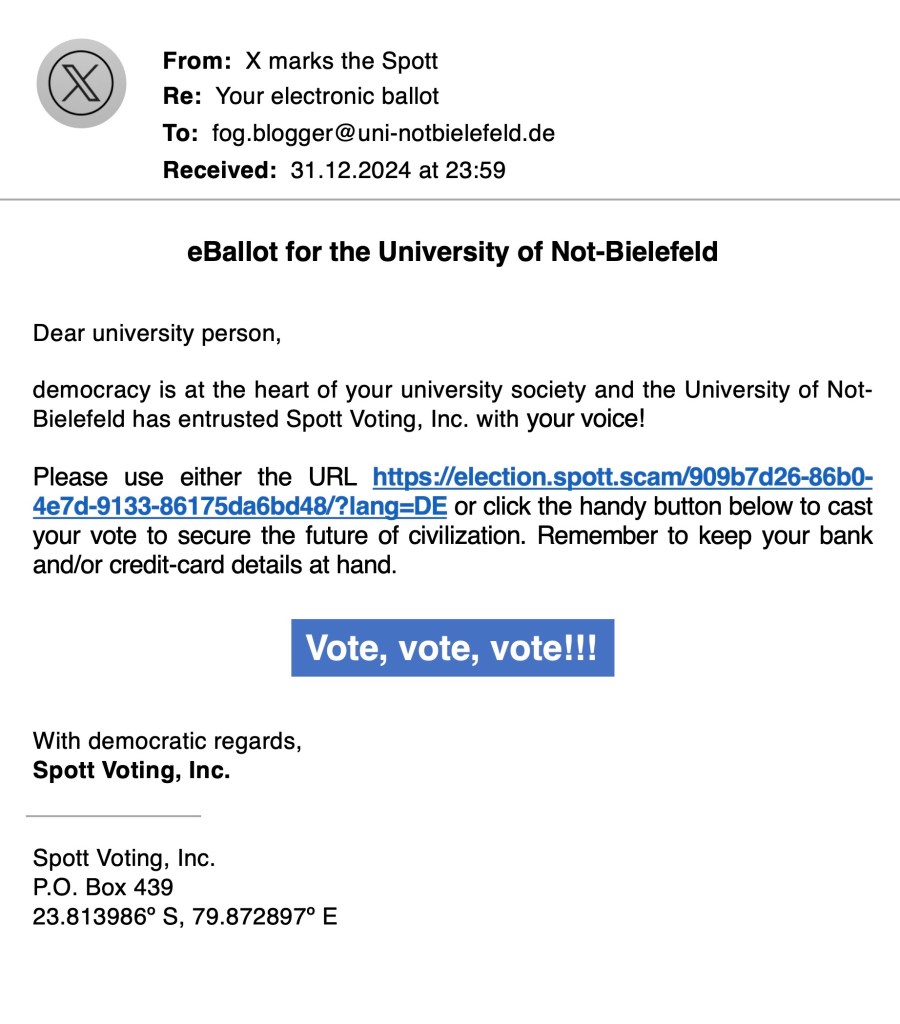
The University of Not-Bielefeld recently wrapped up its biennial exercise in democracy by holding elections for both the Senate as well as the Boards for each of its six faculties. (And, no, that isn’t a typo in the title but a bilingual play on words. Spot does exist in German and pretty much means the same thing as in English. But the German Spott means sarcasm, which, of course is pretty spot on for this blog.)
(These elections, of course, are not to be confused with the imminent German federal election, one that Elon Musk, ever the visionary and me-speech activist who is desperate to prove that Twitter (now known as X) was not some one-hit wonder, has referred to as being critical to “the future of civilization.” Unfortunately, ol’ Elon’s visions of pending catastrophic doom depending on German election results are about 90 years late. And, fortunately, even with his presumably favoured party winning that election, civilization did not drop to its knees despite taking quite the beating for a while. Really kinda hard to see us even coming close to something like that this time around no matter who wins this coming weekend.)
Two things always amaze me about these university elections. The first, of course, is that there are enough people wanting to run so that the elections are even necessary. Take the Senate elections for example where you had over 100 candidates competing for only 11 seats. And this despite that getting elected means a lot more admin for exactly no more pay. Admittedly, you are that much closer to the reins of power but it’s a university: those reins are leading to a shrivelled up nag with colic that’s long since missed its appointment at the glue factory. At best, any candidates from the political-science department could view it all as a nice, practical exercise for their otherwise largely non-applied research, but for the rest of us?
The second is, just like any German election, how complicated it all is. For a start, people can’t vote for just anyone but only for those candidates in their own status group (professors, technical staff, remaining staff, and students). And then most of the candidates also belong to university-specific parties, each with its own platform and agendas. (One of these parties in the last election was literally called Nicht wählen (Don’t vote), although it’s unclear if that message applied only to them or more broadly. Nevertheless, despite its name and exact intention, the party did garner the vote of exactly one illiterate troublemaker.) Finally, despite voting directly for individual candidates, the seats are actually differentially allocated among the status groups first, then among the parties based on how many votes their candidates jointly received, and only then among the candidates based on how many votes each actually got. All this occasionally leads to some American Electoral College like madness insofar as people with fewer votes than others, either within or across status groups, can get elected. (And, if you can somehow wrap your brain around all that, then you’re ready for the big leagues and Überhangmandaten(overhang seats), some serious psychedelic German electoral shit that make it impossible to say exactly how many seats will be in any German parliament before the votes have been counted.)
Anyway …
This past election was particularly memorable because it was the first one where we could also vote electronically. Now, despite having the capability to conduct the e-voting internally (as witnessed by our department doing just that for our recent committee elections), the University chose instead to outsource it to another company, a decision that you can view as anything from ironic to hypocritical given the hyperallergic reaction of the University‘s IT department to any personal data being housed outside of their apparently ultra-secure servers and firewalls. (Secure, that is, except to those outside hackers wanting to print something.)
The fun came because the University neglected to inform us about this outsourcing. So after a couple of years of being regularly spammed by our Office of Dataprotection and Informationsafetymanagement about how dangerous all external e-mails are, enough people were suspicious of some unknown company e-mailing them some e-voting log-in details in combination with a handy “click-here” URL that the University had to send around a follow-up e-mail indicating that it was all legit. Even worse, they had to arrange a system with the company so that all those people who had trashed the original e-mail out of an abundance of sensibility could get replacement log-in information.
The kicker was that the initial e-mail, despite definitely coming from outside the University, did not contain the gaudy banner indicating its external origin and designed to protect us from all its potential, associated evils. Which all makes you wonder (again) what that banner is actually good for. Not only can this system be fooled by a simple spoofing of the sender’s e-mail address, but IT can apparently selectively toggle it on and off. More importantly, it appears that enough people in the end didn’t actually need the banner to recognize an e-mail that looked like it might be a phishing attempt.
Looks like employees at the University of Not Bielefeld might in fact be capable of some critical thinking after all. And that’s never a bad thing when it comes to elections.
After many, many attempts to get the Jetpack AI to deliver me a good picture of a dog in Ikea for my latest blog post (and after having long given up getting it to have that dog peeing on some of the furniture), it finally gave me one that I really liked and that you can see again here.
However, it was only after I’d published the post that I noticed something weird about the picture. Take a look at the upper left corner. Those are either two really tall Ikea employees (even for Swedes) or else they’re growing out of the furniture for some reason.
Or, better yet, maybe this is some new product line from Ikea for decorating your home. (Why not? Let’s face it. Pretty much everything else you own is from Ikea, right? Might as well be up front about it.) If so, then comes the really important question of what to call it. Billy would work, but has been taken since 1979 and is unfortunately not that gender-neutral. They’re also too big for Busta, but Tørsø might fit. A real nerdy choice would be Herma, especially if the shelves below are part of the package. (Look it up. Or ask ChatGPT about it like I did.)
And, no, I’m not writing this during working hours. Nope. Uh uh. Never …
My dog and I pretty much have a 24/7 relationship. This includes bathroom breaks on both sides. Me for hers for bagging purposes and her for mine for whatever reason. (Ask her …) It also includes work where I blatantly smuggle her into the building and where she also attends all my classes. (But none of my committee meetings because of animal-welfare concerns …)
Now although I‘m convinced that my dog is both more famous and more loved at work than I am—especially, but not exclusively, by the students—her being there is completely outlawed. The official, primary reason given for this is that some people are afraid of dogs (cynophobia), something that was pointed out in a general e-mail from my faculty relatively shortly after I started bringing her to work. (I saw it as coincidence …)
I both fully get this and am sensitive and responsive to it. My dog is usually in my office and I always ask at the start of each semester if anyone minds if she tags along to class with me. I just don‘t understand why fear of dogs is always the go-to reason for banning them instead of potential allergies to them. Fear of dogs is easy to deal with: get the dog away from that person. And my experience has been that most people with this phobia are relatively understanding about the whole situation, especially when it’s clear that the dog is friendly and more or less under control. Being allergic to dogs, by contrast, is a much more difficult problem. Again, it’s easy to remove the dog but damn near impossible to remove all those allergens that they leave behind. And, although it’s difficult to get any hard numbers on this, it seems that more people are allergic to dogs (anywhere between 10 and 30%) than are afraid of them (up to 10%). Yet it usually remains, at best, a secondary justification.
Ok, so where am I going with this? (Besides someplace really controversial …)
Recently, I wanted to go to some huge, anonymous Swedish furniture store and was curious if I could take my dog along. The answer on the website was the default one: no because some customers might be scared of dogs. (You can freely substitute the word allergic in there, BTW. The point remains the same.) But right underneath that it was stated that assistance dogs were, of course, more than welcome. How does this work? Are assistance dogs somehow inherently less scary than my dog? Or is a person’s need for assistance somehow more important than someone else’s phobias?
And it’s the generalization of this last point that has been occupying my thoughts for quite a while now in this day and age of personal rights: people are so concerned about egotistically proclaiming their rights without any real reflection about the whole concept. This general attitude was perfectly summed up in an e-mail from the University of Not-Bielefeld from late last year where it was stated that “every person at our university has the right to set personal boundaries that are accepted by everyone.” If you read between the lines, the e-mail was obviously talking about sexual harassment and that is equally obviously a non-starter. But, in typical admin-speak, the text was deliberately vaguely specific and only referred generically to “personal boundaries”.
But what exactly is a personal boundary? Or, more to the point, what is a legitimate personal boundary? Take the following statement:
“I’m afraid of dogs because I was attacked by one once.”
Most people will not have a problem with it and will see it as an understandable, if not completely justified, statement on the part of the person saying it. Change the word “dogs” to “men” and that’s still pretty much the case, especially when it is assumed that a woman is saying it. (And, yes, I have asked people their opinions on exactly these two sentences to support my suppositions.) But, change “dogs” to some visible minority or ethnic group and you’ve just booked yourself a place in some very hot part of the afterlife for the rest of eternity. (And, no, the practical part of this experiment stopped with the previous questions.)
But why? Why are only some fears (AKA boundaries) legitimate? And, in light of that e-mail from the University of Not-Bielefeld, what right do you have to judge my personal boundaries? And that is the point that I’m trying to make: what do you do, like when you want to go furniture shopping, when those boundaries clash? Again, there are no-go areas like murder, rape and harassment, and persecution. But even some of those areas regularly allow commuters to visit them, war and self-defense being two contexts that immediately spring to mind here.
Comedians have long faced this boundary problem when making jokes about people outside of their “group”, especially if those people are seen as somehow being “inferior” to them. Dave Chappelle, in response to ongoing criticism of his jokes about transgender people, explicitly addressed the subjectivity of him punching down in this instance by asking how we as a society objectively determine who is “higher” in the social hierarchy—in this case a black man from Washington, D.C. or a transgender person—and therefore might be allowed to make jokes about the other. Admittedly, Dave Chappelle is now a very rich black man from Washington, D.C. but does this really change anything? Or do we instead have to restrict his comparison to transgender people who are also very rich?
In the end, perhaps the only thing that is clear in this whole debate is that punching up is clearly the way to go, if only because it gives you a better angle on the other person’s nuts.
I have to admit that this little gem passed me by for the longest time, in part because I don’t read those mostly self-serving pieces of propaganda (AKA press releases) put out at far-too-frequent intervals by the University of Not-Bielefeld.
All last summer there were some serious excavations going on in front of one of the buildings on the main campus. Turns out that it was all part of the University’s new found commitment to becoming more environmentally friendly. And, indeed, it has all the hallmarks of the University’s overall climate policy: unraveling a good intention with unnecessary gimmicks.
The heavy-duty construction was all for installing a new set of bike racks. But, not just any set of bike racks of course. Noooo. With the University proudly accepting (and even more proudly promoting) its role as the last defense against environmental oblivion, the solution to saving the planet obviously lies in roofed-over, double-decker bike racks. (Or to doubling the number of sweaty (or rain-soaked) students in your classes as compared to before. Same overall impact.) That’s it. And we’re not even talking any of those fancy motorized elevators like you have for cars where parking space is at a premium. Just some cantilevered bike racks powered by elbow grease on a university campus where space really isn’t an issue. At least they listened to my suggestion about making the roofs green (admittedly before I’d actually made it) but too bad they chose to do it on the smallest possible roofs on campus.
But then comes the bottom line for all this, which, appropriately enough, is flooring.
The overall price tag for this latest act by the University to combat global warming? A cool 1.4 million EUR. That‘s just north of 4000 EUR for each of the 340 bikes that can be parked there in all their luxurious glory. Or, for even more perspective, even further north of 8000 EUR for each of the extra 170 bikes that can be parked in them lofty penthouses compared to on plain ol’ low tech asphalt.
And even the (green) roofs are more of a gimmick than anything else. Yes, this is northern Germany where the winters are charitably described as “moist”. But those roofs only help keep you dry the whole time you aren’t actually on your bike. Granted, no one likes to start their bike ride by squishing down onto a soggy saddle, but there were other roofed-over rack stands that they could have converted into two-story jobbies instead. In any case, 1.4 million EUR will buy you a literal ton of 2.99 EUR saddle covers. Even without any bulk discounts …
(Hate the idea of environmentally decimating plastic saddle covers, especially because God only knows that there’s no plastic to be found anywhere else on a bike? Then let’s splurge on lambskin covers for an extra 7.50 EUR a cheek. No. Wait. Those 1.4 million EUR at hand would mean that a lot of animals would be suffering. Hmm. Maybe adding even more concrete to the ecosystem is indeed the eco-friendly way to go.)
In the end, apart from wondering what all the months-long construction was for and where all that money really went to, you also have to wonder that there are people from the University willing to go on record to double down on this double-decker disaster. The word-for-word translation of the quote from the Head of Building Management was that “It was worth it.”
But then it’s this kind of fiscal arithmetic that also explains why there’s nothing left in his budget to repair all the broken doors, leaky roofs, and drafty windows plaguing the buildings on campus that he’s also responsible for …
Another week, another example of environmental pseudo-do-goodery on the part of the University of Not-Bielefeld. This time around, the plan is to enlist volunteers from the university community to plant a Tiny Forest (their capitalization, not mine) on the grounds of the university according to the Miyawaki method. Through this action, the hope is to “ecologically enhance” small areas like the “classic dog meadow” .
In and of itself, it’s not a bad idea. As usual, however, there is a lot of crap floating around the idea that is more than questionable. (But ideal to help the forest grow. See step #2 below).
First, I know I’m biased, but, my God, can we leave the dogs alone for a second here? It’s amazing how often “man’s best friend” is on the short end of society’s stick instead of chasing it. (Not nearly as often as a lot of people, admittedly, but still.) Moreover and somewhat fittingly, dogs aren’t even all that welcome on campus, so who gives a shit? Definitely not the dogs and definitely not on that meadow.
Second, like the city of Not-Bielefeld itself, the university campus is actually already pretty green with lots of bushes and trees and comparatively few open spaces to enhance. Admittedly, there is a clear difference between some scattered pockets of bushes and trees and even a Tiny Forest (although a strip of grass qualifies as a meadow according to the University), but, nevertheless, what kind of extra biodiversity are they hoping for here really? Moose? Wild boars? Because there are exactly none of those in the (non-tiny) forest located directly adjacent to the university campus.
Finally, anyone judging biodiversity primarily in terms of more vs. less, good vs. bad doesn’t know their job very well. Is a forest an “ecological enhancement” over a dog meadow? For forest dwellers, yes. But any inhabitants of that meadow might beg to differ and meadows (without signs) have been around for a lot longer than either humans or dogs. Does this mean that Nature failed Biodiversity 101? Or is it more likely a case that the person in charge has an advanced degree in Anthropocentrism and thinks that more complex environments are simply those where we can see more big plants and big animals? The key to biodiversity, you see, is actually right there in the name, namely diversity. And not just within any given habitat but also between habitats. Going strictly by the criterion of “more is better” ironically turns global warming into a good thing because we’ll be upgrading all that low-rent tundra into something much more ecologically productive. And, any extra deserts can be easily handled via the “Irrigation method”, thereby using all the excess water from the melting of the polar ice caps that we’re going to have to find a use for anyway. (But only if we think that keeping Holland and the US eastern seaboard around is a good idea.)
Easy …
Again, I’m not saying that this action is a bad thing and certainly every little environmental effort helps. Instead, what bothers me about it (and related actions on the part of the University of Not-Bielefeld) is that they all seem much more like publicity stunts rather than anything rooted in deep conviction. Often the time, energy, and money that the University has invested in promoting their sense of environmental responsibility has far exceeded their investment in the actual actions themselves.
Take the gratuitous bit of namedropping in this case. Ever heard of the Miyawaki method before? Me neither. Sounds fancy and official though, doesn’t it? The reality, however, is that the method essentially boils down to the following four, really simple steps:
scope out the native plant species that comprise mature forests in the area,
fertilize the designated plot as needed,
plant the desired, native seedlings in a dense, mixed manner, and
weed the plot as needed for up to three years.
With no offense to Akira Miyawaki (especially because the Tiny-Forest method itself seems to stem from the Indian engineer Shubhendu Sharma based on Miyawaki’s ideas), but as much as this method might have been a revelation in highly industrialized (i.e., barely ecologically conscious), post World War II, western societies, it hardly seems like rocket science now. Much of its appeal seems to lie in it enabling a mature forest to be established in decades rather than the more usual centuries because it avoids all those intermediate, regenerative steps with other plant species that Nature throws in. But, what’s the rush? Like a dog meadow, these intermediate, successional habitats also support their own biodiversity and so aren’t unimportant either. And even mature forests have immature bits in them and, gasp, sometimes also Tiny Meadows. But, no, we need our better kind of biodiversity now and especially in a way where we don’t get our hands all that dirty.
Speaking of which …
The homepage for the event also has a FAQ where one of the questions answered is what kind of clothes the volunteers need to wear for the event. Really? Do you really need to tell people at a university that they should wear clothes that can get dirty when planting trees? (Even more idiotic, however, is the next sentence in this same answer where they advise people that “certain weather conditions can prevail at the end of November to which the clothing should be adapted”. (And this wasn’t just a bad translation because the original German wording was word-for-word just as self-importantly uninformative.) George Carlin would go nuts here. First off, the end of November is not some magical time. Certain weather conditions prevail at any time of the year you can think of. And why not go out on a limb and actually name those conditions, namely cold and wet? Scared of a lawsuit in case it turns out to be hot and dry and some by-the-book moron collapses because they showed up in a waterproof polar-exploration suit regardless? Finally, if you have to say anything here at all—and you don’t—just say that everyone should dress appropriately for the weather on that day.)
Finally, like I said, it’s an awful lot of hype for such low-hanging fruit, which, when you consider that we’re talking about a Tiny Forest here, are hanging even lower than normal. Yes, the University of Not-Bielefeld did put up some new windows with built-in solar panels on my building this past year (replacing some of the surrounding bushes with biodiversity enhancing paving stones in the process), but then that helps lower their energy bill too, doesn’t it? What about some real and selfless investments, like installing green roofs on all the buildings or replacing the other windows in my building, which at 40 years old are at least 10 years past a normal window’s functional lifespan of about 15 to 30 years? Or maybe mothballing all those gas-powered leafblowers in favour of a few more people with a few more rakes? Or just leaving the leaves? Nature always seemed to find something to do with them, even back in the day when there were more trees and fewer meadows or paving stones.
Nah …
The problem here is that most real solutions cost real money and are usually much harder to advertise. No one will see your self-congratulatory sign on a green roof now will they?
If the university wants to shamelessly promote itself, so be it. Let’s just see some truth and balance in the process though. For instance, since I’ve been at the University of Not-Bielefeld, the university has been putting up new buildings at a rate of one building about every two years or so. New buildings, of course, are great for PR: big, shiny, and complete with over-sized scissors for the press to photograph at the official ribbon-cutting ceremony. But, how about also including a new sign with each new building to round out all that self-promotion?












_ATR.72-212A(500)_FlyFireFly_TLS_30AUG11_(6097869500)_(cropped).jpg)








_(cropped).jpg)