More boneheaded crap from those ever-inventive airlines …
I was recently on a flight where we were reminded numerous times during boarding to sit in our assigned seats only, which had been allocated for reasons of weight and balance.
Umm. How?
Doing something like that properly would require that the airlines know how much each passenger and, even more unlikely, their carry-on luggage weighs. It’s been a long, long time since my hand luggage was checked for size and weight and exactly never outside maybe a doctor’s office since I was. And, in any case, the airlines have already assigned me my seat before they ever had the chance to do either.
Ok, maybe the airlines are doing some sort of rough estimate based on passengers being male or female, children or adults as well as assuming that our carry-on bags all meet both their weight and number restrictions (uh huh …), but is this sufficient for their apparently highly precise calculations that forbid us from swapping seats with someone else? For our own safety no less? What if someone cancels at the last minute or is a no show? Or simply went nuts at duty free? What if the other identical twin wants to look out the window for a bit? Am I inviting disaster simply by walking to the loo for a pee? (I certainly am if I don’t …) Are the flight attendants really allowed to walk around with their carts that much?
Admittedly, some airlines have been weighing both volunteer passengers and their carry-on luggage recently but mostly to get better estimates for these data than the global averages that they currently rely on. Even so, it remains a mystery to me how any airline could apply these data on a day-to-day, flight-to-flight basis to balance out the plane.
Finally and more importantly, most airlines now allow you to pick out your own seat for a fee. How do they control for weight and balance then? Granted, not everyone buys their seat ahead of time but many do. It’s also something that the airlines are increasingly encouraging by tying seat selection to unnecessary upgrades like being able to bring a real piece of carry-on baggage in the cabin or having enough legroom on the odd chance that you’re not a munchkin. And, if enough people do, can the airlines really compensate with the leftover cheapskates for any skewed weight distributions that might have arisen from it? All using data that they don’t have? (Apart from them overwhelmingly being munchkins with personal items only …)
Nah. The only balance here that the airlines really care about is the one in their financial reports …
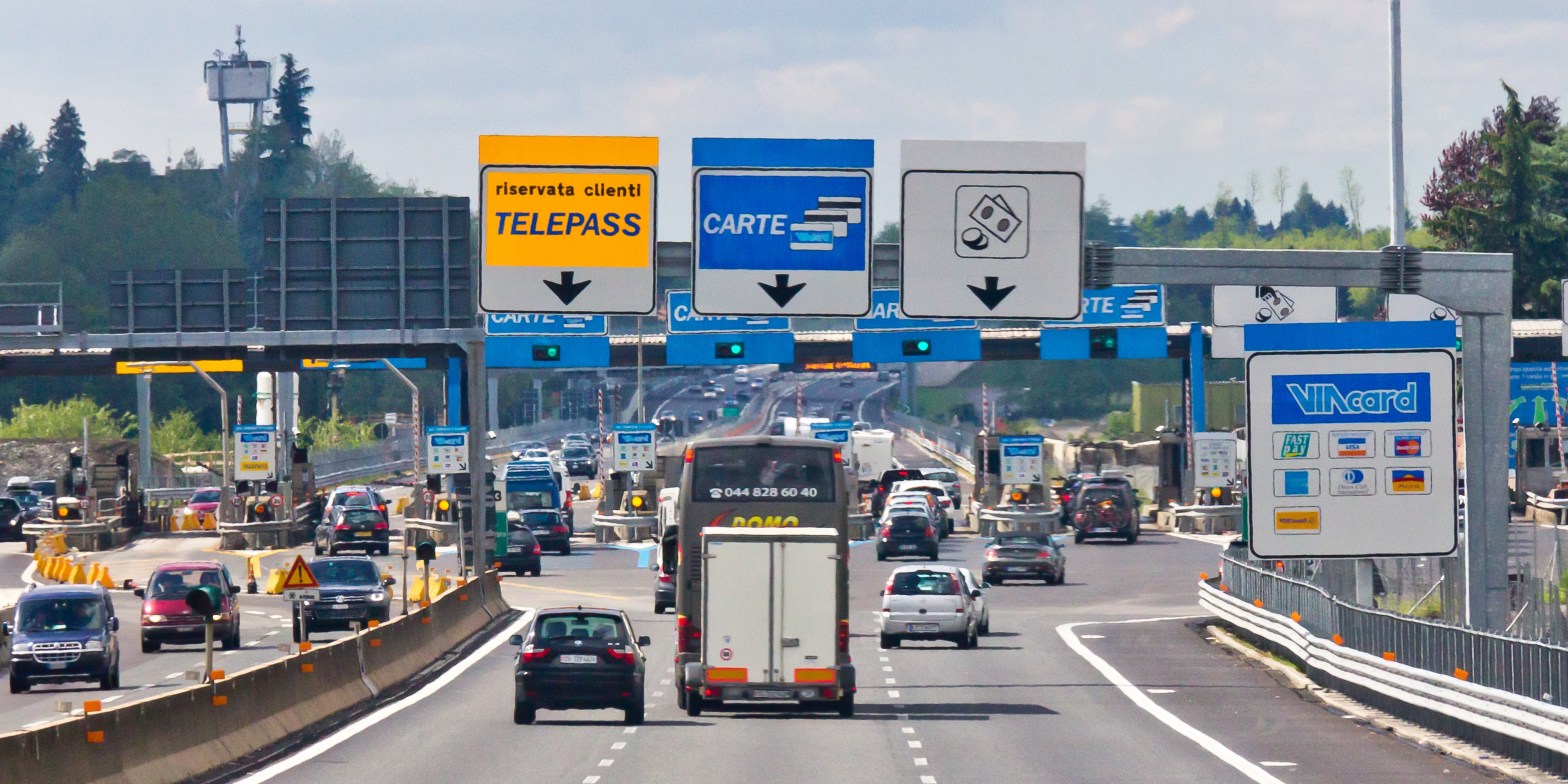
I recently returned from a weekend trip to Bratislava in the Slovak Republic and, like many other countries in Europe (with a few notable exceptions), the Slovak Republic charges a toll to use its motorways. Whereas before one had to stick one of those little vignettes to the windshield of your car as proof of payment (and then somehow get the damn things off again), much of this is now handled electronically such that virtual vignettes are now tied to the license plate of your car instead.
Adding to the convenience, in large part by eliminating the scraping, is that a lot of these countries, including the Slovak Republic, also now helpfully offer e-mail reminders of when your electronic vignette is going to run out. Unhelpfully, however, the Slovakian e-mail contained (or, more accurately, pretty much solely comprised) possibly one of the longest, most confusing, and obfuscated sentences that I have ever read in my life.
How long was it?
Put it this way. This criticism is coming from someone who regularly gets roasted for his overly long sentences. And WordPress’s new AI to help you write more simply and directly? After reading the sentence, it simply quit and directly took up a new job writing beat-poetry haikus.
And here is that sentence:
Dear Customer, the administrator of collection of vignette payments for the use of specified road sections in the Slovak republic, hereby notifies You through this automatically generated e-mail notification about approaching the expiry date of the electronic vignette for the vehicle NBD-FB007 with the country of registration Germany on 05.08.2024 (inclusive).
Sounds like something German admin would be proud to write. (Or more so a German legal department because it’s arguably much more legalese than officialese.) But they can’t …
… because Germany, you see, is one of those notable exceptions from above. Despite having one of the largest motorway networks in Europe at roughly 13.000 km (second only to the nearly 16.000 km of the surprise winner in Spain, which, admittedly, does have 1.4x more area to cover), only increasingly smaller trucks have had to pay a toll to use it since 2005. (As of this summer, anything over 3.5 t now has to pay.) Although plans have been afoot for about as long to also impose a similar toll on cars, the latest attempt was foiled by the EU courts in 2019 who decided that giving Germans the fee back via tax credits was discriminatory because only foreigners would essentially be paying the motorway toll.
That was five years ago and, by all accounts, a German motorway toll is now such a low priority that we need not fear how German admin will retaliate against (or just try to plain one-up) the e-mail reminders of their Slovakian colleagues.
It should be obvious that, like many other amateur technoweenies, I’m fascinated by AI. Or, better said, I’m fascinated by what AI can finally do.
Many of the components, tools, and algorithms current generative AI is based on have been around for a lot longer than most people realize. It’s only in the last few years that the hardware and software have reached the point where initiatives like OpenAI have been able to put all the pieces together to give us something resembling the computers from the original version of Star Trek. (Which, if you think about it, were pretty dorky compared to what we have now. If you lobotomize ChatGPT, give it Majel Barrett’s voice (definitely a missed opportunity there by OpenAI), add some chattering background noise, and throw in some sort of seizure for good measure, you would probably come close to the overtly metallic and stilted interface that 1960s network TV envisaged Captain Kirk and friends would be interacting with some 150 years from now.)
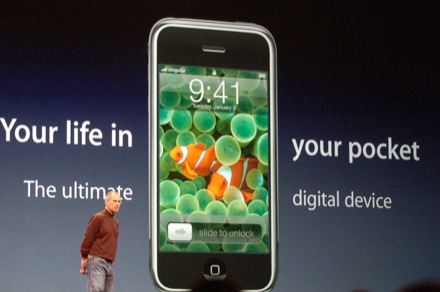
I’m similarly fascinated at how quickly such revolutionary inventions are copied. For instance, it took Apple about two and a half years to develop the first iPhone and, by all accounts, its debut in January 2007 was very premature. (There are numerous accounts about how the Apple engineers were all fervently praying (when they weren’t even more fervently drinking) that the multiple prototypes used during Steve Jobs’ keynote address at Macworld 2007 would not crash and burn despite all the other tricks and fakery that were in play.) But in October 2008, only 16 months after non-Apple people could finally get hold of an iPhone, the first copy of it in the form of the HTC-Dream, complete with a from the ground up new, Android OS, came out. Admittedly, HTC and Google had a blueprint to work with (whereas Apple had to create theirs), but they still had to reverse engineer most of it.
And so it is with generative AI. Within months of ChatGPT exploding on to the world stage, literally dozens of other generative AI applications have also hit the big (computer) screen, enabling people to generate music, art, and even entire comedy routines in the style of someone else (as well as to frequently, if very mistakenly, claim them as their own creative creations). And the list of new uses goes on and on.
Never being one to shy away from biting the hand that I feed, even WordPress is getting heavily in the AI act …
Through its Jetpack extension, WordPress has recently begun offering its users diverse AI tools to facilitate and even improve their blog writing. I’d stumbled upon some of these tools already and and was rudely made aware of some of the latest ones while writing my last blog when some new AI writing tools suddenly popped up with their suggestions without even asking. (You know, like Clippy, that moronic Microsoft office assistant that no one ever used.) The WordPress tools will check your text for complex words (which are highlighted in yellow), long sentences (in purple), and unconfident words (in green). If you let them, that is.
I won’t …
For starters, I don’t need WordPress telling me that my sentences are too long. I know that my sentence are too long. People have been telling me this literally for decades now and my father reminds me every time he reads one of my new blogs. (Which is ironic considering that he’s German and so should not be calling this Kesselschwarz when it comes to long sentences.) In any case, flick the switch to show which sentences in my blogs are too long and the purple haze that Jimi Hendrix sang about is nothing compared to what WordPress throws back at me.
And you know what? I don’t care. You want short sentences? Try Twitter (now known as X) …
The complex-words tool is even better because it’s just so, well, bad. Here is a list of all the words that it’s flagged in this blog until now (in italics) and the “simple, direct” corrections that it’s suggested instead (immediately following the complex word in parentheses):
where initiatives like OpenAI have been able to (can) put all the pieces together
There are numerous (many) stories … during Steve Jobs’ keynote address (discuss).
complete (finished) with a from the ground up new, Android OS
whereas (since) Apple had to create theirs
and thereby to frequently (often), if mistakenly
begun to offer its users numerous (many) AI tools to facilitate (help) and even improve
immediately following (at once next) in parentheses
Many of the corrections are just dead wrong and sound like the invisible-idiot game where you had Google translate some phrase into a foreign language and then back again. (Some of the classic examples of mistranslation here might have been made up but there were still apps to automate the process for you. And they often came up with similar bits of nonsense.) As for the others, it would appear that the Jetpack AI has a thing against syllables, which would also explain why its writing service is called Writing brief with AI instead of the grammatically correct Writing briefly with AI.
As for unconfident words, the AI hammers me each and every time I use words like “probably” or “could”. And I literally mean each and every time. For instance, even though their usage in the first sentence of this paragraph is completely justified, the AI flagged probably and could nevertheless (and in this sentence too for good measure).
And, truth be told, who really needs these writing tools anyway? Or wants them? A lot of blog writers are writers and, so, probably know how to write in the first place. Or, more importantly, want to express themselves in their own words, not some standardized schlock that an infinite number of CPUs with access to an infinite number of keyboards churns out. When was the last time that any computer won any one of the Pulitzer, Booker, or Nobel Prizes anyway?
One tool that I admittedly had high hopes for was for the AI to generate suitable images for the blog. To be honest, one of the hardest parts about writing this blog is finding (or making) suitable, public-domain pictures for it. The words are easy, the pictures less so. It sometimes takes me hours to find or make good ones. If AI can do it for me in a couple of seconds, well, so much for the better.
Too bad that it can’t.
To the right is the AI’s free attempt to summarize this blog as one, featured picture. It’s very, very good, but what the hell is it exactly? And what the hell does it have to do with the content of this blog? I’m not 100% happy with the featured image that I did find (they should be computer chips, not poker chips …), but at least it captures the “all in” aspect of the title.
Fortunately, it is possible to get the AI to deliver an image according to some instructions so I asked it to make me a picture of “a computer poker player going all in but with computer chips and not poker chips” …
… and got an angry, older, and washed up Ryan Reynolds instead. (Still no computer chips either.)
Another, potentially useful tool is the one to suggest titles for the blog (although the official verb being used is “improve”, not “suggest”), another aspect of my blog writing that often costs me more time than I’d like. But, given these suggested improvements, I’ll happily invest that time.
The impact of generative AI on technological advancements
WordPress Jetpack AI tools: benefits and limitations for blog writing
Enhancing blog content with AI-generated images: expectations vs. reality
Sounds like their AI was trained on admin memos …
The final, kinda fun tool is for the AI to generate feedback about the content and structure of the blog (which you can request over and over again until you get one that you like!). I’ll just leave you with my preferred version uncharacteristically uncommented.
The content touches on the fascination with AI and its rapid development, discusses WordPress Jetpack’s AI tools, and expresses disappointment with the AI’s image and title suggestions. The AI’s writing tools are criticized for providing inaccurate corrections and being unnecessary for most experienced writers. The AI’s inability to deliver suitable images is highlighted, along with receiving unexpected results. The blog titles generated by AI are considered useful, and the feature to generate feedback about the blog’s content and structure is mentioned as well. The feedback is comprehensive and provides a good overview of the content, but it could benefit from some reorganization to improve flow and coherence, especially in the section discussing the writing tools. A more focused approach to analyzing the specific features of the Jetpack AI tools for blog writing could enhance the overall presentation.
This story is actually comparatively old, but work isn’t especially enticing at the moment. So …
Nearly two years ago, “wiser” heads in Zagreb were searching for some way to get the city’s residents to recycle more. Although Zagreb uses all the standard bins (household, organic, paper, and plastic waste), its Zagrebians don’t. Or at least not in any sort of differentiated manner. Whatever needs to be thrown away tends to land into / onto the first handy receptacle, be it a bin, a bush, or a boulevard. The picture at the right is not staged and can really only be described as “precycling”. (And, yes, that is indeed the organic-waste bin right next door.)
The solution?
ZG Vrećice or new plastic bags for household waste that, from then on, represented the only way in which such waste would be collected. Apparently, the logic was that because Zagrebians would be reluctant to shell out the additional, new user fee of 0.26 EUR per bag (on top of the “mandatory minimum public service” fees (or garbage tax) that every homeowner has to pay every month anyway), they would be more careful to reduce what went into them and thereby would start sorting their waste properly.
(And people are indeed inherently and endlessly creative when it comes to saving money sometimes. At least in Not-Bielefeld, the city had to start rationing the number of yellow (plastic) recycling bags per household because people would use the otherwise free bags for their normal, household waste. Ever hear the old adage about how you can never make anything foolproof because fools are so ingenious? Same idea …)
But, work with me for a second here …
All told, this means that the city’s solution to get Zagrebians to recycle more (although most plastics currently cannot be recycled anyway) is to buy, at a premium price (0.26 EUR for a 10-L bag?!), new, purpose-designed plastic bags that although they themselves are recyclable (but with no indication whether or not they are made from recycled plastic) are treated like the normal household waste they contain to be either burned or end up in the dump? Talk about leading by disaster …
And, on top of that, if saving the environment wasn’t incentive enough to sign on to the new system (which it never was before), there were the inevitable fines for not using it to help your motivation along. Or for other people to help themselves to your bins to avoid using the new system. Yes, the new system also meant that Zagrebians were now responsible for the contents of their garbage bins and could get fined for anything neispravno (= nicht ordnungsgemäß = not in accordance with the rules and regulations) in the bin, even if it came from some unknown, third party. And, Zagreb’s garbagemen (sorry, household-waste collection engineers) were indeed initially tasked with not just collecting the garbage but also ensuring that its presentation was indeed ispravno and reporting any violations.
The end result was either that a few people started locking up their bins (as in locking the bins themselves, not just locking them away) but that many more simply abandoned them altogether to instead throw their ZG Vrećice onto the sidewalk to wait it out until the next weekly collection day. Now, considering that it can easily top 35 ºC on a summer’s day in Zagreb, most of those ZG Vrećice had learned how to walk (in an oozy sort of way) days before they were collected. At least the bins confined both the garbage and its stink in one place.
(Abandoning the household bins completely was, as it turns out, actually exactly what the city wanted and had decreed as part of the new system. Except that the ZG Vrećice were only be put out on collection day itself to instead learn to walk in the comfort of their own home. (Oh joy …) And, as demonstrated by the precycling example above, the new system does absolutely nothing to prevent people from putting the wrong stuff into the bins that remain. (And they do.))
And, as with many other dog owners, this all made the collection of their poop (the dogs’, not their owners’) even more work than usual. Blue poop bags are uncommon, especially in the convenient ZG Vrećice standard of 10 L. And, if I’m conscientious enough to pick up my dog’s poop in the first place, then I’m unlikely to throw it neispravno into someone else’s bin for them to be fined for. (Maybe.) Finally, because buying individual ZG Vrećice to use as single-use poop bags is clearly out of the question, it means literally lugging the shit around for even longer than normal until a public garbage can appears like an oasis on the horizon.
Fortunately, however, the enthusiasm for the new system (if there was any in the first place) died down quickly, probably because the enthusiasm for issuing the fines died down even more quickly. Like garbagemen the world over, their counterparts in Zagreb have a shitty enough job as it is, even more so when you consider that they tend to work during the night, and they probably tossed the idea of sorting through the bins (with their bare hands!) to issue possible fines into the nearest ZG Vrećice.
And so, nearly two years on, it all turns out to be another example of classic admin: instituting a “great” new idea (and even more great new laws and paperwork to go along with it) to quickly return to a system pretty much exactly like it was before.
Just before Christmas last year, some well meaning, unionized elves (so, not Santa’s) wanted to put a little something extra in the stockings of the students that we hire to help with all our teaching. Instead of being able to hire them purely on a course-for-course basis as before, the new framework dictates that we have to provide them with a bit more security insofar as we have to hire them for an entire year from now on.
(And, as an added bonus, they also got a new, completely unnecessary designation in the form of studentische Hilfskraft (student helpforce, soon to become part of the MCU) from the old Hilfswissenschaftler (helpresearcher). Although the change removes the male gender-specificity of the latter term (and/or avoids the just plain ugly ungender-unspecificity of its neutered derivative, Hilfswissenschaftler*in), it does nothing for phonetics or efficient communication. Hilfswissenschaftler was always shortened to the rather pleasant-sounding, and gender-neutral, HiWi (HEE-wee), whereas studentische Hilfskraft becomes the 50% syllabically enhanced and, even for German, much harsher sounding SHK (ESS-ha-ka).)
Unfortunately, well meaning is not necessarily the same thing as well thought out …
German universities largely use a semester system where the bulk of the teaching is done in two 14-week blocks. Do the (not very complicated) math and it’s clear that the new, year-long contracts, when intended solely for teaching purposes, involve just about as much paid vacation time as they do actual, working time. (Ok, we can do teaching outside of those 14-week blocks but it really only happens between the winter and summer semesters and altogether this possibility is much more of a bookkeeping tool on the part of admin to fake the workloads of the students to under a legal 40 hours per week. In any case, it still amounts to a whole lot of sitting around doing nothing, something that students, unlike civil servants like me, lack the proper, highly technical training for.)
Some more math, this time combined with a bit of economics …
To teach our comparative anatomy labs in the winter semester, we need eight teaching assistants for seven weeks. Or 56 weeks in total. (That’s the math.) So whereas before our teaching budget allowed us to give a bit of money to help eight different HiWis, we now have to spend it all on one SHK. And, even more stupidly, we now also have to hire a second SHK for a full year to ensure that there are still two teaching assistants per lab to meet the demand. Or, in other words, our budget costs just doubled for the same amount of work. (That’s the economics.) Both of these people then get to spend the remaining 45 weeks of the year getting paid to do nothing because SHKs cannot be hired by the department (say to serve as a pool of shared teaching assistants) but only by the individual working groups and we really don’t have any more teaching duties for them until the next autumn. (That’s the admin.)
Fortunately, however, the new agreement does have a general escape clause insofar as the length of the contract can be shorter than the prescribed one-year minimum in “justified instances”. And, a mere seven brief but sleepless months after the agreement was published (and three months after it went into effect), probably together with more than a couple of important memos unusually not dealing with cats and cucumbers, central admin at the University of Not-Bielefeld finally managed to codify what those instances are:
appointment as a teaching assistant,
appointment as a replacement for another SHK,
appointment to a one-time event,
appointment to an externally-funded or other project,
appointment to a lab practical,
by request of the candidate, and
other (please specify).
Two of those exceptions are worth highlighting. The first, of course, is “other”, that most well known and most specific of justifiable instances. (This same specificity also refers to the exception relating to project work, where “externally-funded or other project” is really just the same as, well, “project”.) More importantly, who gets to decide exactly how justified your other is? Or can they? So long as “other” is listed by the University as a justified exception, then that should be enough, right?
The second is the one above “other”, which I suspect to possibly be illegal. Rumour has it that Germany has a law that prevents you from signing any contract that is to your own detriment. (ChatGPT helpfully localized this rumour to sections 305 to 310 of the German Civil Code (AKA Bürgerliches Gesetzbuch, BGB) along with some other laws with some other acronyms.) For instance, and I’ve actually run into this rumoured situation myself when trying to hire someone for my working group, if you have a position that pays out according to someone having a Master degree, it is actually illegal for someone with a PhD to hold it, even by their own request, because they would be underpaid according to their qualifications. Now given that the new agreement was made for the benefit of the students, it stands to reason that agreeing to a shorter timeframe, even if it was by their own request, would be to their detriment and therefore similarly illegal. So, instead of adding to the red tape with this latter exception, why not just request those candidates use that tried-and-true method known as quitting?
Or just enjoy their 45-week paid holiday without complaining?
In any case, all these changes and changes to the changes have brought us right back to exactly where we were before, begging the question of why anything had to be changed in the first place. Ostensibly it was all to help the students out. But, as I pointed out above, the new law in practice means that it’s qualitatively better only for quantitatively fewer students in some sort sort of weird application of the motto of the Three Musketeers: all (the money) for one and one for all (the teaching).
And, although many of my students will disagree, I’m not sure if they really needed to be helped out all that much in the first place. At least not compared to those in many other countries. After the vocal outcry following the brief fling that the public universities in Germany had with real tuition fees in the late 2000s(instituting fees that were comparable in magnitude to those that I paid in Canada over two decades earlier), undergrad students have since gone back to paying semester fees only. Sounds suspiciously similar to tuition fees but the only thing that they have in common are last four letters. And the preceding space. For starters, the current semester fees here at the University of Not-Bielefeld are just over over 400 EUR per semester,
<slight pause to allow any North-American students reading this blog to regain consciousness again>
with over half of that money going to provide the students with a semester ticket that allows them to use most public transport in the province (including regional trains) free of charge.
<again, a second, slight pause for similar reasons>
Never mind the trains. Just considering how expensive the busses here in Not-Bielefeld are, that’s one sweetheart of a deal that I’d love to have as well. And if all that still isn’t enough to help cover the bills, German students can apply for interest-free student loans from the government via programs like BAföG (not short for Blög Aböut föG, but for Bundesausbildungsförderungsgesetz and thank God for that).
Oh and BAföG? If you’re willing to fight through all the associated admin, only half of the loan, up to a maximum of 10010 EUR, has to be repaid (interest-free). The rest is provided as a grant.
And we’ll just stop right there before any North-American students start hemorrhaging from their eyeballs. Even a third pause wouldn’t help there anymore …
For some time now, CNN has been my go-to source for general news. Unfortunately, they’ve shown an increasingly annoying tendency to clickbait their headlines.
It all started out innocently enough with the fluff pieces that no one is really interested in. You know, “Two strangers met on a flight to Paris. Find out what happened next.” (Answer: who cares?) But then they started doing it for borderline real new pieces that didn’t seem to be generating enough traffic, usually because the headline basically told you the entire story. You could actually watch the headline evolve over the course of the day from “Canada places ban on imported moose meat” to “This country has stopped importing moose meat” to try and entice more readers. (Better solution: try reporting real news.)
But CNN outdid themselves the other day with this headline associated with the attempted Trump assassination:
For starters, how can this photo possibly be iconic? It’s at most one goddamn day old. Iconic photos are ones that have stood the test of time, not hours. Had the photographer actually gotten a shot of the bullet just as it was about to hit Trump and not of one that just whizzed by him, then come back and talk me. But in this day and age where every event is “historic”, I suppose every photo has to be “iconic” too.
More importantly, how long does it take the average person to say “dumb luck” or “I just pressed the button”? Seriously. What else do you expect the photographer to say? “I waited for the sound of the gunshot and then counted to a thousandth of a second before pulling the trigger myself”?
Apparently, however, it takes CNN an entire three minutes and 34 seconds to say it. (Unfortunately, finding that little bit of information out required me to click on the link, thereby reinforcing their use of that clickbait headline.) Maybe (hopefully) there’s more to the video than just the explanation, but then modify the obvious, stupid headline and save the bonehead catchline for the two moose exporting themselves from Canada to Paris.
I’ve written more than a few times now about AI on this blog, AI in this case being artificial intelligence and not admin intelligence, which is something completely different. Although not among my list of followers, ChatGPT must’ve perused my blog from time-to-time in its pursuit of subjugating the human species, so I thought it would be cool to ask its opinion of it.
Ultimately, the impetus for this bit of time wasting on my part came from some of my students. While I was holding a lecture on generative AI and what it means in a university setting, they were busy killing time by asking ChatGPT everything it knew about me. Apart from showing me that I needed to make my lectures more interesting, the episode got me curious as to exactly what ChatGPT was indeed saying about me. (My students wouldn’t tell me.) Sort of the next generation of googling yourself, I guess.
It’s actually quite the interesting exercise because it’s like a three-paragraph summary of what the internet has to say about you. The review was very flattering (even without having Skylett Johanssonread it to me) and, in addition to that, it also made some other mistakes. For instance, ChatGPT had me being born at the wrong space-time coordinates, namely October 8th, 1969 in Germany. Apart from being just plain wrong, it’s also completely impossible because “Germany” as such, unlike Canada where I was born, didn’t exist at that time. (And, yes, I suppose the latter is the same sort of admin hairsplitting that I often poke fun at, but then you could also rightfully claim that Julius Caesar was Italian because he was born in Rome. No just ignore the anachronism and go right ahead and enjoy your Little Caesars’ pizza …)
In any case, I quizzed ChatGTP about what it thought about “The Blog About Fog” and promptly found out the following:
“The Blog about Fog,” also known as “Squinting through Fog,” is written by Cameron Lee, who is a professor of family studies and a Christian theologian. The blog focuses on reflections about the Bible, theology, and the Christian life, aiming to provide deeper insights into faith and scripture.
…
Take-home message: despite what WordPress claims in its annual review of my site, I’m not engaging with my readership, especially the artificial kind, as well as I could be. (And, before I get accused of plagiarism or just outright ripping someone off, I will point out that Lee’s blog is officially called “Squinting through Fog” and colloquially as “The Fog Blog”. That I know of, mine is the only one of many fog blogs, some dealing with actual fog, with the word “about” in the title. But ChatGPT just ran with it.)
After I clarified to ChatGPT that, no, I wanted the fog blog about admin, it returned with:
“The Blog about Fog,” also known as “Adventures in Admin,” is a satirical blog that humorously critiques the often frustrating and convoluted world of university administration. The blog is written by a university professor who uses the pseudonym “fogBlogger.” It delves into various aspects of administrative tasks, poking fun at bureaucratic inefficiencies and the absurdities that come with academic administration.
One notable post highlights the creation of a COVID-19 safety assessment form using ChatGPT, comparing it favorably to the overly complex forms typically produced by university administration. The blog post appreciates the efficiency and user-friendliness of the AI-generated form, contrasting it with the cumbersome and intimidating nature of traditional forms used in the author’s university.
Another post explores the use of “Beamtendeutsch,” or bureaucratic German, showcasing how administrative language can be unnecessarily complex and confusing. The blog provides humorous translations of official terms, illustrating the absurdity and inefficiency inherent in bureaucratic communication.
Overall, “The Blog about Fog” serves as a humorous outlet for venting frustrations about the administrative side of academia, while also providing insightful commentary on the inefficiencies and challenges faced by university staff and faculty. The blog is appreciated for its wit and relatability among those familiar with the intricacies of university administration.
Note once again the glowing review, which makes it clear now how WordPress generates the text for their annual reviews. Far more interesting, however, is the pat on the back that ChatGPT gives itself in the second paragraph. Now, it is true, I did come to that same conclusion. But I find it utterly fascinating that ChatGPT chooses to highlight that post, which is personally not one of my favourites, out of the 70+ other ones that I have made.
Late last year, a long stretch of sidewalk along the main campus of the University of Not-Bielefeld was cordoned off and replaced. And, like any other roadworks project in Germany, the entire section to be replaced was shut down from day one to provide all the non-existent construction workers with the maximal amount of safety and all the rest of us with the maximal amount of inconvenience.
At the time, I really couldn’t see the point of it all because the sidewalk looked to be in perfectly good shape. Or at least not anywhere run down enough to justify replacing an entire block’s worth of it. And, after the work was completed (many, many months later), I still really couldn’t see the point of it.
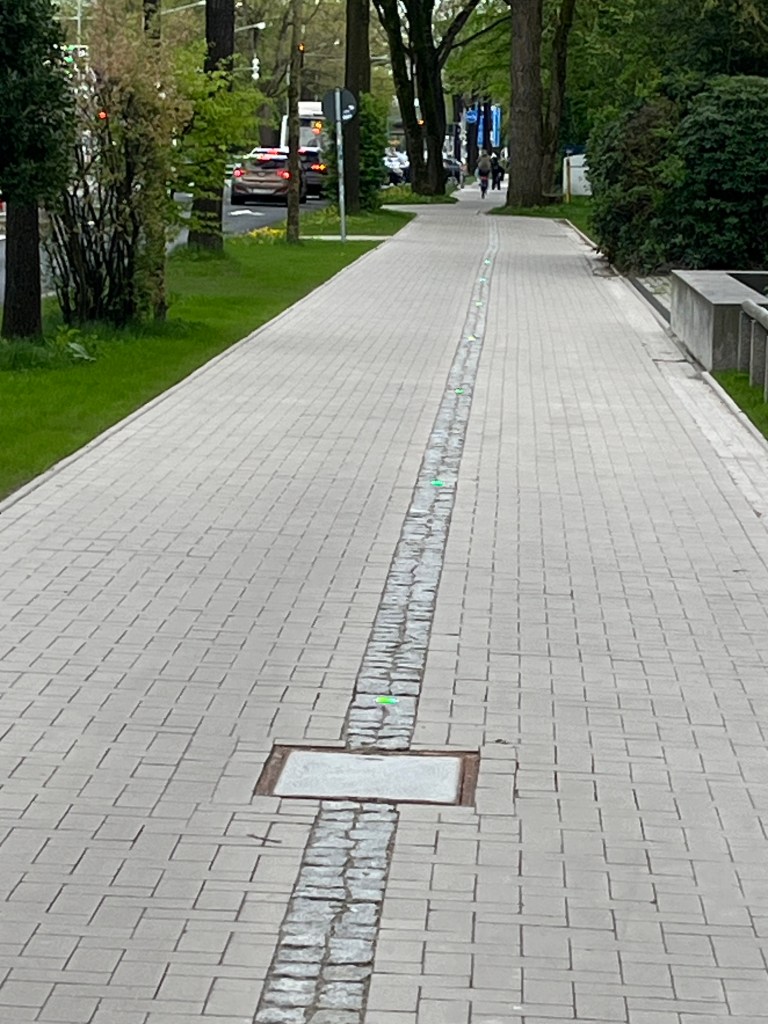
It turns out that the reason behind all the (on average) non-activity was to install a test section for a green wave for cyclists, a green wave being that fairy-tale situation where a series of traffic lights along a given stretch all go green for you when you hit the right speed. The principle behind it is simple enough. A series of green LED lights are embedded in the bike path. If the lights are on when you pass them, you’re riding the wave and will make the next traffic light. (As such, the traffic lights are now necessarily timed for the bike traffic and no longer the car traffic.) If they’re not, then there’s a power failure, either in the city as a whole, but more likely in your legs and you have to speed up to catch the wave again. (Or slow down and wait for the next one.) All this is hardly a new idea on the part of Not-Bielefeld and they themselves admit that their system is based on the “Copenhagen Model”.
Implementing this simple principle properly is a completely different story, however …
Key to any green wave is having the traffic going at the right speed to stay in the wave. Here in Not-Bielefeld, they decided on a fairly leisurely 18 km/h for the bike riders, which is 2 km/h less than the more robust vikings in Copenhagen have to sweat out. And, not to be outdone, the Aussies down in Melbourne have to put at least another 2 km/h on top of that.
Less obviously, but perhaps more importantly, there can’t be any traffic preventing you from keeping that target speed. It’s little wonder then that the most successful green waves are for cars and then on one-way roads where the only effort required is moving your right ankle. Nevertheless, Copenhagen and Melbourne have successfully applied this simple logic by implementing their bicycle green-wave systems on dedicated, one-way bike lanes.
Not-Bielefeld, by contrast, has decided to try this all out on a four-lane, undivided sidewalk. So not only do the local cyclists trying to stay in the wave have to swerve around other cyclists who can’t go or don’t care about going 18 km/h, but they also have to deal with pedestrians going in all directions. And, if all that weren’t bad enough, there’s oncoming bike traffic to contend with as well. All this on a sidewalk that is less than 3.5 m wide in total and occasionally narrows down to about 3 m when it has to jig around either trees or bus stops. Those surfing the wave are heading for a major-league wipeout.
(I should point out that oncoming bike traffic is not an uncommon occurrence in Not-Bielefeld. The cyclists here tend to be any or all of apathetic, suicidal, or moronic and drive however and wherever they feel like. And Not-Bielefeld just half-heartedly puts up with it all. For instance, very close to where I live, there are two street signs on the sidewalk, each pointing in opposite directions and both within plain sight of one another. The one forbids bike riding in the wrong direction (because outside of a car you need to be reminded of basic traffic laws for some reason), whereas the other warns you to watch out for that forbidden oncoming bike traffic. Be all that as it may, leave it to Not-Bielefeld to install their green-wave test stretch on a sidewalk where oncoming bike traffic is actually officially allowed.)
Apart from setting up their green waves properly, there’s an important difference between Not-Bielefeld and either Copenhagen or Melbourne, namely size. According to World Population Review, Copenhagen is pushing 1.4 million inhabitants and Melbourne has just over 5.3 million. Not-Bielefeld? Under 200 000. Or, put another, more relative way, less than the number of cyclists that pass over one single bike bridge in Copenhagen—the Dronning Louises Bro bridge—in a typical workweek.
In other words, there aren’t that many people to move and, by extension, they don’t have that far to move either. The city centre is about 2.2 km away from the university or about 7.3 minutes at a green-wavish 18 km/h. Optimistically assuming that surfing the wave makes you about 25% faster than normal (initial trials in Copenhagen showed it to be about 17%), this shaves less than two minutes off your travel time without it. (Or about three and a half minutes should you decide to go home again in the evening.) It’s really only after you retire that the savings work out to anything substantial (about a month), but only if you didn’t succumb to the temptation to take your car (or, gulp, the bus) on one or more of those dark, wet, and windy Not-Bielefeld winter days.
And these time savings could be incredibly optimistic indeed when you consider that Not-Bielefeld’s green wave might actually be slowing its cyclists down. According to data from the activity app Strava, the average, wave-free bike commuting speed on pavement (i.e., with lights and with traffic) is a more viking-like 19.5 km/h. Or, by the time you’re ready to retire, slightly over a week of exciting other things you could have been doing in Not-Bielefeld besides trundling along with the wave.
All told, there have been any number of weird decisions made here, including the ones above.
First, the green LEDs are only present for the last one-third of the test section. Apart from the question of why the city then had to replace three-thirds of a block of sidewalk for this project, it means that cyclists won’t know if they are in the wave until it might be too late. And, remember, although lights out for a green wave typically means “too slow”, there’s a good chance in Not-Bielefeld that it could mean “too fast”.
Second, although the green wave is directed toward the city centre, most of the commuter bike traffic along this stretch goes in the other direction toward the university, thereby sort of explaining why oncoming bike traffic is allowed in the first place. (But only sort of. Why the other side of the road isn’t sufficient for these cyclists—apart from them being any or all of apathetic, suicidal, or moronic—remains an open question.)
Third, by giving priority to the bikes over the cars, you also impede the bus traffic along the road. (Again, the same initial trials in Copenhagen showed up to 14% longer bus times.) Now, apart from my dog, no one I know particularly enjoys riding the bus and especially not in Not-Bielefeld where bus fares are steadily approaching a whopping 3 EUR for a single ticket. A green wave is guaranteed to only further increase the number of smiling faces among those on the bus and especially among those driving the bus, most of whom haven’t smiled once since 2004. (No offence. Shit job. I get it …)
Finally, the city of Not-Bielefeld proudly proclaims that there are a little less than 2000 spots to lock up your bike downtown. As such, this means that they’ve spent 200 000 EUR (so far) to benefit about 1% of its population and even fewer of its bikes given that they also proudly proclaim that—even ignoring all the dead bikes in the canals—there are more bikes than people in the city. (How they determined the latter is a mystery. I’ve lived here for over 15 years now and no one has ever asked me how many bikes I have.) And all this money was only for a single, one-block test section on a route that has no clear run toward downtown. Nope. Because right after the very next intersection (= about half the distance to downtown), the cyclists not only have to again yield the right of way to some more trees and another bus stop before negotiating two sharp, right-angle turns (like this section of the Copenhagen Model, just more extreme) to get onto the parallel residential street where the non-dedicated bike lane continues. So no more chaotic pedestrians to deal with, but now with the added thrill of oncoming car traffic instead. In any case, scale down the target speed by about a factor of 10 and you might come out of those corners with some skin still attached to your body.
Oh. And that very next intersection? It also happens to be a major junction with on- and off-ramps to the motorway that runs through Not-Bielefeld. Forget downtown. This junction probably accounts for the biggest chunk of car traffic along this road, meaning that instituting a green wave will do comparatively little to reducing car traffic and comparatively a lot to increasing the chaos that the junction already happily provides.
Call it what you will—sleight of hand, a smokescreen, or even LED and circuses—it’s the same old shell game that authorities have been playing for centuries: throw big money at some over-the-top, glitzy solution to distract the marks from the fact that some basic necessity is missing, namely the fundamental cycling infrastructure needed for a green wave in this case. Impressing is always so much easier than redressing after all.
And then double down on the fiasco to quell any lingering doubts.
First you employ lots of advertising, banners, and slogans and sound bytes and dare people to call you on it. Less than 2000 bike spots in the downtown is actually more than a little embarrassing for a city that is officially certified as “bike friendly”, but Not-Bielefeld proudly parades that number on its webpages anyway. (And it’s downright pathetic when you realize that it’s less than half the number of parking spots available downtown for cars.) Then you unilaterally declare the pilot project an unmitigated success worthy of expansion. Indeed, visions of thermal cameras, bike counters, and other sugar plums to automatically enable the green wave to regulate itself are already dancing in the city administrators’ heads. But all this doubling downing does is to waste even more money that could otherwise be spent on more sensible, more productive but decidedly less showy ideas like reduced, reasonable bus fares or dedicated bike lanes.
And then there are other opinions like those recently voiced by some “critics”. (Ok, vandals.) First, they simply ripped out all the LEDs last December and threw them in some neighbouring front lawns. And then just after the whole project got rolling in March of this year, they painted over all but one of the new LEDs with white paint. And apparently in the middle of a Friday afternoon when no one was around to see it.
Looks like Not-Bielefeld’s green wave needs CCTV more than it does thermal cameras …
For just over a year now, I’ve been unofficially officially severely handicapped. This will come as a surprise to many, especially those closest to me who have accused me of being handicapped for decades now. (Family. Sigh …) But, whereas chronic depression got me close, a little bit of prostate cancer will do the trick every time.
(And, before I get started, a word to the Word Police: I have no idea what the accepted terms for “handicapped” or “disabled” this week are and whether or not you can even use any version of the first term in any context outside of golf anymore. And, to be honest, I care even less. The problem, you see, doesn’t lie so much in our choice of words as in our choice of attitudes: as long as we as a society continue to treat any identifiable group of people as second-class citizens, it doesn’t really matter what we call them. New labels combined with old attitudes does nothing except to create a need for more new labels after a couple of years.)
It wasn’t clear to me before this entire process began, even after having been in Germany for so long now, but there are rules involved to qualify as being disabled. A lot of them. In Germany, it’s all pretty much functionally summarized by the Grad der Behinderung (or GdB), a scale that quantifies the level of disability from 20 to 100. For almost any ailment or missing body part that you can think of, there’s a GdB-value attached to it on the official list. (A summary, albeit also in German, can be found here. The EU also has its own lengthy version.) For instance, if you happen to lose your penis and can’t for the life of you remember where you put it, that counts as GdB 50. By contrast, a missing vulva only gets you GdB 40, a clear sign that the list was probably written by men. (And, yes, I am well aware that the penis and vulva are not each other’s respective equivalents. However, in an even clearer indication as to the list’s male authorship, the clitoris is impossible to find.)
Rumour has it that this whole idea of levels of disability had its origins from war, that favourite of human pastimes that ensures for a lot of missing body parts. I know a version of it from my youth in Canada from ads for disability insurance, which, in a weird combination of Let’s Make a Deal then and reality TV now, would happily tell you how much your different body parts were essentially worth. So whereas losing a thumb got you enough money for a new car (with power windows if it was the thumb on your dominant hand), a small toe got you a packet of cheese doodles (maybe), and a head got you a brand new one, albeit one made out of stone, and much, much more for your next of kin.
If it seems curious that the modern German scale first starts at GdB 20, it makes even less sense that it all means nothing in practical terms until you hit GdB 50, the threshold for being severely handicapped. For instance, my chronic depression only got me GdB 30, which for all intents and purposes is the exactly same thing officially as being absolutely healthy. In other words, you also have to be sufficiently handicapped (cf. that missing penis) to be officially disabled.
But whereas depression maximally gets you only GdB 40 (= healthy), prostate cancer minimally gets you two years at GdB 50 (= severely handicapped). I’m stretching but still somehow suspect that this particular distinction might lie with how the two respective illnesses are viewed. Many, many years ago and before I knew any better, I said that I’d rather have a heart attack than depression at least insofar as the latter tends to get you more understanding and sympathy. Unlike me, that statement has actually aged pretty well many, many years later where I do now indeed know better. No heart attack yet (no rush, I’m patient …), but whereas my depression has always gone unmentioned, my cancer diagnosis shocked everyone.
Cancer has by far the worse reputation because it can strike anyone and kill them. Depression? Although society has become increasingly aware of it, the perhaps still common perception is that it only affects wimps and doesn’t kill them. (At least not directly. Via suicide, sure, but that’s just another form of wimpiness, isn’t it?) And, going back to the possible wartime origins of the entire disability system, war heroes that lost part of their body got any or all of respect and sympathy, a medal, and financial compensation. (Or at least they used to.) War cowards that only lost part of their sanity because of PTSD (AKA shell shock) mostly got scorn with the optional upgrade of incarceration in a rubber room with a matching new wardrobe.
Cancer (left) and mental-health (right) awareness ribbons.
The reality, however, is that mental illness lingers and there is usually no cure for it. Cancer tends to be much more clear-cut: either you get rid of it or it gets rid of you. And my case history mirrors this reality. My depression, although officially classified as only “moderate”, has been the way more debilitating of these two illnesses. At the height of my depression, I was on sick leave for an entire year and have missed countless days over the almost 10 years since then. (Scares me to think what severe depression must be like.) By contrast, my prostate cancer cost me just under a month in total, most of which was spent recovering from the surgery.
Admittedly, I was extremely lucky with the cancer, which was caught in its very early stages and which was also completely localized to the prostate. Plus everything south of the equator seems to be working fine after the operation too. (And, if it wasn’t, the incontinence might nab me a few extra GdBs too. Like I said, the catalogue covers just about everything. At least for men.)
But that’s exactly the point: the lack of much differentiation in the system means that cancer gets you an automatic GdB 50 regardless of what its outcome and repercussions are. Understandable, however, because they can’t possibly check every case individually, right?
You’d like to think so, but, as a matter of fact, THEY DO …
You see, the reason for the delay in my getting official severely handicapped status is manyfold. First, it’s all backdated to when I got the cancer diagnosis last May. Fair enough, I guess. But I only found out that I could apply after the operation last autumn, some five months and many missed cheaper movie tickets later. Second, the various disabilities all have to be documented by the handling physicians. Again, fair enough. But whereas my urologist took care of this relatively quickly, my psychiatrist took another couple of months to submit his report. (Can’t say that I blame him though. He couldn’t rely on already completed hospital statements and lab reports and loves paperwork just as much as I do.)
But the last couple months’ delay was because the two reports each had to be independently verified by the government’s very own team of medical officers, the Betriebsärzte. I’ve run up against the Betriebsärzte more than a couple of times now and still have absolutely no real idea why they exist.
Usually they came into play when some big medical expenses were looming, like braces for the kids or therapy for me, and the Beihilfestelle, the governmental half of the overly complicated health-insurance plan for civil servants, wanted to make sure that my kids were ugly enough and that I was nuts enough to justify the money they were going to have to pay out for the necessary adjustments. One time, however, I actually met a Betriebsarzt face-to-face after that year-long sick leave to ensure that I was indeed ready to start working again.
As much as transparency and second opinions are good ideas in general, you really have to wonder what good they are providing here at all. That I know of, no Betriebsarzt ever looked at one of my kids or, with the exception of the one I exceptionally met, asked me how I was feeling that day. And even for that one, the meeting took all of about 20 minutes, a short enough time for me to sincerely fake either sanity or insanity depending on what outcome I wanted.
In the end, they all must’ve relied on the doctors’ reports, which they can’t possibly contradict having never met us and having no knowledge of our case histories. Or is there a real danger that I can convincingly fake hospital reports for both the biopsy results as well as my prostate surgery?
Instead, the Betriebsärzte seem to be there more for their math skills. GdBs for whatever you’re missing (tumours, penises / vulvae, sanity, …), you see, aren’t strictly additive. Instead, it all depends on the “reciprocal relationships” of the individual ailments with one another. For instance, unless you’re a bird or very creative, a missing penis usually means sterility. According to the EU list, however, 40% for the penis + 25% for the sterility = 45% in total. But, like I said, a missing penis and sterility are pretty much the same thing, right? However, how my very different and completely unrelated cancer (GdB 50) and depression (GdB 30) only add up to GdB 60 raises more questions and non-missing eyebrows than Fermat’s Last Theorem did.
The obvious takeaway from all this is that it’s apparently better to misplace your body parts in Germany than the rest of Europe. Not only do you get those 10 extra penis points, but the added European bureaucracy means that—forget the clitoris—they can’t even find the vulva.
The University of Not-Bielefeld, like many other institutions these days, has hopped on the environmental bandwagon (electric powered, of course) and, among other things, designed an Action Plan to guide it along its path towards becoming CO2 neutral. (Me? I’ve always been CO2 neutral, except when there’s too much of it in a room trying to kill me. Then I get CO2 hostile and open a window.)
As with most documents of this kind, the Action Plan was long on big words and even longer on bigger promises (and, at 50+ pages, just bloody long too), but surprisingly short on actual, concrete actions. One of the few mentioned, however, was to replace the aging, 40-year-old windows on campus.
Now in replacing the windows on the very large, glass-fronted foyer on our building (good) while also fitting a good many out with solar panels (better), they had to remove a two-meter strip of shrubbery to provide a solid base for the heavy machinery (not great, but understandable), which they then cobbled over when all was said and done (WTF?). Apart from providing even less runoff area for northern Germany’s torrential winter rainfalls, it appears that University’s idea of achieving CO2 neutrality is to remove about 20 square meters of objects that remove CO2 naturally.
On top of that, a very much optional part of the renovations was to add a two-meter large, double-sided LED display panel that, until now, has mostly displayed only advertising. On top of a university generally needing this like Elon Musk needed to sell flamethrowers, the presumably non-solar powered cooling fans are already going crazy in the 20 ºC spring “heat”. The University, it would seem, is taking CO2 neutrality literally instead of trying for the more farsighted goal of becoming CO2 negative.
But then, as one of my colleagues put it, at least they didn’t chop down any trees to ensure that the solar panels see enough sunshine.



























 The Blog About Fog