Over the past few weeks, any number of the following signs have been sprouting up on the grounds of the University of Not-Bielefeld.
The literal, word-for-word translation of the sign is:
I am an insect-friendly flower and wild meadow!
This all is, of course, complete nonsense in oh-so-many ways. First, it’s a sign and not a meadow. More accurate would be “I am a sign on an …”. Second, even so, signs cannot really refer to themselves in the first person. (Nor can meadows, with or without the help of a sign.) Third, there’s no need whatsoever for the exclamation point. The message is not all that exciting or surprising and signs and especially meadows are not prone to shouting. Fourth, this particular “meadow” is really just an elongated strip of grass between the parking lot and the sidewalk. Finally, and most importantly, the actual translation of the sign is much more along the lines of:
We’re hoping that everyone interprets this as us being environmentally responsible instead of really just trying to reduce our gardening costs.
In a recent post of mine about AI, I took some potshots at the new AI features that WordPress had rolled out through its Jetpack plugin. A couple of blog posts later and the AI still hates the way that I write and I still hate its suggestions for titles for my blogs. So, we’ll call it even up to now …
(Sort of. According to the Jetpack website, “optimal readability” comes when you write at a grade-eight level. Or, put another way, for junior-high-school dropouts. (For those who, like the AI, are keeping score, my blog entries tend to hover between a grade-ten and grade-eleven level. So still for dropouts but at least for a better class of one.) Even more curiously, Jetpack seems to think that writing is a video game, suggesting on the same webpage that I can “adjust my writing in real time” according to the dynamically updated readability score. Uh, sure. (That being said, this utterly gratuitous adjustment to simply insert the word supercalifragilisticexpialidocious just increased the reading level of this post by about a third of a grade. Apologies to all those that might have been left behind because of this …))
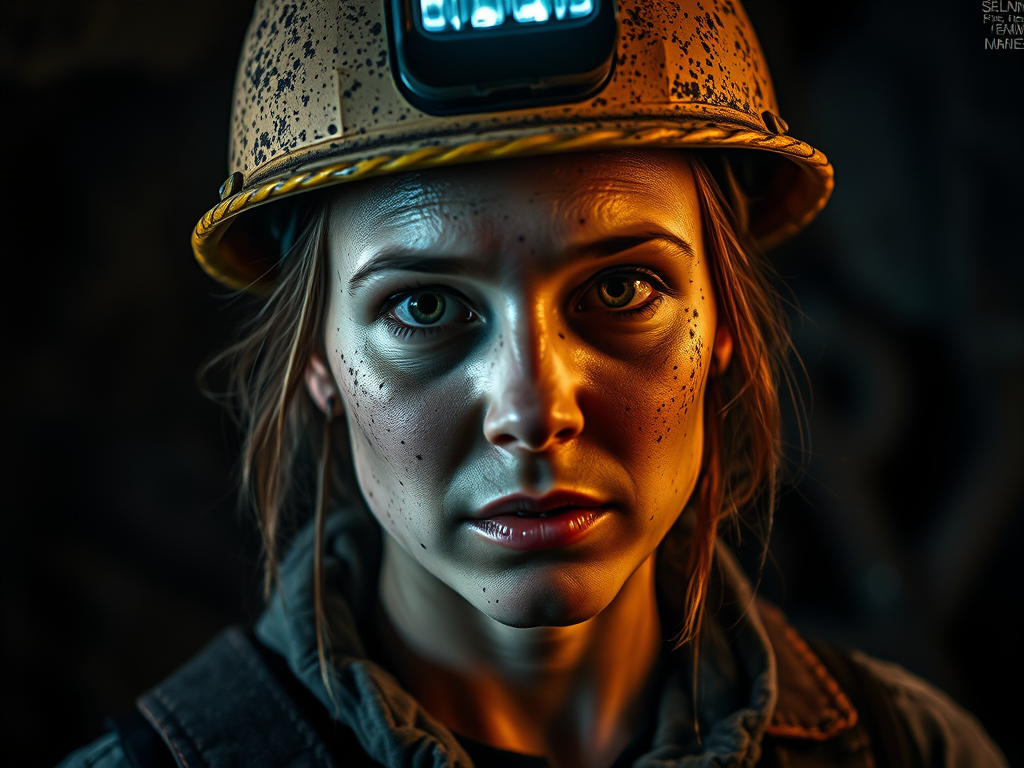
Where I greatly and unfairly underestimated the AI, however, was its ability to generate images for my blog given the right prompt and I have been increasingly turning to it to populate my pages with pictures. It doesn’t always deliver what I want but, in many (simple) cases, it is by far an easier option to generate more and better hits than a Google image search under the restriction of the appropriate creative-commons license.
Nevertheless, I’ve noticed that the people that the AI creates tend to be extremely white, extremely young, and with extremely perfect features, especially the women. For instance, to the right is the example of the first image it produced when I asked for an “ugly person”. It’s often said that beauty is in the eye of the beholder but that is unquestionably one damn fine looking ugly person. (When I put the same request to ChatGPT, it hemmed and hawed a lot at first, saying that it could produce a picture of a face with “unique or unconventional features” albeit one that would still be “respectful” and, in the end, gave me the obvious caricature below via DALL-E.)
Now, there’s no shortage of articles about the “pale, male, and stale” bias also infecting AI, something that one firm confidently predicted would be addressed by 2021, but there seems to be more to it than that. For one thing, pale, male, and stale typically refers to middle-age white men—hi there!—and, unless all these people are from the Middle Ages, none of the pictures being generated for me are getting anywhere near that age bracket. For another, where is the bias coming from? By all accounts, AI now has the entire internet to train on and a quick Google image search for almost anything spits back a lot of non-white, non-young people in the pictures, most with definitely non-perfect features. Or, in other words, more what your average person more or less looks like.
I know that the A in AI stands for “artificial”, but this doesn’t mean that the selection of people it throws back at us has to be as well.
Over the past few years, a number of women in my lab group have welcomed children to the world, the most recent being just a month ago. And, it got me to thinking just how much things have changed through the years regarding how pregnancy is viewed and especially how admin wants to spread the labour pains around to be enjoyed by as many people as possible.
(At the uncharacteristic risk of potentially annoying someone, I’m going to pretty much sidestep any discussion regarding the relationship between womanhood (or gender identity in general) and pregnancy and just talk about pregnant women. Pregnant person or pregnant individual sounds to me like something that admin came up with. And, although commonly used, the phrase “we’re pregnant” is just plain stupid because one partner clearly is not. The couple might be “having a baby” together (with one of them doing a lot more of the actual having), but one of them is very much very not pregnant.
And, since I’m digressing anyway, why is it that we take a shit but give birth? Both activities involve more or less the same geographically localized, generalized actions. And, if you really want to give something away, it’s definitely your excrement rather than your newborn baby. But, nevertheless, giving in the context of shit is never good, either when you’re giving someone some of it or not giving anyone any of it.)
Ahem …
In looking back, it’s abundantly clear that times have certainly changed regarding pregnancy in the 15+ years that I’ve been at the University of Not-Bielefeld. Back when I started, pregnancy was pretty much a non-issue and, despite occasionally holding lab courses with some mildly dangerous chemicals, female students were not required to inform anyone if they were pregnant. As a matter of fact, any obligation in this regard at all lay on us, the teaching staff, to instead recognize if any woman was pregnant.
The situation was, of course, patently ludicrous. There is a both reason and a need behind all those home-pregnancy tests: in those first few weeks, pregnant women are generally unaware of having gained that particular adjective. So what chance does an outsider, especially a male one, possibly have? Guessing wrong in either direction is at least embarrassing, if not dialing up to potentially dangerous in the current social climate.
Take these two, real-life examples …
First, the false positive. After some kind, older gentleman repeatedly offered a good friend of mine his seat on the tram, she finally got him to stop by telling him that she was “not pregnant, just fat.”
And then the flip side, the false negative. A student was recently shocked this past May when the woman in my group who just gave birth told him that she wouldn’t be doing any teaching in the Autumn because she would be on maternity leave. He had absolutely no inkling that she was pregnant, despite her being about halfway through it and thus in the category of obviously pregnant. (Or, in other words, “not fat, just pregnant.”) And we were talking obvious here. I mean, she rocked when she walked and not in the sense of head banging.
Perhaps fortuitously, however, that all was in the days before data privacy was entombed in official bits of bureaucratic overkill like the GDPR and when you could ask a woman for such direct, personal information and only come away embarrassed at worst and not under arrest. However, since then, society has increasingly become aware of just how precarious the life of the unborn is (unlike the lives of the born, which we can happily stuff full of calories, chemicals, and carcinogens) and the University of Not-Bielefeld has followed suit, due in no small measure to the overblown sense of self worth that the corona pandemic gave to its Work and Safety Office.
The paperwork remains mostly the same piece of stupidity inherent to most forms, but everything else around it has been leveled down to match.
But first the form …
It’s an eight-page monster from the provincial government that attempts to gauge what dangers lurk for the pregnant woman and her unborn child at her workplace. Part of the reason why the form is so long is because many of the questions are duplicated, once for when the woman is pregnant and once for when she is nursing. Fine. But, despite the respective, duplicated questions being clearly separated from one another in their own separate sections, the form nevertheless has to be submitted twice. You guessed it, once for when the woman is pregnant and once for when she is nursing.
Much of the form is filled with questions as to whether “unjustified endangerment because of <insert risk here>” exists in the workplace. But, like the successful McDonald’s coffee lawsuit that won on the grounds of the coffee being “unreasonably dangerous”, such questions immediately beg the further question as to what counts as “justified endangerment”. (Especially given that one of the risks listed is simply “accidents”. Can anyone explain to me what unjustified endangerment because of accidents actually means in practice?) Fortunately (?), the effective answer for the University of Not-Bielefeld is nothing whatsoever. For instance, my group does quite a bit of work with electron microscopes. Although the machines are shielded like crazy and emit less radiation than a three-year-old worn-out glow stick, pregnant women can’t go anywhere near them, even despite the form only referring to “extreme electromagnetic radiation”.
Undoubtedly the most bizarre part of the form is that it explicitly asks about any risk posed by “underground mining activities”, which, together with their above ground variant, are lines of work with a notoriously heavy female bias. This is not to say that women, heavy or otherwise, can’t be miners, only that minors shouldn’t be miners. It’s more so that there just aren’t that many of them. So why is just mining being singled out in the form and not some other high-risk profession like, say, space travel? Or firefighting? Surely the inherent risks to pregnant women through mining (or space travel, …) are covered by all the other, more generally applicable risks on the same form.
A new twist since the pandemic is that corona automatically counts as level two / three biohazard. (Well, automatic in the sense that I am obligated to check it off on the form as a risk. Can’t have admin doing any of the work associated with their new rules, now can we?) I could understand this during the pandemic. But now? Is corona even a thing anymore? Even the University of Not-Bielefeld has loosened its corona regulations to the point where corona no longer prohibits you from coming to the university and no longer obligates you to wear a mask either. (And, thank God too. To be honest, I’d much rather live with the guilt of infecting my neighbour with corona than with the pain of having to fill out the University’s new forms for going on sick leave.) But, for pregnant women, it means that they either have to get their own office (which are in extremely short supply) or they have to work from home.
What is unknown to many, however, is just how risky ubiquitous, everyday items can become once they are placed in a lab setting. Take ordinary table salt for instance. Use it in a lab at the university and it’s strictly controlled. Use it across the hallway for lunch and it’s controlled only by your taste buds and/or high blood pressure. (But this comparative lack of caution might be a more of a practical concession considering how difficult it is to eat through a respiratory mask.) The same is true for caffeine, that necessary catalyst for almost any scientific endeavour. It officially comes with the warning that it is “harmful if swallowed” together with the subsequent recommendation to “immediately make victim drink water (two glasses at most)” as well as to “consult a physician”. How fortunate then that caffeine is generally off-limits for pregnant woman anyway.
And finally there’s folic acid (AKA vitamin M but really vitamin B9—say what?), which for some time now has been a recommended supplement for all pregnant women to minimize the risk of spina bifida and other spinal defects in their babies. Although not classified officially as hazardous—it is a vitamin after all—there are nevertheless safety precautions to be observed when using folic acid in the lab, which again include drinking water after swallowing it. This, of course, is in complete contrast to the situation at home where you normally drink the water to help you swallow it.
The form then painfully meanders its way through the admin maze before finally landing on the desk of a Betriebsarzt (company / government doctor), which are to real doctors what all those helpline specialists in Asia are to the technician actually sitting in front of your busted piece of technology. (I’m not saying that either Betriebsärtze or the helpline specialists don’t know their shit, just that their shit goes a lot further when the patient is actually right in front of them.) And, based on the form and a vague job description, the Betriebsarzt then makes the official call as to what the pregnant woman, someone whom they have never seen nor talked to, is allowed to do at work.
… and which, for all the women who have gotten pregnant in my group (n = 3), has always amounted to little more than sitting in their new, private offices and trying to fill their workdays doing stuff on the computer. (At this point, we’ll just conveniently ignore the inconvenient fact that computers and mobile phones, like all other sources of electromagnetic radiation, can increase the risk of miscarriage and abortion during pregnancy. Because they are not listed on the form, they can’t be a risk, now can they? Especially because they’re not commonly used while mining underground.) Fortunately, however, this restriction does provide them with ample time to figure out how to get a replacement to do the required bits of their jobs that they are no longer allowed to do. That’s right. Although the University of Not-Bielefeld does provide money to hire the replacements, there is no clear mechanism to get at it. Or at least no admin type in my entire faculty, including the equal-opportunity officer, knows how it’s done.
In the end, you have to wonder how many of these precautions are really that necessary. Back when I was a fetus, my mother continued to smoke and drink alcohol and also partied like it was already 1969 on New Year’s Eve to try and get me to come out a little bit sooner. And, you know what? I turned out ok. Got my share of health issues, sure, but they seem paltry compared to what a lot of young people today are suffering from despite their protected pregnancies. Back when I was growing up, I was the only kid I knew who had asthma, almost to the point where my teachers had to look up the word themselves to spell it for me. Although better diagnosing (as well as over-diagnosing) are playing their part, all the stats indicate that the incidence of asthma is higher than it’s ever been. And, although I have absolutely no data to back me up whatsoever here, the same seems to be true for ADHD or neurodermitis or a host of other conditions that were virtually unknown back when I was young. In fact, there’s a growing suspicion that the increasing incidence of asthma and many other autoimmune diseases is caused in part by us increasingly overprotecting our children by oversterilizing their environments (the hygiene hypothesis), causing their immune systems to desperately search around for something else to prime themselves on.
In so doing, I’m not saying that pregnant women should not be looking after both their own health and that of their unborn baby. But the degree to which western medicine and western society want to treat pregnancy as a disease seems like a unnecessary luxury that all other mammal species and indeed most other humans have never really needed.
Right. An e-mail came around from my Faculty here at the University of Not-Bielefeld this past week that I still have no idea what to really make of.
Apparently the question was raised at a recent faculty committee meeting as to what rights the teaching staff have to deal with “acute disruptions” during their classes. And, after the Faculty sough the feedback of the President’s Office, the answer came back that we have the power of Hausrecht.
Now Hausrecht is a word that was actually unknown to me before now (and could’ve stayed that way) and doesn’t have a succinct, English translation. The literal translation is simply “householder’s rights”, but practically it has more to do with deciding who can and cannot enter your property. So, sort of like the American idea of “stand your ground”, just without the guns.
Really?
They had to go all the way up to the President’s Office to officially clarify something that I took for granted, namely that I have the right to throw any annoying little SOBs out of my classes? (Although how I actually enforce that right without any American-style guns remains an open question. Cue the President’s Office again …)
What was really bizarre, however, was the single example of an acute disruption that was provided in the e-mail upon which you could flex your Hausrecht. It wasn’t something like a loud demonstration nor disobeying important safety regulations. Nor was it being generally disruptive by talking too loud, persistent heckling, or dancing to a TikTok video on your neighbour’s desk. Nooo. Instead, it was that ever present and pervasive threat of advertising.
Umm. What?
For some reason, I never realized that acute advertising is that much of a going concern in a university setting these days. Maybe it’s because I’ve been teaching for a long time now—and at four universities in four different countries—and can’t ever recall a single instance of explicit advertising, either by me, my students, or any of those door-to-door vacuum-cleaner salesmen that tend to loiter on university campuses disrupting, let alone even being present, in my classes.
In fact, the only advertising that I know of comes from the universities themselves. For instance, way back in the late 1990s, my undergrad university back in Canada followed the going trend in North America and signed something like a 10-year contract with Pepsi that gave Pepsi the exclusive rights to sell their soft drinks on campus. Soft-drink Hausrecht if you will. And then there is all the official merchandise—bags, shirts, hoodies, even art supplies—all emblazoned with the logo of the home university. German universities have been late to this latter game, but even the University of Not-Bielefeld has joined in since I’ve been here.
Of course, all of this begs the question as to exactly what counts as advertising, but the e-mail unhelpfully provides no examples for its example. Can I throw someone out who dares to promote a different university (i.e., the University of Not Not-Bielefeld) on their sweatshirt? Or if they bring some contraband Coca-Cola to class (and don’t offer me any)?
Now, I’m sure that I could ask for clarification on this last point. The President’s Office seems to have nothing else better to do than answer burning questions like these. But, writing about it instead seems more productive and a lot more fun …
As I’ve mentioned before, my wife is Croatian and still lives and works in Zagreb, meaning that I spend a good portion of the year down there to be together with her. (And before all the usual civil-servant jokes start surfacing, I want to point out two things. First, as nice as Zagreb is, it isn’t the Croatian coast and there’s far fewer ways to do nothing but bask in the sun in Zagreb. Second, that means that I do work while I’m down there and not just on my tan (probably impossible for a Canadian otherwise living in northern Germany anyway) or doing fjaka, a Dalmatian word that I recently learned and that means a state of blissful laziness. (The closest English equivalent is probably SFA, both from its meaning and (minus the sweet) its pronunciation.) Thanks to the pandemic, the University of Not-Bielefeld luckily now officially recognizes working from home as a viable, alternative work environment. They just forgot to specify whose home is all …)
Now if you want two fairly diametrically opposing viewpoints to life in Europe, it’s hard to find more opposition than between Germany and Croatia. (Or perhaps between Germany and most Mediterranean nations generally.) As weird as the combination sounds, Germany is all about efficiency and admin (which go together about as well as, say, matter and doesn’t-matter), whereas Croatia is all about cafes and coffee houses. (And, as much as that might sound like a putdown of Croatia, it isn’t. My wife actually laughed appreciatively at that comment. Come to Croatia sometime and you’ll quickly realize how important coffee is to their day-to-day culture and their generally more relaxed way of life. And also why Starbucks & Co., and especially what Starbucks has become, are nowhere to be found in the country.)
Curiously, however, as much as the Autobahn and driving are synonymous with Germany, they’re nothing in comparison to the time, money, and effort Croatia puts into its road network. Seriously. With the possible exception of Ministry for the Elimination of Vowels (the successor to the highly successful one for eliminating Qs, Ws, Xs, and Ys), the highway department and its municipal equivalents have got to be the best funded government agencies in the country.
Croatian roads, you see, are constantly being worked on. (Sort of like the German Autobahn but with actual workers actually working on it.) But not for sensible things like filling potholes or improving traffic flow but rather much more so for the exact opposite. (Ok, maybe not for making potholes but I wouldn’t put that past them either.) In short, it seems like the road planners there are always doing their utmost best to stifle any feeling of driving enjoyment, comfort, or complacency amongst its drivers.
(Or, put a different way, just trying to somehow find a way to brake that natural sense of “exuberance” many Balkans have behind the wheel. I mean, I live in a country without speed limits and more than enough people willing to enjoy that freedom and the drivers in Zagreb still scare the ever-living shit out of me sometimes. Imagine a city where the majority of the traffic is composed of taxi drivers, and impatient ones at that, and you‘ll know what I mean. (Must all be in a rush getting to their cafes for their daily dose of fjaka.) Add then add in a generous helping of that post-pandemic pandemic of food-delivery people suicidally zipping in, out, and around all the traffic on their e-bikes and mopeds to round things out.)
It’s either that or Croatia must have an enormous surplus of road paint, posts, and manholes from their first forays into a free-market economy (those bargains on eBay weren’t, in hindsight, as good as they seemed at the time) that they are now desperate to get rid of to meet the economic requirements for continuing eurozone membership. (Might have bought them all off the Brits now that I think of it. They also use a ton of the things although there’s no reason for them to get rid of them anymore.)
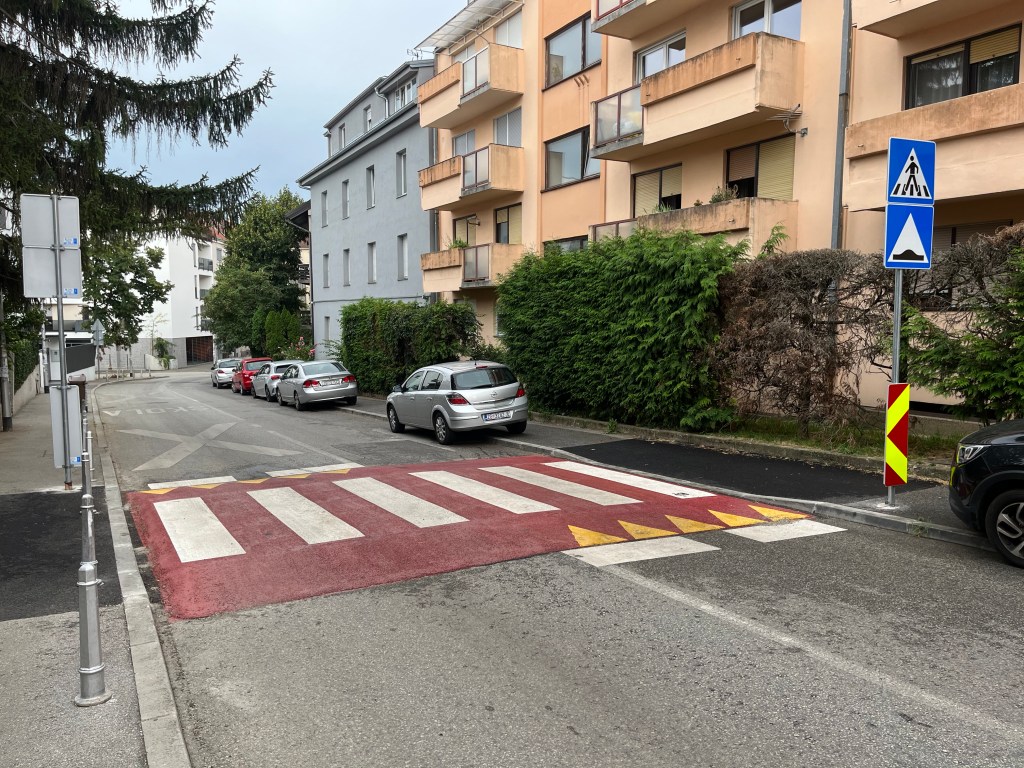
I’ve never been in a place with so many zebra crossings, sleeping policemen (for the North Americans, think speed bumps on steroids), or the unnatural combination of the two with a splash of red for extra measure. (Forget penguins with sunburns, it’s Croatian sleeping policezebra crossings that are black and white and red all over.) In fact, they are so ubiquitous that they simply fade into the background, sort of like those screams from that pedestrian you winged two blocks back at yet another zebra crossing. They even put zebra crossings on blind corners as well as on relatively major thoroughfares where the traffic zips along at a legal maximum / illegal minimum of 80 kmh. No flashing lights or anything obvious to alert you to either one. Just a little triangular sign and some road paint. It’s an open question as to whether it’s the street planners there who have no sense of reality or the pedestrians who are actually tempted to try those zebras out wanting nothing more to do with it.
In fact, the only zebra crossing I’ve ever seen in Zagreb with overhead flashing lights was only recently installed. It was right next to a Lidl, who must’ve complained that too many of their customers were getting killed off …
And even the private citizens get into the act. I mean who really needs a speed bump at the entrance to the underground parking of your own building? Surely the closed garage door should be enough of a signal to tell you to maybe slow down a little?
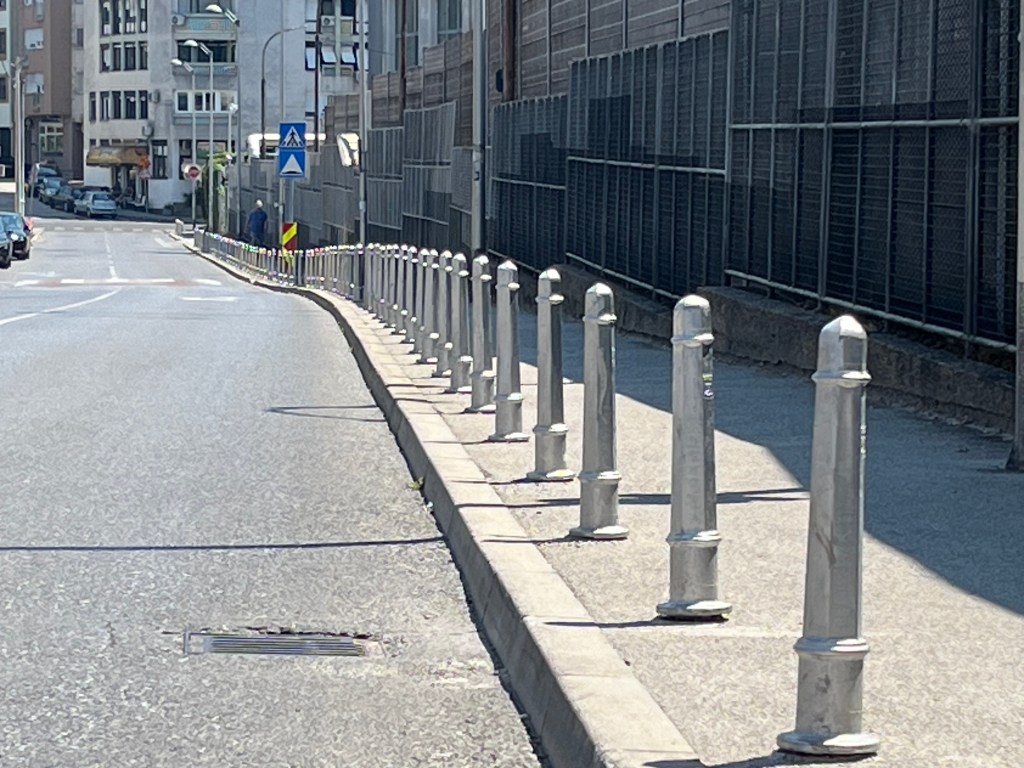
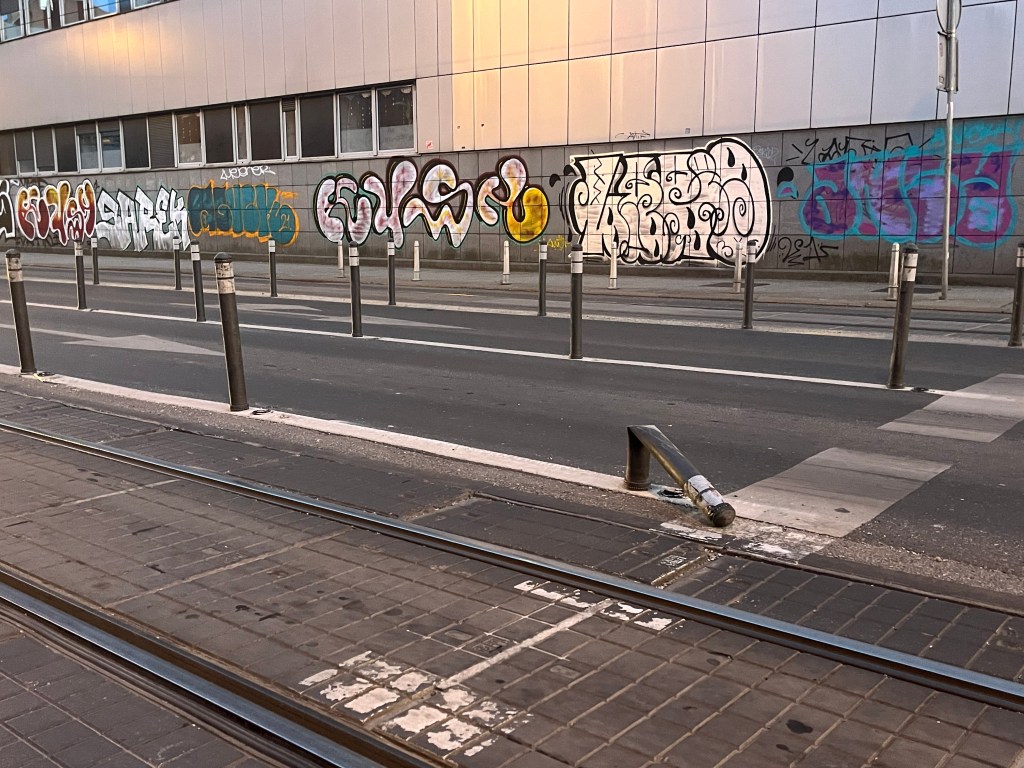
Adding to the obstacle course are plastic posts in the middle of the road in some places to separate the car lanes (road paint sometimes just isn’t enough it seems) and endless numbers of metal posts on the sidewalks in most places to prevent people from parking there. But, metal or especially plastic, the life expectancies of the posts are inversely proportional to their ubiquity. In other words, more background noise, especially when you back into one of the metal ones. Unfortunately, however, the posts are like the mythical hydra in the sense that the fallen comrades are not only quickly replaced but usually with reinforcements to boot. (My suggestion: use the metal posts in place of the plastic ones to separate the driving lanes. I’m fairly certain you won’t have to replace them nearly as often …)
And if all that isn’t enough to slow the traffic down (and it isn’t; traffic ordinances—be they parking spots, stop signs, or no passing zones—tend to be viewed as suggestions at best), then they simply change the road layout every couple of months, largely through the magic of road paint. The best, worst example of this occurred a few years ago close to my wife’s apartment, which lays along a semi-important throughroad that gets its fair share of traffic. Literally overnight the road engineers came out with their paint brushes and changed this two-lane, two-way street into a one-way street with on-street parking. So while it did mean no more parking on the one sidewalk and the chance to use even more metal no-parking posts, it did force the now forbidden oncoming traffic (including the bus traffic) down a parallel, formerly purely residential road that was similarly altered to become a one-way street with on-street parking and a lot of new metal posts. Following two solid weeks of even more solid outcry from the residents along both streets (who hadn’t been informed about a thing beforehand), the midnight elves came out again to put even newer road paint on the now dry old, new road paint so as to make everything just like it had been before as well as to find some other forests to plant their metal posts in.
Admittedly this is an extreme example, but many road layouts are often unpleasantly new to me when I’m away for more than a couple of months.
And finally there are the manholes …
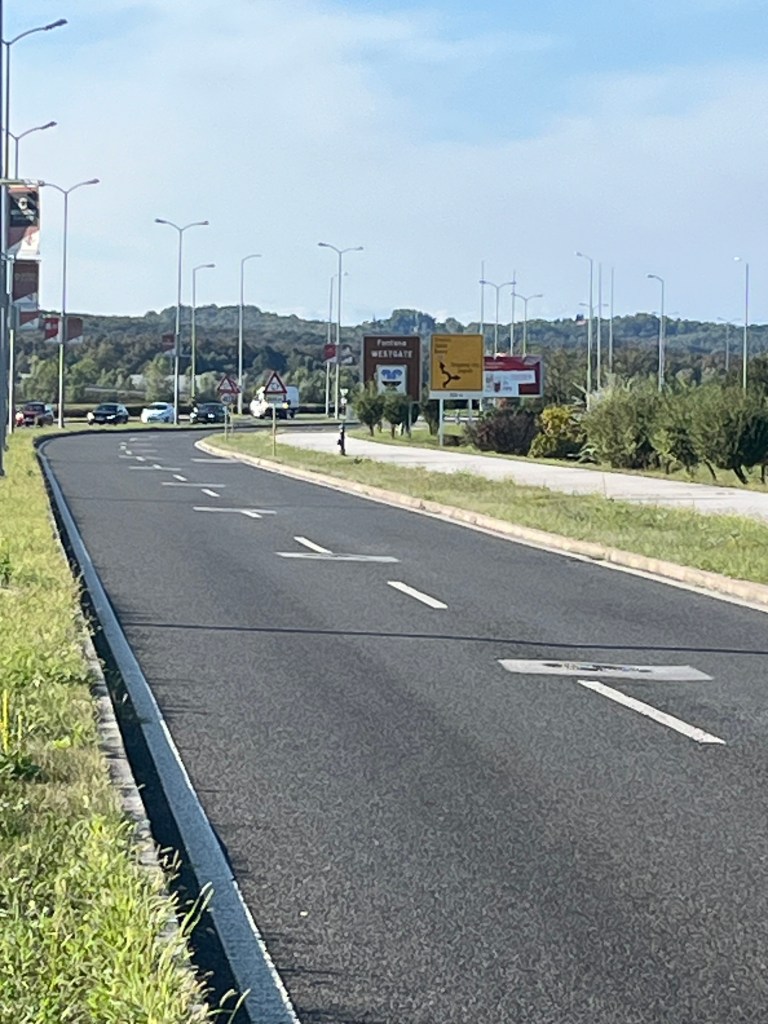
Surprisingly, there don’t seem to be any hard-and-fast regulations in Europe (or even Germany) as to how far apart manholes should be; however, there seems to be some general agreement that the maximum distance should be about 100 metres for straight sewer lines. Not so in Croatia. Croatian sewer workers must be incredibly scared of the dark (or Croatian sewer rats must be really terrifying) because it feels like there is a manhole every ten meters or so ready to balance out your car’s suspension from all those sleeping policezebra crossings.
And, if you look at the picture, it’s more than a feeling. Every one of those light patches disappearing into the distance contains a manhole. (For reference those road signs are about 80 m away, making that 10-metre feeling pretty darn real.) Admittedly, there is a big shopping centre off camera to the right but absolutely nothing but horizon to the left. How much access to a barely used sewage system do you really need? Or are Croatian sewers just not straight?
In any case, I’m convinced that it’s only a matter of time before Croatian road engineers figure out how to put manholes on bridges …
Important news coming out of the business world this week, with the stunning announcement that the Campbell’s Soup Company is changing its name after 155 years to simply the Campbell’s Company. It’s all still subject to stakeholder approval, but you can feel the tremors on Wall Street from here.
But, let’s let the CEO of the Campbell’s (Soup) Company describe the precise reasoning behind this change:
This subtle yet important change retains the company’s iconic name recognition, reputation and equity built over 155 years while better reflecting the full breadth of the company’s portfolio.
Mark Clouse, President and CEO of the Campbell’s (Soup) Company
Couldn’t have said nothing better myself …
Still, let’s examine that statement a little bit more closely, especially the last part where the name change is “better reflecting (of) the full breadth of the company’s portfolio.” If I understand this all correctly (and bear in mind that I’m a biologist and not a businessman), you go from Campbell’s Soup Company, which directly indicates soup and therefore more generally food to simply Campbell’s Company, which directly indicates what exactly?
On a more important note, who really cares and why is this even newsworthy?
For starters, hands up anyone who knew that the company making Campbell’s soup was officially known as the Campbell’s Soup Company and not just Campbell’s. Even Wikipedia says that they do business simply as Campbell’s.
Which leads into the main point: it’s just a name. You can call your company anything you like. It doesn’t have to mean anything, especially after you have brand recognition like Campbell’s does. I mean, what the hell does Unilever or Nestlé actually mean? No idea either but over 90% of my grocery money goes to them anyway. Even Campbell’s Nasdaq stock symbol of CPB makes you think more of cannabis than it does of Campbell’s (with or without the soup). And as Coca-Cola literally found out in the mid 1980s, you don’t change a winning formula.
Granted, Campbell’s is not breaking new ground here. Even Apple changed its official name from the Apple Computer Company to just Apple Inc. in 2007 with the introduction of the iPhone to reflect their increasing foray into the wider consumer-electronics market. And I betcha very few people knew that either and still think that the company’s full name is simply Apple.
But at least Apple did it in a reasonably timely manner (six years after the debut of the iPod in 2001), whereas it took Campbell’s executives one heck of a long time to realize that they weren’t hawking just soup anymore. Campbell’s been producing baked goods under Pepperidge Farms since 1961 (something that, admittedly, also passed Andy Warhol by), salsa under Pace Foods since 1995, and those all-important, snacky foods (apparently the real driver of the name change) under Late July Snacks under Snyder’s-Lance since 2018. And, again, hands up anyone who knew this. (You can put your hand down please, Mark.)
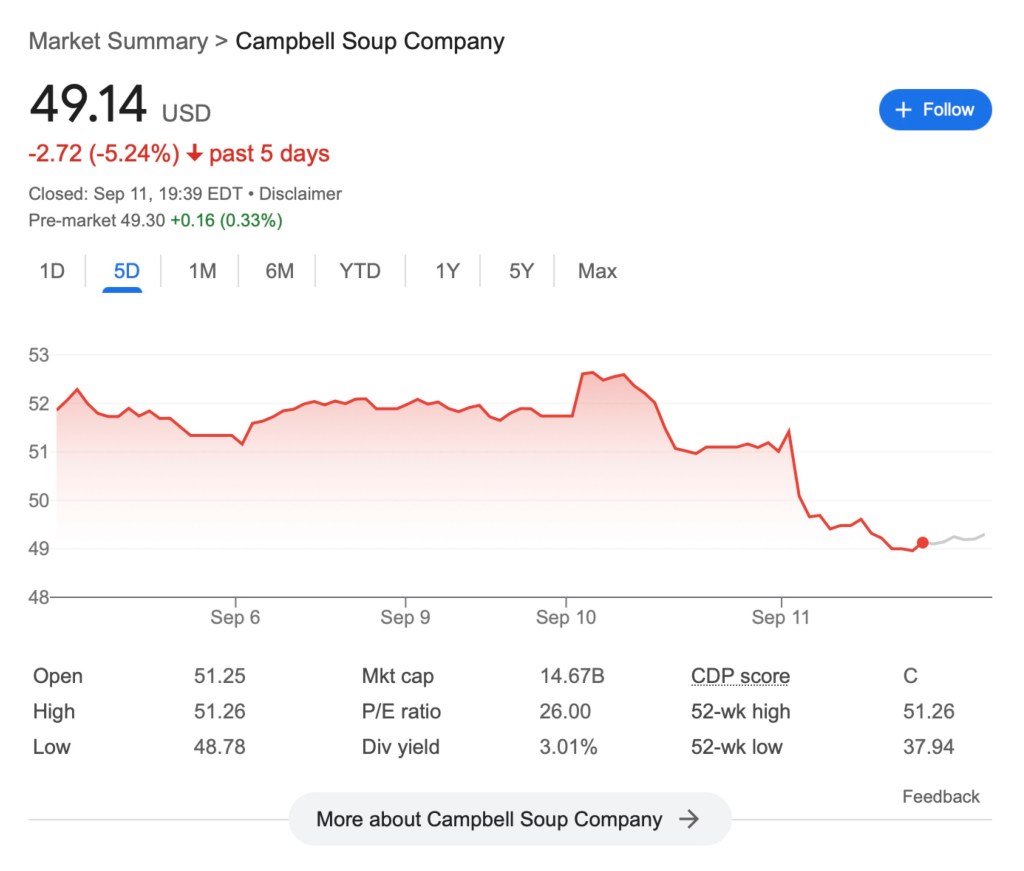
Ultimately, however, it’s not common sense but the free market that decides in a pseudo-capitalist economy like ours. And the first reviews are not great, with CPB stock prices falling by a little over 5% in the two days since the announcement.
But, this is the stock market and maybe the weather is equally to blame here as well.
Right. Time to get a little more controversial than usual as well as to return this BCD subtext to its origins.
I originally launched this subtext—bonehead comment of the day—to fill the then current lull in admin stupidity with quotes from people who should have known better. Although there have been a few of those, most of the BCDs have been relatively quick rants on my part about some topical nonsense with the C in the title punningly swapped out for something vaguely appropriate.
But, we got ourselves a quote again …
You’re an example for everyone, for all the countries that maybe, and this might sound funny, these families prefer to have a cat or a little dog instead of a child.
The context here is that the Pope made this remark to political leaders during his current visit to Indonesia, which repeats his views implying that people should be having more kids. Seems like Pope Francis has been reading too much about Dope Vance’s ideas about childless cat ladies again …
As always, there are more than a number of things wrong with this comment.
For starters, having children is not an out-and-out commandment that I can find in the Bible. Not killing certainly is and not coveting your neighbour’s wife is too. (So no kids with her.) That being said, “go forth and multiply” certainly is in the Bible. It’s in Genesis 1:28 (among many other places, with most of the multiplying being in the appropriately named Book of Genesis). However, it’s not a general obligation and also not the complete passage. The full, google-translated quote from the original scrolls reveals that God said it to Adam and Eve:
And God blessed them, and God said unto them, be fruitful, and multiply, and replenish the earth, and subdue it: and have dominion over the fish of the sea, and over the fowl of the air, and over every living thing that moveth upon the earth.
The missing context shows that all the fruitfulness was meant to replenish the Earth, the same as when God said it to Noah and his sons following the Great Flood (Genesis 8:17 as well as Genesis 9:1 in case Noah forgot in the meantime). And some would argue that the Earth is more than plenished enough now. You could also argue that people choosing to have dogs instead of daughters are actually fulfilling the separately and also highly cited, dominion instruction of the very same sentence. Other times, God says to be fruitful mostly to specific people, but never really as a general directive for all humanity that I can find.
Also, isn’t Pope Francis being a little hypocritical here? I mean, how many children does he have? Or all the bishops, priests, and nuns underneath him in the Catholic Church? Yes, you could argue that they are all serving God in a different way, but who says that the same can’t be true for those people choosing to not have children? Ok, many aren’t and are choosing to fruitfully multiply their assets instead. But then more than a few officials in the Catholic Church have served God over the ages in some rather questionable, if not downright un-Biblical, ways too. Many priests also refer to their congregations as “their flock”, something that also sounds more like pets than people.
Finally, what business is all this of the Pope and the Catholic Church anyway? If some couples only want pets, let them have pets. That’s free will and it’s not the Pope’s job to judge them. (Someone else does that later.) And if there’s no free will and only the Divine Plan, then one interpretation is it really wasn’t their decision in the first place.
Or, as God says,
For I will have respect unto you, and make you fruitful, and multiply you, and establish my covenant with you.
Ah, the many, many existential problems of the airline industry post-pandemic. Over the weekend, news came in that Swiss International Air Lines (aka SWISS) is being forced to retrofit many of their aircraft as part of the process of modernizing their fleet. In this day and age, you’d hope that all this effort would be in the name of greater economy and you’d be absolutely right.
Unfortunately, however, we’re talking yet again about the bottom-line kind of economy and not the environmental kind …
The driving problem, you see, is that the first-class cabins on most of SWISS’s planes are sooooo turn of the millennium and therefore not up to the discerning standards of today’s first-class passengers with their first-world problems. Not enough privacy it would appear. It’s bad enough seeing your fellow passengers at the gate (you know, that annoying, crowded part of the airport between the first-class lounge and the plane?), but does it have to be on the plane too?
Therefore, as part of a “much needed revamp”, the new SWISS Senses design (actual tagline: “Experience SWISS with all your senses”) is offering its first-class passengers new suites (yes, suites) in two configurations depending on whether they want a window seat or not. Those opting for the view will have to make do with only 2.4 m2, whereas those sharing the one in the centre of the plane could run laps around the queen-sized bed (3.1 m2) that would fit comfortably inside their 3.5-m2 enclave.
There’s a slight catch, however …
In combination with the ever lighter lawn chairs being provided in economy these days, these new suites are apparently going to be so heavy that they’ll be throwing the balance of the planes off and making their noses pitch downward. And this is especially problematic in SWISS’s Airbus 330s, an airplane model that tends to be a little nose-heavy from the get-go. (But not in their Boeing 777s. First good news for Boeing in a long time …) The solution? Better seats in economy? C’mon, get serious. Nah, just a second nifty, gas-guzzling, rain forest-killing retrofit in the A330s in the form of some lead plates in the back of the planes to prevent those embarrassing face plants while taxiing.
Sorry, but I just don’t get it …
… starting with all this being for the benefit of at most four passengers per flight.
How much privacy does anyone need on a commercial flight anyway? Even those flying first class? Now, I’ve flown long-haul business class exactly once in my life and I found it to be incredibly roomy and pretty private despite being shielded by only (gasp) half-high walls. (Of course, this is coming from someone used to too many inflight hours of smelling all my seat neighbours and what they had for dinner the night before. Maybe not the kind of experience SWISS Senses is after, but hey, they did say all my senses.) If you need more privacy than that, then maybe consider buying your own plane?
Also, don’t rich people have friends or partners? Economy might be a little overly familiar most of the time, but business and first class seem a little overly sterile sometimes. If the half-high walls of business class aren’t more that enough to isolate you from your partner, the outer first-class suites effectively put you in an isolation tank. For all that space, there is still only one seat in those suites for exactly one bum. And what do you do if some other rich person booked just a single in that shared centre suite? Sacrifice your privacy? Or, in the case that you do have a partner, book just them into business class instead?
More importantly, just how much do these bloody suites weigh? (Short answer: they don’t know exactly yet!)
To save lead, SWISS has actually cut back the number of first-class suites from the eight the A330s had before to just four. (For reference, the old, inferior suites were a mere 205 kg each. Now there’s half as many and they still have to compensate for the added weight?) And, on top of that, they also did away with plans for sliding doors for those comparative cost-cutters in the business-class seats (yes, seats, not suites).
One thing that they did not do, however, was to move the suites closer to the middle of the plane, which was my wife’s immediate suggestion. It’s actually a fair point. Where exactly is it written down that the seats have to get exponentially more expensive the further away from the tail you are? And once the first-class passengers are encased in their little privacy suites, they won’t know where they are on the plane anyway. (Or, in the case of that centre suite, probably that they even are on a plane.)
Fortunately, SWISS also decided against cramming even more deadbeat deadweight (aka passengers) into economy. (Not that it’s physically not possible. Just some other little Swiss thing in the form of the Geneva Convention probably getting in the way.) Now, for some unknown reason, SWISS doesn’t seem to provide any readily available information regarding the legroom in economy other than to describe it as “generous”. However, this article puts it at about 81 cm, which combined with a seat width of 50 cm (which SWISS does provide) works out to your own personal economy suite of about 0.4 m2. Or, put another way, about 5.2 economy suites to compensate for the average of each first-class one. Or, put another, another way, 159 economy-class passengers aren’t enough to already balance out the weight of the new suites for just four people?
And, as I wrote not even a few short weeks ago, if the airlines are routinely assigning us our seats according to weight and balance considerations anyway, where’s the problem? Put all the families with small kids closer to the front (sort of like an excruciating, inflight kindergarten) and all the, ahem, larger individuals and heavy-duty, duty-free shoppers at the back and you’re good to go.
Finally, there’s the maths: fewer first-class passengers, heavier planes, the retrofitting costs, and it all still makes economic sense somehow …
A little something new that I want to try out here. The topic isn’t directly connected with admin but has many of the hallmarks of it insofar as it all might not be that necessary and just that little bit of thinking might have revealed the otherwise obvious problem.
These new things are signs. Not signs from God, the zodiac, or even of love, but simple signs that we humans have put up to ostensibly make our lives easier but, like admin, do so in an unnecessarily complex manner and thus often tend to do just the opposite. (So, more so signs of disaster.) For some reason, I’m fascinated by signs, especially how badly implemented something otherwise so simple often is. So every now and again I’m just going to post a sign that I saw where I simply asked myself what the hell the person responsible for it was thinking. As such, I’m generally going to avoid signs with typos, dodgy translations, or where any humour is mostly context-dependent to focus on the truly unnecessary ones. As well as those that invoke unnecessary self-justifications. The latter could mean that a lot of these signs might come from the advertising industry (an example of which I’ve pointed out before in my BCD subtext) who, like admin and government, often don’t seem to think too much about what they’re doing because they must assume that we as their customers don’t either.
(As an aside, the UK has been by far the absolute best source for these kinds of signs. This is both fortunate and ironic. Fortunate because the signs will be in English and so accessible to the greatest number of readers. Ironic because one of the key drivers of Brexit (beyond all the lies) was the Brits wanting to get away from the stifling EU bureaucracy. But, as we shall see, the Brits should have been largely immune to it given the amount of their own unnecessary nonsense that they already have to deal with …)
So without further ado …
… the photo on the right is “courtesy” of Belfast International Airport and immediately begs two important questions. First, given that we’re not taking about paper towels here, who doesn’t already know this? (Or, said otherwise, is this sign at all necessary?) Second, how can anyone possibly dry their hands when their fingers are sticking in their ears? As such, instead of the warning, instructions might have been more helpful. And, wouldn’t another warning about hot air blowing on your head maybe have been more appropriate? Or simply about the air possibly being reasonably hot? (And that’s “reasonably” in both a normal, day-to-day sense as well as in a idiotic, legal sense a la all the McDonald’s coffee lawsuits.) And blind people? Completely screwed. Absolutely no chance for them to shield their more acute hearing before they dry their hands.
Ok, perhaps more than two questions, and some definitely more important than others, but at least someone is doing the hard thinking around here.
I recently signed up for a ride-hailing app for my smart phone. (Not really important which one because they’re all pretty much the same.) The reason it took so long is because these things are pretty much unknown in Germany. When Uber first came out with ride-hailing in Germany in 2014, the taxi lobby fought against it. Hard. By March of the following year, Uber was essentially banned by the courts because they couldn’t (read: didn’t want to) guarantee that all its drivers had the necessary chauffeur’s license and the app was similarly outlawed in 2019 because it bypassed the regulated taxi companies. Even though most (all?) Uber rides have long been handled by real, regulated cabs anyway, Uber and the like have never really recovered from these decisions to have any sort of presence in Germany. Apps do exist to hail cabs, and some of them apparently even work out in the wastelands of Not-Bielefeld, but in the end you have to pay official taxi rates with no possibility of searching for a better deal.
Anyway …
Sometimes I’m not in Germany so I thought that I’d finally take the plunge for when I needed a ride in another country. As a welcome bonus for signing up, I got an e-mail today offering me a “10% discount on your next 1 scheduled rides!”. Ok, it’s bad enough that a singular somehow became a plural, but look closer and you can see that the offer expired on “1995-08-17T12:16:38.722+00:00”. Or, to give it a little more context, precisely 29 years, 3 days, 22 hours, 23 minutes, and 29.278 seconds before I received the e-mail and to a long lost time when e-mail and even the internet were really only starting to become a thing.
Lotta lazy IT going on here …
We’ll charitably ignore the seriously flubbed expiry date (which could just be a glitch), but not even bothering to convert the time to something that a human can read and understand? And with the appropriate degree of precision? When was the last time anyone who wasn’t shooting an assassination attempt (with a camera …) ever bothered to count down to a thousandth of a second? Especially for an offer that expired nearly 30 years previously? (For the nerds out there, that’s a difference of about 10 billion orders of magnitude in precision!)