Right. An e-mail came around from my Faculty here at the University of Not-Bielefeld this past week that I still have no idea what to really make of.
Apparently the question was raised at a recent faculty committee meeting as to what rights the teaching staff have to deal with “acute disruptions” during their classes. And, after the Faculty sough the feedback of the President’s Office, the answer came back that we have the power of Hausrecht.
Now Hausrecht is a word that was actually unknown to me before now (and could’ve stayed that way) and doesn’t have a succinct, English translation. The literal translation is simply “householder’s rights”, but practically it has more to do with deciding who can and cannot enter your property. So, sort of like the American idea of “stand your ground”, just without the guns.
Really?
They had to go all the way up to the President’s Office to officially clarify something that I took for granted, namely that I have the right to throw any annoying little SOBs out of my classes? (Although how I actually enforce that right without any American-style guns remains an open question. Cue the President’s Office again …)
What was really bizarre, however, was the single example of an acute disruption that was provided in the e-mail upon which you could flex your Hausrecht. It wasn’t something like a loud demonstration nor disobeying important safety regulations. Nor was it being generally disruptive by talking too loud, persistent heckling, or dancing to a TikTok video on your neighbour’s desk. Nooo. Instead, it was that ever present and pervasive threat of advertising.
Umm. What?
For some reason, I never realized that acute advertising is that much of a going concern in a university setting these days. Maybe it’s because I’ve been teaching for a long time now—and at four universities in four different countries—and can’t ever recall a single instance of explicit advertising, either by me, my students, or any of those door-to-door vacuum-cleaner salesmen that tend to loiter on university campuses disrupting, let alone even being present, in my classes.
In fact, the only advertising that I know of comes from the universities themselves. For instance, way back in the late 1990s, my undergrad university back in Canada followed the going trend in North America and signed something like a 10-year contract with Pepsi that gave Pepsi the exclusive rights to sell their soft drinks on campus. Soft-drink Hausrecht if you will. And then there is all the official merchandise—bags, shirts, hoodies, even art supplies—all emblazoned with the logo of the home university. German universities have been late to this latter game, but even the University of Not-Bielefeld has joined in since I’ve been here.
Of course, all of this begs the question as to exactly what counts as advertising, but the e-mail unhelpfully provides no examples for its example. Can I throw someone out who dares to promote a different university (i.e., the University of Not Not-Bielefeld) on their sweatshirt? Or if they bring some contraband Coca-Cola to class (and don’t offer me any)?
Now, I’m sure that I could ask for clarification on this last point. The President’s Office seems to have nothing else better to do than answer burning questions like these. But, writing about it instead seems more productive and a lot more fun …
As I’ve mentioned before, my wife is Croatian and still lives and works in Zagreb, meaning that I spend a good portion of the year down there to be together with her. (And before all the usual civil-servant jokes start surfacing, I want to point out two things. First, as nice as Zagreb is, it isn’t the Croatian coast and there’s far fewer ways to do nothing but bask in the sun in Zagreb. Second, that means that I do work while I’m down there and not just on my tan (probably impossible for a Canadian otherwise living in northern Germany anyway) or doing fjaka, a Dalmatian word that I recently learned and that means a state of blissful laziness. (The closest English equivalent is probably SFA, both from its meaning and (minus the sweet) its pronunciation.) Thanks to the pandemic, the University of Not-Bielefeld luckily now officially recognizes working from home as a viable, alternative work environment. They just forgot to specify whose home is all …)
Now if you want two fairly diametrically opposing viewpoints to life in Europe, it’s hard to find more opposition than between Germany and Croatia. (Or perhaps between Germany and most Mediterranean nations generally.) As weird as the combination sounds, Germany is all about efficiency and admin (which go together about as well as, say, matter and doesn’t-matter), whereas Croatia is all about cafes and coffee houses. (And, as much as that might sound like a putdown of Croatia, it isn’t. My wife actually laughed appreciatively at that comment. Come to Croatia sometime and you’ll quickly realize how important coffee is to their day-to-day culture and their generally more relaxed way of life. And also why Starbucks & Co., and especially what Starbucks has become, are nowhere to be found in the country.)
Curiously, however, as much as the Autobahn and driving are synonymous with Germany, they’re nothing in comparison to the time, money, and effort Croatia puts into its road network. Seriously. With the possible exception of Ministry for the Elimination of Vowels (the successor to the highly successful one for eliminating Qs, Ws, Xs, and Ys), the highway department and its municipal equivalents have got to be the best funded government agencies in the country.
Croatian roads, you see, are constantly being worked on. (Sort of like the German Autobahn but with actual workers actually working on it.) But not for sensible things like filling potholes or improving traffic flow but rather much more so for the exact opposite. (Ok, maybe not for making potholes but I wouldn’t put that past them either.) In short, it seems like the road planners there are always doing their utmost best to stifle any feeling of driving enjoyment, comfort, or complacency amongst its drivers.
(Or, put a different way, just trying to somehow find a way to brake that natural sense of “exuberance” many Balkans have behind the wheel. I mean, I live in a country without speed limits and more than enough people willing to enjoy that freedom and the drivers in Zagreb still scare the ever-living shit out of me sometimes. Imagine a city where the majority of the traffic is composed of taxi drivers, and impatient ones at that, and you‘ll know what I mean. (Must all be in a rush getting to their cafes for their daily dose of fjaka.) Add then add in a generous helping of that post-pandemic pandemic of food-delivery people suicidally zipping in, out, and around all the traffic on their e-bikes and mopeds to round things out.)
It’s either that or Croatia must have an enormous surplus of road paint, posts, and manholes from their first forays into a free-market economy (those bargains on eBay weren’t, in hindsight, as good as they seemed at the time) that they are now desperate to get rid of to meet the economic requirements for continuing eurozone membership. (Might have bought them all off the Brits now that I think of it. They also use a ton of the things although there’s no reason for them to get rid of them anymore.)
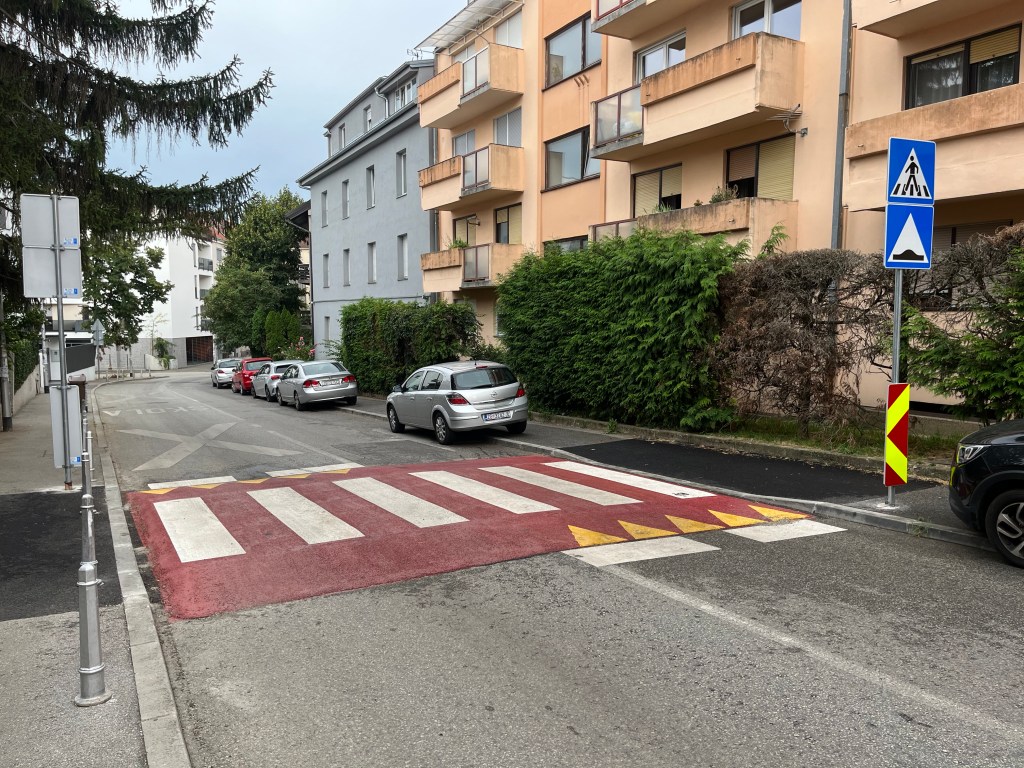
I’ve never been in a place with so many zebra crossings, sleeping policemen (for the North Americans, think speed bumps on steroids), or the unnatural combination of the two with a splash of red for extra measure. (Forget penguins with sunburns, it’s Croatian sleeping policezebra crossings that are black and white and red all over.) In fact, they are so ubiquitous that they simply fade into the background, sort of like those screams from that pedestrian you winged two blocks back at yet another zebra crossing. They even put zebra crossings on blind corners as well as on relatively major thoroughfares where the traffic zips along at a legal maximum / illegal minimum of 80 kmh. No flashing lights or anything obvious to alert you to either one. Just a little triangular sign and some road paint. It’s an open question as to whether it’s the street planners there who have no sense of reality or the pedestrians who are actually tempted to try those zebras out wanting nothing more to do with it.
In fact, the only zebra crossing I’ve ever seen in Zagreb with overhead flashing lights was only recently installed. It was right next to a Lidl, who must’ve complained that too many of their customers were getting killed off …
And even the private citizens get into the act. I mean who really needs a speed bump at the entrance to the underground parking of your own building? Surely the closed garage door should be enough of a signal to tell you to maybe slow down a little?
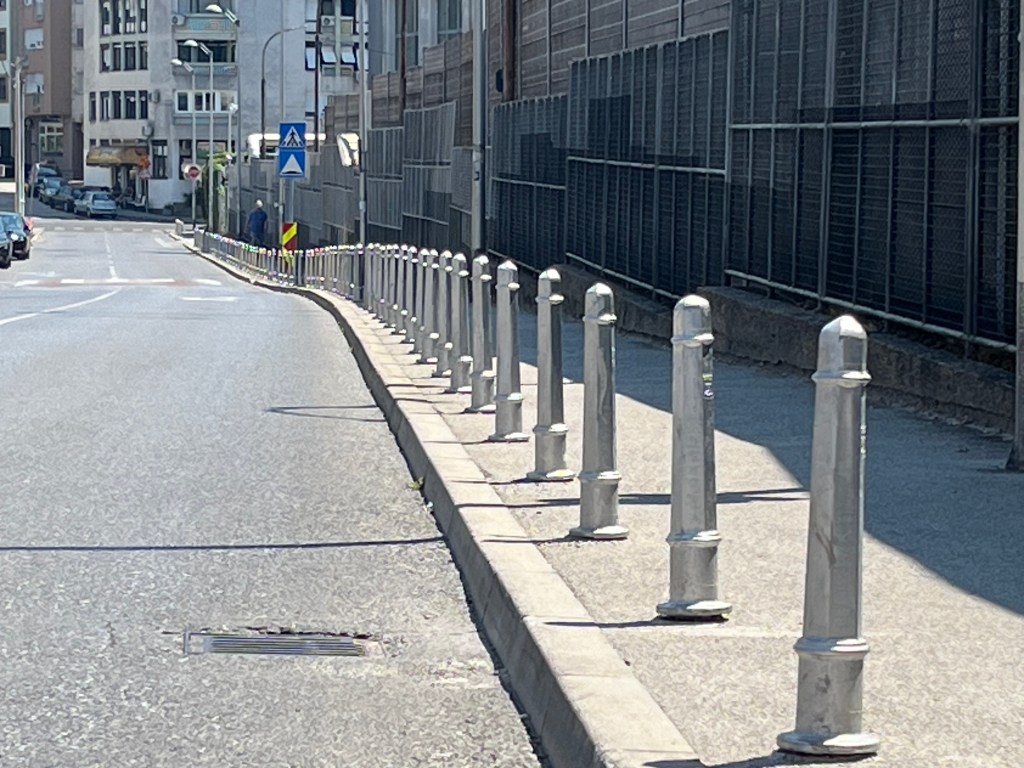
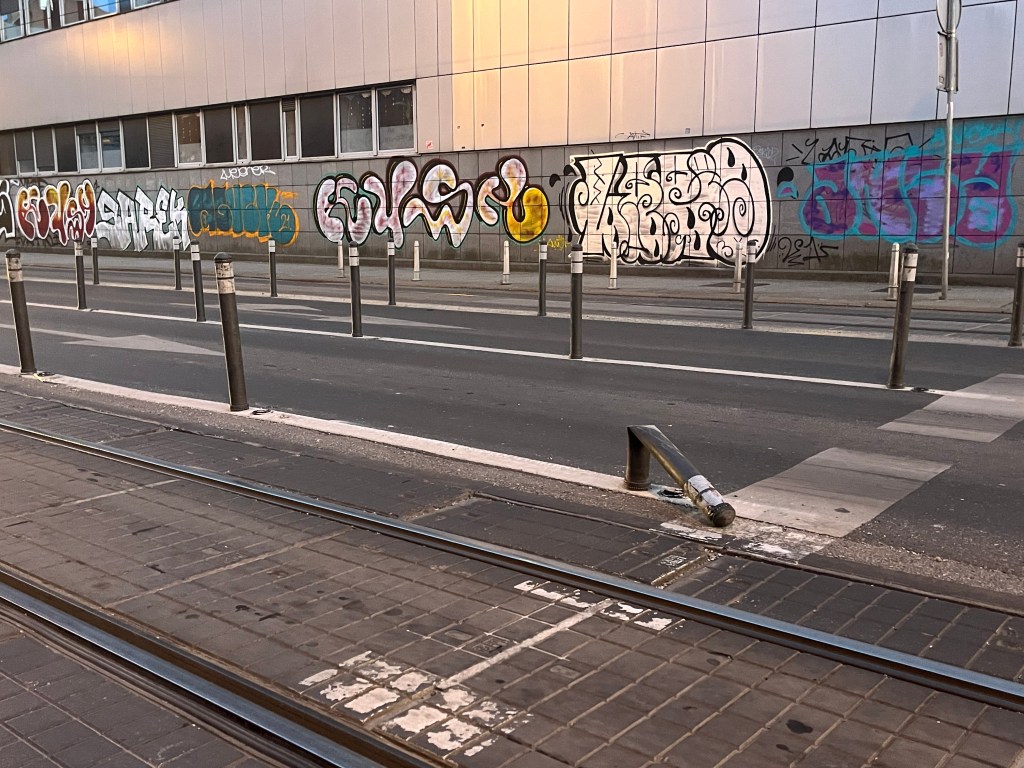
Adding to the obstacle course are plastic posts in the middle of the road in some places to separate the car lanes (road paint sometimes just isn’t enough it seems) and endless numbers of metal posts on the sidewalks in most places to prevent people from parking there. But, metal or especially plastic, the life expectancies of the posts are inversely proportional to their ubiquity. In other words, more background noise, especially when you back into one of the metal ones. Unfortunately, however, the posts are like the mythical hydra in the sense that the fallen comrades are not only quickly replaced but usually with reinforcements to boot. (My suggestion: use the metal posts in place of the plastic ones to separate the driving lanes. I’m fairly certain you won’t have to replace them nearly as often …)
And if all that isn’t enough to slow the traffic down (and it isn’t; traffic ordinances—be they parking spots, stop signs, or no passing zones—tend to be viewed as suggestions at best), then they simply change the road layout every couple of months, largely through the magic of road paint. The best, worst example of this occurred a few years ago close to my wife’s apartment, which lays along a semi-important throughroad that gets its fair share of traffic. Literally overnight the road engineers came out with their paint brushes and changed this two-lane, two-way street into a one-way street with on-street parking. So while it did mean no more parking on the one sidewalk and the chance to use even more metal no-parking posts, it did force the now forbidden oncoming traffic (including the bus traffic) down a parallel, formerly purely residential road that was similarly altered to become a one-way street with on-street parking and a lot of new metal posts. Following two solid weeks of even more solid outcry from the residents along both streets (who hadn’t been informed about a thing beforehand), the midnight elves came out again to put even newer road paint on the now dry old, new road paint so as to make everything just like it had been before as well as to find some other forests to plant their metal posts in.
Admittedly this is an extreme example, but many road layouts are often unpleasantly new to me when I’m away for more than a couple of months.
And finally there are the manholes …
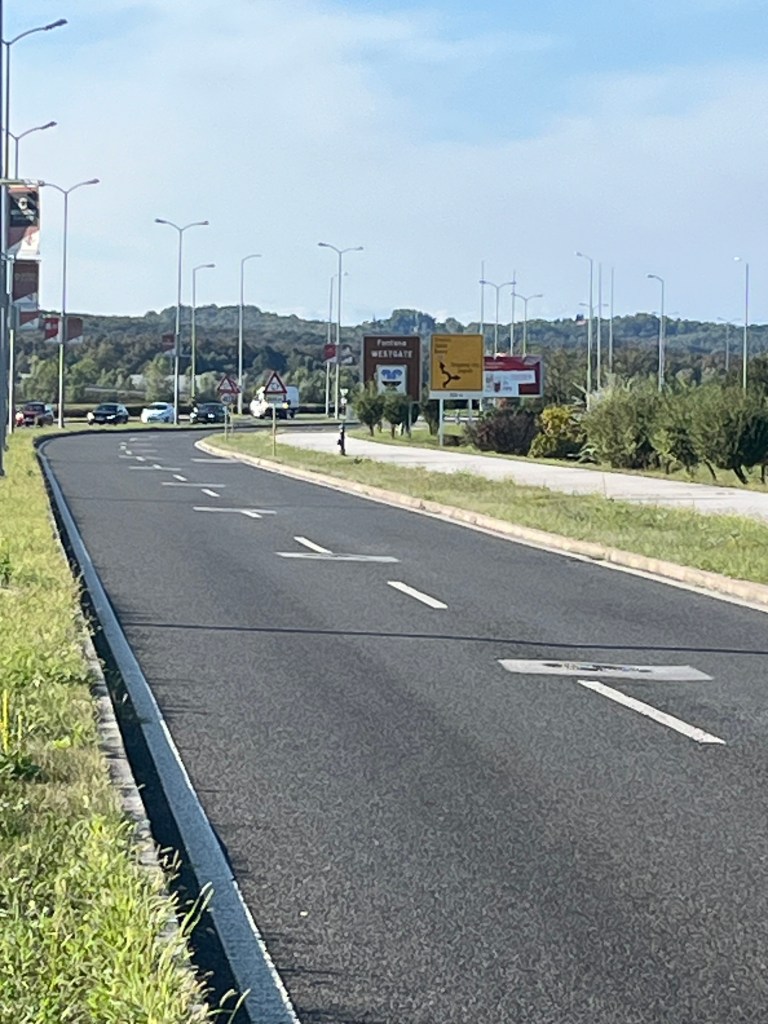
Surprisingly, there don’t seem to be any hard-and-fast regulations in Europe (or even Germany) as to how far apart manholes should be; however, there seems to be some general agreement that the maximum distance should be about 100 metres for straight sewer lines. Not so in Croatia. Croatian sewer workers must be incredibly scared of the dark (or Croatian sewer rats must be really terrifying) because it feels like there is a manhole every ten meters or so ready to balance out your car’s suspension from all those sleeping policezebra crossings.
And, if you look at the picture, it’s more than a feeling. Every one of those light patches disappearing into the distance contains a manhole. (For reference those road signs are about 80 m away, making that 10-metre feeling pretty darn real.) Admittedly, there is a big shopping centre off camera to the right but absolutely nothing but horizon to the left. How much access to a barely used sewage system do you really need? Or are Croatian sewers just not straight?
In any case, I’m convinced that it’s only a matter of time before Croatian road engineers figure out how to put manholes on bridges …
Important news coming out of the business world this week, with the stunning announcement that the Campbell’s Soup Company is changing its name after 155 years to simply the Campbell’s Company. It’s all still subject to stakeholder approval, but you can feel the tremors on Wall Street from here.
But, let’s let the CEO of the Campbell’s (Soup) Company describe the precise reasoning behind this change:
This subtle yet important change retains the company’s iconic name recognition, reputation and equity built over 155 years while better reflecting the full breadth of the company’s portfolio.
Mark Clouse, President and CEO of the Campbell’s (Soup) Company
Couldn’t have said nothing better myself …
Still, let’s examine that statement a little bit more closely, especially the last part where the name change is “better reflecting (of) the full breadth of the company’s portfolio.” If I understand this all correctly (and bear in mind that I’m a biologist and not a businessman), you go from Campbell’s Soup Company, which directly indicates soup and therefore more generally food to simply Campbell’s Company, which directly indicates what exactly?
On a more important note, who really cares and why is this even newsworthy?
For starters, hands up anyone who knew that the company making Campbell’s soup was officially known as the Campbell’s Soup Company and not just Campbell’s. Even Wikipedia says that they do business simply as Campbell’s.
Which leads into the main point: it’s just a name. You can call your company anything you like. It doesn’t have to mean anything, especially after you have brand recognition like Campbell’s does. I mean, what the hell does Unilever or Nestlé actually mean? No idea either but over 90% of my grocery money goes to them anyway. Even Campbell’s Nasdaq stock symbol of CPB makes you think more of cannabis than it does of Campbell’s (with or without the soup). And as Coca-Cola literally found out in the mid 1980s, you don’t change a winning formula.
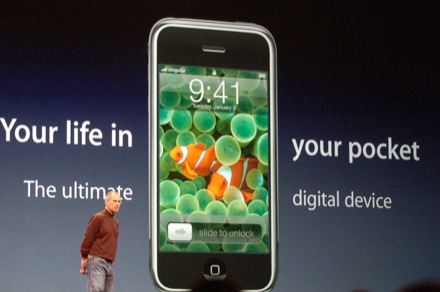
Granted, Campbell’s is not breaking new ground here. Even Apple changed its official name from the Apple Computer Company to just Apple Inc. in 2007 with the introduction of the iPhone to reflect their increasing foray into the wider consumer-electronics market. And I betcha very few people knew that either and still think that the company’s full name is simply Apple.
But at least Apple did it in a reasonably timely manner (six years after the debut of the iPod in 2001), whereas it took Campbell’s executives one heck of a long time to realize that they weren’t hawking just soup anymore. Campbell’s been producing baked goods under Pepperidge Farms since 1961 (something that, admittedly, also passed Andy Warhol by), salsa under Pace Foods since 1995, and those all-important, snacky foods (apparently the real driver of the name change) under Late July Snacks under Snyder’s-Lance since 2018. And, again, hands up anyone who knew this. (You can put your hand down please, Mark.)
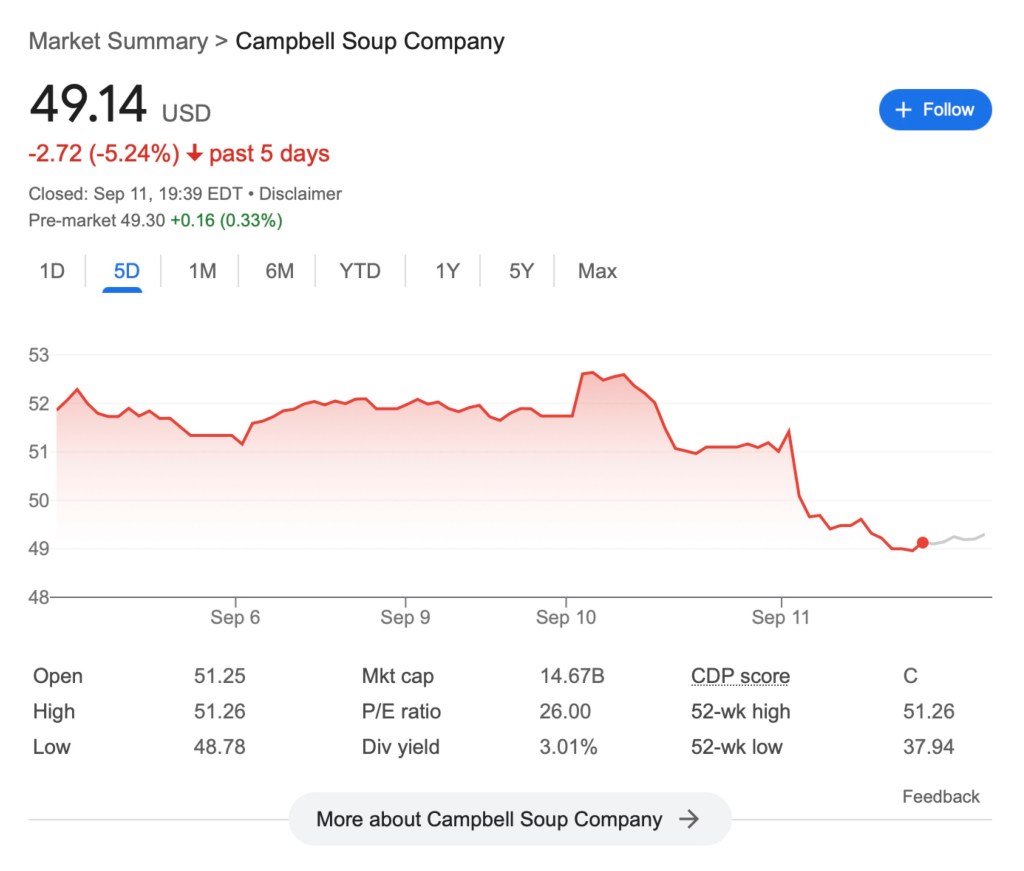
Ultimately, however, it’s not common sense but the free market that decides in a pseudo-capitalist economy like ours. And the first reviews are not great, with CPB stock prices falling by a little over 5% in the two days since the announcement.
But, this is the stock market and maybe the weather is equally to blame here as well.
Right. Time to get a little more controversial than usual as well as to return this BCD subtext to its origins.
I originally launched this subtext—bonehead comment of the day—to fill the then current lull in admin stupidity with quotes from people who should have known better. Although there have been a few of those, most of the BCDs have been relatively quick rants on my part about some topical nonsense with the C in the title punningly swapped out for something vaguely appropriate.
But, we got ourselves a quote again …
You’re an example for everyone, for all the countries that maybe, and this might sound funny, these families prefer to have a cat or a little dog instead of a child.
The context here is that the Pope made this remark to political leaders during his current visit to Indonesia, which repeats his views implying that people should be having more kids. Seems like Pope Francis has been reading too much about Dope Vance’s ideas about childless cat ladies again …
As always, there are more than a number of things wrong with this comment.
For starters, having children is not an out-and-out commandment that I can find in the Bible. Not killing certainly is and not coveting your neighbour’s wife is too. (So no kids with her.) That being said, “go forth and multiply” certainly is in the Bible. It’s in Genesis 1:28 (among many other places, with most of the multiplying being in the appropriately named Book of Genesis). However, it’s not a general obligation and also not the complete passage. The full, google-translated quote from the original scrolls reveals that God said it to Adam and Eve:
And God blessed them, and God said unto them, be fruitful, and multiply, and replenish the earth, and subdue it: and have dominion over the fish of the sea, and over the fowl of the air, and over every living thing that moveth upon the earth.
The missing context shows that all the fruitfulness was meant to replenish the Earth, the same as when God said it to Noah and his sons following the Great Flood (Genesis 8:17 as well as Genesis 9:1 in case Noah forgot in the meantime). And some would argue that the Earth is more than plenished enough now. You could also argue that people choosing to have dogs instead of daughters are actually fulfilling the separately and also highly cited, dominion instruction of the very same sentence. Other times, God says to be fruitful mostly to specific people, but never really as a general directive for all humanity that I can find.
Also, isn’t Pope Francis being a little hypocritical here? I mean, how many children does he have? Or all the bishops, priests, and nuns underneath him in the Catholic Church? Yes, you could argue that they are all serving God in a different way, but who says that the same can’t be true for those people choosing to not have children? Ok, many aren’t and are choosing to fruitfully multiply their assets instead. But then more than a few officials in the Catholic Church have served God over the ages in some rather questionable, if not downright un-Biblical, ways too. Many priests also refer to their congregations as “their flock”, something that also sounds more like pets than people.
Finally, what business is all this of the Pope and the Catholic Church anyway? If some couples only want pets, let them have pets. That’s free will and it’s not the Pope’s job to judge them. (Someone else does that later.) And if there’s no free will and only the Divine Plan, then one interpretation is it really wasn’t their decision in the first place.
Or, as God says,
For I will have respect unto you, and make you fruitful, and multiply you, and establish my covenant with you.
Ah, the many, many existential problems of the airline industry post-pandemic. Over the weekend, news came in that Swiss International Air Lines (aka SWISS) is being forced to retrofit many of their aircraft as part of the process of modernizing their fleet. In this day and age, you’d hope that all this effort would be in the name of greater economy and you’d be absolutely right.
Unfortunately, however, we’re talking yet again about the bottom-line kind of economy and not the environmental kind …
The driving problem, you see, is that the first-class cabins on most of SWISS’s planes are sooooo turn of the millennium and therefore not up to the discerning standards of today’s first-class passengers with their first-world problems. Not enough privacy it would appear. It’s bad enough seeing your fellow passengers at the gate (you know, that annoying, crowded part of the airport between the first-class lounge and the plane?), but does it have to be on the plane too?
Therefore, as part of a “much needed revamp”, the new SWISS Senses design (actual tagline: “Experience SWISS with all your senses”) is offering its first-class passengers new suites (yes, suites) in two configurations depending on whether they want a window seat or not. Those opting for the view will have to make do with only 2.4 m2, whereas those sharing the one in the centre of the plane could run laps around the queen-sized bed (3.1 m2) that would fit comfortably inside their 3.5-m2 enclave.
There’s a slight catch, however …
In combination with the ever lighter lawn chairs being provided in economy these days, these new suites are apparently going to be so heavy that they’ll be throwing the balance of the planes off and making their noses pitch downward. And this is especially problematic in SWISS’s Airbus 330s, an airplane model that tends to be a little nose-heavy from the get-go. (But not in their Boeing 777s. First good news for Boeing in a long time …) The solution? Better seats in economy? C’mon, get serious. Nah, just a second nifty, gas-guzzling, rain forest-killing retrofit in the A330s in the form of some lead plates in the back of the planes to prevent those embarrassing face plants while taxiing.
Sorry, but I just don’t get it …
… starting with all this being for the benefit of at most four passengers per flight.
How much privacy does anyone need on a commercial flight anyway? Even those flying first class? Now, I’ve flown long-haul business class exactly once in my life and I found it to be incredibly roomy and pretty private despite being shielded by only (gasp) half-high walls. (Of course, this is coming from someone used to too many inflight hours of smelling all my seat neighbours and what they had for dinner the night before. Maybe not the kind of experience SWISS Senses is after, but hey, they did say all my senses.) If you need more privacy than that, then maybe consider buying your own plane?
Also, don’t rich people have friends or partners? Economy might be a little overly familiar most of the time, but business and first class seem a little overly sterile sometimes. If the half-high walls of business class aren’t more that enough to isolate you from your partner, the outer first-class suites effectively put you in an isolation tank. For all that space, there is still only one seat in those suites for exactly one bum. And what do you do if some other rich person booked just a single in that shared centre suite? Sacrifice your privacy? Or, in the case that you do have a partner, book just them into business class instead?
More importantly, just how much do these bloody suites weigh? (Short answer: they don’t know exactly yet!)
To save lead, SWISS has actually cut back the number of first-class suites from the eight the A330s had before to just four. (For reference, the old, inferior suites were a mere 205 kg each. Now there’s half as many and they still have to compensate for the added weight?) And, on top of that, they also did away with plans for sliding doors for those comparative cost-cutters in the business-class seats (yes, seats, not suites).
One thing that they did not do, however, was to move the suites closer to the middle of the plane, which was my wife’s immediate suggestion. It’s actually a fair point. Where exactly is it written down that the seats have to get exponentially more expensive the further away from the tail you are? And once the first-class passengers are encased in their little privacy suites, they won’t know where they are on the plane anyway. (Or, in the case of that centre suite, probably that they even are on a plane.)
Fortunately, SWISS also decided against cramming even more deadbeat deadweight (aka passengers) into economy. (Not that it’s physically not possible. Just some other little Swiss thing in the form of the Geneva Convention probably getting in the way.) Now, for some unknown reason, SWISS doesn’t seem to provide any readily available information regarding the legroom in economy other than to describe it as “generous”. However, this article puts it at about 81 cm, which combined with a seat width of 50 cm (which SWISS does provide) works out to your own personal economy suite of about 0.4 m2. Or, put another way, about 5.2 economy suites to compensate for the average of each first-class one. Or, put another, another way, 159 economy-class passengers aren’t enough to already balance out the weight of the new suites for just four people?
And, as I wrote not even a few short weeks ago, if the airlines are routinely assigning us our seats according to weight and balance considerations anyway, where’s the problem? Put all the families with small kids closer to the front (sort of like an excruciating, inflight kindergarten) and all the, ahem, larger individuals and heavy-duty, duty-free shoppers at the back and you’re good to go.
Finally, there’s the maths: fewer first-class passengers, heavier planes, the retrofitting costs, and it all still makes economic sense somehow …
A little something new that I want to try out here. The topic isn’t directly connected with admin but has many of the hallmarks of it insofar as it all might not be that necessary and just that little bit of thinking might have revealed the otherwise obvious problem.
These new things are signs. Not signs from God, the zodiac, or even of love, but simple signs that we humans have put up to ostensibly make our lives easier but, like admin, do so in an unnecessarily complex manner and thus often tend to do just the opposite. (So, more so signs of disaster.) For some reason, I’m fascinated by signs, especially how badly implemented something otherwise so simple often is. So every now and again I’m just going to post a sign that I saw where I simply asked myself what the hell the person responsible for it was thinking. As such, I’m generally going to avoid signs with typos, dodgy translations, or where any humour is mostly context-dependent to focus on the truly unnecessary ones. As well as those that invoke unnecessary self-justifications. The latter could mean that a lot of these signs might come from the advertising industry (an example of which I’ve pointed out before in my BCD subtext) who, like admin and government, often don’t seem to think too much about what they’re doing because they must assume that we as their customers don’t either.
(As an aside, the UK has been by far the absolute best source for these kinds of signs. This is both fortunate and ironic. Fortunate because the signs will be in English and so accessible to the greatest number of readers. Ironic because one of the key drivers of Brexit (beyond all the lies) was the Brits wanting to get away from the stifling EU bureaucracy. But, as we shall see, the Brits should have been largely immune to it given the amount of their own unnecessary nonsense that they already have to deal with …)
So without further ado …
… the photo on the right is “courtesy” of Belfast International Airport and immediately begs two important questions. First, given that we’re not taking about paper towels here, who doesn’t already know this? (Or, said otherwise, is this sign at all necessary?) Second, how can anyone possibly dry their hands when their fingers are sticking in their ears? As such, instead of the warning, instructions might have been more helpful. And, wouldn’t another warning about hot air blowing on your head maybe have been more appropriate? Or simply about the air possibly being reasonably hot? (And that’s “reasonably” in both a normal, day-to-day sense as well as in a idiotic, legal sense a la all the McDonald’s coffee lawsuits.) And blind people? Completely screwed. Absolutely no chance for them to shield their more acute hearing before they dry their hands.
Ok, perhaps more than two questions, and some definitely more important than others, but at least someone is doing the hard thinking around here.
I recently signed up for a ride-hailing app for my smart phone. (Not really important which one because they’re all pretty much the same.) The reason it took so long is because these things are pretty much unknown in Germany. When Uber first came out with ride-hailing in Germany in 2014, the taxi lobby fought against it. Hard. By March of the following year, Uber was essentially banned by the courts because they couldn’t (read: didn’t want to) guarantee that all its drivers had the necessary chauffeur’s license and the app was similarly outlawed in 2019 because it bypassed the regulated taxi companies. Even though most (all?) Uber rides have long been handled by real, regulated cabs anyway, Uber and the like have never really recovered from these decisions to have any sort of presence in Germany. Apps do exist to hail cabs, and some of them apparently even work out in the wastelands of Not-Bielefeld, but in the end you have to pay official taxi rates with no possibility of searching for a better deal.
Anyway …
Sometimes I’m not in Germany so I thought that I’d finally take the plunge for when I needed a ride in another country. As a welcome bonus for signing up, I got an e-mail today offering me a “10% discount on your next 1 scheduled rides!”. Ok, it’s bad enough that a singular somehow became a plural, but look closer and you can see that the offer expired on “1995-08-17T12:16:38.722+00:00”. Or, to give it a little more context, precisely 29 years, 3 days, 22 hours, 23 minutes, and 29.278 seconds before I received the e-mail and to a long lost time when e-mail and even the internet were really only starting to become a thing.
Lotta lazy IT going on here …
We’ll charitably ignore the seriously flubbed expiry date (which could just be a glitch), but not even bothering to convert the time to something that a human can read and understand? And with the appropriate degree of precision? When was the last time anyone who wasn’t shooting an assassination attempt (with a camera …) ever bothered to count down to a thousandth of a second? Especially for an offer that expired nearly 30 years previously? (For the nerds out there, that’s a difference of about 10 billion orders of magnitude in precision!)
More boneheaded crap from those ever-inventive airlines …
I was recently on a flight where we were reminded numerous times during boarding to sit in our assigned seats only, which had been allocated for reasons of weight and balance.
Umm. How?
Doing something like that properly would require that the airlines know how much each passenger and, even more unlikely, their carry-on luggage weighs. It’s been a long, long time since my hand luggage was checked for size and weight and exactly never outside maybe a doctor’s office since I was. And, in any case, the airlines have already assigned me my seat before they ever had the chance to do either.
Ok, maybe the airlines are doing some sort of rough estimate based on passengers being male or female, children or adults as well as assuming that our carry-on bags all meet both their weight and number restrictions (uh huh …), but is this sufficient for their apparently highly precise calculations that forbid us from swapping seats with someone else? For our own safety no less? What if someone cancels at the last minute or is a no show? Or simply went nuts at duty free? What if the other identical twin wants to look out the window for a bit? Am I inviting disaster simply by walking to the loo for a pee? (I certainly am if I don’t …) Are the flight attendants really allowed to walk around with their carts that much?
Admittedly, some airlines have been weighing both volunteer passengers and their carry-on luggage recently but mostly to get better estimates for these data than the global averages that they currently rely on. Even so, it remains a mystery to me how any airline could apply these data on a day-to-day, flight-to-flight basis to balance out the plane.
Finally and more importantly, most airlines now allow you to pick out your own seat for a fee. How do they control for weight and balance then? Granted, not everyone buys their seat ahead of time but many do. It’s also something that the airlines are increasingly encouraging by tying seat selection to unnecessary upgrades like being able to bring a real piece of carry-on baggage in the cabin or having enough legroom on the odd chance that you’re not a munchkin. And, if enough people do, can the airlines really compensate with the leftover cheapskates for any skewed weight distributions that might have arisen from it? All using data that they don’t have? (Apart from them overwhelmingly being munchkins with personal items only …)
Nah. The only balance here that the airlines really care about is the one in their financial reports …
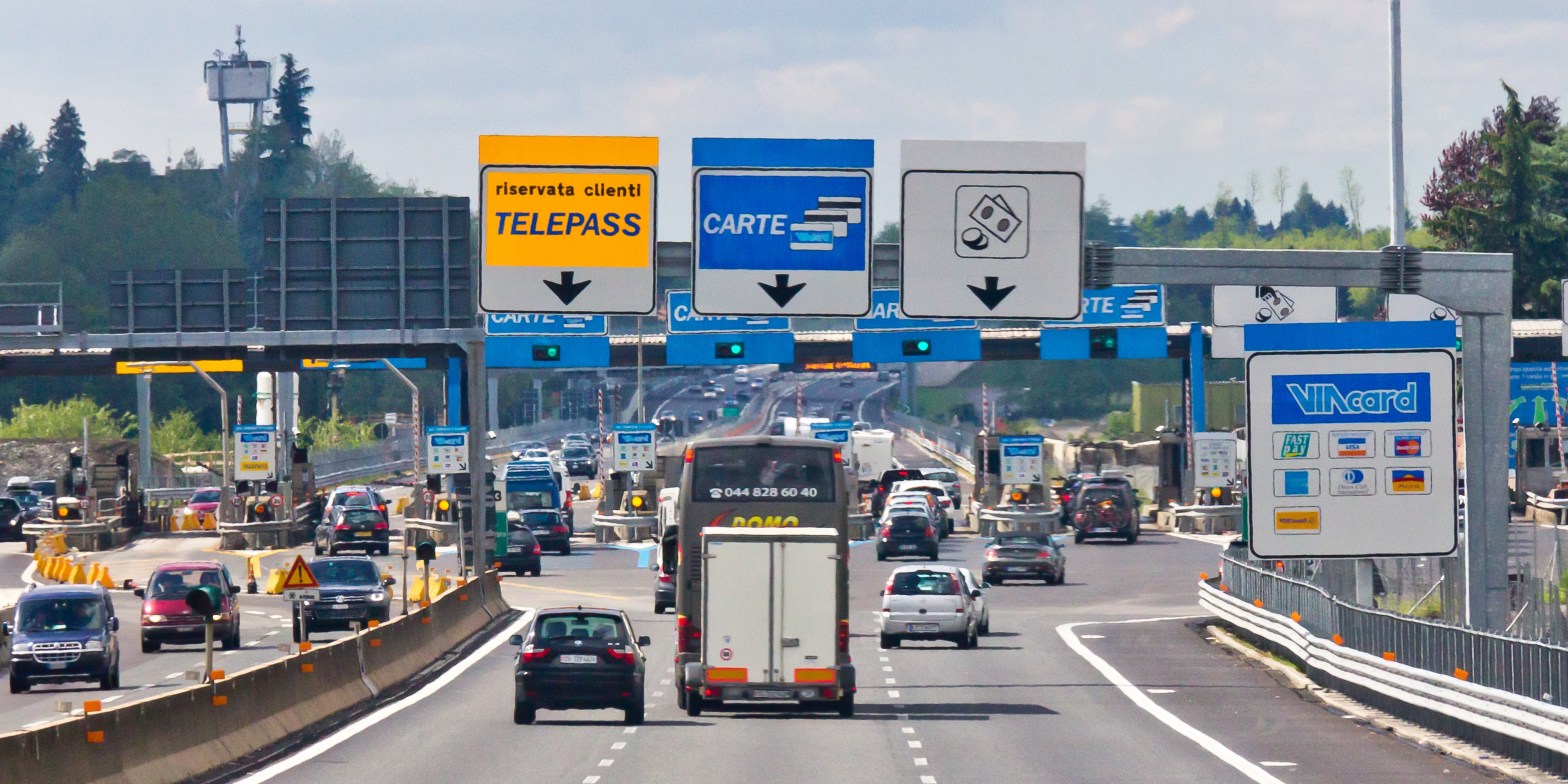
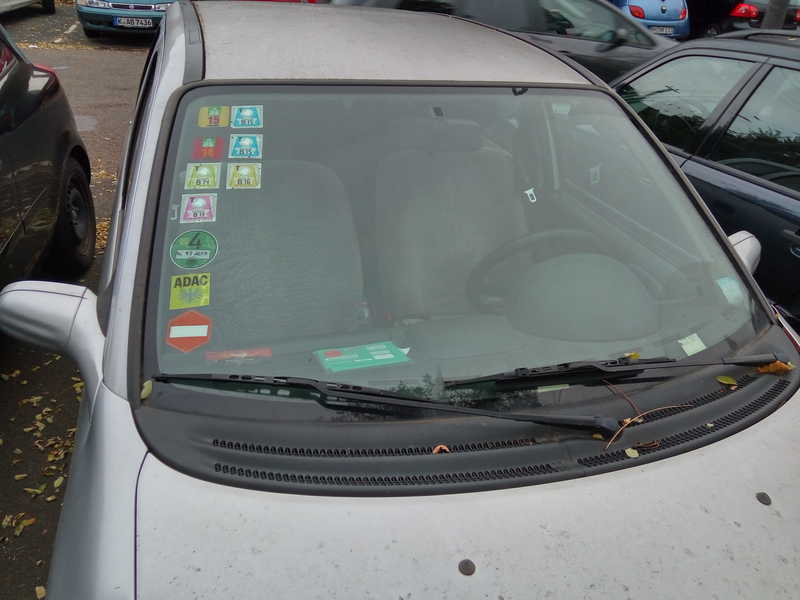
I recently returned from a weekend trip to Bratislava in the Slovak Republic and, like many other countries in Europe (with a few notable exceptions), the Slovak Republic charges a toll to use its motorways. Whereas before one had to stick one of those little vignettes to the windshield of your car as proof of payment (and then somehow get the damn things off again), much of this is now handled electronically such that virtual vignettes are now tied to the license plate of your car instead.
Adding to the convenience, in large part by eliminating the scraping, is that a lot of these countries, including the Slovak Republic, also now helpfully offer e-mail reminders of when your electronic vignette is going to run out. Unhelpfully, however, the Slovakian e-mail contained (or, more accurately, pretty much solely comprised) possibly one of the longest, most confusing, and obfuscated sentences that I have ever read in my life.
How long was it?
Put it this way. This criticism is coming from someone who regularly gets roasted for his overly long sentences. And WordPress’s new AI to help you write more simply and directly? After reading the sentence, it simply quit and directly took up a new job writing beat-poetry haikus.
And here is that sentence:
Dear Customer, the administrator of collection of vignette payments for the use of specified road sections in the Slovak republic, hereby notifies You through this automatically generated e-mail notification about approaching the expiry date of the electronic vignette for the vehicle NBD-FB007 with the country of registration Germany on 05.08.2024 (inclusive).
Sounds like something German admin would be proud to write. (Or more so a German legal department because it’s arguably much more legalese than officialese.) But they can’t …
… because Germany, you see, is one of those notable exceptions from above. Despite having one of the largest motorway networks in Europe at roughly 13.000 km (second only to the nearly 16.000 km of the surprise winner in Spain, which, admittedly, does have 1.4x more area to cover), only increasingly smaller trucks have had to pay a toll to use it since 2005. (As of this summer, anything over 3.5 t now has to pay.) Although plans have been afoot for about as long to also impose a similar toll on cars, the latest attempt was foiled by the EU courts in 2019 who decided that giving Germans the fee back via tax credits was discriminatory because only foreigners would essentially be paying the motorway toll.
That was five years ago and, by all accounts, a German motorway toll is now such a low priority that we need not fear how German admin will retaliate against (or just try to plain one-up) the e-mail reminders of their Slovakian colleagues.
It should be obvious that, like many other amateur technoweenies, I’m fascinated by AI. Or, better said, I’m fascinated by what AI can finally do.
Many of the components, tools, and algorithms current generative AI is based on have been around for a lot longer than most people realize. It’s only in the last few years that the hardware and software have reached the point where initiatives like OpenAI have been able to put all the pieces together to give us something resembling the computers from the original version of Star Trek. (Which, if you think about it, were pretty dorky compared to what we have now. If you lobotomize ChatGPT, give it Majel Barrett’s voice (definitely a missed opportunity there by OpenAI), add some chattering background noise, and throw in some sort of seizure for good measure, you would probably come close to the overtly metallic and stilted interface that 1960s network TV envisaged Captain Kirk and friends would be interacting with some 150 years from now.)
I’m similarly fascinated at how quickly such revolutionary inventions are copied. For instance, it took Apple about two and a half years to develop the first iPhone and, by all accounts, its debut in January 2007 was very premature. (There are numerous accounts about how the Apple engineers were all fervently praying (when they weren’t even more fervently drinking) that the multiple prototypes used during Steve Jobs’ keynote address at Macworld 2007 would not crash and burn despite all the other tricks and fakery that were in play.) But in October 2008, only 16 months after non-Apple people could finally get hold of an iPhone, the first copy of it in the form of the HTC-Dream, complete with a from the ground up new, Android OS, came out. Admittedly, HTC and Google had a blueprint to work with (whereas Apple had to create theirs), but they still had to reverse engineer most of it.
And so it is with generative AI. Within months of ChatGPT exploding on to the world stage, literally dozens of other generative AI applications have also hit the big (computer) screen, enabling people to generate music, art, and even entire comedy routines in the style of someone else (as well as to frequently, if very mistakenly, claim them as their own creative creations). And the list of new uses goes on and on.
Never being one to shy away from biting the hand that I feed, even WordPress is getting heavily in the AI act …
Through its Jetpack extension, WordPress has recently begun offering its users diverse AI tools to facilitate and even improve their blog writing. I’d stumbled upon some of these tools already and and was rudely made aware of some of the latest ones while writing my last blog when some new AI writing tools suddenly popped up with their suggestions without even asking. (You know, like Clippy, that moronic Microsoft office assistant that no one ever used.) The WordPress tools will check your text for complex words (which are highlighted in yellow), long sentences (in purple), and unconfident words (in green). If you let them, that is.
I won’t …
For starters, I don’t need WordPress telling me that my sentences are too long. I know that my sentence are too long. People have been telling me this literally for decades now and my father reminds me every time he reads one of my new blogs. (Which is ironic considering that he’s German and so should not be calling this Kesselschwarz when it comes to long sentences.) In any case, flick the switch to show which sentences in my blogs are too long and the purple haze that Jimi Hendrix sang about is nothing compared to what WordPress throws back at me.
And you know what? I don’t care. You want short sentences? Try Twitter (now known as X) …
The complex-words tool is even better because it’s just so, well, bad. Here is a list of all the words that it’s flagged in this blog until now (in italics) and the “simple, direct” corrections that it’s suggested instead (immediately following the complex word in parentheses):
where initiatives like OpenAI have been able to (can) put all the pieces together
There are numerous (many) stories … during Steve Jobs’ keynote address (discuss).
complete (finished) with a from the ground up new, Android OS
whereas (since) Apple had to create theirs
and thereby to frequently (often), if mistakenly
begun to offer its users numerous (many) AI tools to facilitate (help) and even improve
immediately following (at once next) in parentheses
Many of the corrections are just dead wrong and sound like the invisible-idiot game where you had Google translate some phrase into a foreign language and then back again. (Some of the classic examples of mistranslation here might have been made up but there were still apps to automate the process for you. And they often came up with similar bits of nonsense.) As for the others, it would appear that the Jetpack AI has a thing against syllables, which would also explain why its writing service is called Writing brief with AI instead of the grammatically correct Writing briefly with AI.
As for unconfident words, the AI hammers me each and every time I use words like “probably” or “could”. And I literally mean each and every time. For instance, even though their usage in the first sentence of this paragraph is completely justified, the AI flagged probably and could nevertheless (and in this sentence too for good measure).
And, truth be told, who really needs these writing tools anyway? Or wants them? A lot of blog writers are writers and, so, probably know how to write in the first place. Or, more importantly, want to express themselves in their own words, not some standardized schlock that an infinite number of CPUs with access to an infinite number of keyboards churns out. When was the last time that any computer won any one of the Pulitzer, Booker, or Nobel Prizes anyway?
One tool that I admittedly had high hopes for was for the AI to generate suitable images for the blog. To be honest, one of the hardest parts about writing this blog is finding (or making) suitable, public-domain pictures for it. The words are easy, the pictures less so. It sometimes takes me hours to find or make good ones. If AI can do it for me in a couple of seconds, well, so much for the better.
Too bad that it can’t.
To the right is the AI’s free attempt to summarize this blog as one, featured picture. It’s very, very good, but what the hell is it exactly? And what the hell does it have to do with the content of this blog? I’m not 100% happy with the featured image that I did find (they should be computer chips, not poker chips …), but at least it captures the “all in” aspect of the title.
Fortunately, it is possible to get the AI to deliver an image according to some instructions so I asked it to make me a picture of “a computer poker player going all in but with computer chips and not poker chips” …
… and got an angry, older, and washed up Ryan Reynolds instead. (Still no computer chips either.)
Another, potentially useful tool is the one to suggest titles for the blog (although the official verb being used is “improve”, not “suggest”), another aspect of my blog writing that often costs me more time than I’d like. But, given these suggested improvements, I’ll happily invest that time.
The impact of generative AI on technological advancements
WordPress Jetpack AI tools: benefits and limitations for blog writing
Enhancing blog content with AI-generated images: expectations vs. reality
Sounds like their AI was trained on admin memos …
The final, kinda fun tool is for the AI to generate feedback about the content and structure of the blog (which you can request over and over again until you get one that you like!). I’ll just leave you with my preferred version uncharacteristically uncommented.
The content touches on the fascination with AI and its rapid development, discusses WordPress Jetpack’s AI tools, and expresses disappointment with the AI’s image and title suggestions. The AI’s writing tools are criticized for providing inaccurate corrections and being unnecessary for most experienced writers. The AI’s inability to deliver suitable images is highlighted, along with receiving unexpected results. The blog titles generated by AI are considered useful, and the feature to generate feedback about the blog’s content and structure is mentioned as well. The feedback is comprehensive and provides a good overview of the content, but it could benefit from some reorganization to improve flow and coherence, especially in the section discussing the writing tools. A more focused approach to analyzing the specific features of the Jetpack AI tools for blog writing could enhance the overall presentation.























 The Blog About Fog