Working right up until the last second, the admin elves at the University of Not-Bielefeld published a set of 11 recommendations shortly before the Christmas break to advise its teaching staff in how to deal with generative AI in the classroom. And then took a well deserved seven-week break before facing the even more arduous task of translating it into English.
It was all worth the wait …
Given the sheer number of brilliant, academic minds devoted to this problem (the Vice President of Student Affairs, the Department of Student Affairs, and the Council of the Deans of Students), you’d expect something insightful, inspiring, and cutting edge to guide us. But, as with most things done by committee, the end product was instead a near-sighted, dispirited, and blunted piece of buzzword bingo that, as always, left all the real work to us:
stay informed
foster and nurture students’ competencies
acknowledge and value
review and adapt
sanction violations
define and communicate
But, most importantly, they got to use the word “overarching” by cramming their 11 recommendations into four overarching areas.
(Now if there’s one word that deserves to be eliminated from the English language—together with those people inclined towards using it—it’s “overarching”. The problem is that you expect something along the lines of the Arc de Triomphe when you hear it, but usually get the Golden Arches served up to you instead. (Which is not intended as a slight against McDonald’s. At all. Love it or hate it, it’s still fast food and not a surprisingly French-made architectural masterpiece.) Call it overarching themes, overarching concepts, or overarching whatever-you-wants, they’re all just categories and the use of the word is always much more of a case of overreaching than it is of overarching. This is especially true here. Eleven recommendations dissected into four areas means that some of the latter just barely fit the definition of a category.)
And then there’s the escape clause in which they note that the Recommendations are merely a “product of their time” and so subject to change as generative AI develops. Not only that, but that they also welcome any comments or suggestions to help develop “additional action-oriented recommendations and offerings.”
C’mon. Really?
It took them over a year since ChatGPT and generative AI shattered our illusion of safety to come up with a document as bland, useless, and action-oriented as tapioca? And also one to recommend pretty much what we’ve all been doing while waiting for their received wisdom to rear its ugly, administrative head?
(Why ChatGPT is almost universally vilified for starting the whole AI crisis is beyond me. Listen to the media and you’d think that it’s been systematically destroying humanity in Skynet-like fashion since it came online. (BTW, that’s ChatGPT, not the media, destroying humanity. But it’s a reasonable misunderstanding to make. Interestingly, ChatGPT went global almost precisely 25 years and three months to the day after Skynet became self-aware. Some say it’s a coincidence …) It’s not like ChatGPT invented AI or even a dangerous form of it. The social-media companies with their “algorithms” were way ahead of them there. But somehow their algorithms remained just plain ol’ algorithms and didn’t become dangerous AI. What many forget is that generative AI needs humans to make it dangerous. Just ask the poor guy in Hong Kong who wired $25 million dollars to scammers after they deepfaked him out with a video conference call including the company’s CFO. So, seriously, just how dangerous is generative AI really going to be in a teaching setting, apart from the fact that it’s hard to detect? At worst, it’s merely yet another form of cheating that we are being forced to detect. More charitably, it’s Google with a summarize function. Or, in other words, Wikipedia.)
In any case …
Those suggestions they wanted? How about actually offering something, like access to a tool that will help us teachers to recognize AI-generated content instead of recommending that we “inform” our students to adhere to “good academic practice” by “acknowledging” when they use AI and otherwise “sanctioning violations” that we can’t even detect? That’ll stop any cheating attempts …
Just for fun, if not to “stay informed” about generative AI, I ran the Recommendations through GPTZero, one of many web services that are designed to detect AI-generated content and that are also not mentioned in those same Recommendations. Interestingly, GPTZero was only moderately confident that the German version was written by a human (77%) but highly confident that the translated English version was (87%). Not sure what this says exactly about the Vice President of Students Affairs et al., but it might be worth considering packing some Linda Hamilton type heat, if not a few Turing tests, to the next committee meeting in case they really are cyborgs. (Or just shoot first and ask the questions later. You can never be too careful.)
Even more fun: I compared the English version of the Recommendations with the DeepL translation of the German version using the university provided access to the PlagScan software (which now finally works). The end result of 19.6% of the content being either word-for-word identical or comprising slight textual changes is not surprising given that we are talking about two translations of the same source document. However, DeepL is the acknowledged translation engine of choice for central admin, being used to generate the English translations in their bilingual e-mails for instance. More to the point, it also uses generative AI for its translations such that using it and not acknowledging that fact runs counter to the Recommendations (running because they’re action-oriented, remember?) as a violation of “good academic practice”. Now, I’m not necessarily trying to imply anything but those bilingual e-mails (including the one announcing the Recommendations) no longer mention the use of DeepL and I somehow doubt that all those admin types have suddenly become fluently bilingual.
Or at least bilingual to the point where I as a native speaker can’t tell that a non-native English speaker has written the text …
Most Germans will deny it, if only because they cannot pronounce the voiceless dental fricative (/θ/, one of the two “th” sounds), but they actually live in a theocracy, making it currently only the third western country together with the Vatican and the US to do so.
There are more than a few obvious signs pointing to this, the first being a virtual countrywide ban on dancing on Good Friday that I’ve railed on about before. However, this Tanzverbot is only the most famous restriction on what are known as “silent holidays” in Germany. These are mostly public holidays with religious roots where any number of otherwise normal activities are outlawed to promote reflection and maintain the solemnity of the day. Good Friday is the best known and most universal of the bunch, but there are others as well as “silent days” that don’t double up as public holidays. The list of banned activities varies from state to state and day to day, but generally includes dancing and musical events, circuses, public sporting events, and certain movies.
Yes, to prevent our thoughts on these days of contemplation from being led too far astray, the movie industry through its German self-regulatory rating body, the Freiwillige Selbstkontrolle der Filmwirtschaft (FSK), has been putting together a list of movies since at least the 1950s that are banned from being shown in theatres and on TV on the silent holidays. (You can, however, watch the films on Netflix and the other streamers in the throes of your little cabal for some unknown reason, further begging the question as to how something can be illegal only on certain days and then only in certain ways.) The List contains obvious smut like the 1974 Japanese anime film Heidi, Girl of the Alps together with a bunch of other similar pornos and slasher films that no one probably should ever watch, but not those stalwarts of religious purity and paragons of morality in the form of either of the SAW or Fifty Shadesfilm series.
Could be that poor Heidi just needed a better upbringing. Too bad that the FSK also had Mary Poppins doing hard labour since 1995 as well.
Be that as it may, to promote that desired clarity of thought, feel free to ring the Church bells as long and as loud as you want on the “silent” holiday of your choice (and probably naked too while you’re at it given that Frankfurt’s highest regional court recently upheld a landlord’s right to sunbath nude in the courtyard of his building), but don’t you dare think about subverting anyone through any satanic Swiss-Shintoist cinema.
Many of these observations and ironies about The List are not original on my part. Hell, there’s even an entry in the US Library of Congress blog about it. Nevertheless, as infamous as The List is and given both its legal and moral ramifications, it is surprisingly hard to find. Buried somewhere on its website, the FSK does provide a list of movies that had been blacklisted between 1980 and 2015. However, on the same document, they themselves note that even this catalog is not accurate because of potential data-entry mistakes. (Apparently, this is how Heidi made the list, something the FSK goes to great pains to explicitly point out on the document. Wonder why …) In addition, they add that many of the movies that are legitimately on this list could have subsequently been taken off of it upon appeal as well as because of the changing ethics and norms in German society. (This latter shift is probably best illustrated by the fact that <1% of the movies released since 2020 made the list, compared to the high of 65.9% of all movies in the 1960s being silently banned.) Instead, the FSK say that more accurate results can be found through their website’s (extremely slow) search engine, but even here I found it impossible to find any movie that was on The List.
(A word of warning. For those wanting to hunt down The List, it’s not only impossible to find, but obviously also in German for which I apologize. Twice. First, most of the film titles might not be easily recognizable to non-German speakers. Second, German translations of film titles tend to be boringly factual. Painfully, boringly factual. For instance, the German title of Driving Miss Daisy, namely Miss Daisy und ihr Chauffeur, is really just a census of the film’s major characters, whereas the English title at least has a verb to give it some movement. The Shawshank Redemption comes out as Die Verurteilten (“the convicted” (plural)), which misses the point of the movie entirely. Or the German translations tend to overexplain the title, another variation on over-factualization. For instance, the straightforward Top Gun becomes Top Gun – Sie fürchten weder Tod noch Teufel (“they fear neither death nor the devil”). One of the few exceptions to all this is for the claymation film Chicken Run, where the German translation of Hennen Rennen has the same clever double meaning, but with an internal rhyme to boot! So there …)
In any case, if changes in society mean that movies can become watchable on the silent holidays, including movies with music and dancing (e.g., Dirty Dancing, which is officially not on The List and, as far as I can tell, never has been), then why continue outlawing music and dancing?
But, Heidi notwithstanding, this is to some extent all grown-up stuff. Instead, any good theocracy knows to get them while they are young by offering religion, sorry “religious studies”, in school.
And this is actually codified in law. German basic law (Grundgesetz) officially enshrines religious instruction as part of the public-school curriculum, albeit with some extra caveats on top of that here in Not-Bielefeld: there have to be 12 or more students belonging to the same religion, there’s a willing and qualified teacher in that religion, and the parents of those students under 14 approve of it all. Otherwise, the kids should go in the default class of ethics and norms, hopefully without any of the FSK‘s temporally flexible insights into it. However, the elementary school here in Not-Bielefeld where my daughters went was small (only two parallel classes for each grade) and there were no teachers qualified to teach ethics and norms. (Ironic that. One can teach religion, but know nothing about ethics …) Thus, parental approval be damned, it was religion for all and learning important, general religious concepts like the Lord’s Prayer and the Ten Commandments. Other religions? That they even existed was something left for the very last grade in elementary school.
I have nothing against religion being taught in schools, including all the death, mayhem, and other assorted human-rights violations it was responsible for historically. It just shouldn’t be in elementary schools and also not-so-secret advertising for any particular one. Religious instruction? I believe they already have something called churches for that. (Or are those too busy providing “evolution instruction” these days?) Despite their internal redundancies and obviously plagiarized content, I can sort of accept the teaching of the Ten Commandments because there are universal moral and ethical principles underlying them that go beyond any single religion, if not religion as a whole. But the Lord’s Prayer? Granted, knowing it could win you $200 in Jeopardy, but still …
The problem here is that elementary-school kids tend to idolize their teachers to the point of believing anything they say over their boring old parents. A case in point was when my eldest daughter came home from school one day and told me that I had been saying “clothes” wrong all this time. Instead of my monosyllabic “klowz”, her English teacher told her that the correct pronunciation was the disyllabic “klow-THEZ” and with that emphasis. (The irony here is, of course, beautiful insofar as the northern German, non-native English speaking teacher is indirectly telling the born and bred, native English speaking Canadian how to speak his own language. Technically, she was right, at least up to that extra syllable. Clothes does indeed possess the second “th” sound, the voiced dental fricative (/ð/), but non-technically, this is English we’re talking about. If we want to voice the voiceless fricative and silence the voiced one, well, that’s our God-given right, isn’t it?) I imagine (read: sincerely hope) that the teacher was simply overemphasizing that fricative so that her students wouldn’t be condemned to saying “zis” and “zat” for ze rest of zeir lives, but who know-THEZ?
Now, I say “tend to idolize” because then there’s my youngest daughter. I didn’t know it until years later but she actually got permanently kicked out of her religion class for continually asking how evolution and the Big Bang fit into the whole scheme of things. (Or, in other words, not taking the gospel truth as the gospel truth.) So instead of learning about (a single) religion, she got to watch TV in school for an hour. For years. Pedagogically more than a little suspect but then so was the entire religion class to start with, wasn’t it?
And, finally, there’s the bottom line …
Theocracies cost money to run and the churches have the German taxpayers right where they want them. In many countries, churches are charitable entities and so pay no income tax despite raking in untold amounts of money via donations and, more importantly, through all the property and businesses they own. The inherent contradiction of this situation is finally being realized such that there are debates also starting in some of these same countries as to whether or not to end this tax-exempt status for the churches.
But in Germany?
Not only is there no debate, but in all German states except, ironically enough, the very religious Bavaria, the government actually directly funds the poor, destitute churches by having its tax offices collect a special church tax from the devout among the taxpayers. And there’s no debate there either: depending on which state you live in, an additional 8-9% of your income tax automatically goes to your church (apparently with a 3% handling fee for the tax office) if you’ve been christened or baptized, even if it was against your future will by your good-meaning parents.
And there is some serious money at stake here too. For instance, that 8-9% worked out to some 9.2 billion Euros in 2010 (and, by extension, up to 276 million Euros for the tax office), contributing in no small measure to the net worth of the German Catholic Church, which is estimated to be anywhere between $26 billion and 430 billion Euros. Even the more conservative of those two numbers (conservative because we are talking about the Catholic Church here), makes the German Catholic Church on its own the fourth richest religious institution in the world and is more than ample to place it on the Forbes 2000 list and in the top 35 of the wealthiest German companies ahead of, for instance, that little known shoe company called adidas.
Despite these embarrassing riches, there are separatereports of the tax office / churches investigating the religious background of foreigners who have moved to Germany to ensure they aren’t dodging their tax burden like the churches are. In the end, the only way out of paying the church tax involves some degree of pain, either in the form of dying or surrendering about 30 EUR and filling out the requisite paperwork to formally leave the church.
And even then the churches have found a way to tax the non-devout in the form of “special church money” (besonderes Kirchgeld) based on the joint gross income of those couples living in mixed marriages. Thus, the non-religious person indirectly pays taxes to the church for having fallen in love with a devout person who, in turn, actually pays taxes twice (presumably as punishment for marrying the heathen in the first place) because they also have to pay their normal church taxes. This all apparently only comes into play when the devout person has no to little income of their own. Or, in other words, is poor, and so belongs to exactly one of those demographics in society that the churches are supposed to be helping out.
And yet despite being a paying customer, whether directly or indirectly, my Catholic wife is still officially forbidden from taking Holy Communion or even going to confession because we only married in the eyes of a civil servant and not God. But, thankfully, because we are talking about charitable organizations here (at least in the tax sense of the word), all these church taxes are fully tax deductible …
Some time ago, I wrote how admin here at the University of Not-Bielefeld (if not admin types the world over) like to send chain e-mails, where some e-mail from central admin is successively forwarded down the chain of responsibility (central admin to faculty to department to …) with no one bothering to clean up all the forwarding details along the way. The end result for the sucker on the end of the chain is an unnecessarily long e-mail that begins with “do this” followed by roughly 30 minutes of scrolling to see what actually needs to be done. (Which is usually to click “delete”.)
Well, central admin here at the University went one step better and have now developed chain-link e-mails …
An e-mail came around the other day announcing the exciting news that the President’s Office had established new, formal guidelines for the “standardized wording” of the university address to be used on all scientific publications. And to see the guidelines and additional information, all you had to do was to simply click the link provided. (I know. Already sounds like a phishing e-mail, doesn’t it?)
Only problem was, clicking that link took you to a University webpage that merely repeated the content of the e-mail but with another, different link to actually get to the guidelines. In other words, one pointless click too many: why not just (also) include the guidelines as an attachment to the e-mail in the first place?
In reality, however, it was two pointless clicks too many …
… because the guidelines basically amounted to nearly three pages of the pretty damn obvious. And the all-important, Standardized Wording boiled down to the this:
the name of the university always has to appear in the address and then always as the full name in German (e.g., Baron Munchausen Universität Nicht-Bielefeld; sorry, apparently I’ve been a little lax on this until now) and
e-mail addresses always have to be the work e-mails of university employees, not private ones.
Everything else like the departments and working groups? Who cares! Choose any order you like and feel free to use either English or German. Just make sure to use the full German name of the university.
Seriously? It took them 19 days and two links to inform us of guidelines equivalent to that we should be putting our socks on before our shoes?!
Ostensibly the whole reason behind this move is so that publications from the university are easier to find and to associate with the university. Carrying on, this information can then be used to more easily collate data on how productive both the university as a whole as well as its academic staff have been.
Again: seriously?
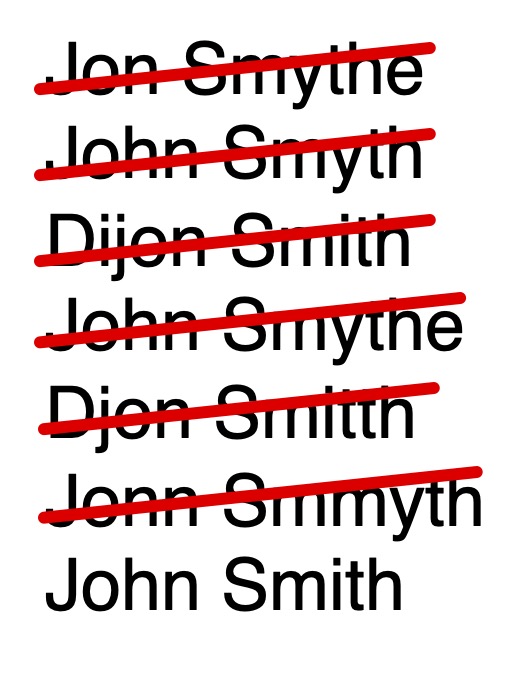
For one thing, it’s really not that difficult for computers, even before the dawn of ChatGPT and the hovering apocalypse of AI, to hone in on variants of something like the name of a university. I know this for a fact because my last name is prone to many weird, wonderful, and downright creative misspellings, yet Web of Science as well as Google Scholar have managed to associate most of them with my real name. It’s even easier with many German universities (worth mentioning) because they carry both the name of a famous historical German figure (always male; no famous German women, I guess) as well as the city it’s located in.
For another, it’s only suggested in the guidelines that the authors use a standardized name under which to publish. But, if one of the express goals of the guidelines is to associate papers with both the University as well as with individual academic staff, then shouldn’t this be more than a mere suggestion?
In reality, the guidelines have more to do with the University’s blossoming love affair with corporate design than anything else. In the past 10 years or so, they’ve redesigned the University’s logo twice, with knock-on effects on everything it was used on like letterhead and PowerPoint presentations. But because the first update was essentially ignored. they went to extra lengths to make people aware of the more recent one. This included releasing a promotional, teaser video filled with all the empty advertising buzzwords they could think of before the official unveiling as well as a 58-page user manual on how to properly implement it on everything from flyers to brochures to business cards to certificates and diplomas to academic posters and presentations.
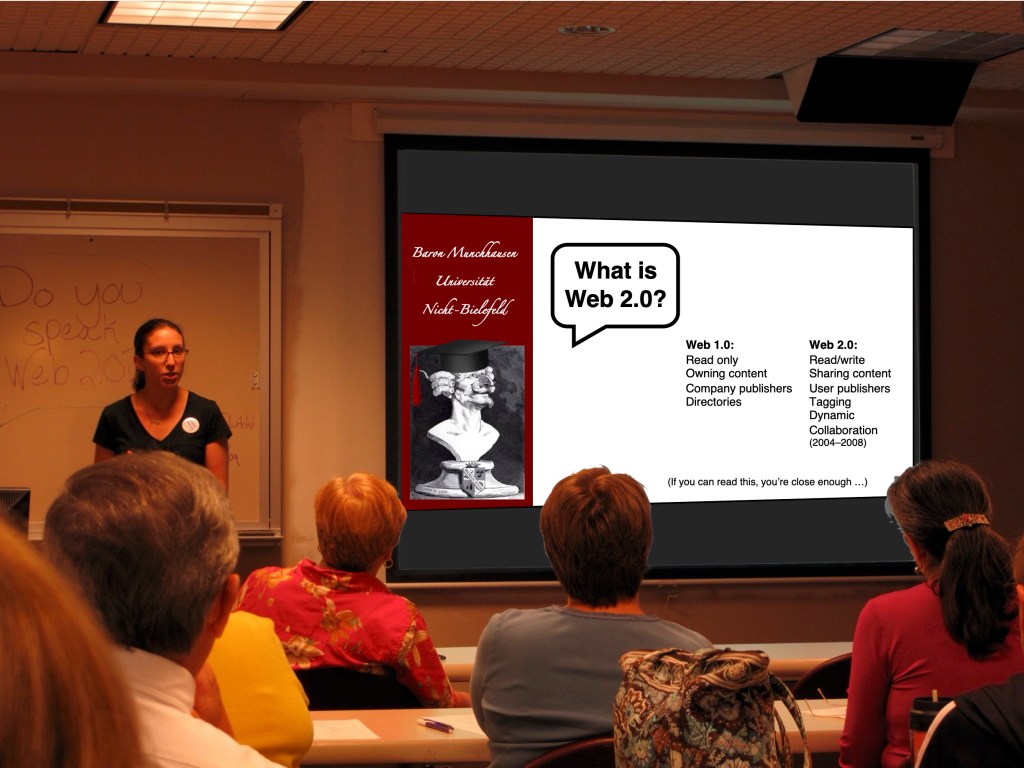
Despite all this, the second update is receiving about the same amount of attention from me that the first one did in general. Really the only areas for me where it’s relevant are my slides for teaching and for scientific conferences. (Do people even do business cards anymore, especially in Academia? I purchased like 200 of them from the University when I first arrived, overly keen, 15 years ago and have about 197 of them left, all with the wrong corporate design now too.) Before, when there was no manual to again guide me through the obvious, I simply put the University logo on the first, title slide of each presentation. But the new guidelines now stipulate that the corporate design has to be used on each and every slide. Why? My natural expectation here is that the audience is there for the scientific content rather than knowing where I work or teach (and my sincere expectation is that the students already know which university they’re at) and that they’re clever enough to remember it having seen it once. Having the logo as an ever-present sidebar also means that there’s that much less space for real content. More personally, it also means that I have to redesign more than a thousand slides, both because of the loss of space but also because the new corporate design has only been implemented for PowerPoint slides in widescreen format, which I don’t use. (And which is generally useless for teaching because the projection areas in most of the University’s classrooms were set up for the much squarer picture that was the default before widescreen. So now you’re trying to fit an overly wide picture in an overly narrow space making for some overly small text.)
I figure if the University has the time and money to redesign their logo every couple of years AND now to make promotional videos about it, then they can also invest some of the same to hire someone to redesign my slides as well.
Unless, that is, they’re already working hard on the next set of corporate guidelines and redesigns …
Apart from the universal, default strategy of continually growing its customer base, another key element of WordPress’ business model must be to keep their band of bloggers happy, motivated, and writing.
Having already gotten me to sign up (= growth strategy), WordPress immediately shifted to inundating me with announcements about how I could make money from all my ramblings (= motivational strategy), something that has thankfully abated in the meantime. Instead, they’re now appealing to my artistic side / pride to keep me writing. Case in point was my 2023 Year-in-Review summary that they sent to me the other day.
How did I do?
Well, this being a site about admin, let’s call a spade a sweat-inducing, personalized appliance for dirt excavation and admit that my stats for 2023 were not great. (And even that is an extreme euphemism.) I’m not complaining though. It’s hard to advertise an anonymous blog through word-of-mouth and this is all much more of a fun, vaguely therapeutic hobby of mine than some desperate attempt for fame and fortune.
Instead, what’s silly about all this is the amount of empty hyperbole WordPress is putting on some very mediocre numbers to try and motivate me. It has, but by giving me more material for this blog, which is probably not what they really intended.
So let’s break all those stats down …
360 page views: A crowd of viewers has engaged with your content, a testament to its appeal and reach.
Nice little bit of sleight of hand that actually suckered me in for an embarrassingly long while: the number of page views is not the same as the number of viewers, but do make those “crowds” seem larger. Instead, the actual 188 viewers do not even approach being a crowd, especially when you consider that it works out to an average daily crowd size of just over half a person. Otherwise, in terms of testaments, these numbers are really only appropriate for last ones, making WordPress the only one to be doing any reaching here.
29 posts: You have added to your body of work and shared your thoughts with the world.
Actually surprisingly bland and factual to match the numbers.
1 like and 3 comments: Your writing has resonated with your readers, and they have shown their appreciation.
Unfortunately, the stats would indicate that my writing seems to resonate in the same way that mashed potatoes dropped from a third-story window do. If numbers like these don’t underline the aforementioned engagement of my crowd of visitors with my content, nothing does.
Best day—March 30, 2023: With 14% of all visits for the year, it seems March 30, 2023 was your day in the digital spotlight.
The “your” here is actually particularly telling because that was the day I kept calling up the site to see how some formatting changes looked for everyone else.
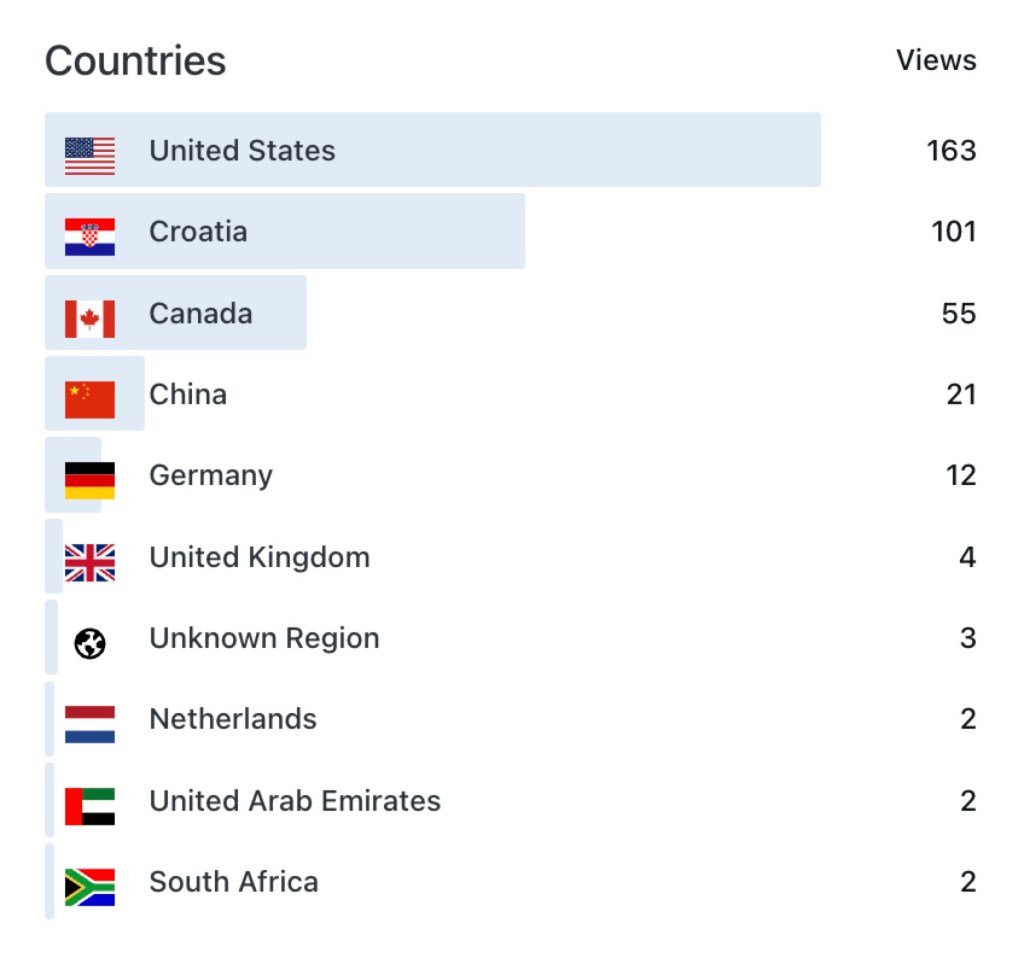
Popular countries—USA, Canada, and Croatia: Spanning continents, your site resonates with an international audience.
Ah, more resonance. But, again, it’s resonance of this kind. Break down the numbers and everything breaks down. Canada and Croatia are where most of my family live and Americans will click on almost anything to ensure that America is #1 at everything. Instead, I find it more interesting that my blog got hits from undoubtedly befuddled people from up to nine different countries (Germany might be all me), including the big three above, all begging the question as to how they landed there in the first place.
Traffic source—facebook.com: facebook.com has been a major contributor to your site’s traffic, a nod to our targeted SEO and marketing efforts.
Oh. That’s how …
Thank God for Facebook and its whopping seven referrals. Major has never been so minor before. But, in the end, it does justify the millions that WordPress undoubtedly spent in its targeted marketing efforts just for my blog. (Just nod …)
99.999% uptime: Almost perfect! We’ve kept your site live and accessible for 525 595 minutes out of 525 600 this year.
The only decent number in the whole bunch (even if it has a ridiculously unnecessary number of digits behind the decimal point) and one that really has nothing whatsoever to do with my blog. Pity that those five minutes of downtime were probably exactly when everyone else was trying to call up the site.
Kinda all explains why WordPress isn’t telling me how much money I can make with my blog anymore, doesn’t it?
Recently, I wrote about how the University of Not-Bielefeld had set up a centralized system for registering when you were on sick leave (i.e., sick for more than three days in a row). The general idea was that instead of simply informing your boss about being sick, you filled in a form, sent it to a central e-mail address (sickleave@uni-not-bielefeld.de), AND informed your boss about it. Given central admin’s reputation for conceiving inefficient, barely thought-out solutions to non-existent problems, what could possibly go wrong, right?
Well, in the past few weeks, I too had the pleasure of using this system for the first time and was lightly admonished for not having included my status group (roughly civil servant, employee, admin, or student) in the subject line of the e-mail. The problem, you see, is that all these e-mails from all these different groups of people are sent to the same, single e-mail address to be handled separately by separate admin types for each separate status group. (Still with me?) By not also including information that is already present on the form itself, I was causing them extra work and therefore slowing the entire process down.
Not wanting to be too blunt about it, but who cares on either count?
They designed the system and my role in the the whole undertaking is to get better as quickly as possible, which, last time I checked, is almost certainly independent of the time it takes them to process my paperwork. Nevertheless, because I was still apparently suffering from some delirium, I actually wrote back apologizing that I didn’t know this because the form only says (without exclamation marks) to include the name of my department in the subject line and suggesting that maybe they could add these instructions for the future? (And God only knows how often central admin likes to amend each and every form here at the University.)
The answer, of course, was classic admin: there was no way that you could know this, but please do it in the future anyway.
Now, I’m no admin type, but, just off the top of my head, here are three possible solutions to this self-created “problem”:
change the form,
create separate e-mail addresses for each status group, or
train the staff there to enter what is presumably the same information into the same central database regardless of which status group the person belong to.
But no. Leave it to admin to choose possibly the least efficient of all solutions: inform each and every person in the University individually and retroactively about what they should have done and should do in the future.
And they’re worried about me slowing the entire process down?
The economic hardships following the collapse of the corona pandemic continue to hit Big Tech really hard. Latest news is that Spotify is laying off 17% of its staff to cut costs. Let’s crunch some numbers …
From June to September of this year, Spotify:
signed up 6 million new subscribers, 2 million more than they projected and
made a profit of 32 million EUR compared to a loss of 228 million EUR in the same time period in 2022.
Let me get this straight. Despite a 260 million EUR turnaround in the past year to enter the black, Spotify is shedding itself now of 1500 “smart, talented and hard-working people” in part because too many of its employees are “dedicated to support work rather than focused on delivering for content creators and consumers.” (Both are quotes from Spotify’s CEO, Daniel Ek.)
Hmm. A couple of points …
First off, I like the way CNN refers to it as “eking” out a profit of “just” 32 million EUR. Now when talking about that kind of money, the word “eking” simply doesn’t belong and the word “just” should only be used in the context of “just the kind of money I’d like to be making.”
Second, doesn’t “delivering” for content creator and consumers count as supporting them?
All seems a little tone deaf for a music-streaming company, doesn’t it?
For years now, I’ve been throwing organic waste in with the normal trash, a crime minimally punishable here in Germany by a stern and very long-winded lecture from the neighbours. Befitting the times, my excuse is simple: I blame Big Government.
The waste, of course, is dog poop, something that I’ve rallied on about before. I’ve had my dog for nearly five years now and, depending on how many cats she’s eaten, she poops about 3-4x a day. (A joke. She’s half Australian Shepherd so she’d rather herd cats than eat them. But she also knows how impossible that is so she just leaves them alone. But squirrels?) Altogether, that means we’re rapidly approaching 6500 bags of decomposable organic waste in the local landfill that is doing precisely not that.
The problem is two-fold insofar as neither dog poop nor biodegradable plastic bags are allowed in the organic waste here in Not-Bielefeld. In fact, animal poop of all kinds is outlawed for hygienic reasons. Fair enough. There can be some pretty nasty things in dog poop and, on it’s own, it doesn’t appear to be the natural fertilizer that many intuitively think it should be. But, after standing outside for two weeks in the summer sun, the organic-waste containers of my building complex are literally crawling with mould and maggots so that you really couldn’t see the poop for the fleas anymore anyway. Also, when properly treated, dog poop does indeed seem to make good compost.
Biodegradable plastic is also out because it apparently degrades too slowly (even for northern Germans) and too incompletely, thereby impacting on the quality of the compost. And, let’s face it, who wants rotten compost? But, do you know what is allowed instead? Wood. Admittedly, the wood has to be cut down to size, but we’re still talking about the same stuff that they make houses out of in North America and that IKEA uses in all its products. (Except its hot dogs. Love them IKEA hot dogs.) Sounds like we should be using the longer lasting biodegradable plastic for our houses in the future, doesn’t it? Instead, the suggestion is to use paper for the organic waste, which makes sense insofar as it really is nothing more than cut-down wood.
But, of course, highly impractical for dog poop, even if it were allowed in the first place.
To be fair, Not-Bielefeld is, at least in part, erring on the side of caution. A lot of the things that are listed as being biodegradable, like wood in the case of North American houses, really aren’t. So there are a lot of products out there, and many brands of plastic (poop) bags among them, cashing in on the environmental movement by simply slapping the terms “organic” or “biodegradable” on the packaging or choosing product names that hint at it. Now I have no idea about the actual process that Not-Bielefeld subjects its organic waste to and whether or not it cannot handle truly biodegradable plastic bags, but I can understand them banning all plastic bags to avoid the fake biodegradable ones gumming up the works.
An analogous, but still opposite, example of truth in advertising is milk. The recent increases in both environmental awareness and health consciousness means that there are a lot of milk alternatives out there: soy milk, oat milk, low-fat milk, and even hemp milk, among many others. But, unlike those companies that actually do produce biodegradable plastic (poop) bags, the milk industry possesses a powerful and well-funded lobby to help ensure that milk means milk. And the latter has been the case in Europe since 2017, forcing the plant-based milk alternatives, with some clever exceptions, to use the word “drink” on their packaging instead. Ostensibly, this is all to prevent the consumer from getting confused from what the milk industry sees as deceptive labelling. Curiously, however, American consumers seem less prone to this same confusion and, if truly honest labelling were the goal, then milk should really be marketed as modified cow sweat.
And somehow through it all, coconut milk can still be sold as such in Europe. Apparently the fact that coconuts and mammals are both hairy is sufficient for those judges on the EU Court of Justice.
Anyway, let’s forget about all that “crap” and get back to the real stuff. Most importantly, why the big to-do about doggie doo on my part in the first place?
Part of it, I guess, is that it just bugs me on a personal level. I’ve already mentioned the irony of entombing a biodegradable substance in plastic for the rest of eternity. Before Not-Bielefeld’s plastic ban came into effect, I actually did manage to find a company that apparently sells certified biodegradable poop bags. (At a premium price, of course.) But there’s no point in buying them anymore because now they’ll just end up in the local landfill doing nothing. Sure, I could still use bags made from recycled plastic to ease both my carbon footprint and my environmental conscience, but, in the end, it still means that a recyclable product in a recycled bag will also be doing just as little in the landfill. There has to be a better option.
Then in “researching” this blog entry, you realize how much scaremongering seems to be going on. The consensus is that dog poop is dangerously toxic thanks to all the extra parasites and bacteria it contains, including the much feared E. coli and other faecal coliform bacteria. 23 million of those bacteria per gram of poop in fact! There are even insinuations that this makes dog poop smellier than the roses we deposit in the toilet each day as well as claims that it is different from the poop of wild animals both because of the sheer number of dogs and because of all the manufactured food we give them. But you know what? There’s also about two million coyotes pooping around the US, including an estimated 800 000 in Texas. That’s still way less than the number of dogs in the Lone Star State (estimated to be about 7.2 million), but still a lot of dangerous faecal potential. And human poop also counts as a biohazard, regardless of whether or not you also eat a lot of the same mass-produced, manufactured junk we give to our dogs. Like other mammals, our intestines also naturally contain E. coli (which count towards the 13 million faecal coliform bacteria present per gram in our poop) and dogs can also become equally sick from the few pathogenic strains of it out there. More to the point, when was the last time you ever heard of anyone becoming seriously ill, let alone dying, from coming into contact with dog poop? Hell, I was always more scared healthwise of my own kids, which as every parent knows are just bipedal Petri dishes. (Kids in general, not just mine.)
(By contrast, there doesn’t seem to be anywhere near as much of a stink raised when it comes to cat poop. Strange that because that stuff must be about as toxic as dog poop given that cats are also carnivores that have a different microbiome to humans. Many owners also allow their cats to roam freely such that the latter are also much more likely than dogs to make a meal of some parasite infested wild bird or rodent to give that extra dangerous kick to their poop. However, cats do tend to bury their poop, leading to the ostrich-like solution of out of sight, out of mind. (Or from the perspective of the cat: out of behind, out of sight.) Why dog poop has to be buried with similar safety precautions as for nuclear waste (if at all …), whereas cats can just flick some dirt over theirs remains an open question however …)
And then there’s all the misinformation on top of that, like the report on how dogs in the US today produce more faecal waste than Americans did in 1959, which is amazing when you consider that there were still about twice as many Americans then as American dogs now. Even more amazing is that the calculation is based on the assumption that the average dog poops about 3x more in weight per day (340 g) than the average human (128 g). (Fortunately, there’s the good ol’ CBC and David Suzuki to put things right: a more reasonable 500 g for a 70-kg person assuming 30 ml of poop for every kilogram of body weight. And, if you think that last number is a little weirdly overly scientific, consider that there’s an actual scientific study showing that all mammals, regardless if you’re a cat or an elephant (or probably also a human without a smartphone or a newspaper), take about 12 seconds on average to poop. Took five people to figure that one out …) Or then there’s the handy dandy poop-o-meter that lets you calculate how much of your life you’ve spent cleaning up after your dog assuming that you spend 20 minutes a day doing it. Or about 33x longer than it took your dog to do it …
The other part of this rant comes from the fact this is indeed an environmental problem and a bigger one that most people, including myself before writing this, probably realize. And probably a needless one at that. There are a lot of dogs—some 90 million in 2017 in the US alone—and they produce a lot of refuse. If you crunch the estimates on this webpage, it works out to about 4% of the solid waste in your average landfill. And not everyone picks up after their dog either. Even if that’s slightly less crap than the average infomercial tries to push on you each night, we don’t have a good way to get rid of it.
Landfills we already know about and I suspect there are quite a few cities like Not-Bielefeld where dog poop similarly can’t go in with the organics. Which leaves the toilet. Sounds a little crazy, but it is actually suggested by quite a few websites (and contradicted by quite a few others), all on the authority of the US Environmental Protiection Agency. (This might be news to the EPA, however. I’ve only ever found this recommendation on a single document of theirs and one that is incredibly hard to find without google and knowing the exact quote to search for.) And why not? After all, if our biohazardous poop can go in there, why not theirs? Admittedly, dogs are a little harder to toilet train than three-year olds, but there are flushable poop bags if you’re willing to fork out for them at about 4x the already premium price of a truly biodegradable one.
But, of course, you have to believe that the EPA really does advocate this, that those “flushable” poop bags really are flushable, and that this all isn’t really just another big infomercial …
For reasons of matrimony, I’ve spent a good deal of time over the past three years in Croatia. (In other words, dividing my time between Not-Bielefeld and Not-Yugoslavia.) Can’t say that I’m much wiser about the Croatian language over that stretch though:
seven cases and so up to seven different words for the same noun,
three genders but no articles,
a general reluctance to include vowels in their words such that the letter r is sometimes (involuntarily) co-opted to act as one, and
no q, w, x, or y in their alphabet (meaning that, among other things, WTF? becomes simply F?), but a whole array of new consonants (č, ć, dž, đ, lj, nj, š, and ž) at least the first two of which even most Croatians can’t tell apart phonetically.
But, if you can believe it, I’m even more confused over the Croatian economy …
(As have been the Croatians for most of 2023. Since the first of the year, the country officially switched over from the kuna (which more or less translates out to “weasel“) to the Euro (which more or less translates out to “admin”). So at midnight last New Year’s Eve, the prices of drinks as well as of everything else dropped by about 7.5x minus the inevitable massive rounding up by all the shopkeepers. Even after they sobered up again, none of the customers really knew if they were getting ripped off more than usual anymore—more on this below—and there was about the same amount of general public confusion as when Germany switched over to the Euro some 20+ years earlier and the population was confronted with the even more mathematically obtuse exchange rate of almost dead-on 2:1.)
What I’ve noticed over the past few years is that Croatian stores don’t really seem to understand the idea of bulk discounts, where things become proportionately cheaper the more of them you buy. In fact, it’s often the other way around insofar as the XXL versions are proportionately more expensive.
Take this example I spotted a few weeks ago …
As you can see, at a local supermarket in Zagreb, the single, larger cans of Red Bull in the middle cost 2.26 € apiece whereas the four-pack of smaller cans on the right costs 6.25 € in total. No problem there so far: more to drink, more to pay. But, if you whip out your electron microscope and try to make out the prices per unit volume on the lower left of the price tags, you see that the four-pack is only marginally cheaper at 6.25 € / L compared to 6.37 € / L for the single cans. The extra cardboard holding those four packs together must be some quality stuff.
(Now, by way of confession, what originally caught my eye by this example, and the inspiration for this blog piece, were the single, smaller cans on the left, which at 1.19 € each are much cheaper per unit volume (4.76 € / L) than the bundled four pack of them. So, whereas most other countries would offer “Buy 4, get 1 free”, Croatia hits you instead with “Buy 4, pay for a 5th you don’t even get.” What I didn’t realize, and what was not so obvious at first glance, was that this was a sale price. So caught between the immortal words of either T.H. Huxley (“The great tragedy of Comedy: the slaying of a beautiful joke by an ugly fact” (or something like that)) or Richard Branson (“Screw it, just do it“), I decided for the latter. The example still shows my general point, just not as ridiculously outrageously anymore.)
This, however, was just one (less) obvious (than originally hoped for) example that I’ve stumbled on. There are many others. Cheese tends to be a good one as well. For some strange reason, there is a worldwide contradiction that cheese becomes cheaper by weight the more you process it (e.g., shredded or sliced cheese compared to block cheese), with the extreme bottoming out, both economically and gustatorily, being Cheez Whiz, which for the longest time was marketed as “processed cheese food”. (Dunno. Maybe processed cheese is cheaper by weight because it represents the scraps from the floor that the company can’t otherwise sell.) But only in Croatia does block cheese tend to be more expensive by weight the bigger the block is. Although thoroughly consistent with smaller, processed cheese bits being cheaper, it is hard to know what the logic behind discounting bulk (as opposed to bulk discounts) is except possibly for an unhealthy sense of cynicism on the part of the Croatian shopkeepers that anyone will even notice. With or without an electron microscope.
What most Croatians do notice, however, is that the prices they pay, regardless of how many of whatever they buy or how big it is, tend to be higher than those in the rest of western Europe and in Germany in particular. Again, this is not a one-off thing. And now where they no longer have to whip out their weasels to pay for stuff, it’s a lot easier to see just how much more expensive everything generally is in Croatia. That bigger can of Red Bull? Costs only 1.69 € here in Not-Bielefeld.
Although the graphic here on the right is only for one, sort of unnamed, drugstore chain, things generally are cheaper in Germany than in Croatia across the board and this despite Croatia losing badly to Germany in any and all comparisons involving salaries and relative purchasing power. (But then Croatia does have the better national football team at the moment, although I’m not sure if that evens things out.)
Naturally there are extenuating circumstances, like having to produce products for a much smaller market with a much weirder language as well as getting them there. Neither really hold water though, regardless of the size of the can.
Transport costs nowadays are by far and away the most negligible component in the sticker price of anything. There’s also the fact that Croatia pretty much borders on the German speaking part of Europe in the form of Austria. (Ok, yes, Slovenia technically does lie between Croatia and Austria, but it takes less time to cross Slovenia than it does to read this sentence.) And remember that Red Bull is Austrian and so much closer to Zagreb than to Not-Bielefeld. In addition, there are very few products made specifically for the Croatian market. Instead, the packaging tends to be in the original language (usually German) with a sticker slapped on top of it to say (in Croatian) what’s in the product and how to use it. Actually quite the clever idea, but definitely not responsible for the price differences.
Unless, of course, those stickers come from the same factory that Red Bull buys its cardboard from …
LEGAL DISCLAIMER
No monetary compensation was received from Red Bull® in the context of this blog post or any other on this website. (So far …) In addition, this post should not be seen as an endorsement of Red Bull® or any other energy drink. And it definitely should not be seen as any kind of endorsement of the unnamed supermarket chain who instead already receive enough monetary compensation from their customers through their extremely weird pricing policies.
Beamtendeutsch (officialese or bureaucratese) is undoubtedly a recurring nightmare in most languages that is designed to obscure the meaning of even the simplest of things. (As perhaps befits the general concept, there is no agreed upon definition of officialese beyond this such that the distinction from the highly similar legalese is unclear. My impression, however, is that officialese is directed more at the individual items whereas legalese operates more at the level of entire sentences. For example, this comparison between these two terms actually uses officialese to help define legalese. But, like any liquid manure, the one can most definitely flow into the other.) Nevertheless, the nature of the German language, where at most only one word is allowed for any noun, is such that the monsters in the German nightmares are much bigger than those in any of the English ones …
My inspiration for this blog piece was a spot I heard on the radio driving to work the other morning where one of the DJs had to try and guess the meaning of some words in Beamtendeutsch. An exhaustive bit of research later (i.e., a quick bit of googling) and I discovered this list, which contained many of the same terms used (lifted) in the radio spot and from which I provide a selection of the most obscure Beamtendeutsch together with their exact and everyday translations in English.
nicht lebende Einfriedung ➜ not living enclosure (fence)
Anleiterbarkeit ➜ ladderable (possibility to lean a ladder on a window, one of the few cases where the everyday translation is just as nonsensical as the officialese, if not more so)
Like many other countries in the world, Germany has a two-tiered health-care system: statutory (public) insurance as the default for everyone and private insurance for those who can otherwise afford it. And like the same, respective systems the world over, the premiums are income-based: your actual income for the statutory insurance and your health status and therefore the income risk for the private insurance companies.
And then there’s something weird and complicated between those two tiers for German civil servants …
Officially we’re privately insured, but, perhaps in a nod to the statutory insurance where the employers pay half the premiums of their employees, the government (as our employer) takes over 50% of the costs. (Actually it’s a minimum of 50% and goes up depending on how many dependent kids you have, but let’s leave this unnecessary complication to the admin types, shall we?) However, instead of the simple, efficient solution of also paying 50% of our premiums, they pay 50% of our actual health-care costs through something relatively untranslatable called the Beihilfestelle.
(Ok, of course Beihilfestelle is translatable. But it becomes either something nondescript and nonspecific like “aid office” or, according to Google, something utterly bizarre in the form of “lubricate office”. So I’ll just stick with Beihilfestelle.)
Now, I have absolutely no idea what the benefit to this system is instead of creating jobs for a good number of (suitably lubricated) admin types and a good deal of unnecessary work for the patients. At least here in Germany, privately insured patients get billed directly by the doctor and then get reimbursed by their insurance company for what they’ve already had to shell out. But, because of this half-and-half system, civil servants in Germany practically have two insurance companies and so double the amount of paperwork. Accordingly, all the bills come in duplicate, the original and a copy, with the only distinguishing feature of the latter being that it has the word “copy” on it. (Seriously.) The original goes to the private health-insurance company and the copy goes to the Beihilfestelle. And, for some reason, this sorting arrangement is very important, because from personal experience I know that both the private health-insurance company and the Beihilfestelle will refuse to reimburse you if you send them the wrong version.
Rumours abound as to the privileges of being privately insured, from being able to jump the queues to having separate entrances to avoid having to mingle with the low-income diseased crammed into the waiting areas, but I haven’t seen that much of a benefit other than having more procedures covered. Haven’t even enjoyed the luxury of a private hospital room (or, more to the point, my former hospital roomies haven’t enjoyed me having this luxury on behalf of my snoring) because the Beihilfestelle, being part of the government where unnecessary waste is naturally frowned upon, won’t pay for it. Instead, the real benefit to private insurance seems to lie mostly with the doctors.
You see, the really interesting, if painful, part of being privately insured comes from being billed directly. As such, you get to see what everything costs, from the proverbial tongue depressor on up, as well as how the doctors “massage” the bills slightly to make their bottom lines that little bit healthier too. (More rumours, but you do hear whispers from time to time that the only reason that most doctors in Germany manage to stay out of the red is because of the private patients.) In fact, the payout seems to be that good that some doctors, either the really good ones or the ones with really expensive car payments, only take private patients.
Most of the financial make believe is relatively benign. For instance, just saying hello automatically makes the doctor about 10 EUR richer. Officially it’s listed on the bill as a “consultation”, but I’ve paid for more than enough consultations that were nothing much more than mere felicitations. And then during the corona pandemic, each bill had an extra surcharge of 6.41 EUR for the “necessary preventive and protection measures”. Six euros and change for a disposable mask and a couple of squirts of alcohol? Dunno …
Sometimes, however, the doctors really do just completely make stuff up …
For instance, one time I got some stitches removed from a head injury that I received in a rugby game. Not only did the bill arrive a whole year after the visit, but nearly half its total of 55 EUR was constituted by a 26-EUR “comprehensive neurological examination” that never happened. (And, more to the point, that should have happened when the injury was still fresh and I was getting the stitches, not two plus weeks later.) Maybe the examination was to see whether or not I could understand the doctor’s greeting through his corona mask, but both these procedures were already covered elsewhere in the bill (i.e., under “consultation” and “protective measures”).
Another money maker for the doctors derives from each procedure having a base weighting factor according to how difficult it is. These typically range from 1.0 to 2.3. (And thereby generally exceed those used by the statutory insurance for the same procedure, which explains why doctors love private patients.) For instance, because northern Germans aren’t renowned for being that talkative, that 10-EUR consultatory felicitation has a built-in difficulty factor of 2.3 already calculated in. However, at their discretion, the doctor can up that factor up to 3.5 (and, in extreme cases even more) for difficult cases, making the potential to earn an extra, easy 50% just by claiming that one or more procedures was more difficult than usual.
All told, not some of the greatest crimes in the world today and ones that I could probably live with. Except …
… the problem is that you do need to question some of the costs from time to time to avoid helping directly finance your doctor’s new car. (Or their kids’ new teeth or whatever.) My private health-insurance company will pay for just about anything (except insurance cards), no questions asked. The problem again is the Beihilfestelle, which goes through each bill line by line to ensure that our tax money can be suitably squandered elsewhere. And any line that ain’t ordnungsgemäß doesn’t get refunded in full. The rejections usually have to do with the difficulty factor being set too high without any appropriate justification. Just as in international diving competitions, anything with a degree of difficulty of 2.3 or less is generally ignored. But, go above 3.0 and the judges start paying attention.
Fortunately, however, doctors are always extremely grateful whenever you question their judgement. I’ve literally had one doctor yell at me in their own waiting room in front of the other patients because I was questioning one of their bills. And, to be honest, I wasn’t even really questioning it, but just asking them to provide more justification for some of the 3.5 weightings that the Beihilfestelle refused to pay out in full. (But, given that this was the same dentist who had the gall to charge us for pulling the wrong tooth from one of my daughters, their outburst is perhaps not that surprising in hindsight.) The usual counterargument brought up by the doctors in such cases is to quote the appropriate chapter and verse from their legal bible, the Gebührenordnung für Ärzte und Zahnärzte (GOÄ), the set of laws that dictates how all fees are to be set and, in particular, that the doctors, and only the doctors, can determine how much each specific procedure will cost (GOÄ §5 Abs. 2).
In Germany, any appeal to the symbol § is usually just a lazy attempt to coerce some behaviour through legal posturing intended to scare off the faint of heart. Just as with the real Bible, however, context is important. Pick and choose your verses, or parts thereof, carefully and you can support almost any position you want from the Bible, including that “There is no God” (Psalm 14:1). (I learned about this latter, beautiful irony from Henry Gee’s book The Accidental Species: Misunderstandings of Human Evolution. What Henry didn’t point out though is that this sentiment is also repeated in Psalm 53:1 or that the respective passages could alternatively be found in Psalms 13 and 52 depending on which translation of the Bible you prefer. In other words, context here is really important.) So although doctors love quoting § 5 Abs. 2 of the GOÄ—Thou shalt determine thine own renumeration—they completely forget to tell you about, or are simply just plain ignorant of, § 12 Abs. 3: Thou must justify it, especially upon request.
And this is exactly the kind of chapter-and-verse argument that I’m had just recently. (To make it even worse, the argument is not even with the doctor, but with the middleman agency they’ve hired to collect their fees for them. And just the fact that there are collection agencies around for just this kind of thing sort of gives you a hint as to how much money there is to be made from private patients.) Again, in response to my questioning several upweighted procedures that the Beihilfestelle refused to pay out fully, they’ve quoted § 5 Abs. 2 back to me, but admittedly also made an oblique reference to § 12 Abs. 3 in stating that the justifications provided for all the 3.5 weightings are sufficient in their opinion. Now given that the entire text associated with one of the procedures in question is literally only “infiltration anaesthesia”, I find their second argument hard to believe. It’s even harder to believe in German where infiltration anaesthesia is only a single word (Infiltrationsanästhesie) that can logically either describe the procedure or provide the justification for it, but not both simultaneously.
But, of course, leave it to the Beihilfestelle to get the last, purely bureaucratic word in here …
After too many weeks, I finally did get a kind of justification from the doctor for all the 3.5 weightings. But instead of simply justifying each position individually with a single, additional line (which is all the Beihilfestelle wants; from experience, they don’t really care what the justification is so long as there is one so they can check it off their list), he found the time to write me an entire page about how difficult and complex the entire procedure is from the get-go. (That is, his secretary found the time to copy-paste a letter with his electronic signature to me because it was clear that my complaint wasn’t the first one on this score.) After hopefully passing this letter on to the Beihilfestelle, my “appeal” (which I didn’t realize it officially was) was hopelessly turned down in a single paragraph because I had missed the deadline for it: over a month had passed since they made payment on the bill. And to support how I could possibly miss this oh-so-obvious point, they themselves cited their own sets of arcane letters, numbers, and symbols: VwVfG, § 7 and VwGO, § 70 Abs. 1.
In the end, paperwork and pointless polemics aside, I don’t believe in a two-tiered health-care system. (And especially not the halfway house that we German civil servants have.) Not wanting to get too awfully political about it, but access to medical care should not only be a universal right but an egalitarian one as well. Unfortunately, as in so many other cases, belief systems are easily undone by cold, hard reality. I could have voluntarily opted for statutory insurance except that the government, despite still being my employer, no longer takes over 50% of the costs / premiums in this situation, leaving me to pay about double in premiums for less coverage for me and especially for my daughters. That much of a martyr for this particular belief system (or economic imbecile) I’m not and so don’t really mind being essentially forced to be privately insured, where its better coverage for burn injuries will help for those convictions for which I really am willing to be burned at the stake for.

































)
 The Blog About Fog