A key, if underappreciated, skill in life is learning when it’s time to let go, be it from life itself or some of your various endeavours while living it. And so, I think that it’s only fitting to do this with The Blog About Fog, especially with this my 100th blog entry.
In helping me reach this decision, AI and ChatGPT in particular were instrumental. While waiting for both the coffee and the motivation to kick in at work this morning, I killed some time by asking ChatGPT what it thought about Not-Bielefeld and the University of Not-Bielefeld. Although both are creations of mine, the idea of Not-Bielefeld at least draws upon the Bielefeld Conspiracy, which holds that the actual German city of Bielefeld does not exist.
And this is pretty much what ChatGPT drew upon when I asked it about Not-Bielefeld. But, its answer to telling me something about the University blew my mind. This is what it came up with:
The University of Not-Bielefeld (UNB) is a prestigious institution dedicated to the study of things that simultaneously exist and do not exist. It is famous for its Department of Applied Non-Existence, where scholars rigorously research paradoxes, conspiracy theories, and the metaphysics of absence.
🔍 Key Faculties & Research Areas
Faculty of Quantum Sociology
Investigates the social behavior of entities that may or may not exist.
Offers a master’s program in Schrödingerian Public Relations.
Institute for Fictional Geography
Specializes in mapping places that people swear exist but can’t quite locate.
Publishes the annual Atlas of Non-Places.
School of Conspiratorial Studies
Offers courses on Advanced Bielefeld Conspiracy Theories and The Psychology of Mass Doubt.
Regular guest lectures by individuals who may or may not be real.
Department of Theoretical Tourism
Focuses on vacations to locations that aren’t supposed to exist.
Organizes field trips that no one can prove actually happened.
Center for Uncertain Mathematics
Develops proofs for numbers that exist only in hypothetical realities.
Pioneered the Imaginary Bus Schedule, which always arrives but never at the expected time.
🎓 Campus Life
The university library contains books that only appear when you’re not looking for them.
The student ID cards are valid both everywhere and nowhere, making discounts at real-world stores hit-or-miss.
The cafeteria serves dishes that people remember tasting but cannot accurately describe.
Would you like to enroll, or are you already an alumnus without realizing it? 🤔😆
From start to finish, that’s one damn fine hallucination. And all without so much of a wink of an AI from ChatGPT hinting it to be so. More pragmatically, when generative AI is both cleverer and funnier than you are (and scores better with Jetpack’s Write Brief writing guide on top of it), it’s a clear sign that it’s time to go.
Yeah, right. Don’t you worry. Just starting to roll up my sleeves here …
The University of Not-Bielefeld recently wrapped up its biennial exercise in democracy by holding elections for both the Senate as well as the Boards for each of its six faculties. (And, no, that isn’t a typo in the title but a bilingual play on words. Spot does exist in German and pretty much means the same thing as in English. But the German Spott means sarcasm, which, of course is pretty spot on for this blog.)
(These elections, of course, are not to be confused with the imminent German federal election, one that Elon Musk, ever the visionary and me-speech activist who is desperate to prove that Twitter (now known as X) was not some one-hit wonder, has referred to as being critical to “the future of civilization.” Unfortunately, ol’ Elon’s visions of pending catastrophic doom depending on German election results are about 90 years late. And, fortunately, even with his presumably favoured party winning that election, civilization did not drop to its knees despite taking quite the beating for a while. Really kinda hard to see us even coming close to something like that this time around no matter who wins this coming weekend.)
Two things always amaze me about these university elections. The first, of course, is that there are enough people wanting to run so that the elections are even necessary. Take the Senate elections for example where you had over 100 candidates competing for only 11 seats. And this despite that getting elected means a lot more admin for exactly no more pay. Admittedly, you are that much closer to the reins of power but it’s a university: those reins are leading to a shrivelled up nag with colic that’s long since missed its appointment at the glue factory. At best, any candidates from the political-science department could view it all as a nice, practical exercise for their otherwise largely non-applied research, but for the rest of us?
The second is, just like any German election, how complicated it all is. For a start, people can’t vote for just anyone but only for those candidates in their own status group (professors, technical staff, remaining staff, and students). And then most of the candidates also belong to university-specific parties, each with its own platform and agendas. (One of these parties in the last election was literally called Nicht wählen (Don’t vote), although it’s unclear if that message applied only to them or more broadly. Nevertheless, despite its name and exact intention, the party did garner the vote of exactly one illiterate troublemaker.) Finally, despite voting directly for individual candidates, the seats are actually differentially allocated among the status groups first, then among the parties based on how many votes their candidates jointly received, and only then among the candidates based on how many votes each actually got. All this occasionally leads to some American Electoral College like madness insofar as people with fewer votes than others, either within or across status groups, can get elected. (And, if you can somehow wrap your brain around all that, then you’re ready for the big leagues and Überhangmandaten(overhang seats), some serious psychedelic German electoral shit that make it impossible to say exactly how many seats will be in any German parliament before the votes have been counted.)
Anyway …
This past election was particularly memorable because it was the first one where we could also vote electronically. Now, despite having the capability to conduct the e-voting internally (as witnessed by our department doing just that for our recent committee elections), the University chose instead to outsource it to another company, a decision that you can view as anything from ironic to hypocritical given the hyperallergic reaction of the University‘s IT department to any personal data being housed outside of their apparently ultra-secure servers and firewalls. (Secure, that is, except to those outside hackers wanting to print something.)
The fun came because the University neglected to inform us about this outsourcing. So after a couple of years of being regularly spammed by our Office of Dataprotection and Informationsafetymanagement about how dangerous all external e-mails are, enough people were suspicious of some unknown company e-mailing them some e-voting log-in details in combination with a handy “click-here” URL that the University had to send around a follow-up e-mail indicating that it was all legit. Even worse, they had to arrange a system with the company so that all those people who had trashed the original e-mail out of an abundance of sensibility could get replacement log-in information.
The kicker was that the initial e-mail, despite definitely coming from outside the University, did not contain the gaudy banner indicating its external origin and designed to protect us from all its potential, associated evils. Which all makes you wonder (again) what that banner is actually good for. Not only can this system be fooled by a simple spoofing of the sender’s e-mail address, but IT can apparently selectively toggle it on and off. More importantly, it appears that enough people in the end didn’t actually need the banner to recognize an e-mail that looked like it might be a phishing attempt.
Looks like employees at the University of Not Bielefeld might in fact be capable of some critical thinking after all. And that’s never a bad thing when it comes to elections.
After many, many attempts to get the Jetpack AI to deliver me a good picture of a dog in Ikea for my latest blog post (and after having long given up getting it to have that dog peeing on some of the furniture), it finally gave me one that I really liked and that you can see again here.
However, it was only after I’d published the post that I noticed something weird about the picture. Take a look at the upper left corner. Those are either two really tall Ikea employees (even for Swedes) or else they’re growing out of the furniture for some reason.
Or, better yet, maybe this is some new product line from Ikea for decorating your home. (Why not? Let’s face it. Pretty much everything else you own is from Ikea, right? Might as well be up front about it.) If so, then comes the really important question of what to call it. Billy would work, but has been taken since 1979 and is unfortunately not that gender-neutral. They’re also too big for Busta, but Tørsø might fit. A real nerdy choice would be Herma, especially if the shelves below are part of the package. (Look it up. Or ask ChatGPT about it like I did.)
And, no, I’m not writing this during working hours. Nope. Uh uh. Never …
My dog and I pretty much have a 24/7 relationship. This includes bathroom breaks on both sides. Me for hers for bagging purposes and her for mine for whatever reason. (Ask her …) It also includes work where I blatantly smuggle her into the building and where she also attends all my classes. (But none of my committee meetings because of animal-welfare concerns …)
Now although I‘m convinced that my dog is both more famous and more loved at work than I am—especially, but not exclusively, by the students—her being there is completely outlawed. The official, primary reason given for this is that some people are afraid of dogs (cynophobia), something that was pointed out in a general e-mail from my faculty relatively shortly after I started bringing her to work. (I saw it as coincidence …)
I both fully get this and am sensitive and responsive to it. My dog is usually in my office and I always ask at the start of each semester if anyone minds if she tags along to class with me. I just don‘t understand why fear of dogs is always the go-to reason for banning them instead of potential allergies to them. Fear of dogs is easy to deal with: get the dog away from that person. And my experience has been that most people with this phobia are relatively understanding about the whole situation, especially when it’s clear that the dog is friendly and more or less under control. Being allergic to dogs, by contrast, is a much more difficult problem. Again, it’s easy to remove the dog but damn near impossible to remove all those allergens that they leave behind. And, although it’s difficult to get any hard numbers on this, it seems that more people are allergic to dogs (anywhere between 10 and 30%) than are afraid of them (up to 10%). Yet it usually remains, at best, a secondary justification.
Ok, so where am I going with this? (Besides someplace really controversial …)
Recently, I wanted to go to some huge, anonymous Swedish furniture store and was curious if I could take my dog along. The answer on the website was the default one: no because some customers might be scared of dogs. (You can freely substitute the word allergic in there, BTW. The point remains the same.) But right underneath that it was stated that assistance dogs were, of course, more than welcome. How does this work? Are assistance dogs somehow inherently less scary than my dog? Or is a person’s need for assistance somehow more important than someone else’s phobias?
And it’s the generalization of this last point that has been occupying my thoughts for quite a while now in this day and age of personal rights: people are so concerned about egotistically proclaiming their rights without any real reflection about the whole concept. This general attitude was perfectly summed up in an e-mail from the University of Not-Bielefeld from late last year where it was stated that “every person at our university has the right to set personal boundaries that are accepted by everyone.” If you read between the lines, the e-mail was obviously talking about sexual harassment and that is equally obviously a non-starter. But, in typical admin-speak, the text was deliberately vaguely specific and only referred generically to “personal boundaries”.
But what exactly is a personal boundary? Or, more to the point, what is a legitimate personal boundary? Take the following statement:
“I’m afraid of dogs because I was attacked by one once.”
Most people will not have a problem with it and will see it as an understandable, if not completely justified, statement on the part of the person saying it. Change the word “dogs” to “men” and that’s still pretty much the case, especially when it is assumed that a woman is saying it. (And, yes, I have asked people their opinions on exactly these two sentences to support my suppositions.) But, change “dogs” to some visible minority or ethnic group and you’ve just booked yourself a place in some very hot part of the afterlife for the rest of eternity. (And, no, the practical part of this experiment stopped with the previous questions.)
But why? Why are only some fears (AKA boundaries) legitimate? And, in light of that e-mail from the University of Not-Bielefeld, what right do you have to judge my personal boundaries? And that is the point that I’m trying to make: what do you do, like when you want to go furniture shopping, when those boundaries clash? Again, there are no-go areas like murder, rape and harassment, and persecution. But even some of those areas regularly allow commuters to visit them, war and self-defense being two contexts that immediately spring to mind here.
Comedians have long faced this boundary problem when making jokes about people outside of their “group”, especially if those people are seen as somehow being “inferior” to them. Dave Chappelle, in response to ongoing criticism of his jokes about transgender people, explicitly addressed the subjectivity of him punching down in this instance by asking how we as a society objectively determine who is “higher” in the social hierarchy—in this case a black man from Washington, D.C. or a transgender person—and therefore might be allowed to make jokes about the other. Admittedly, Dave Chappelle is now a very rich black man from Washington, D.C. but does this really change anything? Or do we instead have to restrict his comparison to transgender people who are also very rich?
In the end, perhaps the only thing that is clear in this whole debate is that punching up is clearly the way to go, if only because it gives you a better angle on the other person’s nuts.
I have to admit that this little gem passed me by for the longest time, in part because I don’t read those mostly self-serving pieces of propaganda (AKA press releases) put out at far-too-frequent intervals by the University of Not-Bielefeld.
All last summer there were some serious excavations going on in front of one of the buildings on the main campus. Turns out that it was all part of the University’s new found commitment to becoming more environmentally friendly. And, indeed, it has all the hallmarks of the University’s overall climate policy: unraveling a good intention with unnecessary gimmicks.
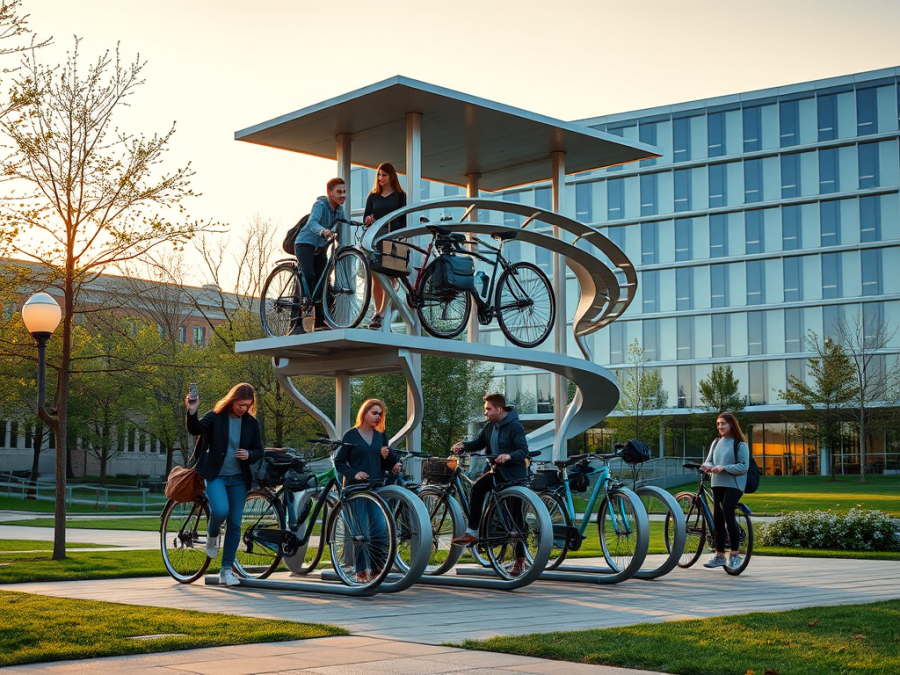
The heavy-duty construction was all for installing a new set of bike racks. But, not just any set of bike racks of course. Noooo. With the University proudly accepting (and even more proudly promoting) its role as the last defense against environmental oblivion, the solution to saving the planet obviously lies in roofed-over, double-decker bike racks. (Or to doubling the number of sweaty (or rain-soaked) students in your classes as compared to before. Same overall impact.) That’s it. And we’re not even talking any of those fancy motorized elevators like you have for cars where parking space is at a premium. Just some cantilevered bike racks powered by elbow grease on a university campus where space really isn’t an issue. At least they listened to my suggestion about making the roofs green (admittedly before I’d actually made it) but too bad they chose to do it on the smallest possible roofs on campus.
But then comes the bottom line for all this, which, appropriately enough, is flooring.
The overall price tag for this latest act by the University to combat global warming? A cool 1.4 million EUR. That‘s just north of 4000 EUR for each of the 340 bikes that can be parked there in all their luxurious glory. Or, for even more perspective, even further north of 8000 EUR for each of the extra 170 bikes that can be parked in them lofty penthouses compared to on plain ol’ low tech asphalt.
And even the (green) roofs are more of a gimmick than anything else. Yes, this is northern Germany where the winters are charitably described as “moist”. But those roofs only help keep you dry the whole time you aren’t actually on your bike. Granted, no one likes to start their bike ride by squishing down onto a soggy saddle, but there were other roofed-over rack stands that they could have converted into two-story jobbies instead. In any case, 1.4 million EUR will buy you a literal ton of 2.99 EUR saddle covers. Even without any bulk discounts …
(Hate the idea of environmentally decimating plastic saddle covers, especially because God only knows that there’s no plastic to be found anywhere else on a bike? Then let’s splurge on lambskin covers for an extra 7.50 EUR a cheek. No. Wait. Those 1.4 million EUR at hand would mean that a lot of animals would be suffering. Hmm. Maybe adding even more concrete to the ecosystem is indeed the eco-friendly way to go.)
In the end, apart from wondering what all the months-long construction was for and where all that money really went to, you also have to wonder that there are people from the University willing to go on record to double down on this double-decker disaster. The word-for-word translation of the quote from the Head of Building Management was that “It was worth it.”
But then it’s this kind of fiscal arithmetic that also explains why there’s nothing left in his budget to repair all the broken doors, leaky roofs, and drafty windows plaguing the buildings on campus that he’s also responsible for …
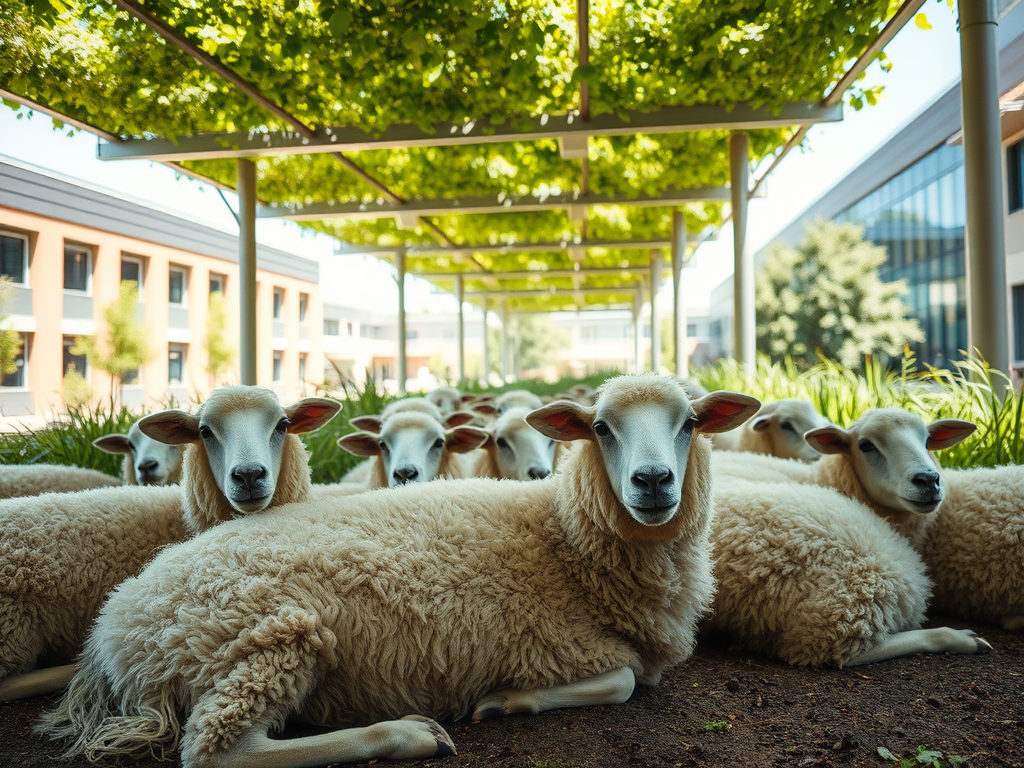
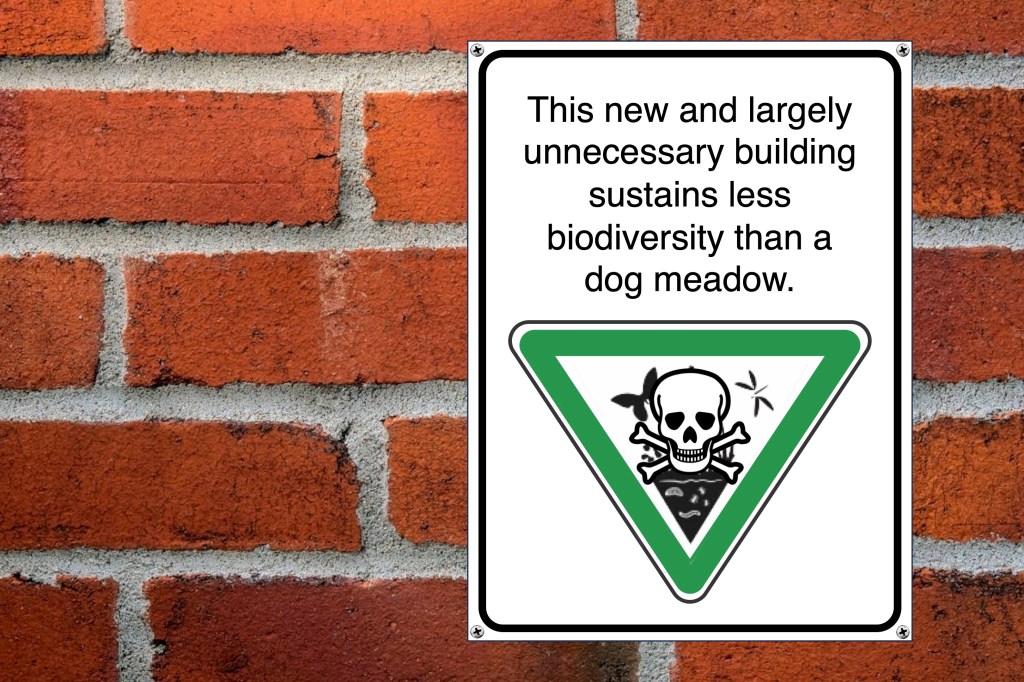
Another week, another example of environmental pseudo-do-goodery on the part of the University of Not-Bielefeld. This time around, the plan is to enlist volunteers from the university community to plant a Tiny Forest (their capitalization, not mine) on the grounds of the university according to the Miyawaki method. Through this action, the hope is to “ecologically enhance” small areas like the “classic dog meadow” .
In and of itself, it’s not a bad idea. As usual, however, there is a lot of crap floating around the idea that is more than questionable. (But ideal to help the forest grow. See step #2 below).
First, I know I’m biased, but, my God, can we leave the dogs alone for a second here? It’s amazing how often “man’s best friend” is on the short end of society’s stick instead of chasing it. (Not nearly as often as a lot of people, admittedly, but still.) Moreover and somewhat fittingly, dogs aren’t even all that welcome on campus, so who gives a shit? Definitely not the dogs and definitely not on that meadow.
Second, like the city of Not-Bielefeld itself, the university campus is actually already pretty green with lots of bushes and trees and comparatively few open spaces to enhance. Admittedly, there is a clear difference between some scattered pockets of bushes and trees and even a Tiny Forest (although a strip of grass qualifies as a meadow according to the University), but, nevertheless, what kind of extra biodiversity are they hoping for here really? Moose? Wild boars? Because there are exactly none of those in the (non-tiny) forest located directly adjacent to the university campus.
Finally, anyone judging biodiversity primarily in terms of more vs. less, good vs. bad doesn’t know their job very well. Is a forest an “ecological enhancement” over a dog meadow? For forest dwellers, yes. But any inhabitants of that meadow might beg to differ and meadows (without signs) have been around for a lot longer than either humans or dogs. Does this mean that Nature failed Biodiversity 101? Or is it more likely a case that the person in charge has an advanced degree in Anthropocentrism and thinks that more complex environments are simply those where we can see more big plants and big animals? The key to biodiversity, you see, is actually right there in the name, namely diversity. And not just within any given habitat but also between habitats. Going strictly by the criterion of “more is better” ironically turns global warming into a good thing because we’ll be upgrading all that low-rent tundra into something much more ecologically productive. And, any extra deserts can be easily handled via the “Irrigation method”, thereby using all the excess water from the melting of the polar ice caps that we’re going to have to find a use for anyway. (But only if we think that keeping Holland and the US eastern seaboard around is a good idea.)
Easy …
Again, I’m not saying that this action is a bad thing and certainly every little environmental effort helps. Instead, what bothers me about it (and related actions on the part of the University of Not-Bielefeld) is that they all seem much more like publicity stunts rather than anything rooted in deep conviction. Often the time, energy, and money that the University has invested in promoting their sense of environmental responsibility has far exceeded their investment in the actual actions themselves.
Take the gratuitous bit of namedropping in this case. Ever heard of the Miyawaki method before? Me neither. Sounds fancy and official though, doesn’t it? The reality, however, is that the method essentially boils down to the following four, really simple steps:
scope out the native plant species that comprise mature forests in the area,
fertilize the designated plot as needed,
plant the desired, native seedlings in a dense, mixed manner, and
weed the plot as needed for up to three years.
With no offense to Akira Miyawaki (especially because the Tiny-Forest method itself seems to stem from the Indian engineer Shubhendu Sharma based on Miyawaki’s ideas), but as much as this method might have been a revelation in highly industrialized (i.e., barely ecologically conscious), post World War II, western societies, it hardly seems like rocket science now. Much of its appeal seems to lie in it enabling a mature forest to be established in decades rather than the more usual centuries because it avoids all those intermediate, regenerative steps with other plant species that Nature throws in. But, what’s the rush? Like a dog meadow, these intermediate, successional habitats also support their own biodiversity and so aren’t unimportant either. And even mature forests have immature bits in them and, gasp, sometimes also Tiny Meadows. But, no, we need our better kind of biodiversity now and especially in a way where we don’t get our hands all that dirty.
Speaking of which …
The homepage for the event also has a FAQ where one of the questions answered is what kind of clothes the volunteers need to wear for the event. Really? Do you really need to tell people at a university that they should wear clothes that can get dirty when planting trees? (Even more idiotic, however, is the next sentence in this same answer where they advise people that “certain weather conditions can prevail at the end of November to which the clothing should be adapted”. (And this wasn’t just a bad translation because the original German wording was word-for-word just as self-importantly uninformative.) George Carlin would go nuts here. First off, the end of November is not some magical time. Certain weather conditions prevail at any time of the year you can think of. And why not go out on a limb and actually name those conditions, namely cold and wet? Scared of a lawsuit in case it turns out to be hot and dry and some by-the-book moron collapses because they showed up in a waterproof polar-exploration suit regardless? Finally, if you have to say anything here at all—and you don’t—just say that everyone should dress appropriately for the weather on that day.)
Finally, like I said, it’s an awful lot of hype for such low-hanging fruit, which, when you consider that we’re talking about a Tiny Forest here, are hanging even lower than normal. Yes, the University of Not-Bielefeld did put up some new windows with built-in solar panels on my building this past year (replacing some of the surrounding bushes with biodiversity enhancing paving stones in the process), but then that helps lower their energy bill too, doesn’t it? What about some real and selfless investments, like installing green roofs on all the buildings or replacing the other windows in my building, which at 40 years old are at least 10 years past a normal window’s functional lifespan of about 15 to 30 years? Or maybe mothballing all those gas-powered leafblowers in favour of a few more people with a few more rakes? Or just leaving the leaves? Nature always seemed to find something to do with them, even back in the day when there were more trees and fewer meadows or paving stones.
Nah …
The problem here is that most real solutions cost real money and are usually much harder to advertise. No one will see your self-congratulatory sign on a green roof now will they?
If the university wants to shamelessly promote itself, so be it. Let’s just see some truth and balance in the process though. For instance, since I’ve been at the University of Not-Bielefeld, the university has been putting up new buildings at a rate of one building about every two years or so. New buildings, of course, are great for PR: big, shiny, and complete with over-sized scissors for the press to photograph at the official ribbon-cutting ceremony. But, how about also including a new sign with each new building to round out all that self-promotion?
The longer I live in Germany, the more I’ve come to realize that the country has a two-tiered income-tax system. And not just the default one for rich people vs. poor people present everywhere else. Instead, there seem to be distinctly different sets of rules depending on whether you’re the one paying the taxes or the one filling your pockets with them. (Although this too is undoubtedly present everywhere else as well.)
One of my first entries for this blog was about how, many, many years ago, the German tax office sent my father in Canada a tax assessment for three years running and, in so doing, also assessed late fees for the first two years because the taxes owing had not been paid promptly. Despite his logical counterargument that it is impossible to punctually pay a bill that was never sent, the tax office insisted that the late fees (and of course the taxes) be paid.
(This is all not nearly as corrupt as it might sound insofar as, as far as I know, German inland revenue does not hire Nigerian princes to target random foreign nationals for them. My father did work in Germany in his 20s and the taxes he owes now are for the pension he earned then. Why the tax office can’t take the taxes directly off his pension check is an ongoing source of bewilderment. To us. Apparently it’s not possible because the tax office and the pension office both belong to the same overall governmental structure. (Same as when I had to provide evidence of my German divorce to the German registry office to be allowed to get married again.))
Fast forward to this year and the stupidity, like the late fees, has been compounded. Instead of having to pay his taxes once per year in arrears as was the case until now, my father is now expected to prepay it in quarterly installments. Or, in other words, being extra financially punished because of the incompetence and greed of the tax office. Because for the necessary international money transfers, quarterly installments also mean quarterly shitty exchange rates on top of quarterly bank fees from, again, banks on both sides of the Atlantic.
My own, more recent experiences with the German tax office have been equally bureautocratic …
I recently wrote about how you have to be handicapped in the right way and in the wrong amount to count as being officially disabled in Germany. (For example, and in my case, any form of depression isn’t enough but any form of cancer is.) The government has officially known about my chronic depression since 2017 but because depression alone doesn’t get you to that all-important cutoff of GdB 50 (= severely disabled), depressed people are considered healthy for all intents and purposes with no benefits.
At least that was the case in 2017. Earlier this year, I discovered by accident that the law had changed in 2020 so that anyone with a GdB got at least some form of tax benefit. I can understand why the government did not take out ads during European football championships that year to announce the change. (And not just because there’s little opportunity to squeeze commercials in during a football match.) But did the disability office inform any of us unseverely disabled people on their books about this new development or per chance inform the tax office about us? No, of course not.
And then last night I was perusing my latest payslip and noticed, again completely by accident, that I was receiving the child-tax credit for only one of my two still dependent daughters. Looking back over my payslips for the past couple of years, it was immediately clear that the child-tax credits were being dropped as soon as my daughters turned 18, regardless if they were still in school or university and thus both officially counting as “dependent” and officially entitled to child support from me. When I asked my accountant about this, she replied that you have to formally apply for the child-tax credit each year in such cases. First off, who tells you this? Second off, how can it be that the tax office immediately knows when one of my daughters turns 18 but is unable to process that the continuing child-care allowance being paid out to my ex-wife for them means that they are still officially classified as dependent?
In other words, inland revenue has absolutely no problem getting information from other government offices when it brings in more money. But they suddenly play Oscar-nominated stupid in the reverse case. One could call that sound fiscal management, I suppose. But if any private citizen tried to follow their lead and stopped paying the obligatory child support at the same time that they stopped receiving the equally obligatory child-tax credit, they’d be on the losing end of a court action before the authorities had finished their next coffee break. And asking for the appropriate rebates after the fact for either my disregarded disability or my dependent daughters is seemingly pointless too. As my accountant told me, once issued, a tax assessment is final.
Except that it isn’t. Again, my experience has been that it all depends in which direction the money is going …
A good many years ago, after having already gotten my tax statement (and refund) for the previous year, I got a revised assessment from inland revenue saying that I owed them more money for that same year. As it turns out, my ex-wife had filed her tax return some time after me and some of her income was pushed onto me, from which the tax office naturally wanted its share. I could have fought it but the amount due was so paltry that it just wasn’t worth the effort to lodge a formal complaint.
In fact, it was more than enough effort to chase down my wife’s accountant just to find out what had happened in the first place. It took me multiple phone calls over the span of two weeks to finally be told matter-of-factly about the above scenario. The accountant wasn’t interested a whit that the money was never actually paid to me and replied that she was just doing what she was told before proceeding to bill me for over 100 EUR for this official “tax advice”. (I calmly wrote her an e-mail back saying that I was not asking for advice but merely an explanation for her illegal activities and that she could go and screw herself. No idea if she did what she was told in this instance too, but I also never got another bill from her (with or without a late fee).)
Now, I’ve never been one of those who are against authority from the get go. (It’s probably better than anarchy but definitely less interesting.) I am, however, becoming increasingly frustrated with unaccountable authority (so not just the tax office) where they dance to a different set of rules and the answer to any question about the process is something lazily unhelpful along the lines of “no”, “just because”, “that’s the way it is”, or the ever-popular “because we said so”, all while quoting some arcane, random collection of letters and numbers from the nearest law book. Is it repetitive and annoying answering the same questions over and over again? Of course it is. I have a similar problem in teaching the same crap to a new cohort of students year in, year out too. But then it’s all part of the job description, isn’t it?
And were I to complain to the University of Not-Bielefeld about it, I’m sure that they would simply tell me that “that’s the way it is”.
Dedicated to my father (†26.11.2024), who sadly didn’t have the chance to read this entry anymore. But, let’s see them get their taxes now …
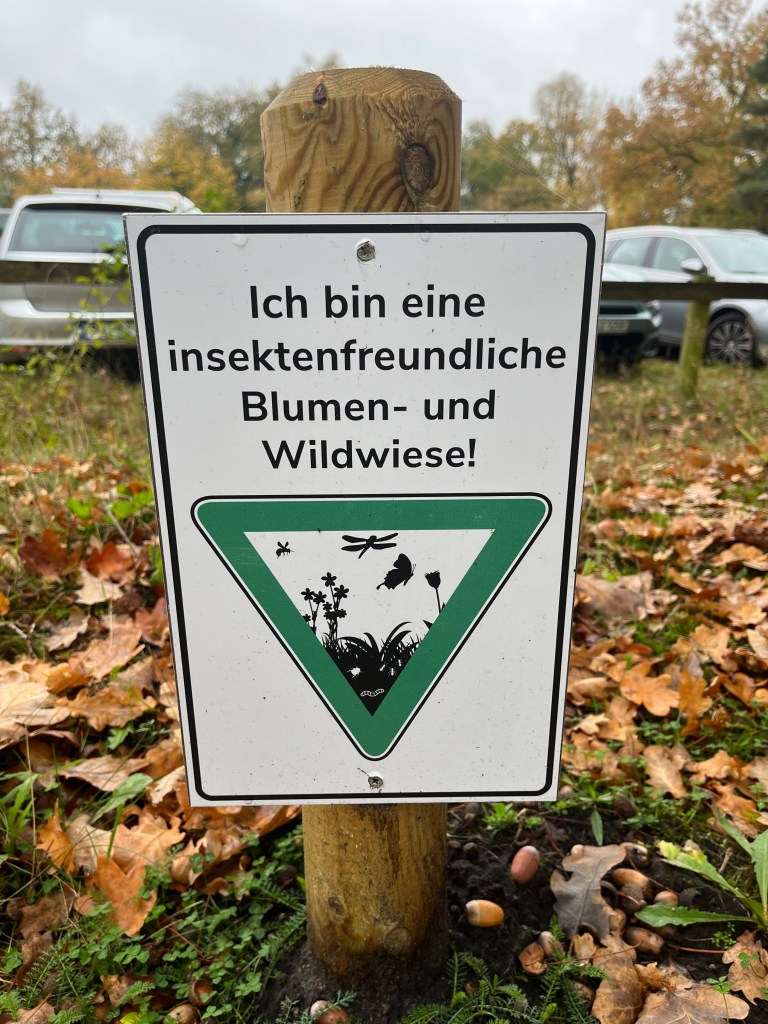
Over the past few weeks, any number of the following signs have been sprouting up on the grounds of the University of Not-Bielefeld.
The literal, word-for-word translation of the sign is:
I am an insect-friendly flower and wild meadow!
This all is, of course, complete nonsense in oh-so-many ways. First, it’s a sign and not a meadow. More accurate would be “I am a sign on an …”. Second, even so, signs cannot really refer to themselves in the first person. (Nor can meadows, with or without the help of a sign.) Third, there’s no need whatsoever for the exclamation point. The message is not all that exciting or surprising and signs and especially meadows are not prone to shouting. Fourth, this particular “meadow” is really just an elongated strip of grass between the parking lot and the sidewalk. Finally, and most importantly, the actual translation of the sign is much more along the lines of:
We’re hoping that everyone interprets this as us being environmentally responsible instead of really just trying to reduce our gardening costs.
In a recent post of mine about AI, I took some potshots at the new AI features that WordPress had rolled out through its Jetpack plugin. A couple of blog posts later and the AI still hates the way that I write and I still hate its suggestions for titles for my blogs. So, we’ll call it even up to now …
(Sort of. According to the Jetpack website, “optimal readability” comes when you write at a grade-eight level. Or, put another way, for junior-high-school dropouts. (For those who, like the AI, are keeping score, my blog entries tend to hover between a grade-ten and grade-eleven level. So still for dropouts but at least for a better class of one.) Even more curiously, Jetpack seems to think that writing is a video game, suggesting on the same webpage that I can “adjust my writing in real time” according to the dynamically updated readability score. Uh, sure. (That being said, this utterly gratuitous adjustment to simply insert the word supercalifragilisticexpialidocious just increased the reading level of this post by about a third of a grade. Apologies to all those that might have been left behind because of this …))
Where I greatly and unfairly underestimated the AI, however, was its ability to generate images for my blog given the right prompt and I have been increasingly turning to it to populate my pages with pictures. It doesn’t always deliver what I want but, in many (simple) cases, it is by far an easier option to generate more and better hits than a Google image search under the restriction of the appropriate creative-commons license.
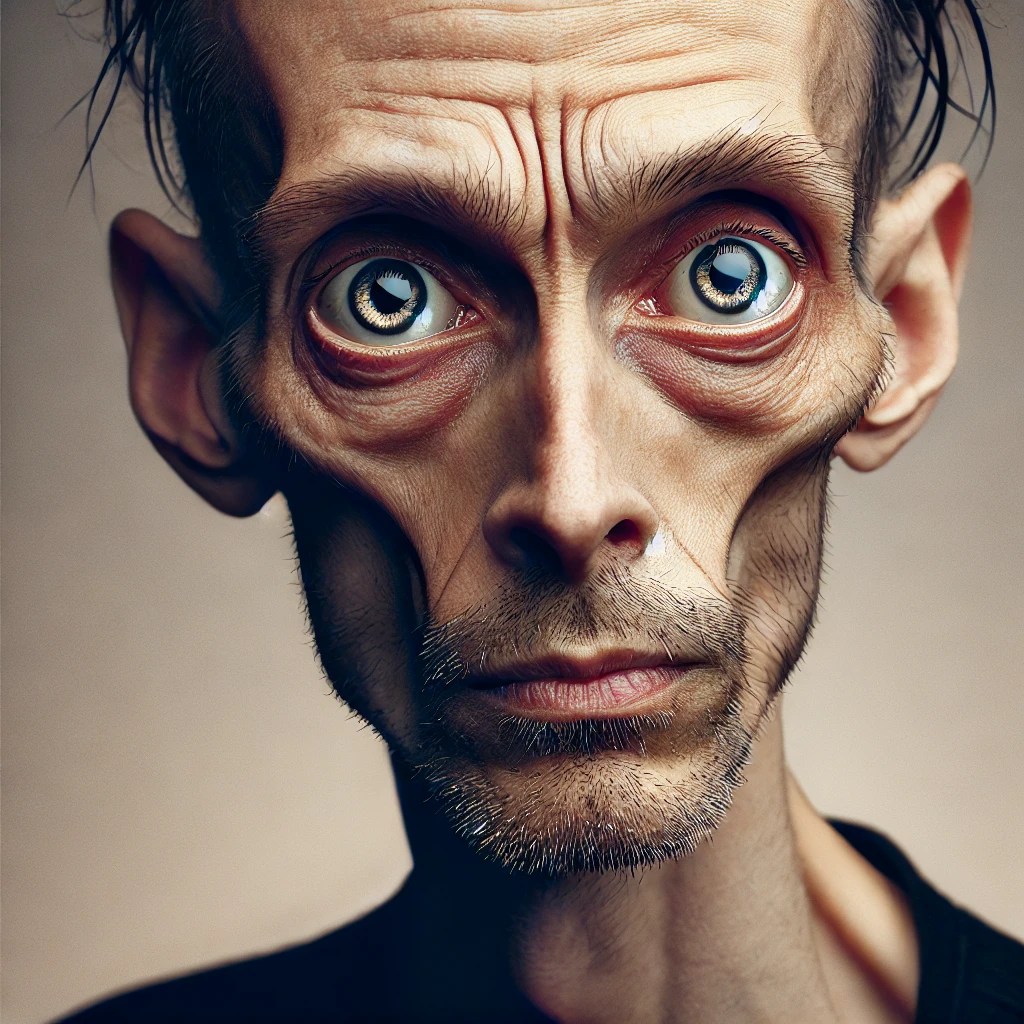
Nevertheless, I’ve noticed that the people that the AI creates tend to be extremely white, extremely young, and with extremely perfect features, especially the women. For instance, to the right is the example of the first image it produced when I asked for an “ugly person”. It’s often said that beauty is in the eye of the beholder but that is unquestionably one damn fine looking ugly person. (When I put the same request to ChatGPT, it hemmed and hawed a lot at first, saying that it could produce a picture of a face with “unique or unconventional features” albeit one that would still be “respectful” and, in the end, gave me the obvious caricature below via DALL-E.)
Now, there’s no shortage of articles about the “pale, male, and stale” bias also infecting AI, something that one firm confidently predicted would be addressed by 2021, but there seems to be more to it than that. For one thing, pale, male, and stale typically refers to middle-age white men—hi there!—and, unless all these people are from the Middle Ages, none of the pictures being generated for me are getting anywhere near that age bracket. For another, where is the bias coming from? By all accounts, AI now has the entire internet to train on and a quick Google image search for almost anything spits back a lot of non-white, non-young people in the pictures, most with definitely non-perfect features. Or, in other words, more what your average person more or less looks like.
I know that the A in AI stands for “artificial”, but this doesn’t mean that the selection of people it throws back at us has to be as well.
Over the past few years, a number of women in my lab group have welcomed children to the world, the most recent being just a month ago. And, it got me to thinking just how much things have changed through the years regarding how pregnancy is viewed and especially how admin wants to spread the labour pains around to be enjoyed by as many people as possible.
(At the uncharacteristic risk of potentially annoying someone, I’m going to pretty much sidestep any discussion regarding the relationship between womanhood (or gender identity in general) and pregnancy and just talk about pregnant women. Pregnant person or pregnant individual sounds to me like something that admin came up with. And, although commonly used, the phrase “we’re pregnant” is just plain stupid because one partner clearly is not. The couple might be “having a baby” together (with one of them doing a lot more of the actual having), but one of them is very much very not pregnant.
And, since I’m digressing anyway, why is it that we take a shit but give birth? Both activities involve more or less the same geographically localized, generalized actions. And, if you really want to give something away, it’s definitely your excrement rather than your newborn baby. But, nevertheless, giving in the context of shit is never good, either when you’re giving someone some of it or not giving anyone any of it.)
Ahem …
In looking back, it’s abundantly clear that times have certainly changed regarding pregnancy in the 15+ years that I’ve been at the University of Not-Bielefeld. Back when I started, pregnancy was pretty much a non-issue and, despite occasionally holding lab courses with some mildly dangerous chemicals, female students were not required to inform anyone if they were pregnant. As a matter of fact, any obligation in this regard at all lay on us, the teaching staff, to instead recognize if any woman was pregnant.
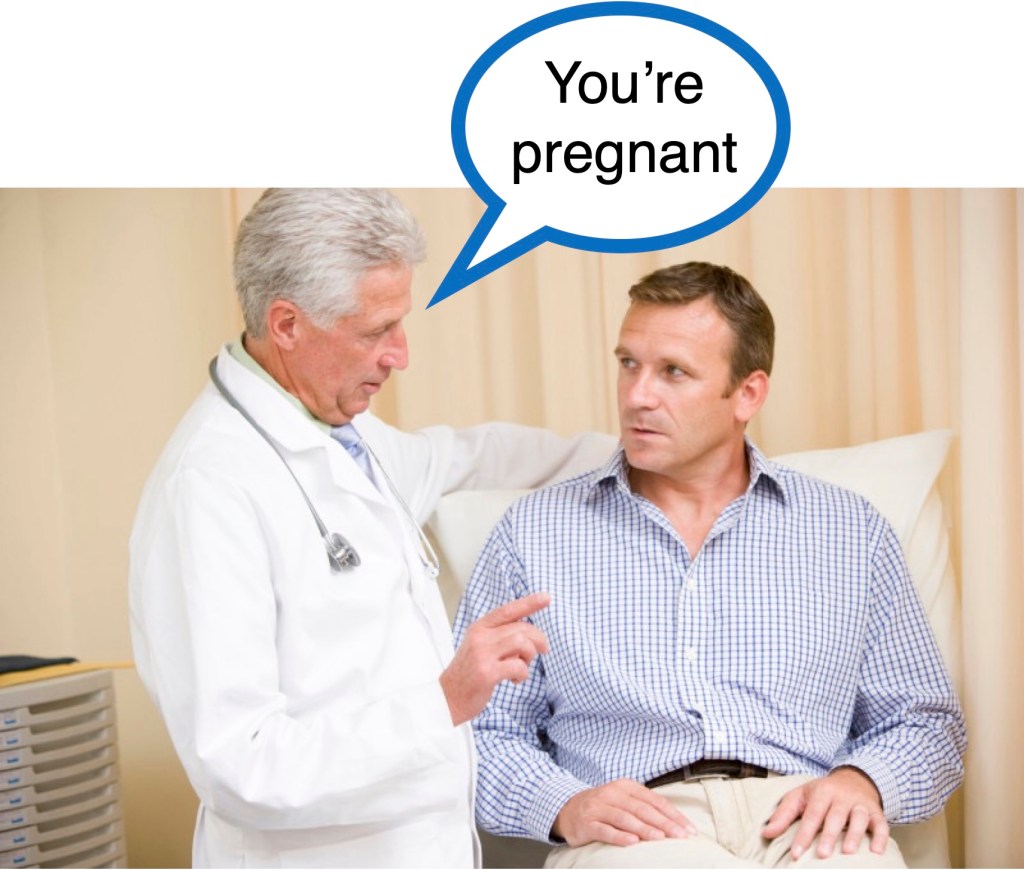
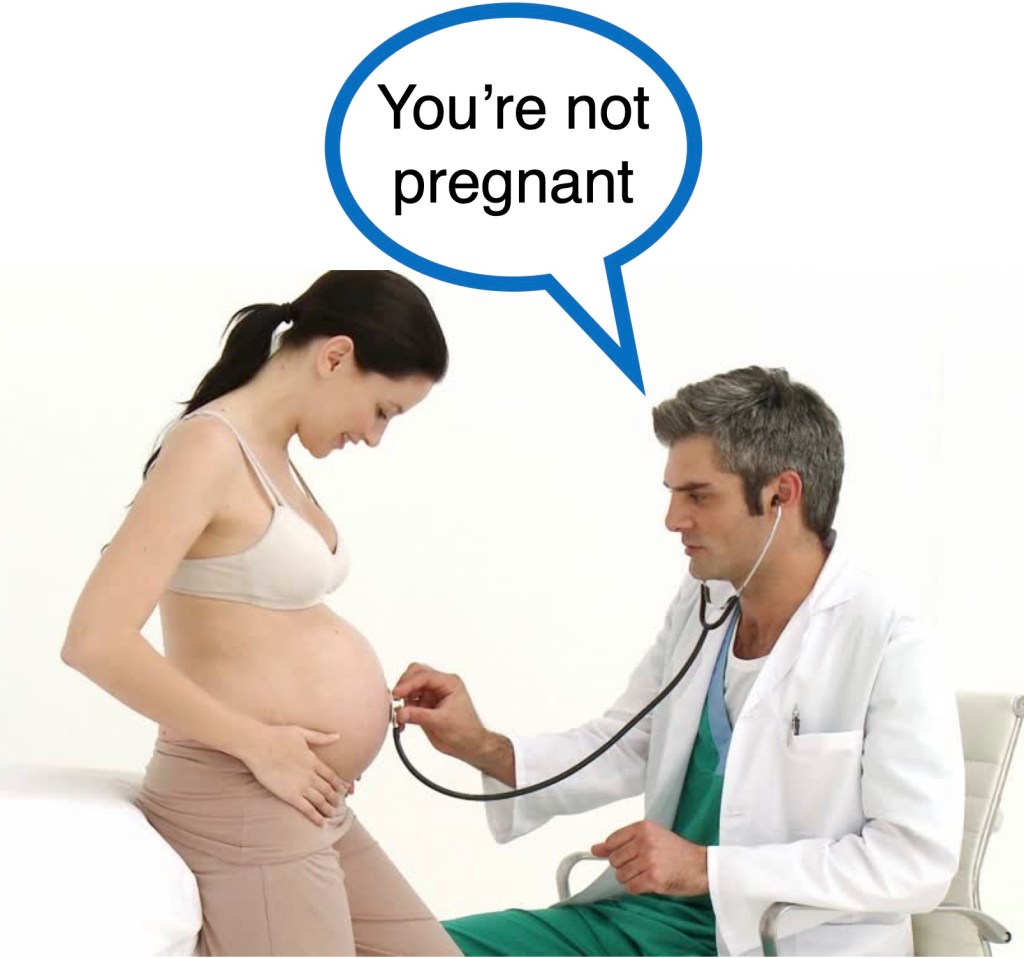
The situation was, of course, patently ludicrous. There is a both reason and a need behind all those home-pregnancy tests: in those first few weeks, pregnant women are generally unaware of having gained that particular adjective. So what chance does an outsider, especially a male one, possibly have? Guessing wrong in either direction is at least embarrassing, if not dialing up to potentially dangerous in the current social climate.
Take these two, real-life examples …
First, the false positive. After some kind, older gentleman repeatedly offered a good friend of mine his seat on the tram, she finally got him to stop by telling him that she was “not pregnant, just fat.”
And then the flip side, the false negative. A student was recently shocked this past May when the woman in my group who just gave birth told him that she wouldn’t be doing any teaching in the Autumn because she would be on maternity leave. He had absolutely no inkling that she was pregnant, despite her being about halfway through it and thus in the category of obviously pregnant. (Or, in other words, “not fat, just pregnant.”) And we were talking obvious here. I mean, she rocked when she walked and not in the sense of head banging.
Perhaps fortuitously, however, that all was in the days before data privacy was entombed in official bits of bureaucratic overkill like the GDPR and when you could ask a woman for such direct, personal information and only come away embarrassed at worst and not under arrest. However, since then, society has increasingly become aware of just how precarious the life of the unborn is (unlike the lives of the born, which we can happily stuff full of calories, chemicals, and carcinogens) and the University of Not-Bielefeld has followed suit, due in no small measure to the overblown sense of self worth that the corona pandemic gave to its Work and Safety Office.
The paperwork remains mostly the same piece of stupidity inherent to most forms, but everything else around it has been leveled down to match.
But first the form …
It’s an eight-page monster from the provincial government that attempts to gauge what dangers lurk for the pregnant woman and her unborn child at her workplace. Part of the reason why the form is so long is because many of the questions are duplicated, once for when the woman is pregnant and once for when she is nursing. Fine. But, despite the respective, duplicated questions being clearly separated from one another in their own separate sections, the form nevertheless has to be submitted twice. You guessed it, once for when the woman is pregnant and once for when she is nursing.
Much of the form is filled with questions as to whether “unjustified endangerment because of <insert risk here>” exists in the workplace. But, like the successful McDonald’s coffee lawsuit that won on the grounds of the coffee being “unreasonably dangerous”, such questions immediately beg the further question as to what counts as “justified endangerment”. (Especially given that one of the risks listed is simply “accidents”. Can anyone explain to me what unjustified endangerment because of accidents actually means in practice?) Fortunately (?), the effective answer for the University of Not-Bielefeld is nothing whatsoever. For instance, my group does quite a bit of work with electron microscopes. Although the machines are shielded like crazy and emit less radiation than a three-year-old worn-out glow stick, pregnant women can’t go anywhere near them, even despite the form only referring to “extreme electromagnetic radiation”.
Undoubtedly the most bizarre part of the form is that it explicitly asks about any risk posed by “underground mining activities”, which, together with their above ground variant, are lines of work with a notoriously heavy female bias. This is not to say that women, heavy or otherwise, can’t be miners, only that minors shouldn’t be miners. It’s more so that there just aren’t that many of them. So why is just mining being singled out in the form and not some other high-risk profession like, say, space travel? Or firefighting? Surely the inherent risks to pregnant women through mining (or space travel, …) are covered by all the other, more generally applicable risks on the same form.
A new twist since the pandemic is that corona automatically counts as level two / three biohazard. (Well, automatic in the sense that I am obligated to check it off on the form as a risk. Can’t have admin doing any of the work associated with their new rules, now can we?) I could understand this during the pandemic. But now? Is corona even a thing anymore? Even the University of Not-Bielefeld has loosened its corona regulations to the point where corona no longer prohibits you from coming to the university and no longer obligates you to wear a mask either. (And, thank God too. To be honest, I’d much rather live with the guilt of infecting my neighbour with corona than with the pain of having to fill out the University’s new forms for going on sick leave.) But, for pregnant women, it means that they either have to get their own office (which are in extremely short supply) or they have to work from home.
What is unknown to many, however, is just how risky ubiquitous, everyday items can become once they are placed in a lab setting. Take ordinary table salt for instance. Use it in a lab at the university and it’s strictly controlled. Use it across the hallway for lunch and it’s controlled only by your taste buds and/or high blood pressure. (But this comparative lack of caution might be a more of a practical concession considering how difficult it is to eat through a respiratory mask.) The same is true for caffeine, that necessary catalyst for almost any scientific endeavour. It officially comes with the warning that it is “harmful if swallowed” together with the subsequent recommendation to “immediately make victim drink water (two glasses at most)” as well as to “consult a physician”. How fortunate then that caffeine is generally off-limits for pregnant woman anyway.
And finally there’s folic acid (AKA vitamin M but really vitamin B9—say what?), which for some time now has been a recommended supplement for all pregnant women to minimize the risk of spina bifida and other spinal defects in their babies. Although not classified officially as hazardous—it is a vitamin after all—there are nevertheless safety precautions to be observed when using folic acid in the lab, which again include drinking water after swallowing it. This, of course, is in complete contrast to the situation at home where you normally drink the water to help you swallow it.
The form then painfully meanders its way through the admin maze before finally landing on the desk of a Betriebsarzt (company / government doctor), which are to real doctors what all those helpline specialists in Asia are to the technician actually sitting in front of your busted piece of technology. (I’m not saying that either Betriebsärtze or the helpline specialists don’t know their shit, just that their shit goes a lot further when the patient is actually right in front of them.) And, based on the form and a vague job description, the Betriebsarzt then makes the official call as to what the pregnant woman, someone whom they have never seen nor talked to, is allowed to do at work.
… and which, for all the women who have gotten pregnant in my group (n = 3), has always amounted to little more than sitting in their new, private offices and trying to fill their workdays doing stuff on the computer. (At this point, we’ll just conveniently ignore the inconvenient fact that computers and mobile phones, like all other sources of electromagnetic radiation, can increase the risk of miscarriage and abortion during pregnancy. Because they are not listed on the form, they can’t be a risk, now can they? Especially because they’re not commonly used while mining underground.) Fortunately, however, this restriction does provide them with ample time to figure out how to get a replacement to do the required bits of their jobs that they are no longer allowed to do. That’s right. Although the University of Not-Bielefeld does provide money to hire the replacements, there is no clear mechanism to get at it. Or at least no admin type in my entire faculty, including the equal-opportunity officer, knows how it’s done.
In the end, you have to wonder how many of these precautions are really that necessary. Back when I was a fetus, my mother continued to smoke and drink alcohol and also partied like it was already 1969 on New Year’s Eve to try and get me to come out a little bit sooner. And, you know what? I turned out ok. Got my share of health issues, sure, but they seem paltry compared to what a lot of young people today are suffering from despite their protected pregnancies. Back when I was growing up, I was the only kid I knew who had asthma, almost to the point where my teachers had to look up the word themselves to spell it for me. Although better diagnosing (as well as over-diagnosing) are playing their part, all the stats indicate that the incidence of asthma is higher than it’s ever been. And, although I have absolutely no data to back me up whatsoever here, the same seems to be true for ADHD or neurodermitis or a host of other conditions that were virtually unknown back when I was young. In fact, there’s a growing suspicion that the increasing incidence of asthma and many other autoimmune diseases is caused in part by us increasingly overprotecting our children by oversterilizing their environments (the hygiene hypothesis), causing their immune systems to desperately search around for something else to prime themselves on.
In so doing, I’m not saying that pregnant women should not be looking after both their own health and that of their unborn baby. But the degree to which western medicine and western society want to treat pregnancy as a disease seems like a unnecessary luxury that all other mammal species and indeed most other humans have never really needed.








_(cropped).jpg)














 The Blog About Fog