Over the last decade of so, the University of Not-Bielefeld has increasingly targeted international students in a bid to become a more global player on the university scene. One “crucial” step in this direction over the past two years or so is having e-mails from central admin (including the President’s Office) in two languages: German and what DeepL assures admin is the English translation of it.
The problem here is that admin types tend not to be bilingual, at least not with English as the second language, so they just run with the translation without checking it. There are, of course, some interesting constructions that DeepL thinks up for itself, but it generally does a good job. However, there are also some obvious, additional, non-DeepL typos that a quick proofread would catch.
For instance, thanks to corona, we supervisors now have the option to register all the Bachelor and Master theses for our students online. (Not really online online in the form of a form, but just e-mailing the form to the Examination Office, probably because they still have to print it out on their end. But, hey, it’s still a step up towards the modern world.) The confirmation-form-e-mail (remove one hyphen around “form” as you see fit), for which someone on their end has to type in the relevant details (so hush hush on the webform before they realize that it shoves even more of their work our way, k?), starts off great in German, not so great in English:
German: Sehr geehrter Herr fogBlogger,
English: Dearfogblogger,
We’ll forget about Sehr geehrter translating out literally as “most honoured” because no one outside of a spam mail would say that in English (so plus points to DeepL), but somehow not only my gender but also a fairly important piece of punctuation has been lost in translation. And this for months now without anyone noticing (or in my case complaining).
Ah yes, bonehead confirmation of the day it seems …
Those of you out there who, like me, are too cheap to pay to remove the ads from their mobile apps know all about this: the commercials for other apps that “challenge” your ego by saying (without any data, evidence, science, or apparently conscience) that “only 5% of people can solve this” or by showing that getting so far in the game means that you have a “brain age” or IQ of some randomly generated number.
Indeed some appeal to intelligence (or lack thereof) seems to be the common ingredient to many of these ads. Ridiculously easy problems are never solved in the puzzle apps and jackpots are always won in the betting apps.
But, I just was confronted with the best one of all time, making for the bonehead commercial of the day …
This ad assured me that only left-brained thinkers could solve the puzzle (some 3D tower block-removal game). Now, if we assume that the notion of being left- versus right-brained is not hair-brained and if we subscribe to the theory that lateralization of brain function does determine (or at least is strongly correlated with) handedness, then only a mere 90% of the world’s population can solve this game. Doesn’t sound like too much of a challenge anymore now does it, especially because all those analytical left-brained types already figured all this out. (Me, being right-brained, am still stuck at “Oooh! Pretty graphics …”)
Admittedly, there are a lot of assumptions being made in my “analysis”, with most of them being debatable at best, but 90% is still a far cry from the stereotypical 5% that was claimed in a previous version of the ad.
Say, you don’t think the ad company might be making all this up, do you?
The longer I think about it, the more convinced I become that Easter originated as an invention by historical admin types to “improve” our life quality.
Think about it …
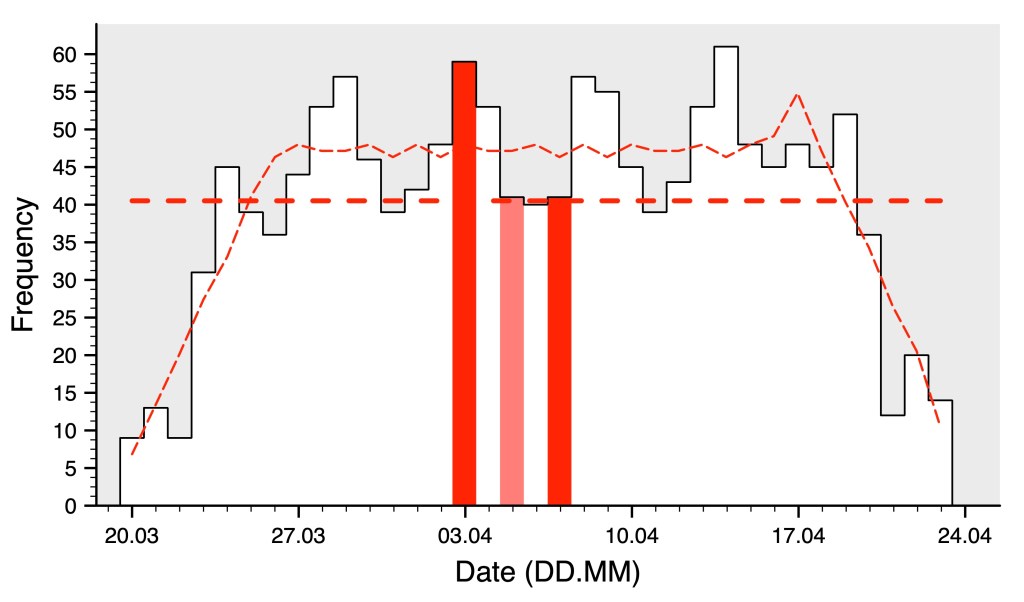
We’re talking about one of the most important religious celebrations / holidays of the year (except perhaps in North America where John Oliver summed Easter up best by referring to it as “shitty Christmas”) and we can’t even figure out when it is. Depending on, of all things, the moon, Easter can fall anywhere between March 22nd and April 25th in any given year.
(This relatively large timespan makes Jesus Christ fairly unusual among famous historical figures. For many such figures, we know the day on which they died (because they had become famous by then), but often don’t know when they were born (because they weren’t yet). Take Shakespeare for example. Assuming that he was not Francis Bacon (or anyone else other than Shakespeare), we know that he died on April 23rd, 1616. But, the most we know about the other side of the life of arguably the greatest writer in the English language is that he was baptized on April 26th, 1564. Another good example is William of Ockham, who died on April 9th, 1347. The most parsimonious thing that we can say about his birth, however, is that he was probably born in 1287 and probably in the British village of Ockham. (My all-time personal favourite though is Plato. According to Wikipedia, he was born sometime between 428 and 423 BC (either that or it was one hell of a labour for his poor mother), but died more politely, if still unusually slowly, from 348 to 347 BC. (Seneca helpfully claims that Plato died on his birthday, but unhelpfully doesn’t happen to mention what day that might have been.))
But with Jesus, it’s the exact opposite. We know precisely on which day and at what time he was born, but he dies on a different day from one year to the next. Huh?)
Anyway. Now where was I?
For me personally, whether holiday or celebration, I simply find Easter to be a logistical nightmare because it hops around more than the bunny it’s come to be associated with. Some years, I can ignore Easter entirely and just enjoy the four-day long weekend it brings. (Sort of. Throughout Germany, there is a ban on dancing on Good Friday. Like Easter itself, there is no standard here and the ban can be as short as part of Good Friday only (Berlin, Bremen, and Hamburg) or extend all the way from 4 AM on Maundy Thursday (the day before Good Friday) to 4 PM on Easter Sunday (Rhineland-Palatinate). I can sort of understand this. The crucifixion of the son of God is not really an occasion for partying, now is it? What I can’t understand is why it’s largely restricted to dancing (meaning that going to a bar and getting drunk is probably ok or at least legal), why only Hamburg also extends the ban to moving house, and why the government has to legislate what in the end amounts to religious decorum. If you feel that dancing on Good Friday is inappropriate, then simply don’t dance. You really don’t need the government to back you up on this.) But, when Easter falls mid (to late) like it does this year, it can hop its the way into the start of teaching for the German summer semester, which is fixed for the middle of April.
For instance, the first day of classes this year falls on Easter Monday, except that that’s a holiday in Germany, so it doesn’t and gets pushed back onto the Tuesday. The week before that, when we usually hold all the organizational meetings for the different classes, are the provincial Easter holidays so those meetings kind of fall flat too and have to be done during the course instead.
Ok. Annoying but not really a nightmare. The latter only starts because of some knock-on effects that chew away even more teaching time. Probably unbeknownst to most North Americans, there are more than a few additional, associated holidays starting 40 days after Easter: Ascension Day, Whit Monday, and Corpus Christi. As such, exactly when they occur depends on when Easter falls in that year; however, they all fall squarely in the summer semester regardless of what Easter decides to do.
The beauty of Ascension Day (or Jesus Skydrive if you translate the German Christi Himmelfahrt literally) and Corpus Christi is that they always fall on Thursdays, meaning that they tend to take out the following Fridays too because one can never have enough Easter-related, four-day long weekends. On top of this, Ascension Day in Germany doubles up as Father’s Day, with many people, fathers or otherwise, completely forgetting the religious significance of the day and instead using the opportunity to get ripe royally ripped and making the subsequent long weekend more or less predestined, if not a necessity. Although it has nothing to do with Easter, add in the first of May (May Day; same principle as Father’s Day, just boozier) and the chaos is more or less complete.
Although I’ve learned to avoid holding classes on Thursdays or Fridays in the summer semester, my Monday course takes a very variable beating from year to year. Best-case scenario is Whit Monday unavoidably chewing away one class. This year, however, Easter Monday and May Day come on top of that. Missing just three classes might not sound like a lot, but that’s a little more than one-fifth of the 14 that there are in total. That’s quite a chunk of material to not be covering and makes it difficult to ensure that the course is consistent from year to year.
As it turns out, most of this is completely unnecessary because Jesus does indeed conform to most famous historical figures insofar as the date of his death has been pretty well nailed down to either April 7th, 30 AD or April 3rd, 33 AD (unsurprisingly, both Fridays) and probably at about 3 PM. Instead, much less is agreed upon about the time of his birth. The consensus of most scholars is that he was born sometime between 6 BC and 4 BC, but the exact date, the month, and even the season remain contested.
So, despite the latter uncertainty, let’s agree to keep Christmas as it is and split the difference and fix Easter as April 5th of each year. Or even the Friday closest to the 5th. It’s still late enough to wreak havoc with my teaching, but at least it’s consistent havoc and I see that as a step up.
At the end of last year, my lab manager went into extended, part-time maternity leave for all of 2023 so that I needed to find a temporary replacement for her for the afternoons. The historical, first step in such cases was always to ask around the department to see if there was someone else who was qualified and on a part-time contract and wanted to stock up for a short time.
And you know what? It all worked out pretty damn good in most cases. The search was simplified and both sides knew pretty much what they were getting (or getting themselves into), part of which was a person who was already in the building and knew all the twisted ropes that this particular department and university had on offer. And, don’t forget, we’re talking about a part-time, temporary position here and so weren’t really doing a great injustice to anyone on the outside.
However, after having found just such a person in our department, I was told that the position, despite being part-time and temporary, still had to be advertised officially to maintain accountability. The University of Not-Bielefeld is, after all, a public institution that is funded by public money (but is, strangely enough, still private property) and the taxpayer has the right to know that their money is being used responsibly. Exactly like when public money is used to bail out private businesses because their unaccountable actions mean that they aren’t making enough profit anymore.
Anyway …
In Act I, I had to form an official hiring committee so I quickly tapped three people from my working group, which is about the minimum number I could get away with. Additionally included as observers on this committee, however, were one member each from the departmental office, the faculty’s equal-opportunities office, the university’s employee council, and, potentially, the university’s equal-opportunities office.
Now this is not to imply that the equal-opportunities offices of the faculty and the university don’t communicate with or trust one another. They just target different minorities is all: women at the faculty level and persons with disabilities at the university one. (I have no idea what politically-correct terminology has against adjectives. Seriously! Beside the extra, convoluting syllables, what is the honest-to-goodness difference between “disabled person” and “person with disabilities”? If anything, the latter implies that the person has more than one disability. And why are adjectives only outlawed for minorities? For instance, no one would ever refer to me, a white male, as a person with underpigmentation and heterozygous sex chromosomes. Seems to me that adjectives should sue for discrimination here …)
At least the university office admits their narrower scope because German name for the officer in charge (SchwerbehindertenbeauftragterIn) clearly indicates the focus on people with disabilities. This isn’t the case for the faculty’s Gleichstellung office, the name of which literally translates out to “equal opportunity” (which is also the English translation that the university uses), but the practical remit of which doesn’t extend beyond women.
You want to hire disproportionately more women? That’s cool. Women have been on the short end of the academic stick (and many others) for far too long. Just call it what it is. (And please don’t call it “positive discrimination”, which is simply moronic because it’s needlessly oxymoronic. Discrimination is negative. Period. So don’t try to be clever and try to make it something positive especially when other, better, and more direct phrases for it like “equal opportunity” or “affirmative action” already exist. Imagine the outcry if you tried the same trick with the word “racism” (which is actually just a subset of discrimination, BTW) …) For instance, our departmental office, which has been 100% female for about a decade now, once had to fight with the faculty “Gleichstellung” office to have a phrase included for an open, secretarial position they had that men, the minority gender in this case, were specifically encouraged to apply. And the “Gleichstellung” officer? Has to be female according to the University’s (almost definitely illegal) regulations and is elected at a meeting to which only women can attend. Gleichstellung has never looked so ungleich before …
And then comes Act II …
The position was then advertised through the personnel department on the university’s web pages and, after all was said and done, there was one whole applicant: the same woman I had head-hunted a few weeks earlier and had informed about the advertisement. Everyone else seems to have somehow overlooked the ad despite it running for an entire two weeks (the official minimum) from December 14th to 28th. Curious …
And then came the motions in Act III …
First a meeting to decide on a shortlist (and if one isn’t a short list then I don’t know what is), then another meeting where the candidate was interviewed by the committee, and finally a meeting where the committee made a recommendation of who to hire. And then the obligatory paperwork: minutes of each of the “meetings”, a form indicating the “Gleichstellung” measures, and finally a form to hire the preferred candidate. Annoyingly, most of these forms asked for the exact same information such that they could have been combined into one with copies sent around as needed. More curiously, although all the forms allowed the applicants for the position to be non-binary, the same was not true for members of the hiring committee who had to be either male or female. And this on the “Gleichstellung” form of all things! So non-binary people apparently either have to choose their gender upon being hired by the University of Not-Bielefeld or don’t get to sit on any hiring committees.
In the end, the one lingering question to this three-act charade is where the much ballyhooed accountability was. There was a lot of talk—and a lot more bureaucracy—but little to no real action.
Let’s be honest: the result with all the “accountability” was exactly the same as the one I would have gotten otherwise. Both the hiring committee and the advertisement (especially the timing of it) were just this side of illegitimate. And all the other control mechanisms were largely no-shows as well. I’ll give the university equal-opportunity office a pass here because there were no candidates with disabilities so their input wasn’t needed. The same goes for the departmental office, which had actually done their work already in letting me know beforehand what the legal requirements for the process were. But, the faculty “Gleichstellung” office politely jumped ship before anything got rolling and I only ever heard back from the employee council twice, both times saying on short notice that they wouldn’t be able to attend the meetings where the important decisions (making the shortlist and who to hire) were being made. For the employee council they at least admitted that it was because of a shortage of Homo-sapiens power and the same was probably true for the faculty “Gleichstellung” office as well.
But if you’re going to make other people jump through hoops for you, then at least have the decency to be there in person to hold the damn hoops and not just reserve the right to veto any decision afterwards that you could’ve actively been a part of beforehand.
If you can’t, then maybe those hoops weren’t all that important in the first place now were they?
When I first came up with the acronym BCD (bonehead comment of the day), I never realized that it would be so versatile. Or at least the C in it. Today, it again revolves not so much around a comment as it does a command.
Yesterday evening, the University of Not-Bielefeld followed the provincial decree to downgrade the obligation to wear a medical mask inside its buildings to a recommendation as of February 2nd. Although this has happened far later than most anywhere else in Germany, I don’t have a problem with this, having always been on the more cautious side of corona. No, rather than the arguably late timing of it all, it was the inarguably weird timing of the implementation that had me wondering.
For instance, why not repeal it immediately instead of three days in the future? Do we all need to somehow prepare ourselves mentally for this or something? Does corona get even less dangerous in those three days? And will we still get thrown off the campus for trespassing (no joke!) if we get caught without a mask on until then?
And then there’s the odd date: Thursday, February 2nd. Not the start or end of a week or even of a month for that matter. (Although it is technically the end of the workweek for many here in the University given how empty the place is on Fridays.) Could it have something to do with Groundhog Day perhaps? You know, letting the bottom of your face finally emerge from its “burrow” to predict when the pandemic might end?
One thing is certain though. I’m really curious to see what many of the faces actually look like compared to how my mind has been filling in the details over the past three years …
Not so much of a bonehead comment this time around as of a bonehead contraction …
I’ve written a couple of times about how the Germans like their laws and about how they like referring to their overly long names with sometimes rather cryptic abbreviations. Today, I discovered perhaps one of the most unfortunate abbreviations ever.
The Maternity Protection Act here in Germany (Mutterschutzgesetz) is officially abbreviated as MuSchG. This is not only difficult to type, but also highly reminiscent of the German slang term for a certain part of a woman’s anatomy, namely Muschi. Interestingly enough, Muschi is also a popular name for female cats, drawing immediate parallels to the English word with which it sort of rhymes and which can also refer to either cats or, on about the same level of vulgarity, female anatomy. Even more interestingly, despite the same parallels between cats and anatomy also existing in French, only the German Muschi seems to have come upon its dual meaning from two different sources and not the one from cat going over into the anatomy.
As always, anyway …
The first, immediate question that arises is who came up with this? The only other German word my Langenscheid returns as starting with “musch” is Muschel (mussel), so it’s not as if my mind is in the gutter. There are very few linguistic associations that can otherwise be made here.
The second question is why no one else has ever noticed. But then here at the University of Not-Bielefeld, it literally took them years to notice that they shouldn’t derive the acronym to their open-house day for high-school students from all the major words of its German name, Schulischer Hochschulinformationstag, otherwise it turns into a SHIT event. (Thanks to my eldest daughter for pointing this one out to me.)
Last year was a year to remember. The war in the Ukraine. The death of Queen Elizabeth II. Deadly human-rights protests in Iran. Corona finally beginning to loosen its grasp. And earth-shaking tax reform in Germany.
Well, maybe not earth-shaking, but at least earthy insofar as it had to do with property …
The backstory is that in 2018, the Federal Constitutional Court in Germany declared that the law governing property tax was invalid and had to be updated. The problem was that the law was based on data and calculations from either 1964 (former West Germany) or 1935 (former East Germany, presumably because the Wall meant that nothing in East Germany could be updated until 1989) and so was hideously out of date. As such, identical, neighbouring buildings could have wildly different property values because of the vagaries of the real-estate market and the even bigger vagaries of the municipal assessment offices. This effectively amounted to discrimination, something that is thankfully illegal according to the German constitution.
(Now, if you think that’s all kind of silly, then let’s talk about parking spots. This being Germany, the allowed sizes of them have been written into law since at least 1939, the relevant one being some variation on the word Garagenverordnungen (“garage ordinance”) and “helpfully”, if variably, shortened to any of GarVO, GaVO, or GaStellV. Now, when my apartment building was built in 1998, the ordinance in power at the time specified a minimum width of 2.3 m for a parking spot. The problem is that my 2013 Nissan Note is about 1.7 m wide without the mirrors, leaving about 30 cm on each side when it’s parked. For reference, I’m slightly less than 40 cm wide and about 30 cm “deep”, making it a real squeeze to even get to the car door I can’t open. And, according to the British site buyacar, my Note is only average in width. (As am I too, according to anthropometrics.) Worse yet, a quarter of a century later, those exact same specifications are still being used in the Garagenverordnung currently in force in Not-Bielefeld.)
Anyway, 2022 was the chosen year to end homeowner discrimination in Germany. The solution was simple: update the database. And the method was even more elegant: get all the property owners to do it!
Fortunately, there were any number of people willing to help out with this daunting task. For instance, in my case, it included my tax accountant, the property-management company overseeing my building, and even the ex-tax accountant of my ex-wife. Why all the unsolicited generosity? Ah, there was money to be made here you see, namely about 200 EUR for the service.
Probably unbeknownst to most, however, is that it wasn’t so much of a service as a ripoff, with even the German Ministry of Finance saying that the whole process was relatively easy to accomplish. All the data that were needed for this process were
the contact data of the owner(s),
the surface area of the entire property,
the percent of the property owned,
the year of construction of your building on the property,
the surface area of your house / apartment,
the number of garage parking places (presumably according to the current GarVO, GaVO, or GaStellV and not reality),
the entry number of the property in the land registry,
the tax or reference number of the property, and
the ground value of the property.
Only the last three of these were perhaps slightly more difficult to get, with most of the rest being spelled out in the purchase contract and/or basic data about the building that you should have gotten when buying it. (“Most” meaning that you should really know your own contact details, even if it too was in the same documents.) And, to get as far as getting a purchase contract, you had to update the entry for the property in the land registry first. And, once you know that entry number (which you need to update the entry), there were websites set up by the government to give you the last two values.
So definitely not no work, but definitely not 200 EUR worth either because it probably involved only about 15-20 minutes for those who knew how it all worked and got the necessary data from you in the first place. (Or about three plus hours for me who didn’t, most of which involved trying to understand and navigate the government’s tax website with its arcane language and finicky forms to input all the data.) In any case, I managed it and forgot completely about it until the official confirmation / new assessment arrived in the mail the other day …
… in Croatia.
Ah yes. It seems that I made a(t least one) slight mistake in filling out the forms and flipped the addresses of my wife and I. Thus the assessment was addressed and mailed to her with a note that it should be brought to my attention. (So, yes, I did know my contact details, I just didn’t know how to enter them properly. Interestingly, had I gotten her address wrong, the undeliverable letter would have ended up in Salzburg, Austria according to the postmark and no one would know anything about it ever again.)
Should be an easy fix, right?
Roadblock #1: getting in contact with the tax office.
First stop was to phone up the tax office, which was also the first mistake. The assessment only listed a phone number that led to an answering machine with only two messages, neither of which were particularly helpful or accurate: 1) all the lines are busy and 2) you’re calling outside of normal working hours. My mistake was to call on a Friday, a day that is holier to admin than Good Friday is to Christians. Forget about the Germany-wide ban on dancing on Good Friday, we’re talking about an admin-wide ban on working on Any Friday. So there’s a good chance that the lines were not so much busy as the office was just empty. All morning long. And contrary to the second recorded message, my last try on that Friday was indeed well within the times printed on the assessment. But, I guess that office hours can unexpectedly change a lot in the entire week since the assessment was printed and mailed.
Roadblock #2: the tax office.
Thankfully, calling again after what for us mortals counts a normal weekend resulted in reaching an actual admin type, but, unfortunately, with an unthankful answer: no, they couldn’t change anything. Instead I’d have to formally object to the assessment, either by mail or through the website. That’s right. Object to the assessment essentially because of a change of address. Even though the change was my fault, it’s really no different than moving or selling the property (either of which would also be my fault) and hopefully don’t merit a formal objection as well. Or updating the database, which is what this whole exercise was about in the first place.
Roadblock #3: the website of the tax office.
Not having learned my lesson the first time around, I decided to use the website to register my objection. After all, if I could achieve the same thing with a simple letter, I could probably send that letter directly via the website, right?
Hahahahaha …
Turns out there exists a specific, dedicated four-part form for objections that is as obscure and finicky as any other on the website. Got my name and address in ok (this time, sigh …), but then it was off to the meat of the form, the objection itself. I had to choose which assessment I was objecting to (Bescheid über die Grundsteueräquivalenzbeträge; mercifully available from a dropdown list), the relevant year (another dropdown list), whether I was objecting to the entire assessment or only part of it (button), and then why I was objecting to it (free text). After the form resolutely objected to my input for 20 minutes, I discovered that the year was optional in this case and could be left blank, but whether I was objecting in whole or in part was not and had to be filled out. Just changing the address sounded like “in part” to me and so I went with that. The form was happy and submittable and so I too was weirdly happy if slightly vegetable.
In the end, it all wasn’t so much a case of a lot of time wasted, but a lot of time unnecessarily wasted because it was all so unnecessary and unnecessarily complicated. The closed-ranks nature of the entire process makes it seem like it was specifically designed to keep outsiders who don’t speak the lingo out so as to make money for the insiders who did. Even the non-eagle-eyed among us can easily see that precisely none of the updated data are going to be any different than the outdated data already on the books that they are replacing. The only exception to that might be the ground value of the property—probably the only relevant piece of data in the entire process—and that value came directly from the government anyway and so should have already been on the books.
So why on earth did so many people have to fry their sanity trying to navigate that awful website or surrender 200 EUR to have someone else do it for them?
With Northern Germany’s annual attempt at winter being upon us again (dark, drizzly, not really cold, definitely not snowy), my thoughts at this time of year always turn not to Christmas (which to this Canadian requires snow), but to how the chain of responsibility inevitably seems to be tied to the ankle of the average citizen.
You see, “dark and drizzly” tends to mean “bloody slippery” here in Not-Bielefeld, mostly because of all the leaves on the ground. And, here in Not-Bielefeld there are always a lot of leaves on the ground come autumn. The solution is as obvious as it is onerous: keep raking up the leaves. This is certainly expected of the average homeowner. However, both the City and the University of Not-Bielefeld often write their own free passes here by simply posting signs (often with an overabundance of exclamation marks) warning that the private property that you intend to traverse is not cleared in the winter and so you do so at your own risk.
There’s any number of things that is oh so wrong with these signs …
For starters, when does land paid for and largely used by the public suddenly become private property? And why do I have to clear my truly private property that perhaps no one except the mail carrier has to use? Can you imagine the outcry (and fines) if I dared put up a similar sign? I readily admit that both the University and especially the City have a lot more property to clear, but then they also have much better equipment than my neighbour—some schmo with a leaf blower at 6:30 AM—to do it.
And speaking of signs …
At a park not far from my house, the city has put up a sign stating that you need to pick up after your dog or risk a fine of 50 EUR. (Or, as was pointed out so helpfully, about the same cost as 2500 poop bags, thereby giving poop bags about the same buying power as the Dominican Peso, the Ethiopian Birr, the Macedonian Denar, or the Mauritius Rupee, among others.) And, just so you get the message, the exact same sign is repeated no less than five times every five meters or so. But, strangely enough, despite the universality of the warning and fine, the sign is not present in any other park in Not-Bielefeld that I’ve been too, suggesting that the job order to “just put up these six signs” was given at the very end of someone’s working day.
Another park, however, does proactively go the extra 1.6 km by occasionally supplying free poop bags for you to pick up after your dog. No signs (probably because of the nonsensical conversion rate from Euros to poop bags in this case), just the bags. Oh and a massive guilt trip, with each bag saying in no less than five different ways that using them will help to protect the environment.
As always, I get it. No one likes to step in dog shit, not even dogs. But actively promoting that encasing a biodegradable product in plastic to spend the rest of eternity in an anoxic landfill is more environmentally friendly than simply leaving it in an ecological setting? Makes you wonder how the Earth ever survived long enough until humans came along to save it. Sort of adds an extra justification to shooting wolves too. Not only are they eating all our livestock, but they’re also destroying nature when all the inedible bits of the cows and sheep come out the other end. C’mon! There’s more crap on the outside of the bag than could ever fit inside it.
Instead, what’s really missing from this whole discussion is garbage cans. Tell me to pick up after my dog? Fine. But at least give me somewhere to throw the bag away. I don’t have any real data to back this up other than me sometimes carrying dog poop around for half an hour or more, but I strongly suspect that there are more public mailboxes in Not-Bielefeld than there are public trash cans. And those few trash cans that do exist are usually overflowing with poop bags even though they are located along the main roads or exactly those places you tend to avoid when you go walking with your dog.
(And putting the poop bags into someone’s private garbage can is completely out of the question. Germans are insanely protective of their garbage cans. As in stupidly insanely protective. For example, at our housing unit, I once asked whether we could combine our 11 individual garbage cans into one big one for the entire unit. They looked at me as if I was as insane in general as they were about their bins in particular. Not only would each of us not have our own garbage can anymore, but the single large garbage can, despite being as inconveniently located in the back of the complex like the 11 smaller ones, would simply serve as an open invitation for others to deposit their trash in it as well.)
And speaking of overflowing rubbish …
Even the University has gotten into the swing of things. Some years ago, they replaced the aging, outdoor garbage cans at our campus with sets of shiny new ones all colour-coded for the different flavours of trash that exist today (plastics, organics, paper, and, well, garbage). Fast-forward to today where now only a single outdoor set remains, presumably because the University discovered that convenience costs money and more garbage cans means more costs in emptying them. As an added bonus, the single set was often overflowing as a result, which provided helpful examples of which trash went where for those who couldn’t remember the colour combinations.
And speaking of cost-cutting …
As a result of the war in the Ukraine shutting down natural-gas supplies from Russia to Europe, many German municipalities put emergency energy plans in place so that our natural-gas reserves would hopefully hold out for the entire winter. (Part of these plans apparently being instituted years ago in the form of global warming so as to make this past winter one of the warmest ever on record so far.) One of the more cutting-edge initiatives included in many plans was to turn off the hot water for the showers at public swimming pools and sport clubs.
Problem is that this solution doesn’t do so much for saving energy as it does for saving the municipalities money. Let’s face it, no one really uses public showers because they enjoy the feeling of lukewarm water dribbling onto them. Instead it’s much more of a case of trying to wash all the chlorine (read urine) or sweat off of you before changing back into clean clothes. Turning off the taps doesn’t make all those excretory products suddenly disappear. It merely forces everyone to shower at home on their own dime, which suddenly buys a lot less hot water than it used to.
To top it off, much of the hue and cry about the energy crisis seems to have been completely overblown. BloombergNEF estimates that Europe’s natural-gas reserves in combination with reduced demand are normally sufficient to endure the coldest winter Europe has faced in the past 30 years, not the increasingly warmer ones that we are actually having. In fact, the reserves in Europe were so full in late October of last year, that the price of natural gas actually dropped below zero for some time. Naturally these lower costs were passed automatically on to the end consumer just like they were early on in the pandemic when the price of oil also went negative.
So, as it turns out, the buck always seems to get passed down to the average citizen, but the bucks always seem to flow the other way …
Ever wonder why so many semi-official signs on cars and trucks, at least in Europe, are in French? Ok. Not really that many, but still. CD (corps diplomatique) for embassy cars, convoi exceptionnelor the misspélled vehicule long for long vehicles, and, most recently, the rather macabre angles mort for vehicles with a large blind spot. But, if you ask me, that’s still an awful lot.
Let’s be honest here. French is no longer the lingua franca of the world, both literally as well as particularly in the context of misappropriating the idiom’s English synonym of “vehicular language”. Granted, the phrase corps diplomatique probably has a history that predates the automobile, but the others? France is not really the first nation that one thinks of in the world of horseless carriages. Remember, this is the country that gave us the Citroën 2CV. Now while the Ugly Duckling does ooze charm (and oil), few would contend that it represents motoring par excellence in any way, shape, or form. And few non-French speakers can even spell Peugeot or Citroën, let alone pronounce either properly.
Instead, Germany comes to mind much more often when it comes to cars (as well as useless admin signs) as does the United States, especially with their penchant, both past and present, for building convoi exceptionnel. And you can throw Italy and many others into the mix as well.
Although I spend a good amount of time in this blog taking potshots at German admin, admin remains a universal constant like death or taxes. (Just more painful and permanent than either. That being said, German admin has found a way to bureaucratize death too …) And a recent trip to Canada proved just that …
Despite the current wane in the pandemic, to the point where U.S. President Joe Biden recently declared it to be over, Canada still has a number of corona restrictions in place when you enter the country by plane. (But, strangely enough, not by land or sea. Apparently, some admin type took it a little too literally when they heard that corona is an airborne virus.) So, masks are mandatory on all flights to Canada (as opposed to only being “recommended” on Ryanair) and you have to be fully vaccinated to avoid automatic quarantining and testing.
But even the fully vaccinated aren’t automatically in the clear because there is still random, mandatory testing. Those winning this lottery get informed about it by e-mail within fifteen minutes after clearing customs and have to complete the testing by the end of the next day.
Now, although I’ve been firmly on the side of caution, if not overcautiously caution, throughout the pandemic, the implementation of this whole random testing system is oh-so wrong in oh-so-many ways …
It’s unnecessarily complicated (even for admin)
The simplest solution would be to be informed of the random testing while you’re still in customs, especially given that everyone has to fill in their declaration on a computer terminal anyway. Then they can whisk away those lucky few for a free (nasal) cavity search and get some actual, initial results within those 15 minutes using a rapid antigen test. If they turn out to be positive, then they can put you in quarantine while they PCR you on top of that to be sure.
But instead …
The whole thing is outsourced to several private companies. The best you can do at the airport is to pick up one of their home test kits. Or, if you miss the e-mail (which we did because we simply didn’t think about it having already been awake for about 17 hours, stupidly jet-lagged, and just plain eager to get the hell outa there), you could pick up your kit later at a designated provider or have it delivered to you by courier. After having first chosen the latter, more convenient option, we soon discovered that the delivery time was a mere two to three days—or one to two days after the end of the next day by which we had to take the test.
So after picking up the test instead—in no small part because of the incessant e-mails informing us of our continuing non-compliance with our mandatory testing—we had to make an appointment with the private company so that one of their employees could watch us take the test over video. Then, under the same watchful eye of the same watchful employee, we had to seal up the vial, put it back in the test box, seal up the test box, put it in a courier bag, seal up the courier bag, and, for reasons still completely unknown to us, sterilize the entire outside of said bag with the provided miniature alcohol swab. Once all that was done, we still had to arrange for the courier to pick up the bag to whisk it away to the labs of the company three provinces over.
Waaaaaaay simpler, right?
It takes too long
Although we got our results back in only four days, it could take up to two weeks to get your result depending on the delivery and analysis times. Or, in other words, if you had been positive when you landed, you won’t be anymore when you find out that you are.
Even worse: because you weren’t officially positive for those four days to two weeks, you didn’t have to enter quarantine and could still use public transportation. Or, in other words, happily and unknowingly officially infecting a whole bunch of Canadians whom these measures are designed to protect.
It costs too much
All this nonsense is provided free of charge, probably about the only good thing about it if you’re not a Canadian taxpayer. That includes all the tests, all the staff watching you impale your skull with a Q-tip via video, all the toll-free time spent on hold trying to figure out what’s going on, and all the courier shipping costs.
Remember my all-in-one airport solution? Not only is it much simpler, but it’s probably also much cheaper. But then, isn’t having your tax dollars supporting private companies the essence of a free-market economy these days?
It’s running now?!
Ol’ Sleepy Joe might be jumping the gun a little (but with the midterms around the corner, the truth always takes a bit of a breather), but the pandemic is certainly waning at the moment. It certainly wasn’t waning the last time we visited Canada in March when exactly none of this was implemented.
Fortunately, the fun and profiteering have to end sometime and reports are that all this randomized, mandatory testing (as well as vaccination requirements of any kind) will end on September 30th. Sigh. Had we only waited another two weeks …