I’ve recently returned from a trip to Canada to visit family and wanted to take a few seconds to share a few of the new absurdities that my home and native land has come up with while I’ve been away.
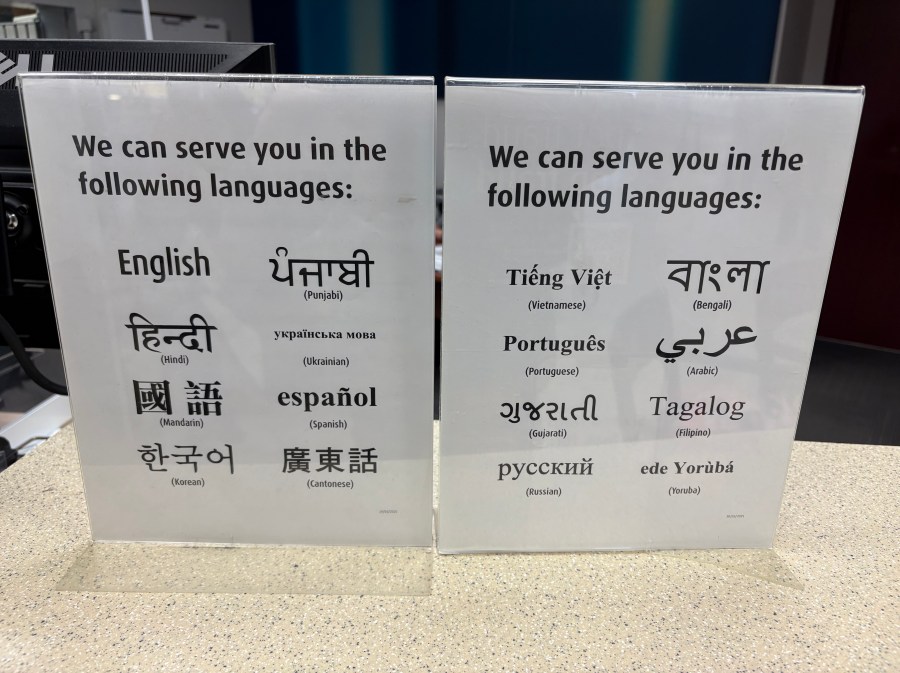
As most people know, Canada is officially bilingual, with English and something vaguely resembling French as the two languages. (Ask someone from France what they think of Québécois. You’ll understand. And probably more than the French person will the Québécois.) Practically, however, it’s a different story and you’re really only threatened with both languages on packaging, Canadian airlines, and anything to do with the federal government. For instance, a quick look at the sign on the right from a local bank in my hometown makes it very clear that they speak every language except French.
So if you get annoyed with all those in-flight announcements in one language (who cares what city we’re currently flying over and that you can’t see through the clouds anyway), it’s officially annoying in two. The same goes for trying to call any Government of Canada hotline where their automated phone tree has that extra branch to climb from the start: “Press 1 for service in English. Appuyez sur 2 pour un service en français.”

Imagine then my bridled joy when I discovered that the Government of Canada office I needed to call had separate, dedicated English and French phone numbers. (Sounds sad, I know, but anyone who’s spent most of their formative years invariably grabbing the wrong side of the cereal box will know exactly what I mean. The scars run deep.) My joy, however, was short lived, with the very first branch of this supposedly English Phone Oak (Quercus telephonus anglicus) being the inevitable “Press 1 for service in English. …”.
And then there are the commercials on Canadian TV …
Unusual for someone used to German ads is that lots of commercials are for prescription medications of all shapes and sizes. Even more unusual, regardless of what country you get deluged with your commercials in, is that many of those ads never tell you what the medication is for. For instance, a pair of commercials I saw have a series of adults happily hopping, dancing, and otherwise excitedly jumping across the screen to some upbeat music, all for some medicine X that I “should ask my doctor about if it is right for me”. Forget asking. Whatever it’s for, I want some! As a white male over 50 now living in northern Germany, I could definitely use just a hint of the rhythm all those people seem to get from the stuff.
(For the interested, the two medicines weren’t for arthritis or depression, which seemed to me to be the most obvious candidates, but for extra-strength varieties of Ozempic designed for weight loss. Now although prescription weight-loss drugs like these probably have name recognition for North Americans, it still strikes me as extremely odd when a commercial doesn’t tell you what a product is actually good for. At all. Imagine how stupid I’d look if I asked my doctor if terconazole was right for me based solely on a commercial filled with happy, smiling, loving couples.)
Nevertheless, the one commercial that I still can’t get over, if only because I saw it several times a day, was one for a frozen pizza. Not just any frozen pizza but apparently some sort of deluxe variety. And to highlight that very point, the commercial features a symphony orchestra on a platform that is being hoisted up by a crane outside the panorama windows of some glamorous woman eating said pizza in her penthouse. What’s really unbelievable, however, is that the word “dramatization” explicitly appears at the bottom of the screen during this scene and only during this scene. Not before when a huge ball of pizza dough falls onto a table covered in flour so as to spray the flour in all directions in slow motion (which apparently is how all frozen pizzas are made), nor when an absolutely perfect looking pizza comes out of the oven (and not the dried-out hunk of cardboard that comes out of mine), nor for the very idea of there being such a thing as a deluxe frozen pizza (cf. oxymoron). Nope, only the scene featuring the orchestra was a dramatization and I’m guessing not because of the crane hoist but because of the female conductor. (Note to the lawyers and activists out there: the percentage of female conductors worldwide barely scrapes into the double digits, hence the sarcasm.)
And, more to the point, what commercial isn’t a dramatization from start to finish? I think we’re long past the point where we believe that those two old guys on the porch really were Bartles & Jaymes or that there really was some guy in a boat cruising around in our toilet tank.
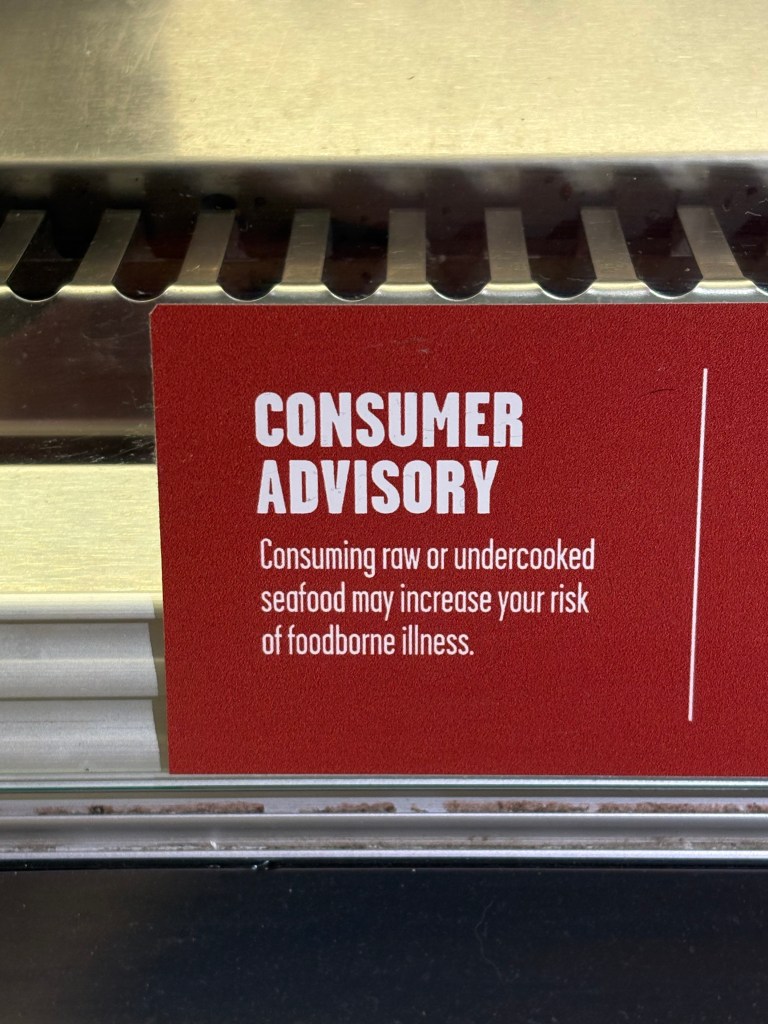
Finally, there’s this warning sign that I found pictured to the left in the local supermarket. Sorry, but way too apologetically Canadian. First: well, duh. Second: the use of the word “may”. Now, I could be one of those grammar police everyone hates by pointing out that it should be “might” (which indicates probability) and not “may” (which indicates permission), but we’re all sick to death of those smart asses who tell us how to use “your” vs. “you’re” correctly, right? Nope. Instead, I’m going to be pedantic in a completely different direction to say that neither may nor might actually belongs there.
By means of comparison, think about the stark contrasts posed to this warning sign by those found on Canadian cigarette packaging, one example of which unrepentantly declares that “Smoking causes lung cancer.” (Et “Appuyez sur 2 pour fumer cause le cancer du poumon.”) Ok, true. But so does coal mining, asbestos, choosing the wrong ancestors, and just plain ol’ dumb luck. The undoubtedly purposeful invocation of causation, however, makes it sound deterministic: smoke and you will get lung cancer. Instead, the reality is that smoking only increases your risk of getting lung cancer compared to if you didn’t. Even smoking asbestos in a coal mine on Friday the 13th is no absolute guarantee of an early death from lung cancer. It just increases the odds. Hell, my mother is 88 years old and without any sign of lung cancer despite smoking for the last 65 years or so. Her doctor even told her that there was no real point in quitting anymore because if the lung cancer hadn’t dropped her already, chances are that it never will.
And, it’s the same in reverse with this grocery-store sign. Eating undercooked seafood is not a case of might / may / possibly / maybe / conceivably / perchance / perhaps increasing your risk of getting food poisoning. It absolutely does compared to if you didn’t. How big this increase exactly is, is another question, perhaps dependent on which grocery store I took this photo at …
Or, as one stand-up comedian whose name I now forget so beautifully put it, “I don’t play the lottery, which makes my chances of winning only slightly smaller than for those people who do.”
 The Blog About Fog
Thank you. I needed this today!
LikeLike
Happy to help … 🙂
LikeLiked by 1 person