
Over the past few years, a number of women in my lab group have welcomed children to the world, the most recent being just a month ago. And, it got me to thinking just how much things have changed through the years regarding how pregnancy is viewed and especially how admin wants to spread the labour pains around to be enjoyed by as many people as possible.
(At the uncharacteristic risk of potentially annoying someone, I’m going to pretty much sidestep any discussion regarding the relationship between womanhood (or gender identity in general) and pregnancy and just talk about pregnant women. Pregnant person or pregnant individual sounds to me like something that admin came up with. And, although commonly used, the phrase “we’re pregnant” is just plain stupid because one partner clearly is not. The couple might be “having a baby” together (with one of them doing a lot more of the actual having), but one of them is very much very not pregnant.
And, since I’m digressing anyway, why is it that we take a shit but give birth? Both activities involve more or less the same geographically localized, generalized actions. And, if you really want to give something away, it’s definitely your excrement rather than your newborn baby. But, nevertheless, giving in the context of shit is never good, either when you’re giving someone some of it or not giving anyone any of it.)
Ahem …
In looking back, it’s abundantly clear that times have certainly changed regarding pregnancy in the 15+ years that I’ve been at the University of Not-Bielefeld. Back when I started, pregnancy was pretty much a non-issue and, despite occasionally holding lab courses with some mildly dangerous chemicals, female students were not required to inform anyone if they were pregnant. As a matter of fact, any obligation in this regard at all lay on us, the teaching staff, to instead recognize if any woman was pregnant.
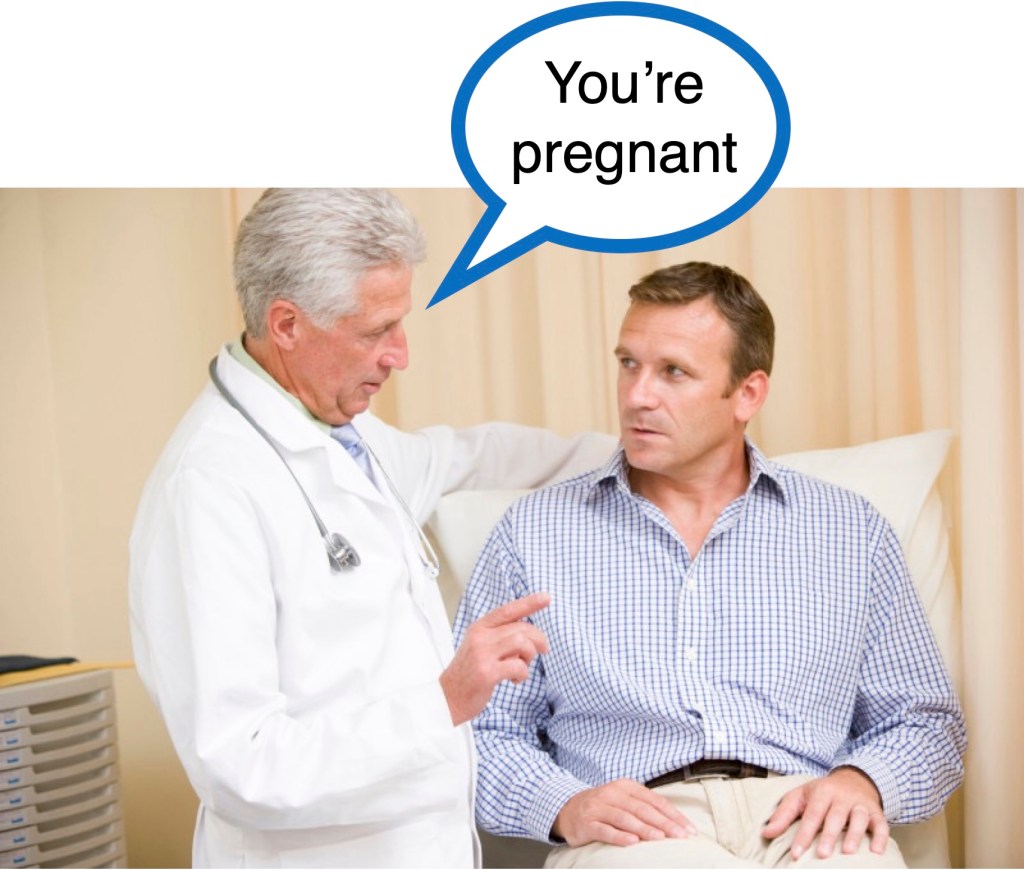
The situation was, of course, patently ludicrous. There is a both reason and a need behind all those home-pregnancy tests: in those first few weeks, pregnant women are generally unaware of having gained that particular adjective. So what chance does an outsider, especially a male one, possibly have? Guessing wrong in either direction is at least embarrassing, if not dialing up to potentially dangerous in the current social climate.
Take these two, real-life examples …
First, the false positive. After some kind, older gentleman repeatedly offered a good friend of mine his seat on the tram, she finally got him to stop by telling him that she was “not pregnant, just fat.”
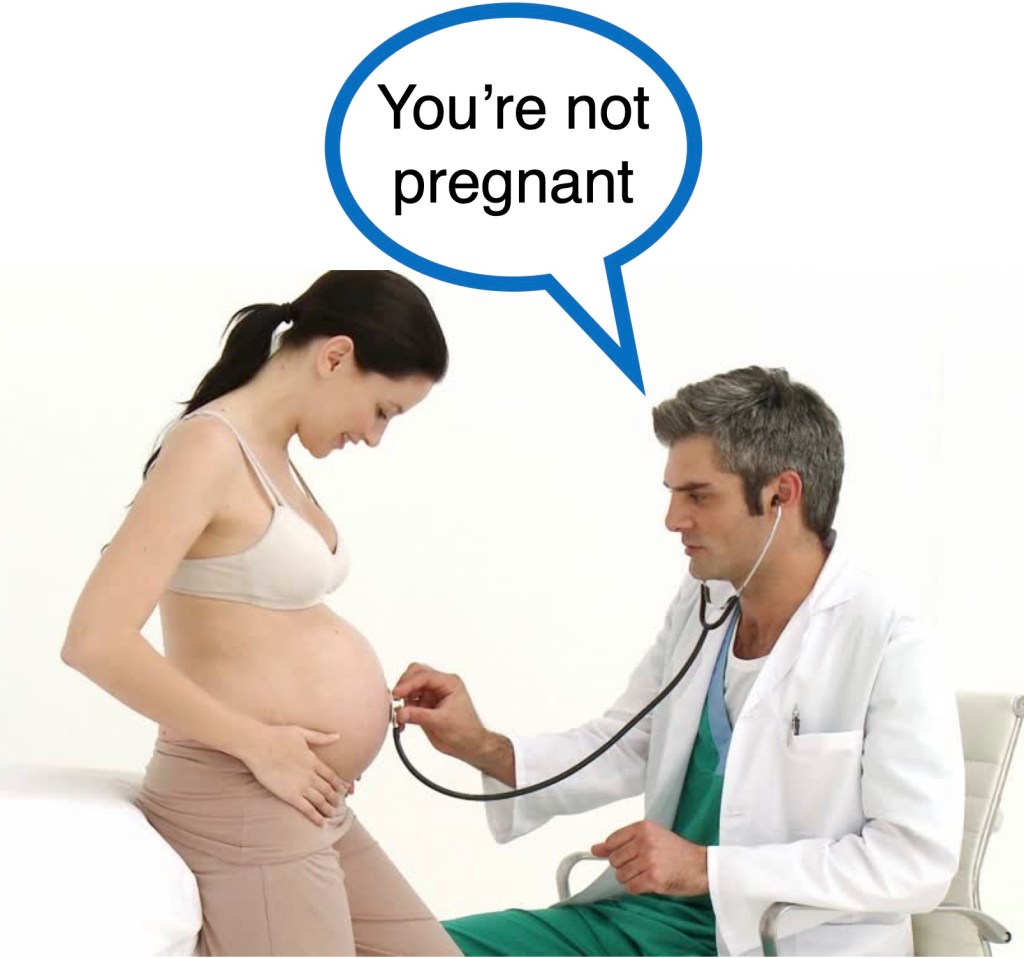
And then the flip side, the false negative. A student was recently shocked this past May when the woman in my group who just gave birth told him that she wouldn’t be doing any teaching in the Autumn because she would be on maternity leave. He had absolutely no inkling that she was pregnant, despite her being about halfway through it and thus in the category of obviously pregnant. (Or, in other words, “not fat, just pregnant.”) And we were talking obvious here. I mean, she rocked when she walked and not in the sense of head banging.
Perhaps fortuitously, however, that all was in the days before data privacy was entombed in official bits of bureaucratic overkill like the GDPR and when you could ask a woman for such direct, personal information and only come away embarrassed at worst and not under arrest. However, since then, society has increasingly become aware of just how precarious the life of the unborn is (unlike the lives of the born, which we can happily stuff full of calories, chemicals, and carcinogens) and the University of Not-Bielefeld has followed suit, due in no small measure to the overblown sense of self worth that the corona pandemic gave to its Work and Safety Office.
The paperwork remains mostly the same piece of stupidity inherent to most forms, but everything else around it has been leveled down to match.
But first the form …
It’s an eight-page monster from the provincial government that attempts to gauge what dangers lurk for the pregnant woman and her unborn child at her workplace. Part of the reason why the form is so long is because many of the questions are duplicated, once for when the woman is pregnant and once for when she is nursing. Fine. But, despite the respective, duplicated questions being clearly separated from one another in their own separate sections, the form nevertheless has to be submitted twice. You guessed it, once for when the woman is pregnant and once for when she is nursing.
Much of the form is filled with questions as to whether “unjustified endangerment because of <insert risk here>” exists in the workplace. But, like the successful McDonald’s coffee lawsuit that won on the grounds of the coffee being “unreasonably dangerous”, such questions immediately beg the further question as to what counts as “justified endangerment”. (Especially given that one of the risks listed is simply “accidents”. Can anyone explain to me what unjustified endangerment because of accidents actually means in practice?) Fortunately (?), the effective answer for the University of Not-Bielefeld is nothing whatsoever. For instance, my group does quite a bit of work with electron microscopes. Although the machines are shielded like crazy and emit less radiation than a three-year-old worn-out glow stick, pregnant women can’t go anywhere near them, even despite the form only referring to “extreme electromagnetic radiation”.

Undoubtedly the most bizarre part of the form is that it explicitly asks about any risk posed by “underground mining activities”, which, together with their above ground variant, are lines of work with a notoriously heavy female bias. This is not to say that women, heavy or otherwise, can’t be miners, only that minors shouldn’t be miners. It’s more so that there just aren’t that many of them. So why is just mining being singled out in the form and not some other high-risk profession like, say, space travel? Or firefighting? Surely the inherent risks to pregnant women through mining (or space travel, …) are covered by all the other, more generally applicable risks on the same form.
A new twist since the pandemic is that corona automatically counts as level two / three biohazard. (Well, automatic in the sense that I am obligated to check it off on the form as a risk. Can’t have admin doing any of the work associated with their new rules, now can we?) I could understand this during the pandemic. But now? Is corona even a thing anymore? Even the University of Not-Bielefeld has loosened its corona regulations to the point where corona no longer prohibits you from coming to the university and no longer obligates you to wear a mask either. (And, thank God too. To be honest, I’d much rather live with the guilt of infecting my neighbour with corona than with the pain of having to fill out the University’s new forms for going on sick leave.) But, for pregnant women, it means that they either have to get their own office (which are in extremely short supply) or they have to work from home.
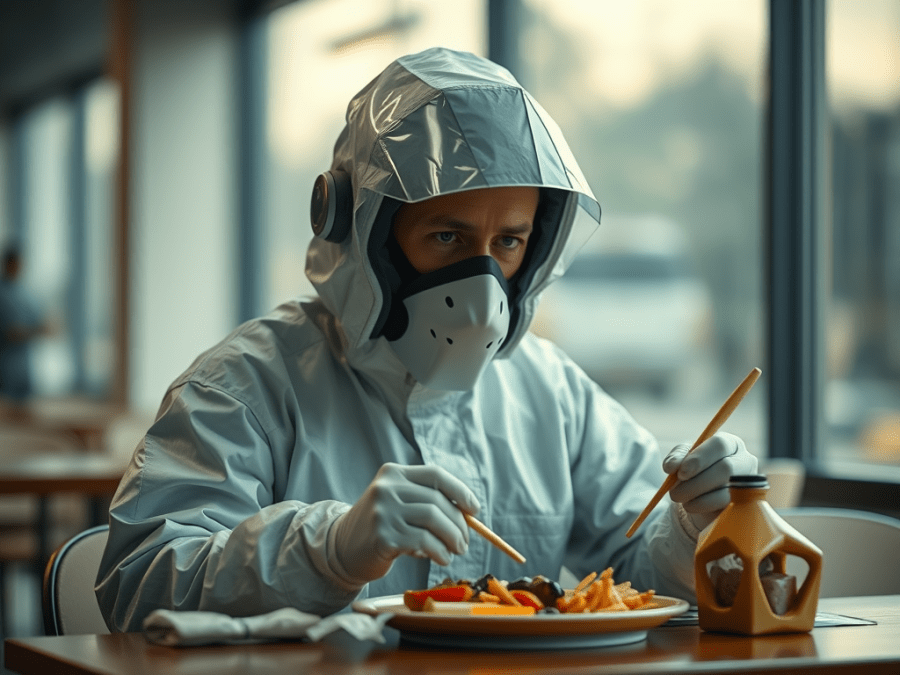
What is unknown to many, however, is just how risky ubiquitous, everyday items can become once they are placed in a lab setting. Take ordinary table salt for instance. Use it in a lab at the university and it’s strictly controlled. Use it across the hallway for lunch and it’s controlled only by your taste buds and/or high blood pressure. (But this comparative lack of caution might be a more of a practical concession considering how difficult it is to eat through a respiratory mask.) The same is true for caffeine, that necessary catalyst for almost any scientific endeavour. It officially comes with the warning that it is “harmful if swallowed” together with the subsequent recommendation to “immediately make victim drink water (two glasses at most)” as well as to “consult a physician”. How fortunate then that caffeine is generally off-limits for pregnant woman anyway.
And finally there’s folic acid (AKA vitamin M but really vitamin B9—say what?), which for some time now has been a recommended supplement for all pregnant women to minimize the risk of spina bifida and other spinal defects in their babies. Although not classified officially as hazardous—it is a vitamin after all—there are nevertheless safety precautions to be observed when using folic acid in the lab, which again include drinking water after swallowing it. This, of course, is in complete contrast to the situation at home where you normally drink the water to help you swallow it.
The form then painfully meanders its way through the admin maze before finally landing on the desk of a Betriebsarzt (company / government doctor), which are to real doctors what all those helpline specialists in Asia are to the technician actually sitting in front of your busted piece of technology. (I’m not saying that either Betriebsärtze or the helpline specialists don’t know their shit, just that their shit goes a lot further when the patient is actually right in front of them.) And, based on the form and a vague job description, the Betriebsarzt then makes the official call as to what the pregnant woman, someone whom they have never seen nor talked to, is allowed to do at work.

… and which, for all the women who have gotten pregnant in my group (n = 3), has always amounted to little more than sitting in their new, private offices and trying to fill their workdays doing stuff on the computer. (At this point, we’ll just conveniently ignore the inconvenient fact that computers and mobile phones, like all other sources of electromagnetic radiation, can increase the risk of miscarriage and abortion during pregnancy. Because they are not listed on the form, they can’t be a risk, now can they? Especially because they’re not commonly used while mining underground.) Fortunately, however, this restriction does provide them with ample time to figure out how to get a replacement to do the required bits of their jobs that they are no longer allowed to do. That’s right. Although the University of Not-Bielefeld does provide money to hire the replacements, there is no clear mechanism to get at it. Or at least no admin type in my entire faculty, including the equal-opportunity officer, knows how it’s done.

In the end, you have to wonder how many of these precautions are really that necessary. Back when I was a fetus, my mother continued to smoke and drink alcohol and also partied like it was already 1969 on New Year’s Eve to try and get me to come out a little bit sooner. And, you know what? I turned out ok. Got my share of health issues, sure, but they seem paltry compared to what a lot of young people today are suffering from despite their protected pregnancies. Back when I was growing up, I was the only kid I knew who had asthma, almost to the point where my teachers had to look up the word themselves to spell it for me. Although better diagnosing (as well as over-diagnosing) are playing their part, all the stats indicate that the incidence of asthma is higher than it’s ever been. And, although I have absolutely no data to back me up whatsoever here, the same seems to be true for ADHD or neurodermitis or a host of other conditions that were virtually unknown back when I was young. In fact, there’s a growing suspicion that the increasing incidence of asthma and many other autoimmune diseases is caused in part by us increasingly overprotecting our children by oversterilizing their environments (the hygiene hypothesis), causing their immune systems to desperately search around for something else to prime themselves on.
In so doing, I’m not saying that pregnant women should not be looking after both their own health and that of their unborn baby. But the degree to which western medicine and western society want to treat pregnancy as a disease seems like a unnecessary luxury that all other mammal species and indeed most other humans have never really needed.


So….no t-shirts with the logo of a favourite beer? Good lord, what has the university experience come to?
LikeLike
Of a favourite beer? For a pregnant woman? Tsk, tsk, tsk …
LikeLike
Oh crap…..I meant to put that on the “Acute Advertising” post. I’m old, I’m tired, and easily confused.
LikeLike
Nah. MUCH funnier here, if not just as on point. Thanks for reading.
LikeLike