To combat cheating, my University here in Not-Bielefeld recently implemented an online tool (PlagScan) to help to assess the degree of possible plagiarism in student reports and theses.
(As an extreme bit of irony, the program came online exactly one day after I submitted a report on a thesis where there were some instances of at least sloppy plagiarism. I couldn’t investigate it further because there was no online tool available, the IT-Department having naturally suspended access to the previous one while setting up the current one.)
Use of PlagScan is relatively straightforward. In the University’s online teaching system, you set up a folder in one of your courses that is designated for the program and any file in it gets automatically and magically scanned for any instances of plagiarism. Shazam! However, because the PlagScan folder appears to be necessarily public (the folder can either be designated for the program or made invisible, but not both), it was explicitly pointed out in the grand announcement of the new service that any personal information in the work should be removed to preserve anonymity and to maintain data privacy.
Let’s follow the train of logic on this one to watch the derailment in real time, shall we?
All the students in my group are working on individualized projects. (For reasons of data privacy and to maintain anonymity, we’ll label these projects as A, B, C, …)
Everyone in my group knows what very specific project everyone else in the group is working on.
I have just uploaded an anonymous thesis reporting on very specific project A to a public PlagScan folder to check for possible plagiarism. Both the folder and the results of the check are accessible by everyone in my group.
Gee, now who could have written that thesis?
So far, my working, but far from efficient, “solution” to this problem has been to create an invisible folder and then to bury the PlagScan folder within that, with the hope that the latter becomes invisible to the students but not to the program. (No idea if this feeble hope has been crushed yet.)
(Sadly for a good story, that resolution came the next day and really was a solution. Although this is not stated anywhere, the PlagScan folder is indeed invisible to students and the removal of personal information is because any files in it get uploaded and saved on the PlagScan servers.
However …
Just out of curiosity, I did upload that one questionable thesis to see what the results were. Over a month later and nothing yet. The optimists out there might point out that this means that the IT Service Desk actually did something better and faster. Not me. Now I need to ask them why that thesis isn’t being checked automatically like it should be. (And, yes, to be extra safe I did move the PlagScan folder out of the invisible one.))
A few years ago, one of the secretaries (if that job description is even allowed to see the light of day anymore) in the department wanted to rise up the pay scale and, this being Germany, could only do it upon achieving “further qualifications”. (In Germany, everything is based on having the appropriate, documented qualifications and apprenticeships. Everything. Even therapy animals have to go through a three-year apprenticeship that they might not pass in the end, begging the question if they would then need their own therapy animals to recover. I am not making this up. (Well, the last bit about them maybe needing their own therapy animals, ok, but not the first bit. Still, if the last bit were true, you could imagine that there must be quite a waiting list.))
Anyway …
One of the mandatory courses that had to be taken was called “Introduction to German bureaucracy”.
Another lesson in admin logic that my father reminded me about, this time a transcontinental one …
Although I always claim to be Canadian, that’s really only true culturally, if it can be said that there really is such a thing as a cultural Canadian. (Molsons, hockey, and poutine does not a culture make. Just a perfect, wintery Saturday evening.) Genetically, I’m actually 100% German and both my parents emigrated to Canada from Germany in the early 1960s. (In hindsight, it makes me wish that I’d listened to them more as a kid because then my German would be miles better than it is now. But then, who would have ever suspected then that I’d reverse-emigrate back to Germany?)
Why is all this important, apart from being a nice excuse for one of my digressions?
Well …
Because my parents were in their mid-20s when they emigrated, they’d already worked a bit here in Germany and so contributed to their pensions. Not for long and not for much, but still something that’s added up over the years “thanks to the Miracle of Compound Interest”. My parents have long since retired and so are also reaping the riches of their German pensions in Canada. And here starts the story.
You’re probably thinking at this point that all the silliness to come derives from the complicated logistics: two countries, two continents, two currencies, two tax systems, two languages, two whatevers, …. Well, you’d be half right. The logistics are “complicated”, but the lunacy is all Made in Germany.
After drawing their German pensions for some years, my parents started getting demands from the German tax office for the income tax due on those pensions. (How you can possibly be expected to pay income tax on an amount that barely buys you a cup of coffee is anyone’s guess, but the Germany’s version of the IRS apparently is very good at guessing.) And here the transcontinental logistics do come into play a little bit: how do you pay a German tax bill from Canada?
The banks, of course, offer numerous convenient options for this, if only convenient for their bottom lines. A bank-to-bank transfer is the most direct obvious route, but it involves two sets of service charges in addition to the usual shitty exchange rates. The Canadian bank takes their cut for setting up the transfer and the German bank naturally takes theirs for receiving the money. Say what? Since when does simply accepting money count as a “service”? (If you’re bored and not easily offended, google “George Carlin” and “service the account”. Same idea.) In the old days, say pre-Y2K, you could sort of understand this, at least on the side of the bank sending the money because there was a bit of work involved to it. But now with it all being electronic and automatic and even more impersonal than the banks ever were?
Cue option #2: the international money order. Only one set of service charges this time around to compensate for the difficulty in printing out that piece of paper. (The usual shitty exchange rate doesn’t cover those exorbitant costs, you see.) Or so you’d think. Even though the money order was in Euros and drawn from a German bank, my parents still got another bill from the tax office for the service charges they incurred in trying to cash something that essentially is cash. Comes the dilemma: how do you transcontinentally pay a bill for the service charges involved in paying a bill? Another international money order? Sorry, no. That’s one step toward a perpetual motion machine and so fundamentally outlawed by the laws of the universe (even if it fits perfectly within the rules of bureaucracy). The solution, of course, was to tap the son living in Germany to transfer the necessary amount of money in Euros drawn from a German bank. Sounds hideously familiar with the exception of the service charges.
It gets better of course. (Better only in the context of this blog. Objectively worse in the context of humanity unfortunately.)
Perhaps to build up the sense of anticipation, the German tax office only did their assessments on my parents in three-year batches. So their tax demand for the previous year was bundled with those for the two years preceding it. Buy one, get two free as it were. Except there was nothing free about it because the total demand also included the interest that was owing on the first two years because the payments were late. My parents actually went to the trouble of phoning the person in charge of their case to point out that it’s kind of difficult to be late with a payment that you’re not informed about. A pretty logical argument when you think about it. But even bombproof, Aristotle-approved logical arguments are no match for Bureaucracy Counterargument #1: those are the rules. (Rules, while not mutually exclusive from logic, are often a couple of doors down from it and typically used in place of real arguments.) The feeble ray of light at the end of the tunnel, however, was that they could formally appeal the interest charges. Which they did.
To cut a long story short, the appeal went to the person’s immediate supervisor who, true to their adjective, immediately turned it down (cf. German efficiency).
So, once again, any ray of light was merely the headlight of an oncoming paper train …
Perhaps the obvious question in hindsight is why all this is even necessary. Why doesn’t the German tax office simply deduct the taxes from the pension before it gets paid out? They do manage this complicated trick with salaries after all. The question was indeed so obvious that my parents did ask it. The not-so-obvious answer was simply that it’s Not Possible because the tax office and the pension department are two separate departments, silly.
In the end, my parents are being punished, financially if not psychologically, for being honest. The tax demands are usually politely phrased along the lines of “Please pay this OR ELSE.” Another German acquaintance in Canada facing pretty much the same situation simply wrote back saying that they’d take “or else”. Since the tax department knows about the money, they can simply take it from there or take steps to withhold the pension or whatever. The acquaintance didn’t really need the peanuts anyway and wasn’t much of a coffee drinker either. Or else turned out to be nothing at all. Because of the two separate departments and the two separate continents, the pensions kept coming untaxed, the tax demands kept coming unanswered, and everyone seemed ok with that.
If you’ve ever wanted a good example of the old saying that time is relative, you need look no further than the admin behind teaching in Germany.
It all seems so simple going in. When I arrived at the University here in Not-Bielefeld, I was told that my teaching load was nine hours a week per semester (which, compared to North America, is indeed a load). And the reality stopped right there.
Now, you might be excused for thinking that the fantasy was in only having to teach nine hours a week and that this blog would be about me whining about how I actually teach much more than that. As true as all that is, the real Alice-in-Wonderland part about all this is in how those nine hours are calculated.
If you thought that calculus and relativity theory are impenetrable, this is the combination of them both …
For starters, an hour isn’t an hour when it comes to teaching in Germany. Not even in name. Instead, it’s formally called a Semesterwochenstunde (or SWS for short), which translates out to the incredibly awkward sounding “semesterweekhour”. More to the point, each SWS also comprises only 45 minutes, meaning that my nine-hour teaching load really only works out to a nice even, real-world six and three-quarter hours. This weird conversion, however, does mean that a double lecture only works out to 90 minutes, so not too onerous on my side and still long enough for the students to make up their sleep deficits on theirs.
Fitting in nicely with these slightly shortened hours is that most classes don’t start on the hour, but 15 minutes later. The famous “academic quarter”. Although there are worse and weirder cases of how this quarter is implemented, part of the problem at my University is that it’s not done so consistently. Lectures, seminars, and committee meetings all start on the quarter hour (or c.t. for the Latin cum tempore), but labs and practicals on the full hour (or s.t. for the Latin sine tempore). Now, why most classes are c.t. but only some are s.t. as well as why there even is a c.t. this far into AD is strictly on the q.t. One reason that I have heard for keeping the quarter is to give the students time to move between the classes. Ok. But given that an hour isn’t an hour anyway, isn’t this travel time sort of already built in? Worse yet, if you have a c.t. lecture followed by a s.t. lab, you need time travel and not travel time to arrive punctually.
And not only do different classes start at different times, but, bureaucratically speaking, they also last for different amounts of time in terms of their contribution to your teaching load. One “hour” of a lecture, seminar, or practice session (Übungen) all count as one whole hour. All good. By contrast, one hour of a practical (Praktika) from the admin point of view is really only half an hour and one hour of an excursion is only 20 minutes. And all the work that we do surrounding and supporting all these endeavours—writing and preparing lectures (especially in these corona times when we have to record them), grading assignments and tests, answering e-mails, or just plain ol’ answering the students’ questions and helping them to understand the material—is worth nothing at all in terms of our teaching load. All that counts is how much time we spend in front of the classroom and then often not even that.
For instance, in the eyes of admin, some teaching doesn’t count as teaching, like the supervision of Bachelor or Master theses. The reason given to us for this is that supervising these projects belongs to our job description. (Unlike, say, teaching …) However, when I offer a Master student an “independent research module” (independent in the same sense that George Carlin holds self-help books to be self help), which basically amounts to the same thing, that does count as teaching and I can tick off 2 SWS for it. This clearly makes no sense whatsoever, not in the least because “independent research”, if taken verbatim, clearly means “no teaching involved”. Otherwise, it’s just research in the sense of George Carlin again.
All this “new math”, of course, has its repercussions. For starters, there’s a new impossible German word to learn: Lehrveranstaltungsstunde (“coursehour”) or LVS for short. Again, this isn’t an hour nor even an SWS. What it is is the SWS multiplied by the correction for the type of course: 1 SWS = 1 LVS for a lecture but only 0.3 LVS for an excursion. And admin loves to use both terms seemingly randomly on us.
In more practical terms, we also don’t really offer any Praktika in my Department anymore, but Übungen instead. (So actually less practical terms / semesters.) No one, not even the admin types, really knows what the difference between them is other than you seem to do (or get credit for) only half as much work for the former despite being there for the same amount of time. And the juicier lectures and seminars also tend to be the exclusive domains of the profs, leaving the undervalued rest to the teaching assistants. The latter can have it really tough because of this. There are certain positions that are largely designated for teaching (Lehrkräfte für besondere Aufgaben or “teachers for specific duties”) and the system makes sure they do nothing but. Because they don’t get to come anywhere near the lectures and because we give them shittier exchange rates than most banks do, their actual teaching load of 18+SWS translates into nearly 40 hours per week. Time for research? Only if you don’t need time to live.
Even the students are subject to these weird time dilations. They also don’t have normal hours, but “workload hours” (if you thought that the Bible was great for inventing or subverting units of time, admin wins hands down), which is the amount of time that an average student would need to complete a given task. (The average student, of course, being another work of fiction. Apart from the problem of knowing what the average student is capable of, when was the last time anyone ever gave a student a C? Although a C should represent the “average grade”, it’s practically a failing grade nowadays.) So, a course that represents 10 semesterweekhours for us teachers becomes 450 workload hours for the students. Teaching assistants aren’t the only ones getting shitty exchange rates. But, then again, whereas we teachers don’t get to count any of our prep work before or after the class, the students get to count everything they do outside of the class in full. My 20 minutes worth of excursion is also a full hour to them. (Or maybe just feels like it …)
To top it off, our Department teaches Master courses in two seven-week blocks each semester. Again, some quick math. 450 workload hours divided by seven weeks is a little north of 60 hours per week that the average student is expected to put in. When I tried to point out that this might be against the labour laws, if not actually illegal, my quick math quickly became administratively adjusted. Although the teaching portion of our semester is only 14 weeks long, the semester technically stretches over an additional 12 weeks (making 26 weeks in total) so that the 450 workload hours should really be divided by 13, making for a perfectly legal and humane, if utterly fictitious, 35-hour week. Never mind that we don’t often use those extra six weeks and actually can’t in half the cases (i.e., all those blocks that fall into the first half of the teaching time that can’t be extended into the extra part of the semester on the back end). It all looks good on paper. And paper is what German admin is all about.
It also all sort of makes sense now why it took a German to come up with the theory of relativity …
For our “protection”, the IT Department here at the University of Not-Bielefeld recently restricted the types of attachments that could be received via e-mail. Most affected by this were the older Microsoft Office documents (e.g., .doc or .xls files), which could be compromised with vicious macros and other similarly evil stuff. Instead, for the past year or so, only e-mails with their Generation-X relatives (i.e., .docx or .xlsx files) and other IT-approved file types as attachments would pass muster and land happily in people’s inboxes.
Fine …
Well, all was fine, until I had an issue where the University’s e-mail server bounced an e-mail back at me because the attachment, a supposedly legal .docx file, was somehow “suspicious”. (With heavy emphasis and foreshadowing on “suspicious”.) Fortunately, the e-mail letting me know that my message had bounced (the receipt of such feedback, unfortunately, being by no means a given) conveniently indicated that I could contact the IT Service Desk should I want to get more information and help on this particular issue.
I wanted and so I did. Particularly because this document was derived from an important template of mine that I have to use over and over and over again.
The response from IT Services was actually fairly quick (cf. German efficiency). After chiding me softly for not including the offending file, they pointed out the “handy” solution of uploading all such nasty documents in the future to the University’s convenient cloud-storage system, generating a link to said document (in said cloud-storage system), and including said link (to said document (in said cloud-storage system)) in the e-mail. Issue solved and case closed.
(As an explanation, each e-mail to the IT Service Desk is assigned an individual case number to which you are to refer to at all times. Under dire penalty of something or other. The case will be kept open until it is either resolved or the Service Desk responds to your e-mail, whichever comes first. Seriously. I’ve almost literally gotten responses from them that said 1. “We don’t know.” and 2. “Case closed.”.)
But, somewhat uncharacteristically, I digress. (And, don’t even get me started on why I can upload this same diseased file to the cloud-storage system for someone else to download and sabotage their computer, but not infect them directly by e-mail (cf. German efficiency).) Let’s dissect that response instead …
If I have a document that’s causing an e-mail to bounce, I really can’t attach it to another e-mail, even one to ask why the first one was bouncing, and have any realistic chance of that second e-mail also not bouncing, now can I?
I literally have no idea who this solution is supposed to be handy for. (And the word “handy” really was used. Well, not as such. The e-mail was in German and “Handy” in German means “mobile phone” so “geschickt” was used instead, which does mean “handy”. But in German. Not in English.) A one-step process (send an e-mail) suddenly involves a three-step, but very handy “solution” (upload, get link, send an e-mail).
Second try.
I write back (obediently using my case number to avoid the unstated and probably unseemly penalties) pointing out the inherent contradiction of including the attachment in the first place and, hold your breath, using the “handy” solution proffered to provide them with a copy of the illegal, legal .docx file.
And I waited (albeit not holding my breath) …
Again, the answer was painlessly rapid and said 1. “We don’t know.” and 2. “Case closed.”
Ok, I’m being a bit unfair with (1). The actual answer was something along the lines of the file probably containing some suspicious formatting even if it is a legal file type. Or, to paraphrase, “we don’t know.”
At this point, I figured that I was lucky to have escaped alive and (mostly) sane and simply accepted (2). I could have pointed out that it’s actually easy enough for IT types to insert some code to give some vague hint as to what naughty bit of formatting is being flagged by their program. (I mean, the base code must literally be something like “if the attachment uses Comic Sans as a font, then bounce” so it’s really easy to rewrite the last bit as “then bounce and say ‘Eek! Comic Sans.’”.) But, instead, I decided the more direct and effective approach was to “simply” rebuild the template from scratch.
I recently got married and this was, of course, by no means as straightforward as you think it ought to be. (My fiancé, BTW, is both the original inspiration and subsequent motivation for this blog. So, kudos or blame to her depending on which side you’re on. And for those thinking of gifts, we’ve registered a table here at our local Kaufhof in Not-Bielefeld.)
In most places except perhaps for Utah, a reasonable requirement for getting married is not being married. A more difficult requirement is proving that, especially when, like me, you’ve already been married. It actually shouldn’t be that tricky here in Germany. Unlike many (most? all?) Anglo-Saxon countries, Germany and many other European nations require you to register locally with the authorities. In so doing, they have all your important data: name, address, date of birth, marital status, number of children, name of your first dog, … In theory, it should be possible just to go to them with my passport (or personal ID) to prove who I am and they can “instantly” (that’s bureaucratically “instantly” as in Biblical “days”) see that I’m not married.
In theory …
Because I’m divorced and despite being listed in their electronic books as being divorced, I need to provide them with the divorce certificate to prove that I really am divorced and so able to re-marry. Doesn’t matter that the divorce happened a few admin doors down here in Not-Bielefeld. I need the divorce certificate. Even worse, I also need to provide the marriage certificate to which the divorce certificate applies to. Absolutely no idea why. You’d think that the divorce certificate, being the later and therefore the more relevant of the two documents, would suffice to show that I’m not married. But, apparently I have to prove that I was married to prove that I am divorced to prove that I’m not married to prove that I am able to marry again. And they say marriage can be rough sometimes …
Comes the problem: I didn’t have a copy of the marriage certificate and didn’t really want to ask my ex-wife for one. Comes another problem: my marriage was in faraway Not-Not-Bielefeld. (And that is not a double negative to indicate that the marriage was indeed in Bielefeld. Because Bielefeld doesn’t exist, my marriage wouldn’t either. Which, now in hindsight, would have reduced the paperwork tremendously …) Now, if the marriage officials here in Not-Bielefeld can’t ask their colleagues in the neighbouring divorce department for information, they sure aren’t going to be able to do it with their colleagues in Not-Not-Bielefeld.
Amazingly enough, however, and as the exception that proves the rule (and was nearly the ruin of this blog), I could actually order the marriage certificate from Not-Not-Bielefeld online just by entering the appropriate, detailed information about myself and the wedding that any competent identity thief would have at hand.
After pinching myself nearly to death (twice because for some quite unknown reason that might actually support the existence of God, I also didn’t have to supply any documentation about my previous Canadian marriage and divorce), the only other thing was my Canadian birth certificate. Although I do have a German passport, one of the requirements for which is being born, and although I’m listed in their electronic books as being born, I still have to prove this beyond simply standing in front of the admin type. And in German. Now, Canada might be officially bilingual, but not when it comes to German and I also come from a part of Canada that tries its best to forget about them having to be officially bilingual. So, my birth certificate is in English. All shiny and glossy like those crap certificates you got for Best Attendance in elementary school, but still in English. Fortunately, however, I already had an official (and expensive) translation of it because of my previous marriage in Not-Not-Bielefeld. (Apparently, being born is very important for getting married anywhere in Germany.)
(At this point, I should mention that getting divorced in Germany, apart from the expensive lawyers, is a far less painful procedure. That I recall, I never had to produce any of this kind of documentation to get divorced. Ok, maybe my ex-wife had to present the marriage certificate that I didn’t have, but I never had to prove that I was born, for instance.)
In the end, I presented all my documents as well as all the translated, authenticated ones of my fiancée in absentia. All that was done with them was to check that they were all there. Not that they were real or accurate or properly translated, just there. Folder open, mostly unread papers filed, folder closed. Could be that they checked them over at their leisure at some later date. Could be that they didn’t.
In any case, did I mention that German admin loves paper?
A long time ago in a part of Germany far, far away …
… comes this little gem.
But, as usual, some background first …
The first bit is that many Germans are awfully impressed by academic titles and Germany offers an impressive number of academic titles to be awfully impressed by. You see, a PhD in Germany isn’t just a PhD and it comes in over 50 different flavours. A doctorate in the natural sciences is not just a doctorate, for instance, but officially a Doctor rerum naturalium or, for short, Dr. rer. nat. (Germans love abbreviations too. But, given some of the words they are regularly confronted by, they have to.)
(Ok. Most PhDs have specializations. It’s not as if I know anything much about medieval English literature (or literature from any period, period) and would never try to pass myself off as an expert on it with my doctorate. However, very few have semi-mandatory, Latinized specializations. Mine doesn’t (in fact, it doesn’t list any specialization) and my alma mater has been the living embodiment of pomp and circumstance for literally centuries now.)
(The love affair with academic titles is actually so strong here in Germany that there are actually more than a few Dr. Dr.s running around the country for those people who have completed two doctorates for some bizarre, unknown reason. Got a professorship? Throw that it there as well to make Prof. Dr. Dr. And, although it’s not an academic title, you can even add your gender up front to make Frau (or Herr) Prof. Dr. Dr.)
The second bit of background is that Germany is one of a few countries that allow their citizens to have their academic titles listed on their passports and ID cards and driver’s licenses. Having found this out shortly after moving to Germany (and also being a German citizen; thanks, dad), I naturally had to do it as well. This was, I admit, motivated by equal measures narcissism and envy. The narcissism part I hope is clear. The envy comes from my wife at the time having Dr. rer. nat. Schmidt on her passport (not her real last name, unless she’s remarried someone named Schmidt in the meantime) and I wanted to officially be a “rare nut” as well.
(It should, however, go without saying that any form of narcissism does potentially have its price, even in the case of a few small letters like this. Having your doctor title on your passport is pretty darn impressive until the stereotypical announcement comes through asking if there is a doctor on board the plane. Lufthansa employees probably understand the many medical limits a Dr. rer. nat. has. Air Canada ones definitely will not.)
So, off I go to the local city hall, documents in hand, ready to feed my narcissism and quell my envy. The admin type looked everything over and told me to come back in a week or so. One very long week later I returned and was told that it all was “Not Possible”. Because my PhD was not a German PhD, no one would know which German flavour it was equivalent to. What if someone was looking for a Dr. iur. (law) but instead got this “rare nut”? Two very (very) different things entirely. What could be done, however, was one or the other of the following, equally grotesque options that all the many foreign medical doctors here in Germany seem to be forced to use (forced if only because I can’t see them actually wanting to use it):
Dr. (University of Not-In-Germany) Me Myself I
or
Me Myself I, PhD (University of Not-In-Germany)
On the surface, the rationale behind the rejection sort of makes sense, even to me. But, here’s the thing. Even though Germans have 50+ different flavours of PhD, they hardly, if ever, use them. Except for the poor medical doctors, it’s really just Dr. this or Dr. that. Even the passport of my then wife just said “Dr. Schmidt”. (So that joke about the Lufthansa versus Air Canada employees? Pretty much pure unbridled artistic license. The reality is that the Lufthansa employees would be equally clueless from my passport as to just how clueless I am medically when it involves anything more complicated than a single Band-Aid. (Which would include two Band-Aids.))
Even though the grotesqueness of either solution had a vague sadistic appeal to it (what would English-speaking people think when they saw my passport?), I decided on remaining plain old “Mr.” for reasons of common decency. But hope sprang anew a few short months later …
In the meantime, you see, I had gotten my professorship here in Not-Bielefeld. A German professorship. Forget Dr. rer. nat. (without the rer. nat.), I was now taking my quest one step further up the narcissism ladder. How could they possibly refuse? Like I said, it was a German professorship. So, same city hall, same same desk, same admin type. Same general request on my side too and same general, initial answer of come back in a week or so.
Unfortunately, same final answer too: “Not Possible”.
The reason this time around is that Professor (like Herr or Frau) is not an academic title in Germany, but merely an academic rank (unlike Herr or Frau) and fundamentally no different than, say, Student Assistant. A job title in other words. Once I retire, I go back to being a plain old doctor. (Sort of. Retirement for professors in slightly odd in Germany in the sense that we don’t retire until we ultimately do, if you know what I mean. Like in North America, we do mutate into a Professor emeritus (another academic rank), but we keep drawing a “retirement salary” instead of a true pension. (Want to make this really confusing? This retirement salary in German is called a “Pension”, which looks exactly like the English pension (but only when it starts a sentence). The analogue of the English pension in German, however, is “Rente”. All sort of like how an English billion is not a German one, with or without the leading capital.)) And passports and other official, personal documents only list academic titles, not academic ranks. (Unlike bank cards, with mine proudly proclaiming my ego-feeding status as Prof. Dr.)
But …
Suddenly, it now was possible to have Dr. listed on all my personal documents. Not Dr. (University of Not-In-Germany), just plain old simple Dr. (University of Not-In-Germany). And, as is usually the case in admin matters such as this, I have absolutely no idea why. In getting my professorship, as was just pointed out to me, all I gained was an academic rank. My foreign, flavourless doctorate remained the exact same foreign, flavourless doctorate it was before. The admin type also remained the same admin type and should have known all this given that this was not the biggest of city halls or the biggest of time intervals. (How big wasn’t the city hall? Put it this way: two desks and no machine to pull a number from. That big.)
Sometimes it’s actually better not to question admin, so I took the offer and ran. Narcissism must be fed after all. In retrospect, however, I can honestly say though that having these few extra letters on my personal documents has impressed exactly no one that I wanted it to. I’ve never been bumped to first class because of it nor to the front of any line anywhere.
But then, I’ve also never had to answer the call of whether there is a doctor on board either …
In a stunning bid to catch up with the 20th century, my University here in Not-Bielefeld mandated that from last Autumn onwards all examination administration was to be done online only. Paper-free exam administration as the name proudly proclaims. As an amateur technoweenie, I found the idea great. Nothing like a bit of superfluous technology to replace a system that’s working just fine as it is. And you know the replacement solution has to be great because it’s literally been in development for at least 10 years now that I know of.
But first a bit of background …
The working system as it stands is that each of my courses is organized as a module that can contain one or more classes. At the end of each semester, I tally up the grades for all the different exams in a module in Excel, print out the results including the final grade, duly sign the summary, and send it to the examination office where they enter the grades manually into the system.
Room for improvement? Obviously. After all, we’re talking about a system where electronic grades are converted to paper grades that are then converted back to electronic grades. Kind of a waste of time and effort, especially on the back end.
Enter paper-free exam administration. Ten plus years in the making to sort everything out.
On paper (if you’ll pardon the pun), it is indeed a wonderful idea. Instead of all this unnecessary digital to analogue to digital back-and-forth, we all just enter the grades directly into the University’s online teaching system and click to automatically and instantaneously send them directly to the examination office who then can also automatically and instantaneously publish the official grades to the students. German efficiency has never been so, well, efficient.
But, like I said, on paper …
There’s any number of problems with the system. For starters, students have to register online for each exam. And, every year, there’s at least one student who forgets to do this and so has to be added manually. I also have to manually enter each exam into the system and wait for it to be approved by the examination office. There’s also no way that I can see to differentially weight the different exams in a course. Or to include different grading schemes in a single exam summary. Or to carry over exams from previous years because some students didn’t complete the module in a single year. Or …
But, to be fair, they’ve only had about 10 years to iron out little cosmetic glitches like these.
(Now, I would like to explicitly, if parenthetically, emphasize that I’m not simply griping after the fact. Griping? Absolutely. But not after the fact. I did point out most of these shortcomings to the person in charge of the system this past summer when the system was not yet mandatory. The response, apparently, was to simply ignore my e-mail, and box the system pretty much as is through the University’s decision-making hierarchy.)
And then comes the kicker: the only thing paper-free in Not-Bielefeld in 2020 were the toilet-paper sections in most supermarkets during the height(s) of the coronavirus pandemic.
As I’ve pointed out elsewhere, German bureaucracy lives and dies with paper, with the corollary that trees live to die for German admin. I can click all the buttons I want, but, for it all to be valid in the end, I still have to print out the grades for each exam from the online system, duly sign each summary, and send each piece of paper to the examination office. Deja voodoo anyone?
A key, repeated word in the previous paragraph was “each”. We’re no longer talking about just a single piece of paper like in the good old days, but potentially many. For example, for a module with three exams, I now need to print out three pieces of paper and send them all in. Some really complex math using this example will hopefully highlight this subtlest of contradictions when it comes to the term “paper-free”. (Bear with me or hold tight. Your choice.)
Old, environmentally unfriendly system: one piece of paper.
New, paper-free system: three pieces of paper.
Net saving: minus two?
In other words, instead of printing out no pieces of paper whatsoever anymore in the new paper-free system (which, naively, is what one would expect from the name), I still have to print out at least one (breakeven) and possibly many more (breakdown). Which marketing genius (and simultaneous mathematical wanker) thought up this moniker?
In the end, paper-free exam administration really amounts to nothing more than getting the teaching staff to take on more of the work of the admin types. IT “solutions” very often are of more benefit to the admin types than the end users after all. You can understand it though. I certainly don’t like spending my time doing admin.
But then maybe that’s why I became a teacher (and former researcher) and left the admin to the admin types …
This entry probably deals more with bureaucracy (a system) than admin (the people and institutions indentured to that system) per se, but I’m hoping that only admin types (together with their lawyers, both of whom I’m also hoping aren’t reading this blog) would take me to task for this.
(More to the point: my blog, my rules …)
After being a lifelong, devout cat person, I took over a nine-year-old female Australian Shepherd mix some two years ago now. (Although there is a very legitimate and accepted term for“female dog”, even I’m not crazy enough in this day and age to use it here. (And, if you think that word is bad, look up the one for an adult female dog of reproductive age, which to me sounds like one of the greatest sounding insults of all time.)) Having owned cats for a number of years, I thought it would be equally simple with a dog, with the notable exception that the dog would actually care what I said: feed the dog regularly, clean up its poop, and take it to the vet every once in a while. (A strategy which, come to think about it, worked pretty well with my kids too.)
Nope …
At least here in Germany, if not in many other places, it’s nowhere near that simple: you need to officially register your dog, officially pay taxes for your dog, and officially take out special third-party liability insurance for your dog. And, just because it’s so much fun the first time around, you have to officially register your dog twice. Duly and properly registered here in Not-Bielefeld doesn’t cut it and you also have to do it provincially. No one tells you about this (definitely not Not-Bielefeld and God forbid they do it on your behalf) and the provincial authority in charge of it definitely does zero advertising about it, so most dog owners don’t know about it. I only found out by accident over a year after I got my dog, but the only time most dog owners will find out about it is when their singly-registered dog is involved in some kind of accident and they have to pay a penalty of up to 10 000 EUR because it should have been doubly-registered.
And all that is just on the dog side of things. Dog owners also have to have a doggie driver’s license to prove that they can properly navigate their dog or something. As always, I am not making this up and not least in that it really is called a dog driver’s license. (I actually managed to sidestep the license because I took my dog over from my best friend. The fine print attached to the license indicated that it was only mandatory for first-time dog owners or, more importantly, for first-time human owners for the dog. In any case, Not-Bielefeld took my registration money without questions and I wasn’t giving any extra answers.)
It’s not just the admin types who have it against dogs, but often the general public as well. It never ceases to amaze me how often I get told to put my dog on a leash, even though this isn’t required in most of Not-Bielefeld. Ok, I understand leashes and can see when they’re necessary. But, with my dog that’s hardly ever the case. Australian Shepherds are renowned “velcro dogs” (in a non-pathological way) and mine, snoring at my feet as I type this, is usually never further than five meters away from me. We’re usually out and about here in the suburbs, which here in Not-Bielefeld are the very definition of not hectic. She always stays on the sidewalk and doesn’t chase after birds or cats or postal carriers, although squirrels à la Pixar’s Up!are admittedly sometimes touch-and-go. I’m always constantly looking out for her (and cops) and she tends to listen very obediently when I get her out of the way of bicycles, joggers, or postal carriers and especially postal carriers on bicycles. (I should point out that my dog being so well trained has absolutely nothing to do with me. I got her that way. Being part Australian Shepherd also makes her the smarter of the two of us. By half.) Even so, I always have her leash with us and do put her on it when it’s crowded, chaotic, or otherwise dangerous either for her or those around us. Like I said, I get it.
Anyway, what never ceases to amaze me even more are some of the answers I get when I respond asking why I should put her on a leash. Four of the better ones:
Because dogs are potentially dangerous.
The obvious one, right?
No question about it: dogs have those big teeth and some dogs like to use them. But, admin has its bite too. In the UK, it’s estimated that there are about 740 dog attacks per 100 000 people each year. (Amazingly, the equivalent stats are not available for Germany.) This makes dogs about half as dangerous as admin, with a reported office injury rate in the UK of 1334 cases per 100 000 employees. (And that’s only to the admin-types themselves, not the recipients of their handiwork.) But, you never hear about anyone talking about putting admin on a short leash, now do you?
Because my dog finds it unfair that yours runs around without a leash. (As relaxed as most dog owners are, this one still comes up a lot.)
Wait. What? Really?!
I won’t bet the farm on this one (even if I had one), but I’m pretty darn certain that dogs don’t have a sense of justice and not just because they tend to be cool with pretty much everything. (Cats, on the other hand, very definitely do. They usually find most things to be hideously unfair to them.) But, on the oddball chance that they did, then wouldn’t my well-trained dog find it unfair in reverse to have to wear a leash because your badly trained one can’t go without one?
Because of the Hinterlassenschaften.
Hinterlassenschaften (which people here really do say; did I ever mention that Germans like big, long words?) is a euphemism that vaguely translates out as “objects that are left behind” or, in plain ol’, George-Carlin-approved English, crap. (In this context. It can also refer to what deceased people leave behind for their relatives. But that also might be crap.) My normal response here is to stare at the person all bewildered and ask them all surprised if that means that my dog won’t crap anymore when she’s on a leash. (Except that I don’t say crap. And I definitely don’t say Hinterlassenschaften.)
Because of the Brut- und Setzzeit.
The Brut- und Setzzeit is a multi-month period beginning each April during which special measures are taken to ensure that wild animals (but mostly birds here in the city) have a chance to raise their offspring in relative peace and quiet. Again, I get this. Cities are screwing up life for most wild animals so that some (any) form of compensation is desperately needed. What I don’t get is that the restrictions also don’t apply to cats. (And explicitly not so.) Or joggers. Or bicyclists. Or pretty much anything other than dogs who, for some reason, have to be chained up within an inch of their owners over the course of these many, many months.
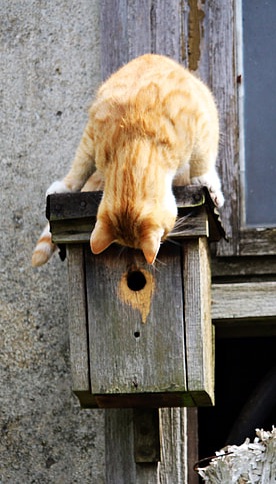
No, seriously. Many dogs, especially the hunting breeds, will eat birds, no question. But many others won’t. (Mine included. If it isn’t some over-priced, former meat product of questionable quality (or human junk food of even more questionable quality) out of a plastic bag, she’s just not interested.) But, really, which is the far bigger threat to a bird, especially the fat, fuzzy ones that can’t fly yet, a ground-dwelling dog or a tree-climbing cat? (Just to help you along here, it’s estimated that outdoor cats (including strays) kill about 2.4 billion birds per year in the United States alone. Even if that estimate is off by a factor of 10, that’s still nearly one bird for each American citizen each year or about what the much more polite Canadian cats eat each year. And that’s just birds.) Here in Not-Bielefeld, they also have at least one annual race that takes place in a wooded area right in the middle of the Brut- und Setzzeit. But, apparently birds, like mothers in maternity wards everywhere, don’t get their feathers in a twist when hundreds, if not thousands, of joggers careen past them. Nevertheless, the inviolability of the Brut- und Setzzeit is so unquestionably ingrained here in Germany that people have stopped to scold me about my dog running off-leash when we’re walking along a relatively busy road.
I’m not trying to argue that dogs are angels. Not in the least. (Except mine. Of course.) But, if your stated goal is to protect wildlife, then being at least remotely consistent about it is not a bad place to start.
What I guess I don’t understand here in general is why dogs always seem to be getting the short end of the administrative stick. The Brut- und Setzzeit story is just an extreme example of it. Less extreme, but more general examples are that dogs are not allowed to go off-leash in most parks and woods in and around Not-Bielefeld and they are absolutely forbidden on school grounds at any time. (Even at eight in the evening in the middle of the holidays when there’s zero students and even fewer teachers around.) By contrast, cats can do whatever they please. However, cats, being cats, will always do whatever they damn well please anyway. They don’t need government support for this and, being cats, really don’t care either if they get it or not. But we give it to them anyways: in late 2019, the EU executive reiterated that its policy of freedom of movement extends to cats, supporting their “unalienable right to roam”and effectively killing any thought of a cat leash law in Europe. Those are 2.4 billion American birds, after all. Fine, but how about maybe a cat “little bell around the neck” law?
But, then, even when the system actually tries to help dogs, it still somehow goes wrong.
For instance, during the coronavirus pandemic in Summer 2020, the German government found the time to debate a proposed law for 2021 mandating that dog owners had to walk their dogs for at least an hour at least twice a day. Ok, as serious and awful as the pandemic still is, it’s not the absolute end of the world (numbers-wise we’re still way behind the 1918 Spanish Flu and the world didn’t end then either) and normal, day-to-day life still has to continue. But, you’d think it would be a bigger priority for the government to discuss some financial aid to the restaurateurs and artists and the many other segments of the society that were really hit hard by the pandemic instead of telling these same people how often they need to walk their dogs each day (or else). I mean, they’re all out of business now anyway because the government is prioritizing Hinterlassenschaften like this. What else do they have to do besides walk their dogs?
Again, the reasoning behind all this is perfectly understandable. Dogs need their exercise, even if they’re roped up and denied the freedom of movement cats have while doing so. But why does it have to be legislated and not just, say, recommended? The second it becomes a law, you have to decide on rigid limits for it as well as how to enforce it. (The impossibility of the latter usually forms the key argument against any sort of law designed to herd in cats.) And, by limits, I mean this two times one hour per day. A lot of people have already made a lot of good counterarguments here. For instance, two hours a day might be too much for some older dogs and an hour outside in the baking hot summer humidity is not ideal for human nor beast. And, my own take on this, what if the dog just plain and simple doesn’t want to? My dog is great at this and she’s part Australian Shepherd (albeit an older one now), a breed that needs activity. Sometimes when I think we’re going out for a long walk, she’ll just go halfway down the block, leave her little Hinterlassenschaften behind (which is sort of a bilingual repetitive redundancy, I think) and that’s it. Really. That’s. It. She’ll just sit there on the sidewalk channelling her inner cat, pointing her snout skywards and will not budge until I turn around and start heading for home again. And this doesn’t just happen when the weather here in Not-Bielefeld is at its winter’s finest: cold (well, cool, says this Canadian), dark, drizzly, … Nope. She’ll do it in lovely T-shirt weather in the summer too. Now, how do I explain that to the cops? Or to the neighbours? Or to whoever is supposed to be keeping tabs on how often and how long we go for walks each day?
But, to mix clichés, it would seem that a dog’s life is not the cat’s meow …
My university here in Not-Bielefeld, on the whole, has taken a careful, considered, and thoughtful approach to the whole coronavirus pandemic. (And to those people who are already screaming that I should be writing “COVID-19”, don’t ever let me hear you refer to “the flu” or “influenza”, ok?) One could only wish that most governments had reacted the same way. Since Spring 2020, most of the University has had to work from home and any actual physical presence in the University was kept to an essential, bare minimum in a balance between the needs of the students and the current threat of the pandemic. Given the use of the word “essential”, it should be clear that most admin types were working from home.
There is, however, an inherent problem to the latter. German bureaucracy is not exactly designed for the 21st century. And, come to think about it, not really for the 20th century either. It’s all paper based, you see. Every important and not-so-important document has to be printed out; otherwise, it doesn’t count. Electronic documents? No way.
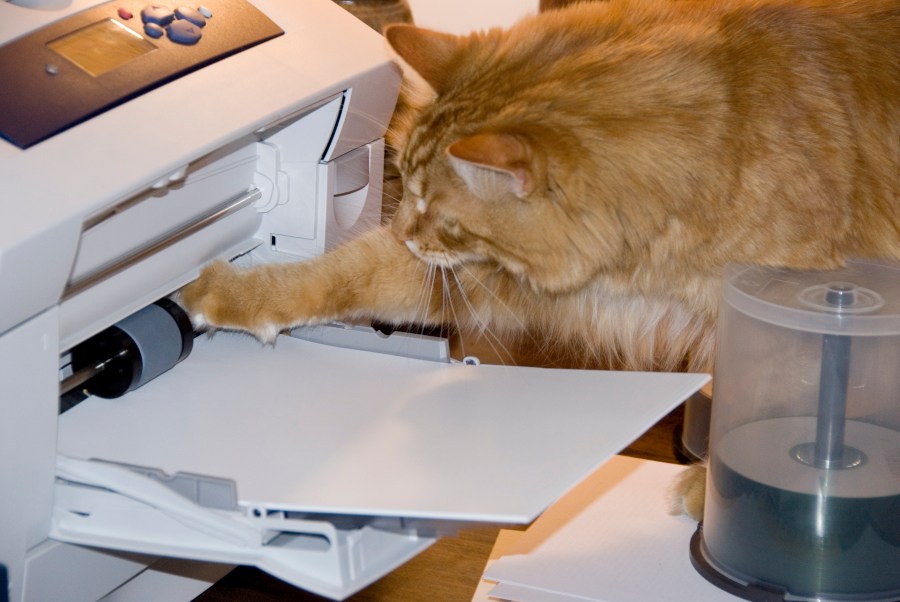
But, don’t ever let it be said that the wheels of German bureaucracy don’t grind with stereotypical German efficiency. Although virtually the entire University had been working from home since Spring 2020, it took until Autumn 2020 for a directive to finally be issued that allowed University employees to print documents on their home printers. Equally mind boggling to the fact that it (only) took six months for this permission to be granted were some of the mandatory conditions under which home printing could only occur:
Documents categorized as “for your eyes only” could not be printed at home.
(Ok, fair enough. There are things such as data privacy and we don’t want all our personal information spilling out into the public domain like this. That’s what Facebook and social media more generally are for. But what information could the University possibly be bunkering (on us) that requires double-0 status to read?)
All documents were to be retrieved from the printer immediately (if not sooner).
All documents were to be kept under lock and key.
Again, I understand things like data privacy. But, I sincerely hope that most admin types aren’t married to dubious foreign agents (with “foreign” here meaning an evil nation outside of Germany or even an evil university outside of Not-Bielefeld) or ruthless identity thieves eager to get their hands on such privileged information. (Or are raising their kids (or pets) to be one or the other.) Most normal people actually go running at the mere hint of these kinds of documents.
In any case, you do have to wonder what all the admin types were doing for those six months without any printing privileges …














 Old, environmentally unfriendly system: one piece of paper.

 No, seriously. Many dogs, especially the hunting breeds, will eat birds, no question. But many others won’t. (Mine included. If it isn’t some over-priced, former meat product of questionable quality (or human junk food of even more questionable quality) out of a plastic bag, she’s just not interested.) But, really, which is the far bigger threat to a bird, especially the fat, fuzzy ones that can’t fly yet, a ground-dwelling dog or a tree-climbing cat? (Just to help you along here, it’s estimated that outdoor cats (including strays) kill about
 The Blog About Fog