Belabelling a point

Every time that I start to worry that I’m running out of material for this blog, admin comes through for me. I suppose that means that I should be grateful somehow …

… but definitely not in this case.

We all know the drill. Once we set up an e-mail account, the very first and very last e-mail that we receive—as well as a good chunk of all those in between—will be junk. Although the Nigerian princes seem to have long since given their millions away, in their place is a whole raft of opportunities for penis enlargements, anti-snoring remedies, viagra rubs, buying bitcoins on the cheap, giving all your bank account or password details away, submitting your latest research to some obscure journal that’s not even close to your field of research, or simply talking to scantily clad women pushing any or all of these desirable items.

(Is it just me or are most junk e-mails directed at men? Not sure whether this has more to say about the different technical aptitudes of men and women or merely their relative stupidities.)

There are, of course, defences against junk e-mail. Thinking is a good place to start, but also a fair amount of work. And, let’s face it, we’ve all had those brain-dead moments where we’ve clicked on or otherwise believed an e-mail that on any other day would scream NOT IN A MILLION YEARS at us.

Enter the spam filters. Spammers, like many of their prey, are not the most creative of creatures sometimes, so it is possible to teach a machine to recognize their e-mails and to filter them out so as to save us from having to do any hard thinking. The algorithms aren’t perfect, of course, and the odd penis-enlargement e-mail still lands in my inbox and the odd e-mail from one of my even odder friends still lands in my junk-mail folder (which, in retrospect, might be a hint), but they’re still pretty good. And, you can even doubly protect yourself against the threat of thinking by combining the spam filter from your e-mail provider with that of your desktop e-mail program. (Tough luck for those in the cloud though …)

(In line with this last sentence perhaps, the e-mail proudly announcing this new “feature” also contained the “advice” to be particularly suspicious of literally all external e-mails. Dunno. I’m much more suspicious (if not downright afraid) of most e-mails that actually do come from within the University because they often mean additional admin work for me.)

Anyway, back to the point, which is: really?!

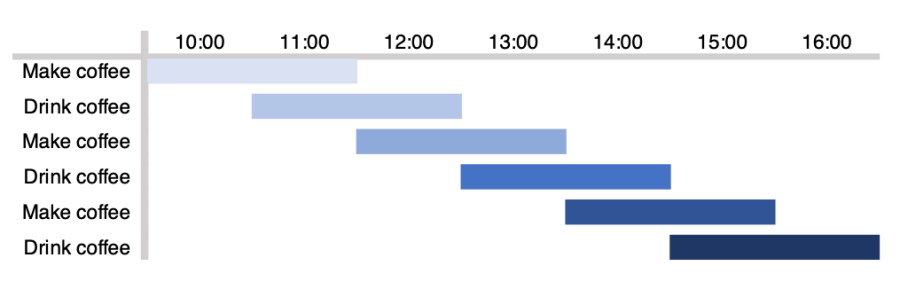
Is this seriously the best that they could come up with? You really do have to wonder just how many late-into-the-afternoon workshops complete with free-for-all brainstorming and superfluous Gantt charts nobly sacrificed their lives for this.

Talk about needless, useless overkill …

Given that a good number of the e-mails that many people at the University receive will come from beyond its ivory confines, that label will appear an awful lot and so slowly fade to become conveniently ignored background noise. People are just like that. Unfortunately, given how much of an effort they put into making the label an absolute eyesore, this is unlikely to occur. Nevertheless, if actually reading the content wasn’t a solution before, then simply adding to that content by indiscriminately flagging nearly everything isn’t really either.

Even better: when replying to one of these highly suspicious, external e-mails, the label remains front and centre, thereby bilingually informing all your important colleagues (even those who do not speak German) what an embarrassment the institution one works for can sometimes be. One can, of course, take the extra time to remove the label, but if some people would take the extra time to actually read their external e-mails in the first place, then all of us wouldn’t be here now.

Even more ominously: what if the spammers hack into the system and start sending their phishing emails from a legit University address? It could happen. My e-mail account has been hacked in the past with the sole purpose of bothering other people and I doubt that I’m the only one. Hackers even managed a few years back to hack into the printer network of the University and forced many of the printers all over campus to spew out pages and pages of nonsense (the hackers’, not ours) until their paper trays were empty and ultimately until IT Services finally restricted access to the printer network to inside the University only. Blind trust in the non-appearance of that label in the place of actual critical thinking isn’t going to help here.

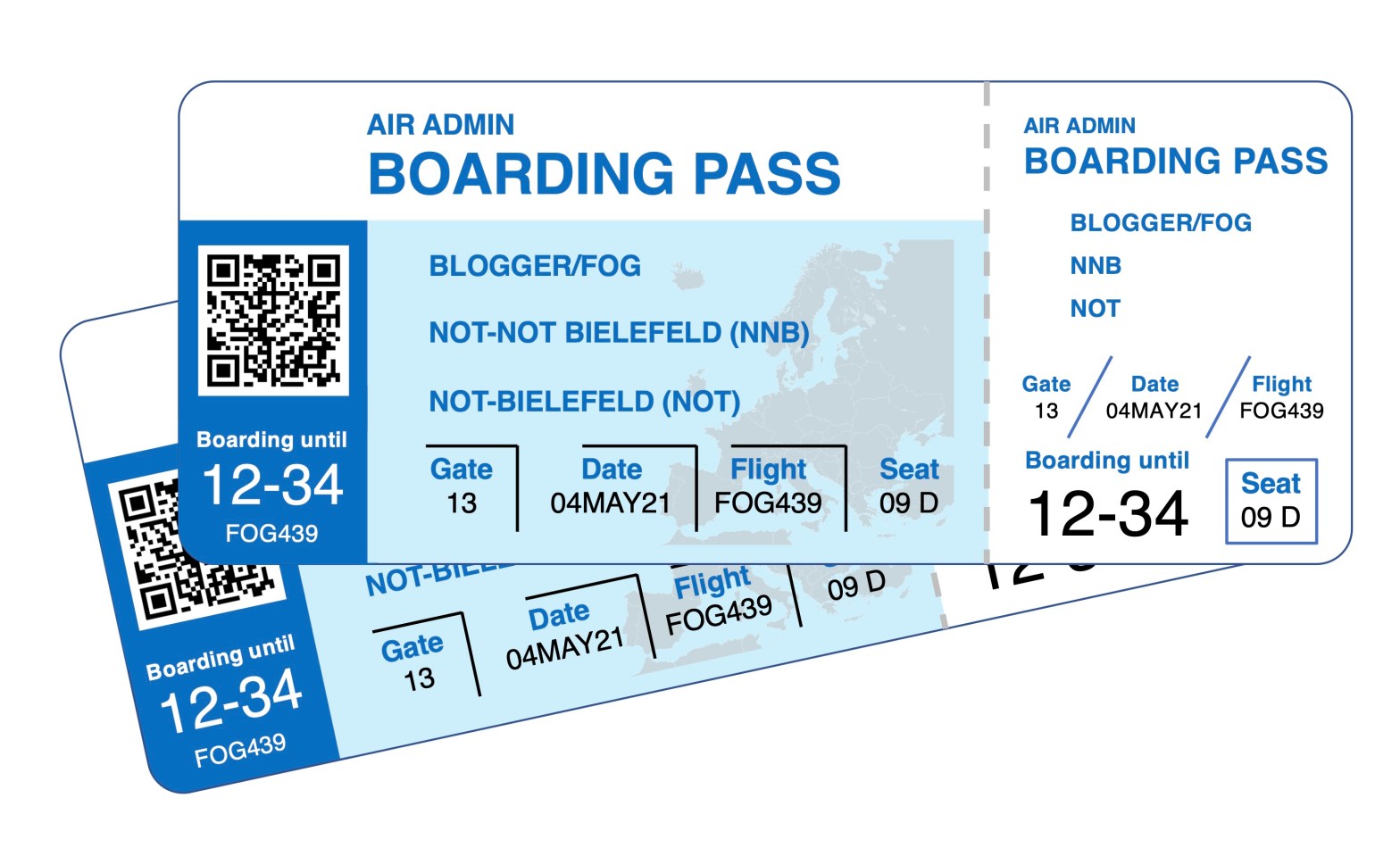
What boggles the mind though is that this “solution” is even necessary. The internet and e-mail isn’t exactly some shiny new toy anymore and the sheer ubiquity of junk mail out there means that everyone has experienced it by now. Most phishing e-mails also aren’t particularly novel or sophisticated. I can’t count how many warnings I’ve gotten about how my e-mail quota is almost used up or my password is about to expire and how simply clicking here will solve everything (for them). On the same day. All slightly different from one another. Surely one warning is enough, right? And then the grammar in these e-mails is often somewhat suspect. I mean, suspect to the point where even I can recognize the German syntax errors. If I get an e-mail from my University here in Not-Bielefeld, you’d hope that the sender would be able to spell, say, Not-Bielefeld. (Especially when the spoofed e-mail address is my own!)

Which brings me to my final point: we are talking about an Institution of Higher Learning here. If there are some segments of society that might somehow be better able to recognize and ignore junk e-mails (or might simply be more capable of learning to do this), you’d hope that this would be one of them.

COST cutting

Right. If this blog is going to be about the absurdities of admin, might as well finally go after the granddaddy of them all: the European Union. You know, the entity of which the choking bureaucracy was part of the reason that an entire country decided to leave Europe?

(Speaking of absurdities, let’s talk about the UK for a second. Is the UK the actual country or is it rather each of England, Scotland, Wales, and Northern Ireland? Has anyone ever figured this out? Including them?)

The admin structure within each COST Action befits that of the European Union paying the dime for the whole thing: hierarchical and overly complicated. An Action is typically divided into numerous Work Packages (WPs) charged with achieving certain deliverables. Overseeing them as well as much of the day-to-day running of the Action is the Steering Committee (SC), a group of about a dozen or so individuals (including the heads of the WPs), usually with the largest vested interest in the project. But, the more important decisions of the SC—including anything to do with the budget besides spending it—need to be approved the Management Committee (MC), a potentially monstrous conglomerate for which each country represented in the Action provides up to two voting members. It’s all supposed to act as a system of checks and balances.

My experience has been that it doesn’t because the set-up beyond this is fundamentally flawed …

For starters, official COST policy is that literally anyone can join any Action for any reason. Relevant experience isn’t really necessary nor is actual interest for that matter. And there are some real COST pros out there who have been involved in Actions numbering in the double digits, including their MCs, and where you can only ask yourself why they are there in the first place. Not only can’t the SC veto people like this, they are indirectly encouraged to accept them because the amount of funding for any given Action is directly tied to the number of countries in it. Not quite what the early alchemists had in mind, but still a good way to turn deadwood into dinero. Who said money doesn’t grow from trees?

Even worse, the whole system is deeply skewed towards the MC passing any and all resolutions it receives. For one thing, there’s no real debate on most motions put before the MC. Except for the required annual meeting, most of the votes are done via electronic ballot. The MC members receive the motion and have to vote yea or nay within seven days. Want clarification about the motion or even, gasp, to debate it? No point. At least for the electronic votes, there literally is no mechanism provided for any debate and it’s a moot point anyway because the voting is already underway.

That’s bad enough, but the basic voting system is also rigged in favour passing the motions. Here’s why. Although each country in the MC has up to two members, it only has one vote. Both members have to vote the same way or else the vote for that country is invalidated. Topping that off, any votes that are not cast, say by any MC members simply along for the plane ride, are counted as approving the motion tacitly. (This is very much different than an abstention, which are neutral and also not an option on the electronic ballots.) In so doing, COST has managed to literally take the stuffing out of ballot-box stuffing. Thus, to reject any motion, you have to get all voting members from a majority of countries in the MC to vote against it. That’s sounds pretty much like how it should be. Instead, what sounds like a load is that the system means that motions can get passed even when absolutely no one votes for them.

Here’s an example of that perverse nay-is-yea scenario in Action …

Imagine a COST Action comprising 20 countries and where each of those countries is represented by two people in the MC. For 19 of those countries, one member votes against the motion whereas the other doesn’t vote, resulting in 19 split votes that are ignored. Both the MC members from the last country don’t vote at all resulting in an imaginary thumbs up that overrules the 19 actual thumbs down that were cast.

Comes the next bit of subversion …

For any physical MC meeting to be legitimate, it has to achieve quorum: at least one member from a certain percentage of all the countries in an Action has to be present. There’s no such explicit requirement for an electronic vote. Theoretically, because all MC members received notice of the electronic vote, all could be argued as being present for it. But there’s a big difference between having the opportunity to be present (receiving notice of the electronic vote) and actually being present (reading it, if not thinking about it). Essentially it’s the same difference as receiving your voting information in the mail and actually casting your ballot. So, even if absolutely no one votes in an electronic vote, the motion still passes because of the tacit approval of the tacit quorum. This rubber stamp is perhaps nowhere so blatant as for the Work and Budget plans for each Grant Period, which are explicitly already approved by default even before anyone has a chance to vote on them. Potentially even more sinister: got a tricky motion that you want to limit debate on and exposure of? Schedule an electronic vote.

Excuse me? That’s all supposed to be democratic? Which third-rate banana republic did they crib that system from?

How this all plays out in reality does, of course, depend in large part as to how active the SC and MC are, but the basic setup does make you long for the relative sophistication of the British House of Commons where they literally shout their votes across the floor at one another.

Unfortunately, this kind of “thinking” seems to be typical of the COST Association, another prime example of which being their bungled response to the coronavirus pandemic. Again, I realize that this was all uncharted territory. Nothing like a pandemic on this scale had been seen for almost exactly a century so mistakes were there to be made. All of a sudden, there was high unemployment, crumbling economies, overburdened health-care systems, and a generally uncertain future to be dealt with. It was unprecedented in this day and age. (At least for western society.) Even those few outliers that actually benefitted from the pandemic—the pharmaceutical industry, companies making masks, and manufacturers of alcohol (for either internal or external use)—took some time to respond properly, something that we’re still waiting for from the COST Association.

Instead, their response, which they have applied rigorously and unwaveringly to this very day, was to do absolutely nothing at all and so make it just that little bit harder for all the Actions they were funding and were supposed to be supporting.

You see, as much as the COST Association goes out of its way to deny it, it pretty much is a travel agency. One for nerds (and innovators), but a travel agency nevertheless. Because the explicit goal of COST is promote face-to-face networking and training to further some common objective, the vast majority of the funding to the different Actions relates to travel costs. Ok, you can throw in the design and running costs of your super fancy website, but it’s still all mostly plane tickets, hotel rooms, and food. (Mostly paid out at a standard flat rate to keep the workload even lower for the COST Association.)

As a result, the Action that I am involved in is throwing tens of thousands of Euros of taxpayer money at open-access publishers as well as proofreaders and graphic designers in a desperate attempt to reduce our budget surplus. Many of these expenditures aren’t really furthering our goals any, but are just outsourcing work that we would normally do ourselves. For free. Instead, their only real purpose is to help the COST Association to balance its own books.

The sheer cynicism underlying all this is unbelievable. Although proofreading and the like represent allowable expenditures for a COST Action, even without a pandemic, this is only the case when they’re done by someone external to the Action. Any Action member doing exactly the same job does it for free. Moreover, two physical meetings in our Action succumbed to the first wave of the coronavirus pandemic in the Spring of 2020. However, because the COST Association was still so busy “monitoring the situation,” the lack of a force majeure meant that most of the people who had already arranged to go to those meetings had to eat their travel costs. (Ok, I know that I said that COST does pay for food, but unfortunately not that kind of meal.) Without an actual, physical meeting where you could sign the all-important attendance list, there can’t be any reimbursement.

A question of form

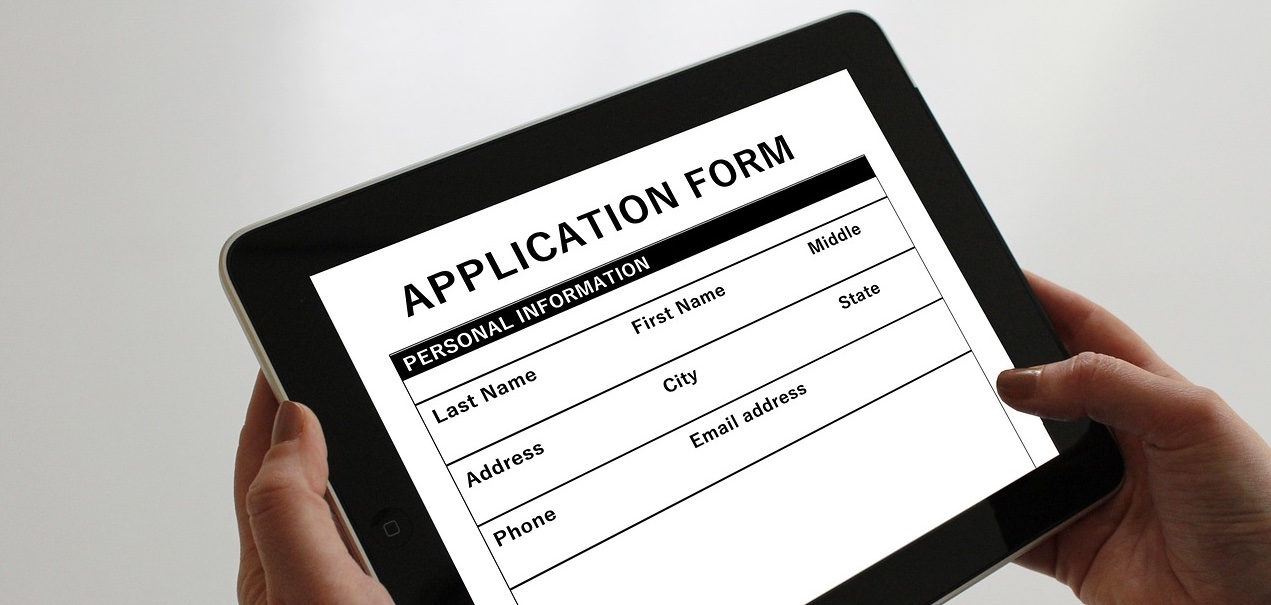
Forms are synonymous with admin. And forms are simply awful. Period. (Although most people would agree with each of these sentiments, I strongly suspect that they have never contemplated the logical consequence of linking them together.) There is, of course, the pain inherent to any form in and of itself. However, there’s whole bunches of other, generally avoidable aspects to forms that help dial this pain up to excruciating.

Computers, as in all other parts of modern life, have revolutionized this process through the advent of electronic forms: more pain, delivered more efficiently than ever before. And, even German admin has hit the ground running in replacing the previous, prehistoric system of paperwork with an efficient electronic one. And, in these pandemic filled days, just in the nick of time too to help maintain the air of “business as usual”. Unfortunately, however, that’s often “hitting the ground” in the way a drunk would seconds after passing out …

(As a point of clarification, I’m going to distinguish between electronic forms that you download and fill out on your computer and web-based ones. I’m only talking about the former here because the latter generally tend to work.

Which might also explain why my University doesn’t use them. Just a thought …)

Now I actually prefer electronic forms to paper ones. The latter are simply not made for my overly large and error-prone handwriting and with the electronic ones I automatically have an environmentally-friendly copy that takes up no space whatsoever. Nevertheless, my relationship with electronic forms tends to be of the love-hate sort of variety because they often seem to be made by the same admin types who previously mangled the paper ones and now get to showcase their lack of basic computer skills to boot. The only increase in efficiency is how many extra problems they can now build in.

But, paper or electronic, Microsoft Word or PDF, take your pick and choose your aspirin wisely …

  1. Brain-dead formatting

Rice_Writing_-_Kolkata_2014-01-24_7431_2We all know this from paper forms: unless one is able to write on a grain of rice or just happens to be generally adept at, say, writing microdots, some of the spaces are just way too small for a fraction of the information that is supposed to go in there. Fortunately, however, no one expects you to colour within the lines after age five, so you could always continue scribbling outside the box and over all the surrounding text for the admin types to try and decipher later. (Yes, Virginia, there is a payback sometimes …)

But electronic forms, with their pre-defined fields, are so much more versatile here …

Usually the fields are active. Or at least that’s the idea. But, sometimes they’re not and you can’t scribble over, above, around, or even in them like you could on paper. Or the fields that you can fill in automatically scale the font size according to the amount of text you enter, making for a typesetter’s nightmare with all the different font sizes. Even worse: not doing this scaling (or scaling of the size of the field) because the creator of the form knew beforehand just how long every answer should be. Answers that are too long, therefore, either can’t be entered in their full length or run unreadably off the side of the field, the 21st century’s version of having to write your entire address in a box that’s just big enough for your postal code.

  1. Endless updates

Taking their cue from google and Firefox, the electronic forms at my University undergo a seemingly endless stream of updates. One can only assume that that extra, discretionary comma added between versions x.x.x.7 and x.x.x.8 must be really, really important to someone.

And, to some admin types, it must be because their policy is to accept only the absolute latest version of any form.

How endless are these updates? Well, one specific form here at the University of Not-Bielefeld deals with hygiene measures related to the pandemic. Through the first eight months of its lifespan, this form was already into its fourth major version (4.x) and who knows how many minor tweaks within that. Now I realize that the speed with which the pandemic took hold in the Spring of 2020 caught nearly everyone flatfooted such that teething problems and the requisite improvements were inevitable. However, some simple proofreading (or just plain ol’ thinking) would have helped too. For instance, the form in question mostly consisted of a bunch of yes / no checkboxes (see #4 below) as to whether specific hygiene measures had been implemented. If the answer was “no”, then some additional explanation was required as to why not. But, some of the questions were essentially phrased in reverse meaning that “no” actually meant “yes, we did it”. But, if you took the instructions to heart, you are then obligated to explain why, for instance, wearing face masks or using disinfectant is a good idea.

(Remember this form. We will, unfortunately, be coming back to it. Again and again and again …)

Unfortunately, this kind of black is white, up is down mix-up is hardly an isolated incident at my University and has plagued any number of its forms. It’s perhaps not surprising then that the first few major updates to this particular form were more concerned with those discretionary commas rather than this indiscretionary logic.

And don’t even get me started on the forms with which I have to register my teaching each semester. A decade on and my teaching schedule is more or less fixed: same courses, same rooms, same times. (Different students, but same confused expressions.) What aren’t fixed are the forms. Every semester it seems like they tweak some little unnecessary box, add that extra comma, or just simply change the layout so that you can’t re-use the same forms from the last time (just adding one to the year), but have to re-enter all the data again and again and again because only the latest form will do.

  1. A central repository

This is actually an example of a good idea that was ruined by trying to make it better. Time was when all the forms my University had to offer were scattered randomly, cryptically, and gratuitously across the many, many webpages of Central Admin. So, even in those rare cases when you knew exactly which form you needed, actually finding where to download it from was often a multi-day adventure.

1280px-Books_in_a_shopping_cart_in_a_library_-_8459_2Enter the good idea: to combat this entropy and to return all the lost souls from the wastelands of cyberspace, my University set up a central repository containing every single form and associated set of instructions ever dreamt up by its admin team for your categorized, one-stop shopping experience. The West Edmonton Mall of forms as it were. (For the non-Canadians out there, think Mall of America. Same idea, but we did it first and it’s still bigger.)

So far, so good. But to make this good idea better, Central Admin restricts what parts of the mall you can visit to access only those forms that they think you need. Teachers get access to teacher forms, students to student forms, and so on. It’s not that I’m a formspotter or anything, but sometimes I need more forms that Central Admin would like to have me believe.

Usually these are the student-related forms. Even though we teachers are generally as hopelessly ignorant of the ways of admin as they are, students still seem to think that we can help them out here. (I wish that I understood what admin wants of me sometimes, let alone of the students.) Before, and with more than a little bit of luck, I could simply give the students a copy of the form that they needed. No more and I have to instead try and describe it to them based on the last version (now probably 3.7 updates old) that I laid eyes upon.

Oh and remember that part about only the latest forms being acceptable? The repository politely provides some of the forms to some of the people, but none of the version information to none of the people. So, each and every time we need a form, we theoretically need to go and download a new copy just to be on the safe side.

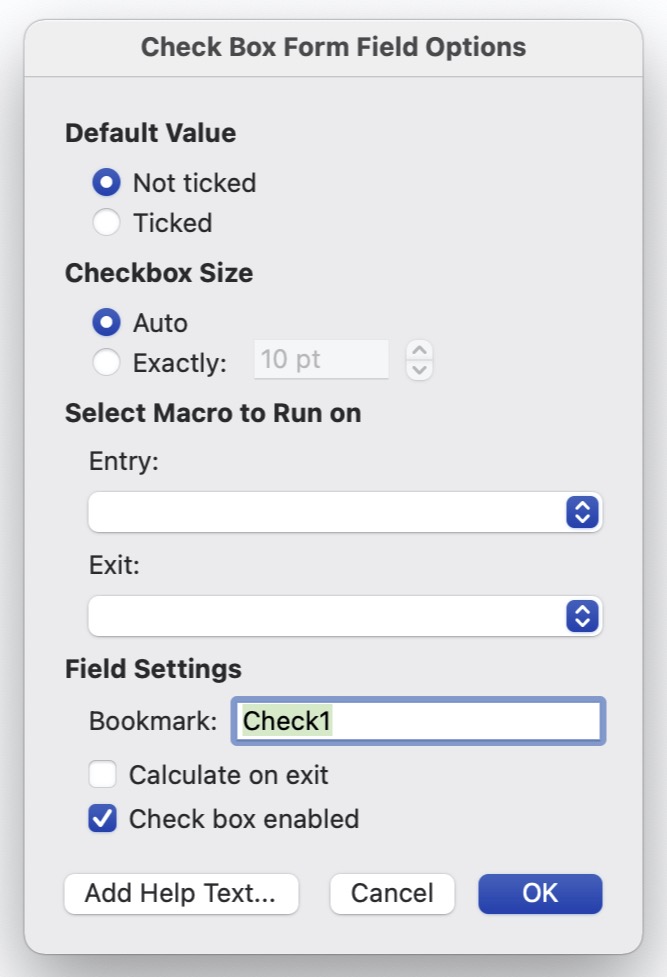
  1. Checkboxes in Microsoft Word forms.

A simple, short, sincere appeal: please, please, please can we just directly tick the box instead of via the pop-up window that always and very slowly comes up after having to double-click it? Or even just control-click it? Ever fill out a Word-based form with more than three checkboxes and you’ll know what I mean.

  1. Write protection. (Or, more accurately, wrong protection.)

Why, why, why?

Unlike some of my more annoying students have done to my questions on their final exams, most teachers really don’t have the desire to also go about correcting the typos on the forms that we have to fill in. Or just changing the form in some simple, random fashion for some simple, random reason. It’s usually more than enough work just filling out the damn thing.

Dunno. Maybe the creators are simply proud of their work, although it’s sometimes hard to see why. There’s been more than a few electronic forms that I’ve had to sign digitally in this, the Age of the Home Office, but can’t because they’re write-protected. I can fill in all the blanks that they want me to, but not all the ones that I want me to. The simple solution, of course, is to remove the pointless lock. One actual, suggested “solution”, however, was to print the form out, physically sign it, scan this signed copy, and then send that along electronically, a solution eerily similar with respect to its end-user inefficiency as one suggested to me by my University’s IT Service Desk in another context.

Remember that black is white work-safety form? That’s one of the worst culprits. If you stop to think about it, which obviously more than a few people here haven’t, if any form is designed for home-office use and digital signatures, this is the one. I mean, this is the form that we have to fill out to be able to go into work in the first place where we could, say, (legally) print it out and return it using the internal (physical) mail.

(It gets worse. After once having availed myself of the offered “solution”, our work-safety office returned my (as it turns out rejected) application via the University’s internal mail system. At the height of the first coronavirus pandemic in the late Spring of 2020. The printed out form literally sat in my University mailbox for months until I went into work again.)

  1. A job well done!

Now I’ve lived in a lot of different countries and have filled in a lot of their forms, but German forms are really the only ones that I’ve ever encountered that use exclamation points. Although most countries use bold face when they want to emphasize something particularly important on their forms (like please print using capital letters), I readily admit that an exclamation point could work here too. It wouldn’t be anywhere near as obvious, but it would work.

Francisco Lindor, Lonnie Chisenhall

But, German forms usually don’t use their exclamation points like this. Instead, they seem to be intended for us to somehow share in the excitement of the admin types or to simply build up some sense of achievement on our parts. Right on! Motivational training and a big high five from German admin!

And here comes that black is white work-safety form again. In the instructions for filling out the checkboxes, the form literally reads “Yes = goal achieved!”. (Take note of that slightly concealed exclamation point.) Even the early versions of the form proudly announced this to be the case despite “Yes = fail!” for some of the questions. And to ensure that you don’t miss out on the party, this phrase is also set in bold face and a larger font size than the subsequent “no = please clarify”, a phrase that is formally included only as a “piece of advice” and is not even arguably the more important of the two instructions.

One last observation …

Have you ever noticed that there’s no real difference between filling out a form and filling one in, despite the completely opposite meanings of “in” and “out”? (And, did you notice that I alternated between using the two “forms” in this entry? I didn’t until I just went back now and checked.) Usually this difference is important, like, say, between “checking in” and “checking out”, whether it be a hotel or just life. Not here for some reason. But, all sort of fits, doesn’t it?

Working the chain gang

Yes, in that long, bygone era (not even a generation ago …), about the only thing to worry about on the internet were the silly chain e-mails that your well-meaning, but still occasionally annoying friends and relatives would send around. You remember the ones.

“This e-mail has been around the world seven times. Keep it going!”

“Alanis forwarded this e-mail on to four friends and won the lottery the very next day. Nigel threw it in the trash and is now sweeping Alanis’ floors for less than minimum wage.”

With time and increasing internet sophistication on our parts, you’d think that these chain e-mails would long be a thing of the past. Unfortunately, however, admin types everywhere have kept this beloved tradition alive for us to cherish like hearing two cats mating at three in the morning. It would be nice if the e-mails actually had some societal relevance like being around the world seven times or some harsh consequences for the Nigels out there, but sadly we don’t even get that.

The whole premise behind this nonsense is that some important person way up in the institutional hierarchy gets the urge to write a memo to some less important people way down in the hierarchy. But, instead of sending it to them directly, it has to go down the whole admin chain of command first (so, a double chain letter then), bumping its headers on every rung of the ladder along the way. I’ve literally gotten e-mails within my University where its twisted, convoluted journey was something along the lines of:

  • VP for Student Affairs
  • My Faculty
  • The Dean for Student Affairs in my Faculty
  • My Institute
  • Me as a teacher

So not exactly seven times around the world, but nearly seven levels of admin. Close enough.

(The “best” chain e-mail that I have ever received from my University here in Not-Bielefeld—and I am not making this one up—was one that limped its way down from above to (eventually) announce that the postal seal for the Karlruhe Institute of Technology had been updated recently because someone had stolen the old one.

Possibly a bit of urgent news for someone at my University, definitely not for most. The only things about this particular e-mail that interested me are what evil genius hatched up this nefarious plot for world domination and, more to the point, why. Unfortunately, these actually useful bits of information were not included in the e-mail, just what the new seals looked like, which, many, many years after the fact, still remain the first and only time that I’ve ever set eyes upon them.)

And, despite most the information in these chain e-mails usually being about as important as new postal seals, I nevertheless invest the three days worth of scrolling, just to make sure that I don’t end up like poor Nigel …

Leerevaluations

First off, I should probably explain that title …

(I think you can see already where this piece is going, but forgive for one more paragraph …)

Call it a draw …

… if only so we can get back on track.

  1. The German salary system

Like everything else in Germany, salaries, especially those for public servants, are highly structured. Moreover, the struture has much more to do with the job description and then with age / experience than with actual performance. Know a person’s job and their level of experience and you can pretty much nail down their gross salary to the penny / Euro cent. An extreme example of this was University professors paid according to the old C salary scale, where their gross salary was determined pretty much entirely by their experience (read age). Yep, all they had to do to get their next pay raise was to age two years until they turned 49, when even that didn’t help anymore. Teaching evaluations? Not a chance …

  1. The incentive system

After wondering for decades why many profs didn’t do much after reachievaluationScaleng 50, the government finally replaced the C salary scale for them with the W scale in 2002. The structure was still there of course (this is Germany remember), but the levels were now performance dependent. Good work = more dosh. Bad work = the same dosh as before. Aging two years = just more wrinkles.

So a step in the right direction, but the teaching evaluations unfortunately never made the bus. (Not even to get thrown under it.) My experience has been that my pay incentives revolved pretty much solely around how much grant money I brought in. The question of how much teaching I’ve done and how good or bad it was was never raised. It was all in my reports, but I never had an ounce of feedback that any of those lines were actually ever read.

But all this, such as it isn’t, is also only for the profs. For all the many other people doing teaching in German universities, and especially those in positions designated specifically for teaching, return to #1 and take your time so you get more age / experience.

  1. The just plain silliness system

All our teaching evaluations are carried out online and have lots of nice summaries to happily ignore. No, really. I mean how helpful is a naked grade without any explanation of it? And especially when the course is taught by several people who all get lumped together under the same grade? Personally, all I ever paid attention to were any additional comments, which at least provided a smidgeon of useful feedback that I could work with. (Even better was doing a live feedback round with the students where you could actually discuss things.)

Access-denied_storyBetter yet, all this cross-indexed, cross-referenced, cross-eyed information by default goes nowhere. Sure, we teachers get to see it, but that’s it. For the Dean of Studies to see the results, or even the students for that matter, we teachers have to explicitly allow this in the system and are under absolutely no obligation to do so. And for courses with multiple teachers, all of them have to do this, thereby providing an effective veto for any teacher who doesn’t really care or is getting bad evaluations. Or precisely those teachers that the entire process is trying to identify. And all this was true even before all the GDPR-induced mayhem steamrolled its way across Europe in 2018.

So, in the end, we have a system where there’s really no incentive for good teaching and no possible punishment for bad teaching even if it could be recognized in the first place.

But the silliness doesn’t end there, of course …

Now, when I said that all our evaluations are online, what I really mean is that they are now online again. When I first started here in Not-Bielefeld, they were also online. However, the students’ union was afraid that somehow the system wasn’t really anonymous such that the teachers could somehow see who gave them a bad review and then tit-for-tat punish these same people by giving them a bad grade. So, despite numerous assurances from our IT-Department to the contrary, we had to switch to paper-based evaluations and accelerated global deforestation for a number of years.

Never understood the arguments of the students here to be honest. For one thing, what teacher has the time to invest into hacking into a system (let alone the know-how) to find out which student said what and then somehow change the grades that had already been published in the meantime? Any teacher who wants to pull this sort of crap already knows which students they don’t like and vice versa and has had ample chance to crap on those students long before this. For another thing, paper evaluations mean handwriting. Final exams mean handwriting, but with names attached. No great hacking skills needed there …

But, with no big changes to the online system or its security, but presumably some to the leadership of the students’ union, we are now back online again.

This little excurse was also wastefully expensive. Nevermind the obvious printing costs. You see, the offline version of the evaluation was exactly the same as the online version it replaced, just on lots of flattened, single-sided A4 bits of trees. Lots and lots. And, except in the world of admin, paper is usually not a very good way of summarizing anything. So with the help of a special new scanner, special new software, and a special new part-time position to operate both, all the paper evaluations were converted into online versions for us to once again happily ignore.

And now that everything’s back online, the scanner and the software are sitting there unused (or at least my request to use them for a questionnaire study of my own was turned down) and the part-time position has presumably been retained and remodelled to do something equally productive.

And just to add insult to injury …

Normally 50% of all the courses my Faculty offers are selected to be evaluated each semester, meaning that each course is evaluated, on average, every second go round. But for some utterly unknown reason, the Faculty decided to evaluate each and every single course this past semester. Why? For really black-and-white non-proof (see #3 above) that we’ve done a bad job in an impossible situation?

Despite all this, I remain a fan of the entire evaluation system. Such a fan, as a matter of fact, that I actually want to see it extended. Vastly. For instance, why not also start up an analogous “commitment to admin excellence” program together with the associated admin evaluations?

It would, at the very least, give that one person in the part-time position something to do …

We are Anonymous

(As an extreme bit of irony, the program came online exactly one day after I submitted a report on a thesis where there were some instances of at least sloppy plagiarism. I couldn’t investigate it further because there was no online tool available, the IT-Department having naturally suspended access to the previous one while setting up the current one.)

Use of PlagScan is relatively straightforward. In the University’s online teaching system, you set up a folder in one of your courses that is designated for the program and any file in it gets automatically and magically scanned for any instances of plagiarism. Shazam! However, because the PlagScan folder appears to be necessarily public (the folder can either be designated for the program or made invisible, but not both), it was explicitly pointed out in the grand announcement of the new service that any personal information in the work should be removed to preserve anonymity and to maintain data privacy.

Let’s follow the train of logic on this one to watch the derailment in real time, shall we?

train-wreck-67775_1280

  1. All the students in my group are working on individualized projects. (For reasons of data privacy and to maintain anonymity, we’ll label these projects as A, B, C, …)
  1. Everyone in my group knows what very specific project everyone else in the group is working on.
  1. I have just uploaded an anonymous thesis reporting on very specific project A to a public PlagScan folder to check for possible plagiarism. Both the folder and the results of the check are accessible by everyone in my group.
  1. Gee, now who could have written that thesis?

So far, my working, but far from efficient, “solution” to this problem has been to create an invisible folder and then to bury the PlagScan folder within that, with the hope that the latter becomes invisible to the students but not to the program. (No idea if this feeble hope has been crushed yet.)

(Sadly for a good story, that resolution came the next day and really was a solution. Although this is not stated anywhere, the PlagScan folder is indeed invisible to students and the removal of personal information is because any files in it get uploaded and saved on the PlagScan servers.

However …

Just out of curiosity, I did upload that one questionable thesis to see what the results were. Over a month later and nothing yet. The optimists out there might point out that this means that the IT Service Desk actually did something better and faster. Not me. Now I need to ask them why that thesis isn’t being checked automatically like it should be. (And, yes, to be extra safe I did move the PlagScan folder out of the invisible one.))

The self-fulfilling prophecy

Just a quick one this time around …

A few years ago, one of the secretaries (if that job description is even allowed to see the light of day anymore) in the department wanted to rise up the pay scale and, this being Germany, could only do it upon achieving “further qualifications”. (In Germany, everything is based on having the appropriate, documented qualifications and apprenticeships. Everything. Even therapy animals have to go through a three-year apprenticeship that they might not pass in the end, begging the question if they would then need their own therapy animals to recover. I am not making this up. (Well, the last bit about them maybe needing their own therapy animals, ok, but not the first bit. Still, if the last bit were true, you could imagine that there must be quite a waiting list.))

Anyway …

One of the mandatory courses that had to be taken was called “Introduction to German bureaucracy”.

‘Nuff said …

Taxing patience

Another lesson in admin logic that my father reminded me about, this time a transcontinental one …

Although I always claim to be Canadian, that’s really only true culturally, if it can be said that there really is such a thing as a cultural Canadian. (Molsons, hockey, and poutine does not a culture make. Just a perfect, wintery Saturday evening.) Genetically, I’m actually 100% German and both my parents emigrated to Canada from Germany in the early 1960s. (In hindsight, it makes me wish that I’d listened to them more as a kid because then my German would be miles better than it is now. But then, who would have ever suspected then that I’d reverse-emigrate back to Germany?)

Why is all this important, apart from being a nice excuse for one of my digressions?

Well …

Because my parents were in their mid-20s when they emigrated, they’d already worked a bit here in Germany and so contributed to their pensions. Not for long and not for much, but still something that’s added up over the years “thanks to the Miracle of Compound Interest”. My parents have long since retired and so are also reaping the riches of their German pensions in Canada. And here starts the story.

After drawing their German pensions for some years, my parents started getting demands from the German tax office for the income tax due on those pensions. (How you can possibly be expected to pay income tax on an amount that barely buys you a cup of coffee is anyone’s guess, but the Germany’s version of the IRS apparently is very good at guessing.) And here the transcontinental logistics do come into play a little bit: how do you pay a German tax bill from Canada?

euros-poignee-de-main

The banks, of course, offer numerous convenient options for this, if only convenient for their bottom lines. A bank-to-bank transfer is the most direct obvious route, but it involves two sets of service charges in addition to the usual shitty exchange rates. The Canadian bank takes their cut for setting up the transfer and the German bank naturally takes theirs for receiving the money. Say what? Since when does simply accepting money count as a “service”? (If you’re bored and not easily offended, google “George Carlin” and “service the account”. Same idea.) In the old days, say pre-Y2K, you could sort of understand this, at least on the side of the bank sending the money because there was a bit of work involved to it. But now with it all being electronic and automatic and even more impersonal than the banks ever were?

Cue option #2: the international money order. Only one set of service charges this time around to compensate for the difficulty in printing out that piece of paper. (The usual shitty exchange rate doesn’t cover those exorbitant costs, you see.) Or so you’d think. Even though the money order was in Euros and drawn from a German bank, my parents still got another bill from the tax office for the service charges they incurred in trying to cash something that essentially is cash. Comes the dilemma: how do you transcontinentally pay a bill for the service charges involved in paying a bill? Another international money order? Sorry, no. That’s one step toward a perpetual motion machine and so fundamentally outlawed by the laws of the universe (even if it fits perfectly within the rules of bureaucracy). The solution, of course, was to tap the son living in Germany to transfer the necessary amount of money in Euros drawn from a German bank. Sounds hideously familiar with the exception of the service charges.

It gets better of course. (Better only in the context of this blog. Objectively worse in the context of humanity unfortunately.)

Perhaps to build up the sense of anticipation, the German tax office only did their assessments on my parents in three-year batches. So their tax demand for the previous year was bundled with those for the two years preceding it. Buy one, get two free as it were. Except there was nothing free about it because the total demand also included the interest that was owing on the first two years because the payments were late. My parents actually went to the trouble of phoning the person in charge of their case to point out that it’s kind of difficult to be late with a payment that you’re not informed about. A pretty logical argument when you think about it. But even bombproof, Aristotle-approved logical arguments are no match for Bureaucracy Counterargument #1: those are the rules. (Rules, while not mutually exclusive from logic, are often a couple of doors down from it and typically used in place of real arguments.) The feeble ray of light at the end of the tunnel, however, was that they could formally appeal the interest charges. Which they did.

To cut a long story short, the appeal went to the person’s immediate supervisor who, true to their adjective, immediately turned it down (cf. German efficiency).

Subway_train_in_tunnel

So, once again, any ray of light was merely the headlight of an oncoming paper train …

Perhaps the obvious question in hindsight is why all this is even necessary. Why doesn’t the German tax office simply deduct the taxes from the pension before it gets paid out? They do manage this complicated trick with salaries after all. The question was indeed so obvious that my parents did ask it. The not-so-obvious answer was simply that it’s Not Possible because the tax office and the pension department are two separate departments, silly.

In the end, my parents are being punished, financially if not psychologically, for being honest. The tax demands are usually politely phrased along the lines of “Please pay this OR ELSE.” Another German acquaintance in Canada facing pretty much the same situation simply wrote back saying that they’d take “or else”. Since the tax department knows about the money, they can simply take it from there or take steps to withhold the pension or whatever. The acquaintance didn’t really need the peanuts anyway and wasn’t much of a coffee drinker either. Or else turned out to be nothing at all. Because of the two separate departments and the two separate continents, the pensions kept coming untaxed, the tax demands kept coming unanswered, and everyone seemed ok with that.

Just gotta love those happy endings …

Hours are not to reason why

If you’ve ever wanted a good example of the old saying that time is relative, you need look no further than the admin behind teaching in Germany.

It all seems so simple going in. When I arrived at the University here in Not-Bielefeld, I was told that my teaching load was nine hours a week per semester (which, compared to North America, is indeed a load). And the reality stopped right there.

Now, you might be excused for thinking that the fantasy was in only having to teach nine hours a week and that this blog would be about me whining about how I actually teach much more than that. As true as all that is, the real Alice-in-Wonderland part about all this is in how those nine hours are calculated.

If you thought that calculus and relativity theory are impenetrable, this is the combination of them both …

For starters, an hour isn’t an hour when it comes to teaching in Germany. Not even in name. Instead, it’s formally called a Semesterwochenstunde (or SWS for short), which translates out to the incredibly awkward sounding “semesterweekhour”. More to the point, each SWS also comprises only 45 minutes, meaning that my nine-hour teaching load really only works out to a nice even, real-world six and three-quarter hours. This weird conversion, however, does mean that a double lecture only works out to 90 minutes, so not too onerous on my side and still long enough for the students to make up their sleep deficits on theirs.

harold-lloyd-1137109_1920

And not only do different classes start at different times, but, bureaucratically speaking, they also last for different amounts of time in terms of their contribution to your teaching load. One “hour” of a lecture, seminar, or practice session (Übungen) all count as one whole hour. All good. By contrast, one hour of a practical (Praktika) from the admin point of view is really only half an hour and one hour of an excursion is only 20 minutes. And all the work that we do surrounding and supporting all these endeavours—writing and preparing lectures (especially in these corona times when we have to record them), grading assignments and tests, answering e-mails, or just plain ol’ answering the students’ questions and helping them to understand the material—is worth nothing at all in terms of our teaching load. All that counts is how much time we spend in front of the classroom and then often not even that.

All this “new math”, of course, has its repercussions. For starters, there’s a new impossible German word to learn: Lehrveranstaltungsstunde (“coursehour”) or LVS for short. Again, this isn’t an hour nor even an SWS. What it is is the SWS multiplied by the correction for the type of course: 1 SWS = 1 LVS for a lecture but only 0.3 LVS for an excursion. And admin loves to use both terms seemingly randomly on us.

In more practical terms, we also don’t really offer any Praktika in my Department anymore, but Übungen instead. (So actually less practical terms / semesters.) No one, not even the admin types, really knows what the difference between them is other than you seem to do (or get credit for) only half as much work for the former despite being there for the same amount of time. And the juicier lectures and seminars also tend to be the exclusive domains of the profs, leaving the undervalued rest to the teaching assistants. The latter can have it really tough because of this. There are certain positions that are largely designated for teaching (Lehrkräfte für besondere Aufgaben or “teachers for specific duties”) and the system makes sure they do nothing but. Because they don’t get to come anywhere near the lectures and because we give them shittier exchange rates than most banks do, their actual teaching load of 18+ SWS translates into nearly 40 hours per week. Time for research? Only if you don’t need time to live.

Even the students are subject to these weird time dilations. They also don’t have normal hours, but “workload hours” (if you thought that the Bible was great for inventing or subverting units of time, admin wins hands down), which is the amount of time that an average student would need to complete a given task. (The average student, of course, being another work of fiction. Apart from the problem of knowing what the average student is capable of, when was the last time anyone ever gave a student a C? Although a C should represent the “average grade”, it’s practically a failing grade nowadays.) So, a course that represents 10 semesterweekhours for us teachers becomes 450 workload hours for the students. Teaching assistants aren’t the only ones getting shitty exchange rates. But, then again, whereas we teachers don’t get to count any of our prep work before or after the class, the students get to count everything they do outside of the class in full. My 20 minutes worth of excursion is also a full hour to them. (Or maybe just feels like it …)

Bundesarchiv_Bild_183-19000-1918,_Albert_Einstein

To top it off, our Department teaches Master courses in two seven-week blocks each semester. Again, some quick math. 450 workload hours divided by seven weeks is a little north of 60 hours per week that the average student is expected to put in. When I tried to point out that this might be against the labour laws, if not actually illegal, my quick math quickly became administratively adjusted. Although the teaching portion of our semester is only 14 weeks long, the semester technically stretches over an additional 12 weeks (making 26 weeks in total) so that the 450 workload hours should really be divided by 13, making for a perfectly legal and humane, if utterly fictitious, 35-hour week. Never mind that we don’t often use those extra six weeks and actually can’t in half the cases (i.e., all those blocks that fall into the first half of the teaching time that can’t be extended into the extra part of the semester on the back end). It all looks good on paper. And paper is what German admin is all about.

It also all sort of makes sense now why it took a German to come up with the theory of relativity …

An open-and-shut case

For our “protection”, the IT Department here at the University of Not-Bielefeld recently restricted the types of attachments that could be received via e-mail. Most affected by this were the older Microsoft Office documents (e.g., .doc or .xls files), which could be compromised with vicious macros and other similarly evil stuff. Instead, for the past year or so, only e-mails with their Generation-X relatives (i.e., .docx or .xlsx files) and other IT-approved file types as attachments would pass muster and land happily in people’s inboxes.

Fine …

Well, all was fine, until I had an issue where the University’s e-mail server bounced an e-mail back at me because the attachment, a supposedly legal .docx file, was somehow “suspicious”. (With heavy emphasis and foreshadowing on “suspicious”.) Fortunately, the e-mail letting me know that my message had bounced (the receipt of such feedback, unfortunately, being by no means a given) conveniently indicated that I could contact the IT Service Desk should I want to get more information and help on this particular issue.

I wanted and so I did. Particularly because this document was derived from an important template of mine that I have to use over and over and over again.

The response from IT Services was actually fairly quick (cf. German efficiency). After chiding me softly for not including the offending file, they pointed out the “handy” solution of uploading all such nasty documents in the future to the University’s convenient cloud-storage system, generating a link to said document (in said cloud-storage system), and including said link (to said document (in said cloud-storage system)) in the e-mail. Issue solved and case closed.

(As an explanation, each e-mail to the IT Service Desk is assigned an individual case number to which you are to refer to at all times. Under dire penalty of something or other. The case will be kept open until it is either resolved or the Service Desk responds to your e-mail, whichever comes first. Seriously. I’ve almost literally gotten responses from them that said 1. “We don’t know.” and 2. “Case closed.”.)

But, somewhat uncharacteristically, I digress. (And, don’t even get me started on why I can upload this same diseased file to the cloud-storage system for someone else to download and sabotage their computer, but not infect them directly by e-mail (cf. German efficiency).) Let’s dissect that response instead …

  1. If I have a document that’s causing an e-mail to bounce, I really can’t attach it to another e-mail, even one to ask why the first one was bouncing, and have any realistic chance of that second e-mail also not bouncing, now can I? 
  1. I literally have no idea who this solution is supposed to be handy for. (And the word “handy” really was used. Well, not as such. The e-mail was in German and “Handy” in German means “mobile phone” so “geschickt” was used instead, which does mean “handy”. But in German. Not in English.) A one-step process (send an e-mail) suddenly involves a three-step, but very handy “solution” (upload, get link, send an e-mail).

Second try.

I write back (obediently using my case number to avoid the unstated and probably unseemly penalties) pointing out the inherent contradiction of including the attachment in the first place and, hold your breath, using the “handy” solution proffered to provide them with a copy of the illegal, legal .docx file.

And I waited (albeit not holding my breath) …

Again, the answer was painlessly rapid and said 1. “We don’t know.” and 2. “Case closed.”

Ok, I’m being a bit unfair with (1). The actual answer was something along the lines of the file probably containing some suspicious formatting even if it is a legal file type. Or, to paraphrase, “we don’t know.”

At this point, I figured that I was lucky to have escaped alive and (mostly) sane and simply accepted (2). I could have pointed out that it’s actually easy enough for IT types to insert some code to give some vague hint as to what naughty bit of formatting is being flagged by their program. (I mean, the base code must literally be something like “if the attachment uses Comic Sans as a font, then bounce” so it’s really easy to rewrite the last bit as “then bounce and say ‘Eek! Comic Sans.’”.) But, instead, I decided the more direct and effective approach was to “simply” rebuild the template from scratch.

Which worked.

2. Case closed.