I’ve mentioned before how time in Academia doesn’t really flow the way it does in the rest of the world. And not just for students in the middle of a death-defyingly boring lecture either.
It gets worse …
At a recent meeting of the profs in my department, it was revealed to us that, on average, we engage in about 30% more teaching than we officially have to do. This, of course, was seen as problematic, but not for the reason that most sensible people would logically come to. The real problem, it seems, is not that we’re overworked, but rather that we’re giving the impression by offering so much teaching that we have too much time on our hands, which could lead to job cuts in the future.
I just don’t understand the maths on this one. Overtime normally means too much work for too few people. Getting rid of even more people would mean even more overtime. Which, by their logic, would mean more cuts and more overtime until only one poor sod is left to work a 40-hour day. And weekends …
So what to do? We could do less teaching, of course, but this would mean cutting into our Bachelor and Master teaching programmes (which combined are already shorter than their North American equivalents, another gripe of mine). Instead, the solution was mindblowingly straightforward: if the University of Not-Bielefeld is not going to give us any gold stars for doing more than our share of teaching then we’ll only claim the amount that we ought to be doing. Yep, that’s right. We reinvented the concept of overtime to not only make it unpaid, but invisible as well.
Once again, the maths elude me …
A big part of the reason why we’re working overtime is because the university has been increasing student (and admin) numbers steadily over the past decade without adding much teaching staff. As such, we have to teach many of the entry-level courses in parallel to shuffle everyone on through. Having the university see that we’re no longer doing too much teaching but now only just enough can only strengthen their resolve to open the floodgates just that little bit more. Which, of course, means even more unpaid overtime and so even more students and, just like in Groundhog Day (which has an amazingly long Wikipedia page, BTW), we start all over from the beginning again, only without the chance for any personal development and so winning over the love interest in the end.
On top of that, there’s going to be a 30% disconnect in the number of teaching hours that we offer and the amount that we actually do. Forget invisible overtime. Now we’re also making normal time vanish out of existence! Would be a really neat trick, but some eagle-eyed, number-crunching admin type is going to notice the fabric of space-time slowly unravelling eventually. And hell hath no fury like an admin type when the sums of two columns don’t add up.
So …
To avoid falling afoul of any of those admin blackholes, we would have to reduce the official number of hours each course has to match the number of hours that we are claiming for it. However, this would mean that the teaching programme no longer offers enough hours for the students to graduate in time, meaning that we would have to offer more courses for us to not claim fully and the entire wibbly wobbly, timey wimey nonsense starts all over again. For the third time.
So much for perpetual motion machines being impossible …
Part of the University of Not-Bielefeld’s justification in opening up fully for teaching this semester was that the incidence of corona among students earlier this year was far lower than in Not Bielefeld generally, meaning that the University was neither a corona hotspot nor a spreader event. And, as part of its meticulously thought out programme to ensure that this continues to be the case, the University no longer requires corona-infected students to register this particular status.
The perfect, unintentional one-liner that comes from putting style above substance: the English acronym of the University of Not Bielefeld’s swishy moniker to justify opening up for teaching, and which becomes especially relevant for the coming semester where we will be fully open despite continuing record numbers of infections in Germany, works out to RIP.
I know. Another corona entry. It just seems there is nothing like a good pandemic and the associated fevers to really stir up the admin creative juices until all those clever new ideas just bubble up out of the froth.
And another form this time around too: danger-assessment forms. (Or, in German, Gefährdungsbeurteilungen. Only slightly longer and with slightly fewer spaces. Admin is a universal constant after all.) And not just any such form, but the one that was newly introduced by the University of Not-Bielefeld’s Work and Safety Office to ensure our safety while working on-site during the pandemic. Basically, for any teaching or research activities that were to take place on campus, this form had to be filled out in advance and approved by the Work and Safety Office.
I suppose that the form is supposed to be for our collective good, but it’s hard to see it as anything more than the pandemic causing the Work and Safety Office to have a sudden fit of new-found self-importance. (Either that or the typical admin ploy of trotting out a new form to give the appearance of having done something.) Make no mistake about it. Like so many other forms, and more than most, the corona-specific, danger-assessment form is exceedingly pointless. (It is also the same brilliant black is white, exclamation-point overloaded, creative masterpiece that I mentioned some time back.) When you boil this form down to its microscopic essence, it works out to agreeing to hold the on-site activities in accordance with the University’s hygiene regulations. These, in turn, are the not too inventive and now all too well known measures of masks, social distancing, copious amounts of alcohol, and frequent breaks with lots of fresh air. Do you really need central admin to sign off on this?
As it turns out, you don’t …
After only a single semester, Work and Safety realized just how many courses take place at the university and just how many forms they had to sign, if not actually read. So they found a way to reduce the admin load (or, more to the point, their admin load) by absolving themselves of the responsibility for their actions by shifting it down the admin chain. Instead of the sensible solution of having us all simply agree to obey the University’s corona-specific hygiene regulations (something that we essentially all do in the form anyway), the job of signing, and possibly reading, all the teaching-related forms now fell to the Dean of Students in each faculty. The Dean, of course, is just a normal prof, who has (been) volunteered for this particular position. Nevertheless that apparently makes them infinitely more qualified to judge whether any and all submitted safety measures adequately meet current work and safety regulations than, say, me, a normal prof who hasn’t volunteered.
To some extent, the point behind any form, and particularly for particularly pointless forms like this one is to create extra work for other people. And this one has fulfilled its role perfectly. First of all, you have to fill it out for every course you teach as well as every separate form of research (e.g., lab-based vs. fieldwork). More surprisingly and annoyingly, although you’d think it would be hard to not get the form approved (I mean, who’s going to tick the box that says that no social-distancing measures will be implemented, right?), it’s happened to me on no less than three occasions.
At the very least, it does indicate that someone is reading my forms besides me …
Strike 1: Work and Safety turned down my request to teach part of a class on campus. The class was basically about how to write and do presentations and, although I did most of the class online, I thought that it would be good for the students to do their presentations live and with a live audience. Anyone who has given a lecture online will understand why. Work and Safety, however, thought otherwise. What was particularly annoying about all this is not that the form wasn’t approved, but how I found out about the rejection. I submitted the form electronically when the whole university was in lockdown and pretty much no one was allowed on campus. Pretty much the only thing more nonsensical than the rejection itself was that it came via the interoffice mail system at a time when the university was still in a partial lockdown and everyone was encouraged to work from home unless it was absolutely necessary. As such, I didn’t discover the rejection until just before the presentations were to take place (no news is good news, right?) and far too late to do anything about it.
Strike 2: The Dean of Students rejected my application to have a Bachelor student conduct behavioural observations for their thesis at a nearby zoo because I hadn’t included what hygiene measures the zoo had and whether they were in compliance with those of the University of Not-Bielefeld. Naturally it made no difference arguing that I had no control over what measures the zoo chose to implement beyond the same ones dictated by the provincial government that the University was also following nor that the zoo was closed to visitors for the foreseeable future (= social distancing) and that the observations would be carried out outdoors (= fresh air) wearing a scarf (= mask, sort of) because of the cold. Luckily, however, copying the hygiene measures from the zoo’s webpage was enough to appease the Dean.
Strike 3: Not even one year later, the Dean’s Office refused to even accept my application to have a different Bachelor student do observations at a different zoo (= different hygiene measures = new form) because such research activities might no longer be within their realm of responsibility. Oh, and could I please check with Work and Safety to see if they are responsible or if it is indeed the Dean’s Office or if my very own signature will suffice. Right. Apart from the ludicrous notion of me filling out someone else’s form only for me to approve of what I want in the first place (and if that isn’t a definition of admin, I don’t know what is), why should I bother to check what job someone else might or might not have to be doing? If my signature is enough, why ask? It’s done. If not, I’ve submitted the form. And, in any case, Work and Safety have never answered any of my e-mails requesting help since the start of the pandemic.
Fortunately, one of the secretaries in the Institute came to my rescue and took up the call on my behalf. A mere 10 days after asking Work and Safety about the situation, they responded (over e-mail!) with the astute and informed observation derived from years of specialized, intense training that they had no objections so long as the hygiene regulations of both the University and the zoo were followed. In other words, pretty much what was on the pointless form in the first place. The request for an official signature on the official form has so far gone unanswered …
And, yer out!!!
(If only because the corona form is now officially obsolete. (Actually, unofficially obsolete. Yes, the absurd situation mentioned above has now been officially realized: completely untrained profs have now been officially “empowered” to approve their own safety protocols on behalf of admin.) Yes, despite Germany still battling record infection numbers, the University continues to stand by its decision to fully open up all teaching again for the coming summer semester …)
Since Gutenberg, the single, greatest invention to further the nefarious causes of admin has undoubtedly been e-mail. (Now spelled increasingly frequently without the hyphen for greater efficiency.) Whereas before the printing, folding, and stuffing of countless pieces of paper into countless numbers of envelopes meant time, effort, and the omnipresent threat of paper cut related leaves of absence, literally hundreds of helpless, unwilling victims could instead be reached with just a few mouse clicks.
(Yes, I know. Those who have been following this blog (hi mom) are now pointing out that I previously stated that German admin lives and dies with paper. It does. How else can you describe a system where they refer to paper-free examinations despite having to submit a signed, paper copy of the grades? Or, for instance, whereas corona has caused our Institute to (finally) accept and archive digital documents, every form that reaches our Faculty has to be printed out. The distinction here is that the paper is meant to torment us, not them. Upon their return home, the forms are usually just filed away in the appropriate drawer.
The second greatest invention, of course, has been the listserver for when even a few mouse clicks are a few too many …
Time was when the admin types had to add everyone’s address to each e-mail individually, the digital version of stuffing envelopes with carpal-tunnel syndrome replacing the paper cuts. Now you add each address to the listserver once and it’s bombs away in just two clicks!
And bombardment is really the only word to describe what’s going on these days. Concomitant with the installation of new software a few years ago that made the setting up and using of listservers incredibly easy, their use has exploded here at the University of Not-Bielefeld and so have the number of e-mails coming around. Whereas the little bit of effort involved before might have made some admin types question if sharing the information was really worth it, the current complete lack of effort makes the answer to that question an automatic yes.
And everything happens via listserver now.
I’m not kidding. I’m on at least 25 of these lists, representing a diverse swath of every digital minority in the University: all staff (ok, not really a minority), all profs, all users of the HPC facility, and then—get this bit of fine German engineering—all teaching staff in the University, all teaching staff in my Faculty, all teaching staff in my Institute, and all teaching staff in my Institute teaching bachelor courses. And on and on it goes.
Anyone can create a mailing list and they can add anyone to it. But, unlike a true listserver, the only way to remove yourself from the list here is presumably to remove yourself from life. (Which is increasingly tempting some days …)
Naturally, most of the e-mails are just form letters, sent to all with the hopes of interesting a few. (Not unlike, but somewhat more socially acceptable than spam mails.) A new twist arrived the other day though in the form of one of these e-mails that was personally addressed to me. (And so starting to resemble spam that much more.) Instead of an e-mail explicitly and mindlessly blasting everyone, here was an e-mail politely, but still mindlessly, blasting just me! Us oldtimers remember this from days gone by, where we got printed form letters in the mail where our name was printed differently from the remaining text to make it that much more personal. Of course, the thrill of this wore off very quickly for everyone over 10 years of age because even without this “helpful” hint, a form letter remains incredibly easy to spot after only one or two sentences in.
Or so you’d think …
You see, not soon after I’d read the first few lines of my e-mail and filed it in the appropriate “drawer”, I received another copy of it that was personally and politely addressed to someone else in the Faculty office. Apparently, the secretary dutifully forwarded the e-mail to our Institute (because we only need to critically evaluate e-mails coming from outside the University after all), which then through the three-step magic of technology (1. Forward e-mail. 2. Select victims’ listserver. 3. Execute.) came to bother us all over again. This time with numerous undeleted and pointless forwarding headers so that you had to read a little bit further than the first few lines to come to the same conclusion.
Fortunately, the appropriate drawer was still only a single click away …
More of a change than a comment, but, as I’ve said before, if you’re looking for a blog with strict adherence to the rules, keep looking …
Just noticed today that they’ve changed the packaging for my underarm deodorant. Again. Although there was more than enough room for both pieces of information, the packaging now proudly, if minutely, states that the deodorant is vegan instead of how to properly dispose of the empty bottle. Yes, if we want to guarantee a sustainable future (apart from refraining from changing the product packaging every six months of course), informing the consumer that they are not rubbing a dead rodent on their armpits must rank right up there. With or without extra cheese …
A minor miracle occurred here recently at the University of Not-Bielefeld. No, no. Admin is still here in all its full glory. (Changing that would require a major miracle and you would not believe the amount of paperwork involved to get miracles on that scale approved nowadays. Much, much easier a few centuries ago.) Instead, someone merely stopped to question whether or not a specific form was actually serving its stated purpose.
The form in question (or the questionable form) comes from the central Equal-Opportunties Office of the university and is designed to increase the proportion of women in the university workplace. Just how it does this by collecting statistics about the hiring process (e.g., what type of position, where it was advertised, how many male / female applicants / invitees / selectors, …) remains somewhat of a mystery. Even more mysterious, however (cf. minor miracle / thinking), was that the Equal-Opportunities Officer of the Faculty of Science decided to send round a questionnaire some months ago to ask if the form was actually doing that.
All told, the feedback from the 40-odd percent of professors in the faculty who responded was nothing short of unambiguous. (And academics don’t tend to agree about anything.) Nearly three-quarters of them said that don’t like the form and even more thought that it did nothing to improve equality within the University. The selected comments that were published echoed this view, with the consensus pretty much adapting the slogan of the NRA to say that “forms don’t hire people, people hire people.”
And, thinking about it, it’s really hard to see how this form can have any influence whatsoever on the hiring process. I already mentioned that it’s more about statistics than anything else. For another thing, it’s filled out pretty much after the entire process is finished and is part of the requisite paperwork to get the chosen person appointed. Finally, the survey revealed that the form is filled out in about one-third of all cases by secretaries who play absolutely no active role in the selection process whatsoever.
Now, despite all this and the double supermajority on the part of the profs against the form, it appears that it will remain because of a simple veto.
In publishing the results of the survey, a statement from the university’s central Equal-Opportunities Office was included indicating that it requires the form for its own statistics (surprise) together with the promise that it will also indicate later how the form does indeed promote equality at the University.
You would have thought that all this would have been done with the blessing of the central office or at least that they would have been consulted beforehand to see if it would even be worthwhile. More to the point, how complicated can the explanation possibly be that it couldn’t have been included directly in the e-mail? I’m sure that most of us could have held the extra half hour out.
As such, the whole incident was admin through and through in the end, with the survey amounting to nothing more than another useless form for us to fill out …
Going a little bit controversial on this one probably. But then, “live by the pen, die by the sword” has pretty much been a constant throughout human history, now hasn’t it?
At the outset, however, I want to point out that this entry has less to do with the question of animal rights per se as to the sometimes haphazard, “idiosyncratic” way that admin deals with them. I also want to stress that I am all in favour of animal rights (although, as a left-hander, I find the concept of “rights” to be terminologically exclusionary, if not morally offensive in this day and age). However, I’m also pragmatic about the entire issue as well. Every day, untold numbers of animals (and plants) are eaten by untold numbers of other animals (and plants). And, if you want to get really creepy about it, there are numerous cases in nature where animals (and plants) actively manipulate other animals for their own benefit and with little to no regard for the other animal.
(Need an example? One of the intermediate stages in the life cycle of the Lancet Liver Fluke, Dicrocoelium dendriticum, changes the behaviour of the ants that it infects as intermediate hosts so that instead of these ants spending their evenings in front of the colony TV like they normally would, they climb up blades of grass to spend the night there. This does absolutely nothing for the ant except to increase its chances of being eaten by some grazing animal, the final host of the fluke. Even worse, if the ant is not eaten, it resumes its normal behaviour the next day before again perching on another blade of grass the next night. And on and on it goes until the ant finally does meet its untimely (i.e., nocturnal) end. And this is only one of several examples of animals being turned into zombies in nature. In that list, there’s even a fungus that does a similar trick to the ants …)
In any case, humans, as animals (not plants), belong to this cycle, with or without zombies. We simply have to re-learn to use as much of as few animals (and plants) as absolutely necessary and to minimize their suffering in the process. (And part of this process is realizing that a buck ninety nine for your favorite fast-food hamburger is unrealistic, if not downright unethical.) Not having been a dog owner for that long, I was quite surprised when I discovered that you can buy dried pig’s ears and noses for your favourite furball to munch on. What a great idea! They’re definitely not my first choices for parts of the pig to eat and compensate for those parts that are.
I try to apply this principle in teaching our undergrad comparative anatomy courses. (That principle being using as much of the animal as possible, not feeding the students pig’s ears or turning them into zombies. (Although the latter does occur by accident sometimes during my lectures.)) Students double up on specimens wherever possible (in non-corona times at least) and the only vertebrates they ever see are fish and rats. The fish are also not just any fish, but restaurant-grade rainbow trout that would otherwise be landing on some dinner plate here in the Not-Bielefeld Greater Metropolitan Area. That way the students not only learn something about fish / vertebrate anatomy, but can also take the filets home afterwards to see what their science tastes like. And the rats are only for the advanced course where there are far fewer students and, where possible, are the unwanted leftovers from the physiologists in the department.
Ok, so where is all this meandering background information heading?
Basically, to ensure the rights of the animals, there are a lot of protocols to adhere to in the University of Not-Bielefeld (and rightly so), whether for research or teaching purposes, and so a lot of forms to fill out. Cue admin (and wrongly so).
But, to paraphrase George Orwell, some animals are more equal than others. You see, only certain animals are subject to those protocols and paperwork. Those animals are basically any vertebrate (so the fish and the rats), but also any cephalopod (e.g., an octopus) or decapod crustacean (e.g., crabs or lobsters) because the latter two groups apparently can clearly sense pain as well as any vertebrate (see footnote 119 on page 163 here).
Naturally, setting any boundary for pain reception or sentience is incredibly gray (even that same footnote casts doubts on it being limited to those three groups), but the gray becomes even muddier when one realizes that it’s not just that only certain animals are subject to the protocols, but then also only under certain conditions. Remember the fish and the rats? We receive them in exactly the same deceased state, just that the fish come from a fish farm and the rats come from the University’s animal house. This difference, however, is enough so that, despite fish also being vertebrates, only the rats are subject to all the paperwork, red tape, and year-end reviews.
And those year-end reviews are sort of like the zombie ants: once you get infected by having done one, you have to keep filling them out year after year until you die. Seriously. For the past two years, we haven’t done the advanced comparative anatomy course because of the corona pandemic. Thus, no rats. Nevertheless, I still have to fill in the form to officially say “no rats”. And this year, this wasn’t even possible because the new version of the spreadsheet didn’t accept the number zero as a valid entry! Nevertheless, I was instructed that I still had to return the form after filling out all the relevant fields that I could.
Or, in other words, my name and address …
(However, to be absolutely accurate about this, I actually still have to return the form because the spreadsheet is in a forbidden file format and so my e-mail gets rejected by the University of Not-Bielefeld servers. Safety first everyone.)
Now, like the fish, these aren’t just any rats, but RATS. As in Émile-from-Ratatouille-style lardballs. You literally have to cut through layers upon layers of fat to see anything interesting. I foolishly once asked if it would be possible to get normal-sized rats and nearly fainted when I was told that it was. I then really fainted when I was informed how much additional paperwork this involved. You see, apparently maintaining normal-sized rats counts as animal experimentation (= paperwork) because doing so would mean not giving them access to food 24/7. For admin-types, this, together with the lack of exercise facilitated by their overly small cages (made even smaller by their overly large sizes), would seem to be a rat’s natural habitat out in the wild.
The fish-rat dichotomy also extends to birds. A few years back I had an undergrad student who was interested in sequencing the DNA of a group of birds to investigate their evolutionary history. Now, the easiest, least invasive way to sequence the DNA of a bird is from its blood and the easiest, least invasive way to get the blood is to remove almost any feather because some blood will remain at the tip of the shaft. Because this method is not non-invasive (but still the least invasive; a very invasive alternative being a venous puncture behind the eye), it counts as animal experimentation with all the requisite paperwork. (General rule: if the animal feels pain, you will too.)
But then comes the non-sequitur. This student was also a breeder who kept several different species from this group of birds at home, which is one of many in which the males and females are virtually impossible (for us) to distinguish from one another by just looking. The only sure-fire way to do it is to sequence their DNA by, you guessed it, plucking a few of their feathers. Now even though both questions use exactly the same methodology and provide exactly the same amount of pain to the bird, there is no paperwork involved at all in sequencing the DNA to determine a bird’s sex because this is a “breeding measure” and not animal experimentation. You can pluck the bird bald like a chicken to see what sex it has (even if bald birds barely breed), but the second you use one of those same feathers to answer another question, it’s an experiment.
It would thus appear that whereas a little bit of physical suffering is just fine for sex, for science it’s a different matter altogether. (Unless, of course, we’re talking about sex between two skinny rats.)
I know. Another corona blog entry. But, with the fourth wave pummeling Germany at the moment, the admin types can’t get up to their usual mischief and are busy focussing their creative energies surfing this current wave.
Now, Germany getting “pummeled” is really a relative thing. A friend from the UK wrote me a couple of days ago to ask how we were all coping and I simply responded that we were finally getting close to the same infection levels that they had been dealing with for ages now. I guess we’re just taking it more personally that a little bitty virus has outsmarted us again.
Ok, the rising infection levels are indeed something to worry about, but no one really seems to be worrying that much. Or that quickly.
The current rates are crushing those that we saw in the Spring, but the precautions aren’t. Back then, store entrances were literally guarded more securely and with more paperwork than the country’s borders. No test, no dice. (Or whatever it was that you were shopping for.) Now? Despite a couple of weeks of record numbers, restrictions are only just coming into force. Slowly …
So, a bit of vocabulary together with some Boolean logic about those restrictions first:
3G: vaccinated OR recovered OR tested
2G: vaccinated OR recovered
2G+: (vaccinated OR recovered) AND tested
As you can see, today’s restrictions are brought to you by the letter G. 3G is what we had in the Spring, just with a fancy new handle attached to it: only those people who are vaccinated, recovered, or tested can take part in whatever it is they want to do. (The Gs come from it all being in the past tense. Whereas English speakers add “ed” in such cases to the end of everything, German ones add “ge” to the front: ge-vaccinated, ge-recovered, and ge-tested. (Mock German, of course, uses both.) With 2G, testing no longer counts for anything, but returns with a vengeance for 2G+ insofar as you also have to be virus-free in addtion to being vaccinated or recovered.
(I’m hardly the first one to have noticed this, but in the case of 2G+, what exactly are the 2Gs bringing to the table if you have to be virus-free as well? The plus (or 1G, which no one outside of physics has yet to use, but wait for it …) is by far the most important safety criterion here because then there’s no virus about, regardless of how many other Gs you might or might not have. Instead, all the Gs are probably a not-so-subtle method to get people to immunize themselves (which is a good thing) without having to mandate it explicitly (which many would see as a bad thing).
The latter becomes even more apparent with the recent decision that getting your booster shot (or being “geboostered“, which looks a lot like mock German although it ain’t) is the equivalent of 2G+?! Except to admin types, this is obviously and patently absurd.)
Still with me? It gets worse …
Adding to the general confusion is the specific confusion associated with the official Corona Warning Levels here in northern Germany that automatically (and inversely) determine the relevant number of Gs to enforce: 0 = 3G, 1 = 2G, and 2 = 2G+. Now, assuming that these warning levels are sticking to whole numbers, we must, by default, always have had at least 3G in play. But, for most of the summer, nothing was enforced (which actually sounds a lot more like a warning level of zero to me) and 3G is only now coming into discussion even though we’ve only officially reached Warning Level 1 just last Wednesday.
(This could be because I strongly suspect that the meaning of the levels has changed sometime recently. I distinctly remember that, at one time, 3G would only come into effect when Warning Level 1 was reached. (Again, something that would give Level 0 some kind of intuitive meaning.))
And, to top it all off, it would seem that these warning levels are really only suggestions and that everyone can do what they please anyway. For instance, here in Not-Bielefeld, Warning Level 1 means that everything here is now “uniformly” either 3G or 2G depending on the type of activity, whether its inside or outside, the number of participants, and the current phase of the moon. The next little town over of Next-To-Not-Bielefeld? 2G+ across the board.
Even the University here in Not-Bielefeld is playing along in this game of shuffling your feet to your own rhythm and you can sense that the priority has shifted more to trying to keep the University and the classes open instead of trying to keep everyone alive. Here’s the timeline of “action”:
Start of the semester (Level 0): no restrictions
About three weeks later (still Level 0): 3G for some classes
Now (Level 1): 3G for all students and all staff
To be fair, the University was mostly following the provincial guidelines of the day and not of to-day. Interesting in all this is the “some classes” part of it. Again, following the current guidelines at the time, the 3G rule only needed be enforced for any gathering (class) with more than 25 people (students) because, as we all know, how infectious corona is depends on absolute numbers rather than density.
With the sudden, unexpected shift to Warning Level 1, everyone is praising the University for its quick response. (Well, not everyone. It’s mostly the University congratulating itself.) Although the coming 3G requirement for the workplace was already known a few days in advance and the wave could be seen heading to slam the shoreline for some weeks already, the University only sat down on the day of Warning Level 1 coming into effect to discuss how they were going to implement it. And, in the end, after one whole day’s worth of discussion where they burned the noontime oil from ten to four thirty, the solution that they came up with was to basically implement 3G in the workplace.
No. Seriously. That was it.
If you read through the flood of e-mails that followed for actual content, that was the take-home message. The President’s Office announced the measures, the Dean of Students repeated the measures, and, for good measure, the Faculty repeated the measures again. Oh, there was lots of other words too, like how any non-3G people caught on the University grounds would be charged with trespassing (seriously!), but what was sort of lacking was the actual implementation of it all.
The students were covered here. Since the start of the semester, the University had invested in an electronic registration system where the students could register their 3G status (and re-register and re-register for those who were only tested) should it ever become necessary. But, the system was (and still is) only for the students. Not for the staff and definitely not for the teaching staff even if they had to enter 3G-certified classrooms to instruct the 3G-certified students.
Instead, we get something better: good old-fashioned paper, beloved by German admin-types everywhere. Why extend a working system when you can create a new one?
Yup, documenting the 3G status of the staff has been delegated to their immediate supervisors who then get to fill out a paper form for each person in their care, each of which then gets sent on to the respective faculty. (And, again, presumably on a daily basis for those with the wrong G.) To date, the form is only available in German because of the inherent difficulty in translating field names like “Name”, “Birthday” (um, why?!), and “3G status” into English. Indeed, the form is so complex that it is divided into thoughtfully numbered sections starting with “1. 3G Status” and ending with “1. 3G Status”. (But at least it is devoid of any exclamation points, gratuitous or otherwise.)
Nevertheless (or perhaps, more accurately, unsurprisingly), questions abound …
For instance, who verifies my 3G status because, as a group leader, I really don’t have a supervisor. I also need to state the date each person’s vaccination or recovery is valid until. Are there any official values here? (Update over the weekend: officially nope, but the field remains.) Wouldn’t it just be more straightforward to provide the date when each was valid from so that the until can be calculated based on the accepted values of that day and phase of the moon?
And, of course, the big one: how is all this really supposed to be enforced for 10 000+ people?
The threat about trespassing is there, but, at the same time, there will be no entry checks into the buildings because “this is not necessary”. The 3G status of the students might be registered, but we as the teaching staff are not required to check it and, indeed can’t, probably because of privacy issues. Apparently, only the largest lectures are actively checked (again, remember, numbers, not density). For everything else the safeguards here are, and I’m not kidding, the mere act of the students registering themselves and the possibility of “further active controls” by the University.
Seriously? Is that all we’ve learned in nearly two years? A little bit of trust and a little bit more laziness to avoid any inconvenience? That’s sure to stop the pandemic dead in its tracks.
Data privacy is a big thing in Germany. Really big. For instance, Germans guard their PIN numbers with utmost ferocity, hunching over the keypad to such a degree that it’s a wonder that there’s even enough light to see which keys they’re actually pressing. However, in addition to being a repetitive redundancy, PIN numbers are actually extremely useless without mugging the person and taking away their bank card. (Which is something that I’ve actually told people who berate me for being “too close” when they are trying desperately to find the right numbers on the keypad.)
In fact, there are so many other possible examples of this degree of data-privacy paranoia, that you can almost be forgiven for thinking that the G in GDPR somehow stands for German …
But, trust the University here in Not-Bielefeld to ramp this whole issue up to the absurd. It’s not that data privacy is a bad thing, but more how the University is forcing it upon us, often to ridiculous extremes and extreme inconvenience. Their first action to once again save us from ourselves was when the use of Doodle was frowned upon some years back, with the Google Docs Editors suite finding its way into the crosshairs soon thereafter. Dropbox was also dropped somewhere along the way. Finally, enter the pandemic and exit video-conferencing tools like zoom or Skype. You’d almost swear that the University had something against the colour blue.
The official justification given for all this was data security: any personal data would not be going through any uncontrolled third-party servers subject to who knows what legislation, but would instead be hosted on the much more secure university servers via properly vetted software.
(I wouldn’t be surprised if the IT people at the University of Duisburg-Essen were thinking along the same lines right up until the cyberattack in November 2022 that utterly crippled the university’s entire IT infrastructure for months on end. You also have to remember that we’re talking about a university here where the entire printer network was hacked from the outside to spit out pages upon pages of nonsense. Whatever …)
In any case, we weren’t left completely hanging. Doodle became the very creatively named Stoodle, Google Docs and Dropbox became Nextcloud, and zoom & Co. became Big Blue Button. (Ok, so much for my conspiracy theory about the University hating the colour blue …) Unfortunately, in giving up those dreaded third-party servers, we’ve taken on mostly third-rate software. Whether you love or hate Google Docs, you have to admit that it works. Really, really well. Same for zoom. Big Blue Button and the secure university servers were simply not up to the task of hosting all the online teaching in the first wave of the pandemic. Some 18 months, a few updates, and a few waves later and it’s still touch-and-go. At a recent video conference in the University, it was recommended that only the moderator have their camera turned on so as to not bog down the system. You don’t hear this about zoom very often, now do you?
And, more to the point, I don’t hear all this happenning with any other universities. I’ve done my fair share of video conferencing in the past 18 months with more than a fair share of software (zoom, Skype, Microsoft Teams, Cisco Webex, …), but our university is the only one that I know of using something like Big Blue Button. And my collaborators from far and abroad are still happily sending me their Google Docs and Dropbox links.
Nevertheless, this is only the beginning. The silliness goes on …
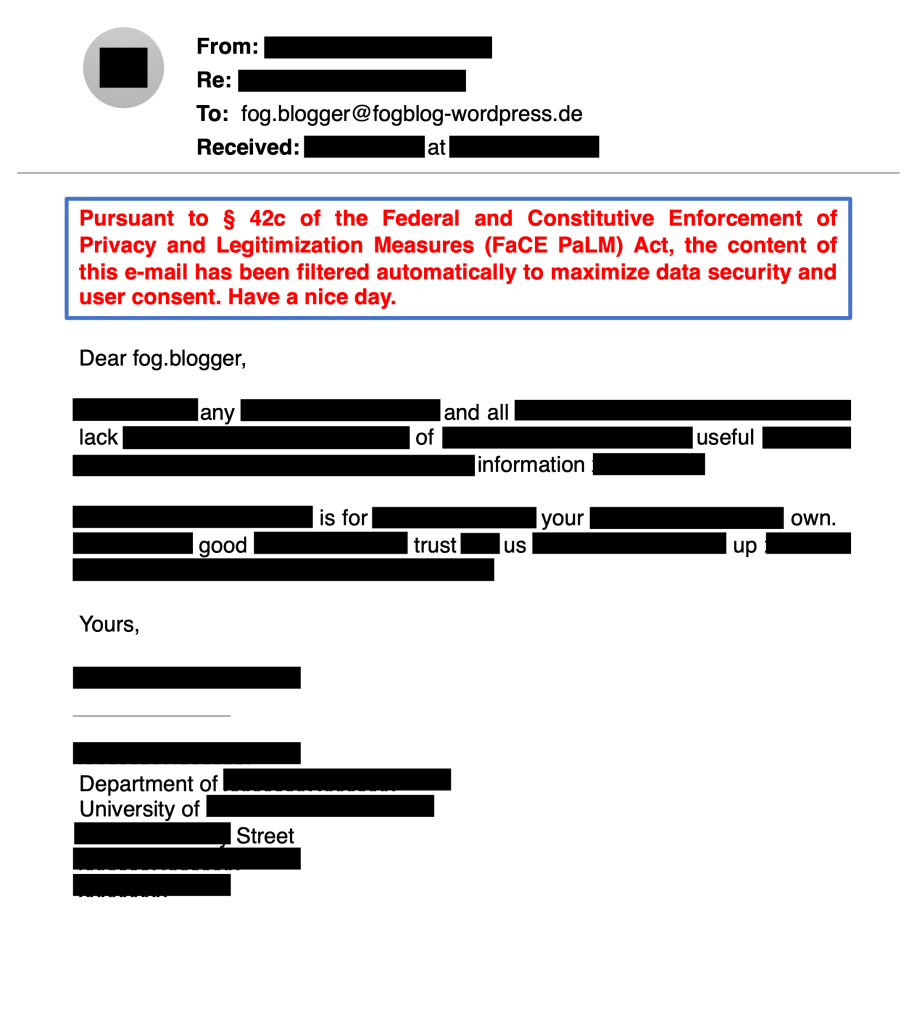
As I found out a few days ago, we’re also not allowed to forward our work-related e-mails to any private, third-party e-mail address that we might have. Apparently, this is because of a lack of consent on the part of the sender to having their e-mail processed by anything other than the university’s servers.
What kind of sheer, unmitigated nonsense is this? (And will anyone dare to admit to having thought it up? (Sadly, the answer to that last question is probably “yes”.))
For pretty much every e-mail that I’ve ever sent, my only expectation in doing so was that it reaches the person that it was intended for. I never for the life of me realized that I was consenting to anything on top of that. (Consentual e-mailing. What a concept. And a pretty forgettable one at that, especially for the spammers …) The whole situation actually becomes really, really terrifying when I now think about just how many third-party servers all those e-mails went through to reach these people, all without my consent! (Just check all the hidden headers on any external e-mail you get and you’ll see what I mean.)
This whole line of argumentation is akin to saying that I can’t take a letter (remember those?) out of my mailbox because someone else might see it. In fact, if you follow the, ahem, logic underlying this consent argument, it would also mean that you can’t print out any work-related e-mails. (Definitely a no-go at home for my University.) Even worse: all the e-mails that I receive exist for only fractions of a second on the university servers before they are downloaded to my third-party laptop. Even if it’s an Apple laptop (or perhaps because of it because our IT department is lost if it ain’t a PC), that must be illegal too and yet another good reason to keep this blog anonymous.
More to the point: how much of all this information is actually useful, or indeed even vaguely interesting, to anyone else? What is some data pirate going to do with the knowledge that our annual Christmas party will take place on the 20th starting from 4 PM and that Jimmy, Sally, and Susie can’t make it? Hell, come and crash it for all I care. There’s three empty places after all.
But, I could be wrong here …
There was recently a successful phishing expedition at the University where a considerable number of people—despite explicit, incredibly gaudy warning labels attached to every external e-mail that are impossible to overlook—gave hackers all their login details. In fact, it apparently was considerable enough that the University forced everyone to reset their passwords to prevent the hackers from, and I quote, “gaining access to the scientific knowledge of the University”.
Scientific knowledge?
Looks folks, most hackers are not of the industrial-espionage sort and looking to steal our valuable data so as to publish them before we can. (If they are, again, go ahead for all I care. Let them deal with all the idiotic comments and brain-dead suggestions of that damn third reviewer. (Which, in this case, might turn out to be me come to think about it.)) For most of the University (and I readily include myself in that most), we’re not really talking about NASA, the Pentagon, or even Coca-Cola levels of research here. What state secrets can someone, say, in the Music Department possibly be hiding? A new note?
And for that small percentage of the University where we really might be talking about “for your eyes only” knowledge, you do have to wonder just how good it can possibly be coming from someone whose eyes missed a phishing attack with all the bells, whistles, and gaudy labels attached to it …
























.jpg)





 The Blog About Fog