In “researching” my last blog post, I came across two of the worst acronyms that I have perhaps ever seen. (And, remember, I’ve seen TdLL.) Unsurprisingly perhaps, they both derive from the same organization, namely the Netzwerk Nachhaltigkeit Niedersächsischer Hochschulen (Network Sustainability Lower-Saxony Universities; and, yes, the German name is similarly devoid of prepositions and therefore just as stilted as the English one).
The first acronym is that for the organization itself, namely HochNiNa. Sorry, but aren’t the full names and the acronyms supposed to be in the same order or since when did Germany start outsourcing its acronym production to the Middle East? And did the person fall asleep before reaching Netzwerk? You do have to admit, HochNiNaNe is unquestionably that little bit catchier than just HochNiNa. (Even better would be NHoch3, which gets the order going back the way it should be while throwing in a geeky pun on top of it, with hoch being German for “to the power of”.)
The second acronym derives from one of HochNiNa’s major programmes, namely the taxpayer-funded project Standardisierung, Weiterentwicklung und Kommunikation von Treibhausgasbilanzen niedersächsischer Hochschulen (Standardization, further development, and communication of greenhouse-gas balances of higher-education institutions in Lower Saxony). Now, exactly why it takes 210 000 EUR and three years to develop an Excel spreadsheet is beyond me. However, when one of the major milestones you advertise for your project is the addition of two new universities one year into it, you know how low the bar for success is: trivial for the high jump and impossible for the limbo.
Anyway …
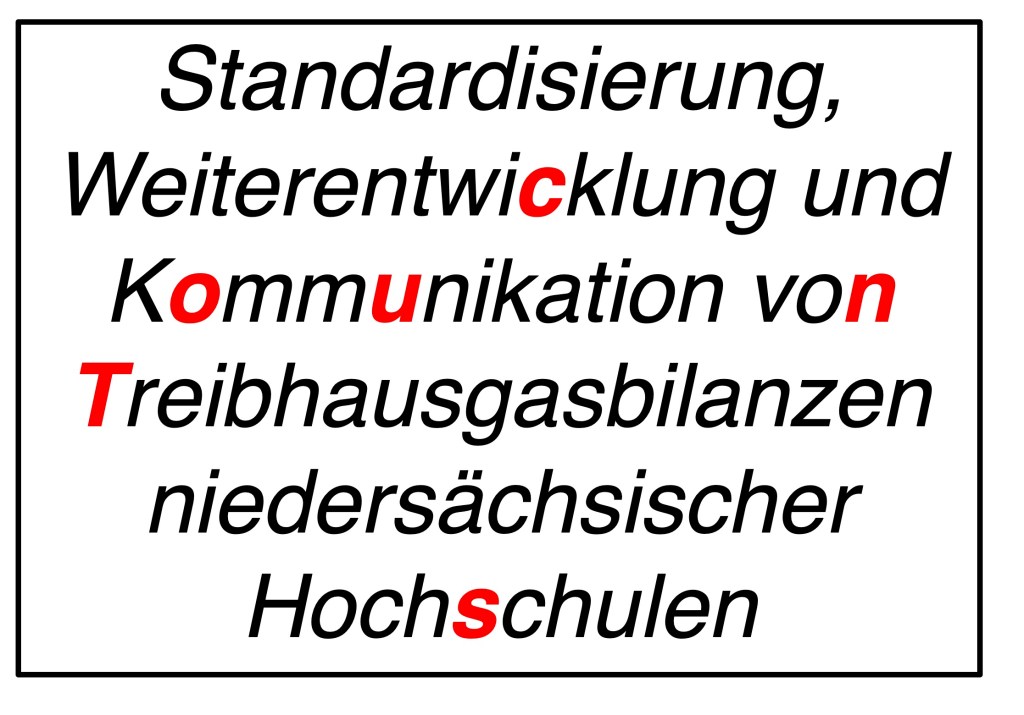
If there was ever a name in dire need of an acronym, this is it. This one will put even admin types to sleep. That fitting acronym here, of course, was COUNTS. Much shorter, a lot punchier, and infinitely more memorable insofar as it has almost nothing to do with the name of the programme, either in terms of the subject matter or the letters it uses. In either language. And in either direction. To help everyone along, I’ve highlighted the official derivation of COUNTS in the figure to the left. Now, I can understand that you sometimes have to grab some letters from the middle of the words in the full name to make an acronym work. Like with HochNiNaNe, for example. But then those letters usually either directly follow another, leading one that has already been tapped in the acronym (or at least start an important syllable) and are usually in lower case as well. And you definitely don’t do it for most of the letters in the acronym.
And, seriously, what is the point of so desperately, awkwardly, and almost randomly jerry-rigging a highly generic, English-language acronym for a highly localized German-language programme? Admittedly, SWKTNH doesn’t really have the same zip as, say, HochNiNaNe (or, even better, HoNiNaNe), but it’s still on the same (low) level as TdLL and you can at least tell where it’s coming from. (If not what you should be running from.)
Instead, maybe they should try REASON, which “counts” both as a valid acronym following their apparent method as well as something generally helpful for the future. Even STRETCH is an improvement because it’s at least honest about how they go about generating acronyms.

On the other hand, if the acronym is clearly so important, why not come up with it first and then derive the name of the programme from it (AKA backronyming)? It’s often much easier. For instance, from COUNTS you could get:
- COmmunication among UNiversities for Tree-hugging Sustainability,
- Coordinating with Other UNiversities for Thermal Savings,
- Carbon Overload Ultimately Neuters The Stratosphere,
- Concrete Overall Underfoot? Now That Sucks!,
or even
- Creating Objectively Uninformative Names This Saturday.
QED …
 The Blog About Fog