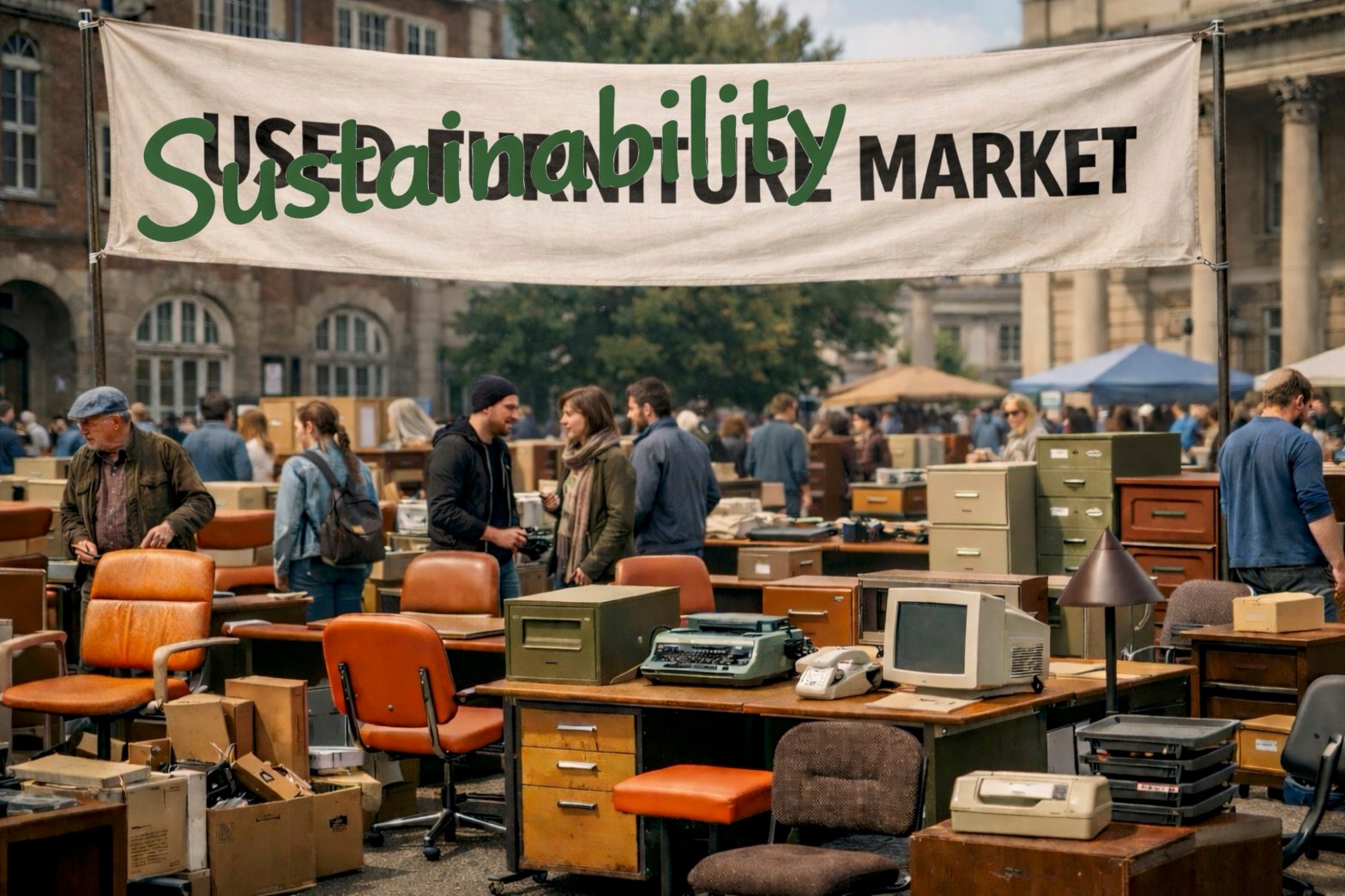
As I’ve mentioned more than too many times in this blog, the University of Not-Bielefeld has taken to increasingly bludgeoning us with its new-found environmental conscience. The latest foray here is in promoting the existence of numerous “sustainability markets” on campus.
Now to those of us lacking spin doctorates, these markets are nothing more than simple, second-hand bazaars where old, unwanted furniture and even lab equipment are offered up for free to whoever needs them among the university community. And they’ve been around since before I joined the University over 15 years ago. True, these markets (regardless of what they’re called) do indeed contribute to sustainability, but it’s primarily of the economic kind. As is the case with universities worldwide, funding is tight at the University of Not-Bielefeld, so anything that still does its job for free is sought after. That it also helps the environment is more thought after.
But nothing like a bit of quick rebranding to provide that veneer of progress, right?

Of course, the environmental movement, like most human endeavours, is not immune to linguistic overkill. For instance, think about just how moronic the word “recycle” actually is. The most common definition of a cycle is that of a repeating series of events, like a life cycle or a sleep cycle or even the lunar cycle. So whereas consumerism, by design of the bottom line, is a cycle (produce, purchase, use, trash), and an increasingly shorter one at that, what happens to the products and the materials that they are made of is not. Instead, it’s only through recycling that they begin to enter something resembling a cycle. But given that the prefix re- also means to repeat, what does it mean exactly to repeat something that is already itself inherently repeating, especially when it wasn’t in the first place? With this kind of logic, women can be happy that they only have menstrual cycles and not menstrual recycles.
But then what do you expect of a word that was coined way back in the 1920s by the oil-refining industry? (Betcha most environmentalists didn’t know that …) Next thing you know, organ transplants are going to be referred to as being both organic and sustainable as well.
Ultimately, however, all this kind of newly-branded sustainability has to be unsustainable and will lead to the downfall of human society faster than AI will. The way I figure it, you can either love the environment or humanity, but not both. Think about it. The more people start buying “sustainable” goods out of the goodness of their ecological hearts, the less demand there will be for new products. That means that less people will be employed to make those products, forcing the rest to buy even more “sustainably” out of the necessity of their empty wallets. And then the whole thing spirals increasingly out of control (also not a cycle) until only Elon Musk has any money left but nothing to spend it on.
Or, in other words, the ecological version of DOGE.
But, back to that veneer …
A few weeks ago, in an e-mail inviting members of the University of Not-Bielefeld to take part in an “information event on potential parking-space management” (or, in plain English, a public meeting about on-campus parking), the urgency of this “event” (originally scheduled for last autumn) was underscored by the surprising, and surprisingly honest, announcement that despite the University’s greenhouse-gas emissions having fallen slightly over the past two years (by 5.3%), they are still 1.3% above the baseline values from 2019. (I had to dig for the actual numbers, which were not in the e-mail. No point in ruining some vague adjectives with hard data.) And this despite the numerous, innovative, and high-impact countermeasures put in place by the University recently: insect meadows, a Tiny Forest, million-Euro bicycle racks, solar panels, and that yet again delayed on-campus parking policy. (Bonus points for those spotting the outlier there.) Someone needs to tell the University that simply amassing a climate fund has much less positive effect on the environment than actually using it.
A chief culprit in the University’s size-14 ecological footprint was identified as “mobility”, which included such environmental evils like day-to-day commuting (28.7% of the total annual footprint), business trips (4.6%), and even semesters abroad (1.5%). How spending semesters abroad even deserves to be mentioned explicitly here is a mystery to me, especially given its meagre contribution toward destroying the planet compared to its important potential of fostering young minds, something that I thought was what universities in general were for.
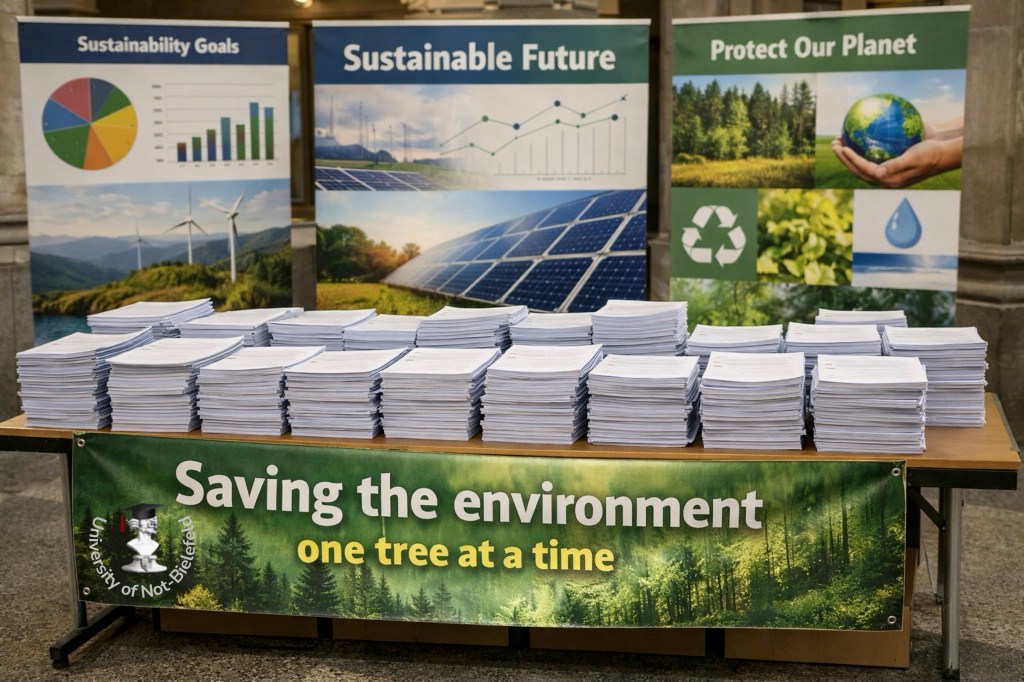
But these data also tend to reveal the true nature of the University’s environmental policy: grab as many headlines as possible while trying not to piss too many people off. (Or spend too much of that climate fund.) Again, take a look at mobility as an example. Four years into its much ballyhooed, 140-page Integriertes
Klimaschutzkonzept (Integrated Climate Action Concept) and all the University of Not-Bielefeld has really achieved to green up mobility is to put an eco-tax on the business trips of a small subset of its population. This stands in stark contrast to the enormous amount of foot dragging over commuting, an area that coughs up 6x as much greenhouse gas but where any solution would disadvantage a much greater percentage of the university population. I mean seriously. How difficult can it be to start charging for parking on campus (stick) or to subsidize public-transportation costs (carrot) to encourage university members to seek out more environmentally friendlier ways of getting to work? However, as this ex-pat Canadian learned very quickly, it is much more dangerous to get between a German and their car than between a mama grizzly and her cubs. And thus, even after four years of information events, committee meetings, and plain ol’ plena, every option regarding on-campus parking officially still remains on the table, especially more information events, committee meetings, and plenty of plena. And somehow forgotten in all this is that remaining 63.0% elephant in the building in terms of the environmental costs of running the buildings themselves.
Instead, perhaps the most interesting but completely ignored stat of them all was how the University’s greenhouse-gas emissions hit a low of 68.0% of their 2019 baseline values in 2021. Now there would seem to be a real sustainability solution there worth exploring, doesn’t there? Oh, wait. That was in the middle of the pandemic, wasn’t it?
Like I said, you can either love humanity or the environment. Take your pick …
 The Blog About Fog