
The University of Not-Bielefeld recently wrapped up its biennial exercise in democracy by holding elections for both the Senate as well as the Boards for each of its six faculties. (And, no, that isn’t a typo in the title but a bilingual play on words. Spot does exist in German and pretty much means the same thing as in English. But the German Spott means sarcasm, which, of course is pretty spot on for this blog.)
(These elections, of course, are not to be confused with the imminent German federal election, one that Elon Musk, ever the visionary and me-speech activist who is desperate to prove that Twitter (now known as X) was not some one-hit wonder, has referred to as being critical to “the future of civilization.” Unfortunately, ol’ Elon’s visions of pending catastrophic doom depending on German election results are about 90 years late. And, fortunately, even with his presumably favoured party winning that election, civilization did not drop to its knees despite taking quite the beating for a while. Really kinda hard to see us even coming close to something like that this time around no matter who wins this coming weekend.)
Two things always amaze me about these university elections. The first, of course, is that there are enough people wanting to run so that the elections are even necessary. Take the Senate elections for example where you had over 100 candidates competing for only 11 seats. And this despite that getting elected means a lot more admin for exactly no more pay. Admittedly, you are that much closer to the reins of power but it’s a university: those reins are leading to a shrivelled up nag with colic that’s long since missed its appointment at the glue factory. At best, any candidates from the political-science department could view it all as a nice, practical exercise for their otherwise largely non-applied research, but for the rest of us?

The second is, just like any German election, how complicated it all is. For a start, people can’t vote for just anyone but only for those candidates in their own status group (professors, technical staff, remaining staff, and students). And then most of the candidates also belong to university-specific parties, each with its own platform and agendas. (One of these parties in the last election was literally called Nicht wählen (Don’t vote), although it’s unclear if that message applied only to them or more broadly. Nevertheless, despite its name and exact intention, the party did garner the vote of exactly one illiterate troublemaker.) Finally, despite voting directly for individual candidates, the seats are actually differentially allocated among the status groups first, then among the parties based on how many votes their candidates jointly received, and only then among the candidates based on how many votes each actually got. All this occasionally leads to some American Electoral College like madness insofar as people with fewer votes than others, either within or across status groups, can get elected. (And, if you can somehow wrap your brain around all that, then you’re ready for the big leagues and Überhangmandaten (overhang seats), some serious psychedelic German electoral shit that make it impossible to say exactly how many seats will be in any German parliament before the votes have been counted.)
Anyway …
This past election was particularly memorable because it was the first one where we could also vote electronically. Now, despite having the capability to conduct the e-voting internally (as witnessed by our department doing just that for our recent committee elections), the University chose instead to outsource it to another company, a decision that you can view as anything from ironic to hypocritical given the hyperallergic reaction of the University‘s IT department to any personal data being housed outside of their apparently ultra-secure servers and firewalls. (Secure, that is, except to those outside hackers wanting to print something.)
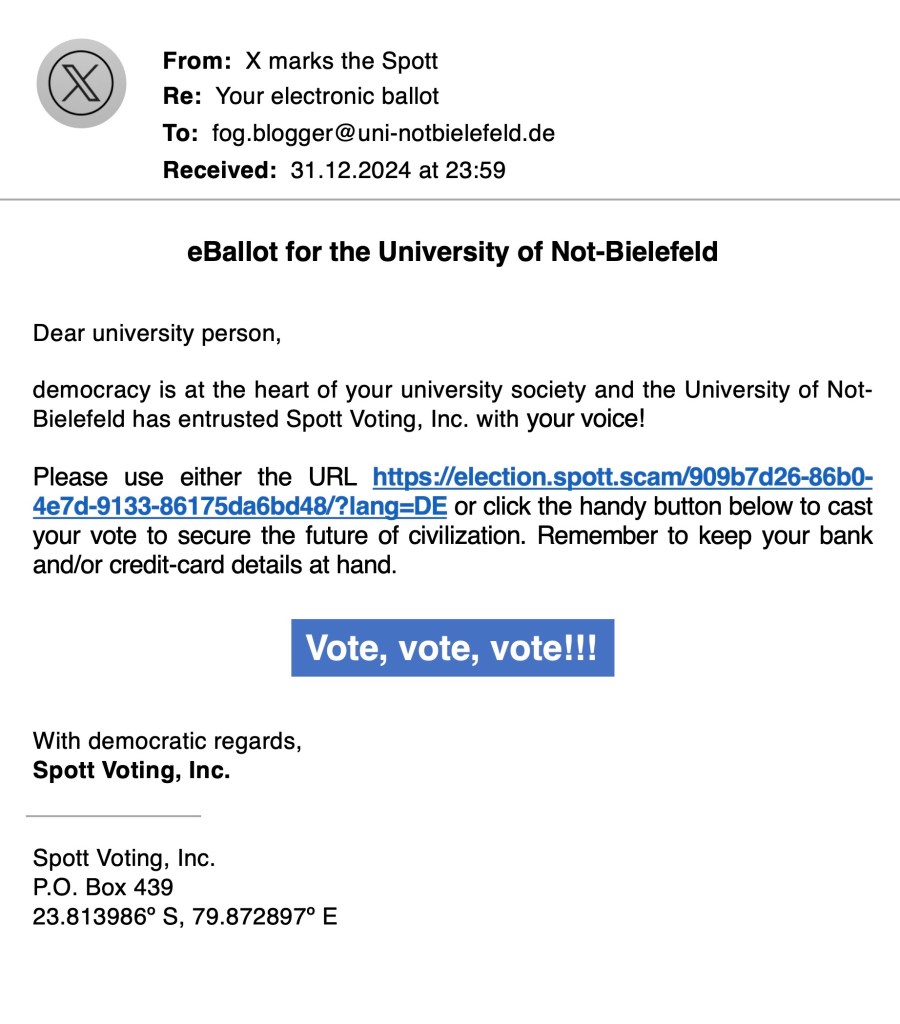
The fun came because the University neglected to inform us about this outsourcing. So after a couple of years of being regularly spammed by our Office of Dataprotection and Informationsafetymanagement about how dangerous all external e-mails are, enough people were suspicious of some unknown company e-mailing them some e-voting log-in details in combination with a handy “click-here” URL that the University had to send around a follow-up e-mail indicating that it was all legit. Even worse, they had to arrange a system with the company so that all those people who had trashed the original e-mail out of an abundance of sensibility could get replacement log-in information.
The kicker was that the initial e-mail, despite definitely coming from outside the University, did not contain the gaudy banner indicating its external origin and designed to protect us from all its potential, associated evils. Which all makes you wonder (again) what that banner is actually good for. Not only can this system be fooled by a simple spoofing of the sender’s e-mail address, but IT can apparently selectively toggle it on and off. More importantly, it appears that enough people in the end didn’t actually need the banner to recognize an e-mail that looked like it might be a phishing attempt.
Looks like employees at the University of Not Bielefeld might in fact be capable of some critical thinking after all. And that’s never a bad thing when it comes to elections.
Right, Elon?
 The Blog About Fog