
As I’ve mentioned before, my wife is Croatian and still lives and works in Zagreb, meaning that I spend a good portion of the year down there to be together with her. (And before all the usual civil-servant jokes start surfacing, I want to point out two things. First, as nice as Zagreb is, it isn’t the Croatian coast and there’s far fewer ways to do nothing but bask in the sun in Zagreb. Second, that means that I do work while I’m down there and not just on my tan (probably impossible for a Canadian otherwise living in northern Germany anyway) or doing fjaka, a Dalmatian word that I recently learned and that means a state of blissful laziness. (The closest English equivalent is probably SFA, both from its meaning and (minus the sweet) its pronunciation.) Thanks to the pandemic, the University of Not-Bielefeld luckily now officially recognizes working from home as a viable, alternative work environment. They just forgot to specify whose home is all …)

Now if you want two fairly diametrically opposing viewpoints to life in Europe, it’s hard to find more opposition than between Germany and Croatia. (Or perhaps between Germany and most Mediterranean nations generally.) As weird as the combination sounds, Germany is all about efficiency and admin (which go together about as well as, say, matter and doesn’t-matter), whereas Croatia is all about cafes and coffee houses. (And, as much as that might sound like a putdown of Croatia, it isn’t. My wife actually laughed appreciatively at that comment. Come to Croatia sometime and you’ll quickly realize how important coffee is to their day-to-day culture and their generally more relaxed way of life. And also why Starbucks & Co., and especially what Starbucks has become, are nowhere to be found in the country.)
Curiously, however, as much as the Autobahn and driving are synonymous with Germany, they’re nothing in comparison to the time, money, and effort Croatia puts into its road network. Seriously. With the possible exception of Ministry for the Elimination of Vowels (the successor to the highly successful one for eliminating Qs, Ws, Xs, and Ys), the highway department and its municipal equivalents have got to be the best funded government agencies in the country.
Croatian roads, you see, are constantly being worked on. (Sort of like the German Autobahn but with actual workers actually working on it.) But not for sensible things like filling potholes or improving traffic flow but rather much more so for the exact opposite. (Ok, maybe not for making potholes but I wouldn’t put that past them either.) In short, it seems like the road planners there are always doing their utmost best to stifle any feeling of driving enjoyment, comfort, or complacency amongst its drivers.
(Or, put a different way, just trying to somehow find a way to brake that natural sense of “exuberance” many Balkans have behind the wheel. I mean, I live in a country without speed limits and more than enough people willing to enjoy that freedom and the drivers in Zagreb still scare the ever-living shit out of me sometimes. Imagine a city where the majority of the traffic is composed of taxi drivers, and impatient ones at that, and you‘ll know what I mean. (Must all be in a rush getting to their cafes for their daily dose of fjaka.) Add then add in a generous helping of that post-pandemic pandemic of food-delivery people suicidally zipping in, out, and around all the traffic on their e-bikes and mopeds to round things out.)
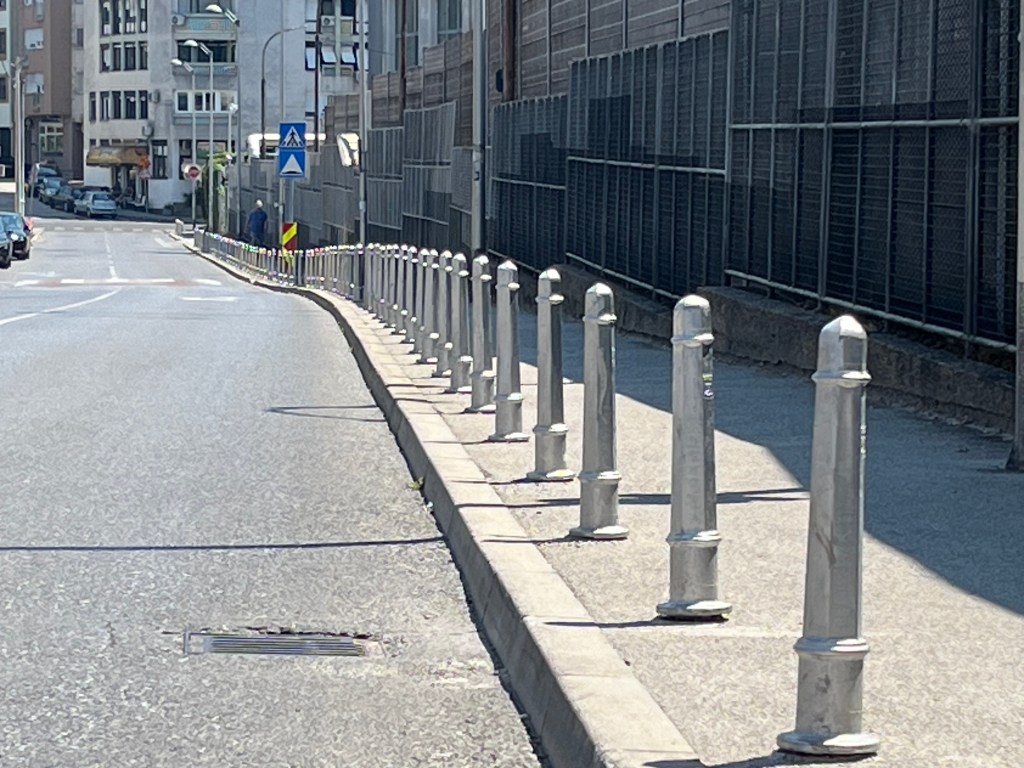
It’s either that or Croatia must have an enormous surplus of road paint, posts, and manholes from their first forays into a free-market economy (those bargains on eBay weren’t, in hindsight, as good as they seemed at the time) that they are now desperate to get rid of to meet the economic requirements for continuing eurozone membership. (Might have bought them all off the Brits now that I think of it. They also use a ton of the things although there’s no reason for them to get rid of them anymore.)
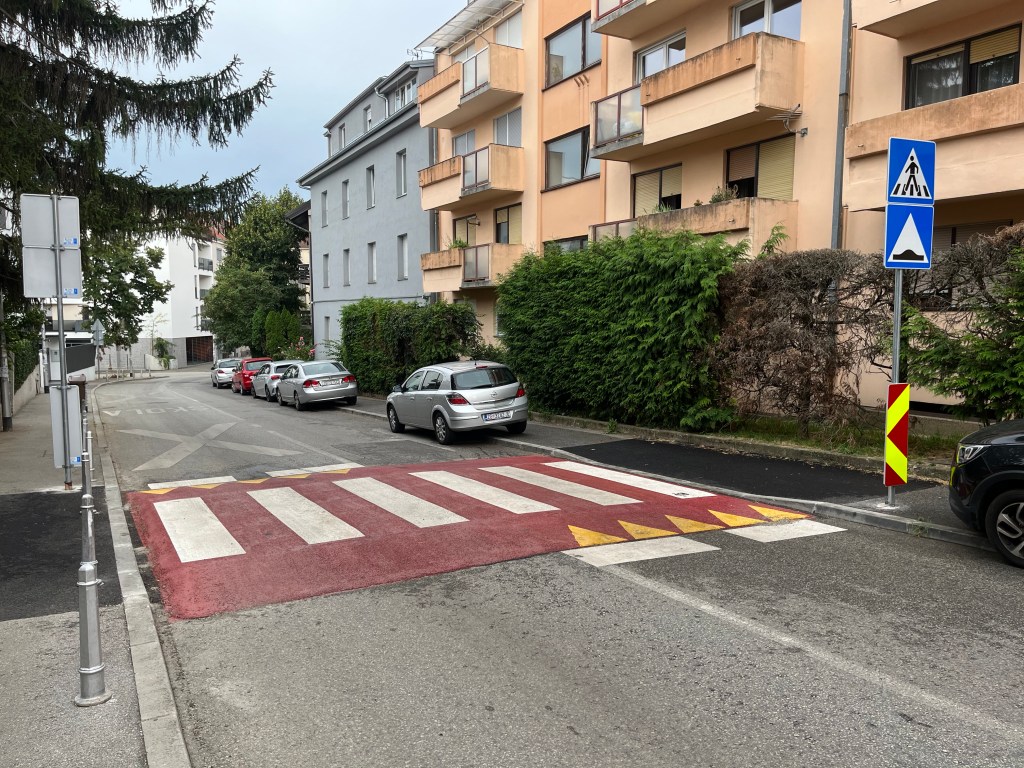
I’ve never been in a place with so many zebra crossings, sleeping policemen (for the North Americans, think speed bumps on steroids), or the unnatural combination of the two with a splash of red for extra measure. (Forget penguins with sunburns, it’s Croatian sleeping policezebra crossings that are black and white and red all over.) In fact, they are so ubiquitous that they simply fade into the background, sort of like those screams from that pedestrian you winged two blocks back at yet another zebra crossing. They even put zebra crossings on blind corners as well as on relatively major thoroughfares where the traffic zips along at a legal maximum / illegal minimum of 80 kmh. No flashing lights or anything obvious to alert you to either one. Just a little triangular sign and some road paint. It’s an open question as to whether it’s the street planners there who have no sense of reality or the pedestrians who are actually tempted to try those zebras out wanting nothing more to do with it.
In fact, the only zebra crossing I’ve ever seen in Zagreb with overhead flashing lights was only recently installed. It was right next to a Lidl, who must’ve complained that too many of their customers were getting killed off …
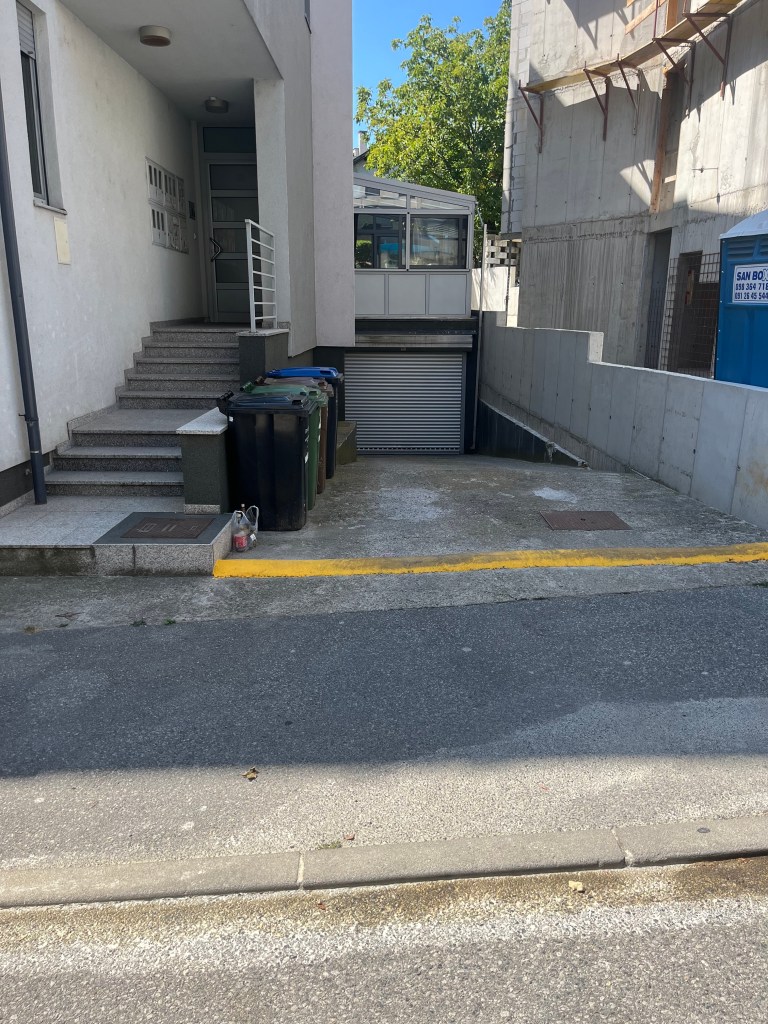
And even the private citizens get into the act. I mean who really needs a speed bump at the entrance to the underground parking of your own building? Surely the closed garage door should be enough of a signal to tell you to maybe slow down a little?
Adding to the obstacle course are plastic posts in the middle of the road in some places to separate the car lanes (road paint sometimes just isn’t enough it seems) and endless numbers of metal posts on the sidewalks in most places to prevent people from parking there. But, metal or especially plastic, the life expectancies of the posts are inversely proportional to their ubiquity. In other words, more background noise, especially when you back into one of the metal ones. Unfortunately, however, the posts are like the mythical hydra in the sense that the fallen comrades are not only quickly replaced but usually with reinforcements to boot. (My suggestion: use the metal posts in place of the plastic ones to separate the driving lanes. I’m fairly certain you won’t have to replace them nearly as often …)
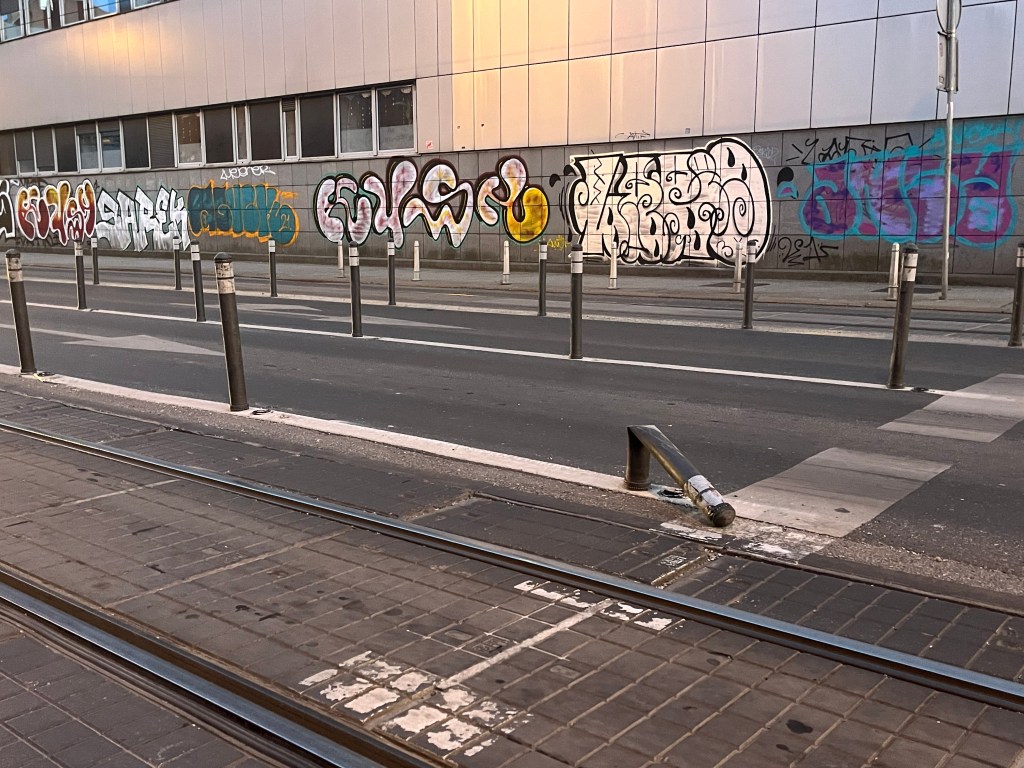
And if all that isn’t enough to slow the traffic down (and it isn’t; traffic ordinances—be they parking spots, stop signs, or no passing zones—tend to be viewed as suggestions at best), then they simply change the road layout every couple of months, largely through the magic of road paint. The best, worst example of this occurred a few years ago close to my wife’s apartment, which lays along a semi-important throughroad that gets its fair share of traffic. Literally overnight the road engineers came out with their paint brushes and changed this two-lane, two-way street into a one-way street with on-street parking. So while it did mean no more parking on the one sidewalk and the chance to use even more metal no-parking posts, it did force the now forbidden oncoming traffic (including the bus traffic) down a parallel, formerly purely residential road that was similarly altered to become a one-way street with on-street parking and a lot of new metal posts. Following two solid weeks of even more solid outcry from the residents along both streets (who hadn’t been informed about a thing beforehand), the midnight elves came out again to put even newer road paint on the now dry old, new road paint so as to make everything just like it had been before as well as to find some other forests to plant their metal posts in.
Admittedly this is an extreme example, but many road layouts are often unpleasantly new to me when I’m away for more than a couple of months.
And finally there are the manholes …
Surprisingly, there don’t seem to be any hard-and-fast regulations in Europe (or even Germany) as to how far apart manholes should be; however, there seems to be some general agreement that the maximum distance should be about 100 metres for straight sewer lines. Not so in Croatia. Croatian sewer workers must be incredibly scared of the dark (or Croatian sewer rats must be really terrifying) because it feels like there is a manhole every ten meters or so ready to balance out your car’s suspension from all those sleeping policezebra crossings.
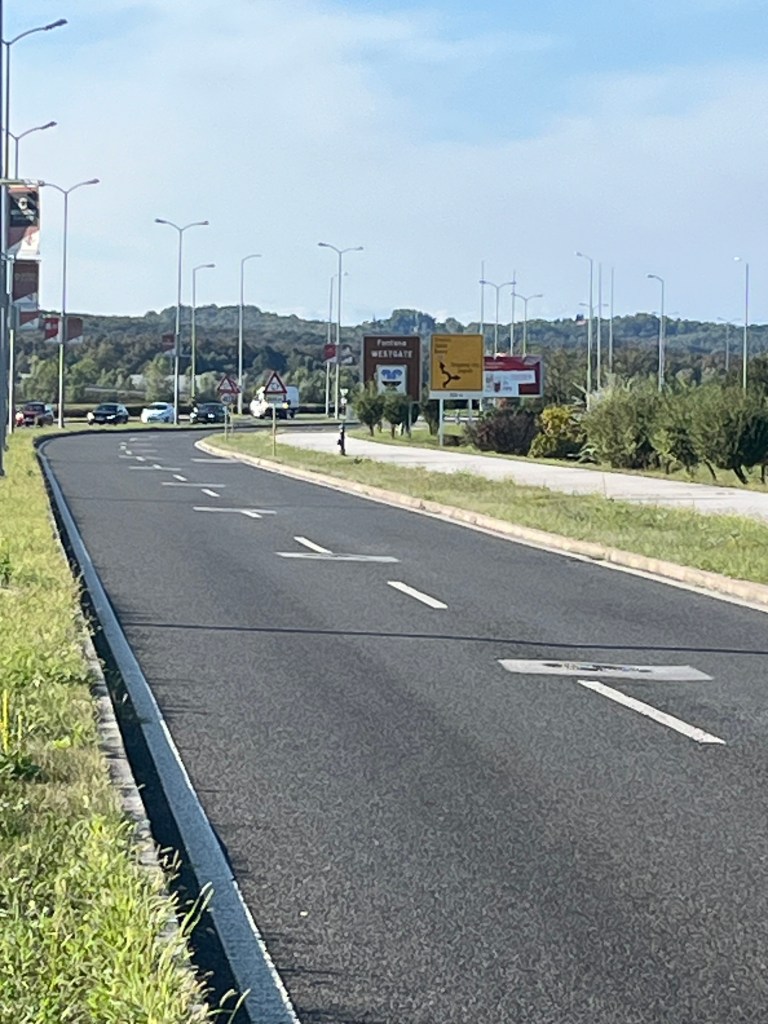
And, if you look at the picture, it’s more than a feeling. Every one of those light patches disappearing into the distance contains a manhole. (For reference those road signs are about 80 m away, making that 10-metre feeling pretty darn real.) Admittedly, there is a big shopping centre off camera to the right but absolutely nothing but horizon to the left. How much access to a barely used sewage system do you really need? Or are Croatian sewers just not straight?
In any case, I’m convinced that it’s only a matter of time before Croatian road engineers figure out how to put manholes on bridges …
 The Blog About Fog
Freaking hilarious!
LikeLike