Late last year, a long stretch of sidewalk along the main campus of the University of Not-Bielefeld was cordoned off and replaced. And, like any other roadworks project in Germany, the entire section to be replaced was shut down from day one to provide all the non-existent construction workers with the maximal amount of safety and all the rest of us with the maximal amount of inconvenience.
At the time, I really couldn’t see the point of it all because the sidewalk looked to be in perfectly good shape. Or at least not anywhere run down enough to justify replacing an entire block’s worth of it. And, after the work was completed (many, many months later), I still really couldn’t see the point of it.

It turns out that the reason behind all the (on average) non-activity was to install a test section for a green wave for cyclists, a green wave being that fairy-tale situation where a series of traffic lights along a given stretch all go green for you when you hit the right speed. The principle behind it is simple enough. A series of green LED lights are embedded in the bike path. If the lights are on when you pass them, you’re riding the wave and will make the next traffic light. (As such, the traffic lights are now necessarily timed for the bike traffic and no longer the car traffic.) If they’re not, then there’s a power failure, either in the city as a whole, but more likely in your legs and you have to speed up to catch the wave again. (Or slow down and wait for the next one.) All this is hardly a new idea on the part of Not-Bielefeld and they themselves admit that their system is based on the “Copenhagen Model”.
Implementing this simple principle properly is a completely different story, however …
Key to any green wave is having the traffic going at the right speed to stay in the wave. Here in Not-Bielefeld, they decided on a fairly leisurely 18 km/h for the bike riders, which is 2 km/h less than the more robust vikings in Copenhagen have to sweat out. And, not to be outdone, the Aussies down in Melbourne have to put at least another 2 km/h on top of that.
Less obviously, but perhaps more importantly, there can’t be any traffic preventing you from keeping that target speed. It’s little wonder then that the most successful green waves are for cars and then on one-way roads where the only effort required is moving your right ankle. Nevertheless, Copenhagen and Melbourne have successfully applied this simple logic by implementing their bicycle green-wave systems on dedicated, one-way bike lanes.
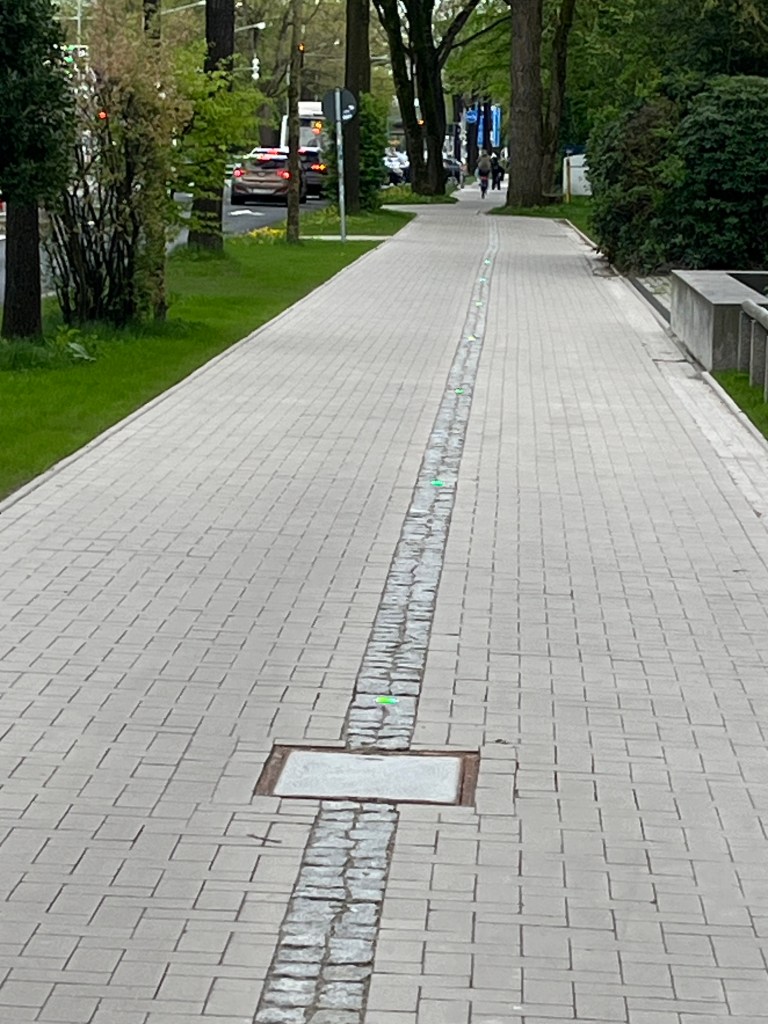
Not-Bielefeld, by contrast, has decided to try this all out on a four-lane, undivided sidewalk. So not only do the local cyclists trying to stay in the wave have to swerve around other cyclists who can’t go or don’t care about going 18 km/h, but they also have to deal with pedestrians going in all directions. And, if all that weren’t bad enough, there’s oncoming bike traffic to contend with as well. All this on a sidewalk that is less than 3.5 m wide in total and occasionally narrows down to about 3 m when it has to jig around either trees or bus stops. Those surfing the wave are heading for a major-league wipeout.
(I should point out that oncoming bike traffic is not an uncommon occurrence in Not-Bielefeld. The cyclists here tend to be any or all of apathetic, suicidal, or moronic and drive however and wherever they feel like. And Not-Bielefeld just half-heartedly puts up with it all. For instance, very close to where I live, there are two street signs on the sidewalk, each pointing in opposite directions and both within plain sight of one another. The one forbids bike riding in the wrong direction (because outside of a car you need to be reminded of basic traffic laws for some reason), whereas the other warns you to watch out for that forbidden oncoming bike traffic. Be all that as it may, leave it to Not-Bielefeld to install their green-wave test stretch on a sidewalk where oncoming bike traffic is actually officially allowed.)
Apart from setting up their green waves properly, there’s an important difference between Not-Bielefeld and either Copenhagen or Melbourne, namely size. According to World Population Review, Copenhagen is pushing 1.4 million inhabitants and Melbourne has just over 5.3 million. Not-Bielefeld? Under 200 000. Or, put another, more relative way, less than the number of cyclists that pass over one single bike bridge in Copenhagen—the Dronning Louises Bro bridge—in a typical workweek.
In other words, there aren’t that many people to move and, by extension, they don’t have that far to move either. The city centre is about 2.2 km away from the university or about 7.3 minutes at a green-wavish 18 km/h. Optimistically assuming that surfing the wave makes you about 25% faster than normal (initial trials in Copenhagen showed it to be about 17%), this shaves less than two minutes off your travel time without it. (Or about three and a half minutes should you decide to go home again in the evening.) It’s really only after you retire that the savings work out to anything substantial (about a month), but only if you didn’t succumb to the temptation to take your car (or, gulp, the bus) on one or more of those dark, wet, and windy Not-Bielefeld winter days.
And these time savings could be incredibly optimistic indeed when you consider that Not-Bielefeld’s green wave might actually be slowing its cyclists down. According to data from the activity app Strava, the average, wave-free bike commuting speed on pavement (i.e., with lights and with traffic) is a more viking-like 19.5 km/h. Or, by the time you’re ready to retire, slightly over a week of exciting other things you could have been doing in Not-Bielefeld besides trundling along with the wave.
All told, there have been any number of weird decisions made here, including the ones above.
First, the green LEDs are only present for the last one-third of the test section. Apart from the question of why the city then had to replace three-thirds of a block of sidewalk for this project, it means that cyclists won’t know if they are in the wave until it might be too late. And, remember, although lights out for a green wave typically means “too slow”, there’s a good chance in Not-Bielefeld that it could mean “too fast”.
Second, although the green wave is directed toward the city centre, most of the commuter bike traffic along this stretch goes in the other direction toward the university, thereby sort of explaining why oncoming bike traffic is allowed in the first place. (But only sort of. Why the other side of the road isn’t sufficient for these cyclists—apart from them being any or all of apathetic, suicidal, or moronic—remains an open question.)

Third, by giving priority to the bikes over the cars, you also impede the bus traffic along the road. (Again, the same initial trials in Copenhagen showed up to 14% longer bus times.) Now, apart from my dog, no one I know particularly enjoys riding the bus and especially not in Not-Bielefeld where bus fares are steadily approaching a whopping 3 EUR for a single ticket. A green wave is guaranteed to only further increase the number of smiling faces among those on the bus and especially among those driving the bus, most of whom haven’t smiled once since 2004. (No offence. Shit job. I get it …)
Finally, the city of Not-Bielefeld proudly proclaims that there are a little less than 2000 spots to lock up your bike downtown. As such, this means that they’ve spent 200 000 EUR (so far) to benefit about 1% of its population and even fewer of its bikes given that they also proudly proclaim that—even ignoring all the dead bikes in the canals—there are more bikes than people in the city. (How they determined the latter is a mystery. I’ve lived here for over 15 years now and no one has ever asked me how many bikes I have.) And all this money was only for a single, one-block test section on a route that has no clear run toward downtown. Nope. Because right after the very next intersection (= about half the distance to downtown), the cyclists not only have to again yield the right of way to some more trees and another bus stop before negotiating two sharp, right-angle turns (like this section of the Copenhagen Model, just more extreme) to get onto the parallel residential street where the non-dedicated bike lane continues. So no more chaotic pedestrians to deal with, but now with the added thrill of oncoming car traffic instead. In any case, scale down the target speed by about a factor of 10 and you might come out of those corners with some skin still attached to your body.
Oh. And that very next intersection? It also happens to be a major junction with on- and off-ramps to the motorway that runs through Not-Bielefeld. Forget downtown. This junction probably accounts for the biggest chunk of car traffic along this road, meaning that instituting a green wave will do comparatively little to reducing car traffic and comparatively a lot to increasing the chaos that the junction already happily provides.
Call it what you will—sleight of hand, a smokescreen, or even LED and circuses—it’s the same old shell game that authorities have been playing for centuries: throw big money at some over-the-top, glitzy solution to distract the marks from the fact that some basic necessity is missing, namely the fundamental cycling infrastructure needed for a green wave in this case. Impressing is always so much easier than redressing after all.
And then double down on the fiasco to quell any lingering doubts.
First you employ lots of advertising, banners, and slogans and sound bytes and dare people to call you on it. Less than 2000 bike spots in the downtown is actually more than a little embarrassing for a city that is officially certified as “bike friendly”, but Not-Bielefeld proudly parades that number on its webpages anyway. (And it’s downright pathetic when you realize that it’s less than half the number of parking spots available downtown for cars.) Then you unilaterally declare the pilot project an unmitigated success worthy of expansion. Indeed, visions of thermal cameras, bike counters, and other sugar plums to automatically enable the green wave to regulate itself are already dancing in the city administrators’ heads. But all this doubling downing does is to waste even more money that could otherwise be spent on more sensible, more productive but decidedly less showy ideas like reduced, reasonable bus fares or dedicated bike lanes.

And then there are other opinions like those recently voiced by some “critics”. (Ok, vandals.) First, they simply ripped out all the LEDs last December and threw them in some neighbouring front lawns. And then just after the whole project got rolling in March of this year, they painted over all but one of the new LEDs with white paint. And apparently in the middle of a Friday afternoon when no one was around to see it.
Looks like Not-Bielefeld’s green wave needs CCTV more than it does thermal cameras …
 The Blog About Fog