
It’s hardly an original observation on my part, but boarding an airplane does not rank among life’s most pleasant experiences: endless queues of aggressive people with elbows flying all jockeying for the best position. And all that before they’ve even announced that the gate is open for boarding.
(The obvious exception here, of course, are the Brits, who love to queue. For any reason …)
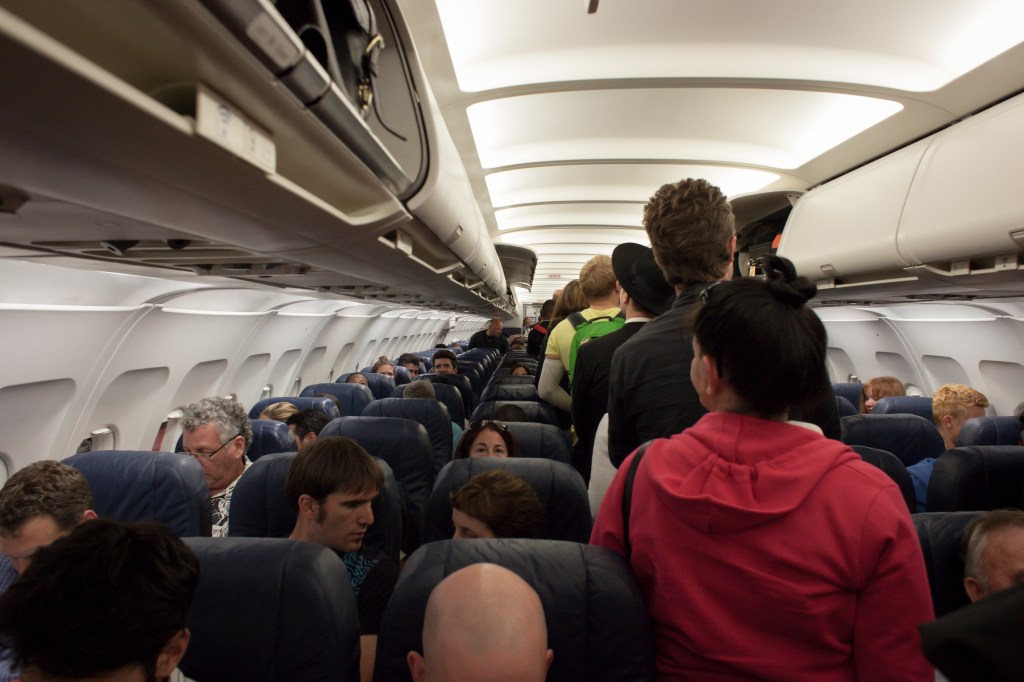
Let’s face it, apart from having to get on the plane, nothing about boarding makes any sense. To start with, no airline has really discovered an efficient way to get people in their seats. (Anyone else find it strange how you’re in your seat on a plane?) The seemingly intuitive way of loading up in blocks from back to front seemingly stops at being intuitive. Intuition, it appears, is just another late arrival in the airline industry. This back-to-front scheme was actually only developed in 2003 (!) with the assistance of industrial engineers at Arizona State University to replace the older, even less intuitive system of filling the plane up from front to back.
More importantly, despite it or some variant on it arguably being the default way to fill most planes, the back-to-front system is one of the slowest methods out there. (So much for that particular group of industrial engineers.) Instead, the most efficient system according to computer modelling by Jason Steffen, which he developed in his spare time while working as an astrophysicist at Fermilab, is one where the plane is filled in alternating waves from back to front: first the window seats in the odd-numbered rows, then those in the even-numbered rows before restarting the system for the dreaded middle seats and then again for the aisle seats.
For those able to wrap their brains around that, it’s said to be about 20-30% faster than the best among the conventional systems and twice as fast as back-to-front. However, it is unfortunately based on two utterly impossible preconditions. First, there are no groups, families, or other clusters among the passengers. Second, everyone has to buy in to such an overly complicated and seemingly unnecessary system. (To which all the admin types can only ask where the problem with precondition #2 is.)

As for actual, existing systems, KLM is at least honest about the whole thing to say that theirs is essentially based more on bribery than it is on seat location: the more money you’ve given them for your current (first / business class) or past flights (frequent-flyer group), the earlier you board. (Ok. KLM didn’t actually use the word “bribery”. I think they refer to it as something like “loyalty” instead …)
Lufthansa, by contrast, tries to straddle the line between loyalty and logic, with loyalty logically getting priority. After the big spenders board, the remaining tightwads are sorted into zones 3 to 5, which are designed to fill the seats progressively from the window to the aisle, the so-called WilMA (for window, middle, aisle) system. As good a system as WilMA indeed is, the problem is that it’s also ignored about as often as its namesake on the Flintstones. As such, only zone 4—and that’s four as in “free for all”—effectively exists. Or, in other words, pretty much KLM’s system.
Or in other, more formal words that assume that queuing aggressiveness does not correlate with seat position, random. And a random system (as opposed to an open one where there are no seat assignments), interestingly enough, appears to be among the best.
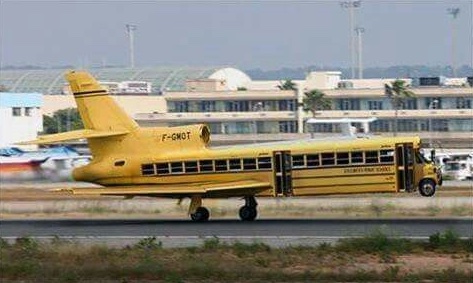
Now, even if the airlines, in doing nothing, have fortuitously stumbled onto one of the more efficient systems for loading passengers on to the plane, it still doesn’t explain the growing trend of inserting another layer of chaos by using a bus to shuttle them between the gate and the plane in its “apron position”. As with so many other, recent “improvements” by the airline industry today, this feature is designed entirely to save them money at the cost of your convenience. And peace of mind.
Now how using busses saves the airlines money is a mystery to most. Including me. They still need to rent a gate, often using ones that could lead directly to the plane via a jetway anyway, and, although they don’t have to hire anyone to operate that jetway for them anymore, they still need to pay for at least one bus with its bus driver together with at least one set of stairs at the plane with its, umm, stair driver. As well as all the people to ensure that you don’t absentmindedly walk into the jet engine. Ryanair, those undisputed champions of cost-cutting, at least have you walk to your plane so as to dispense with the bus entirely.
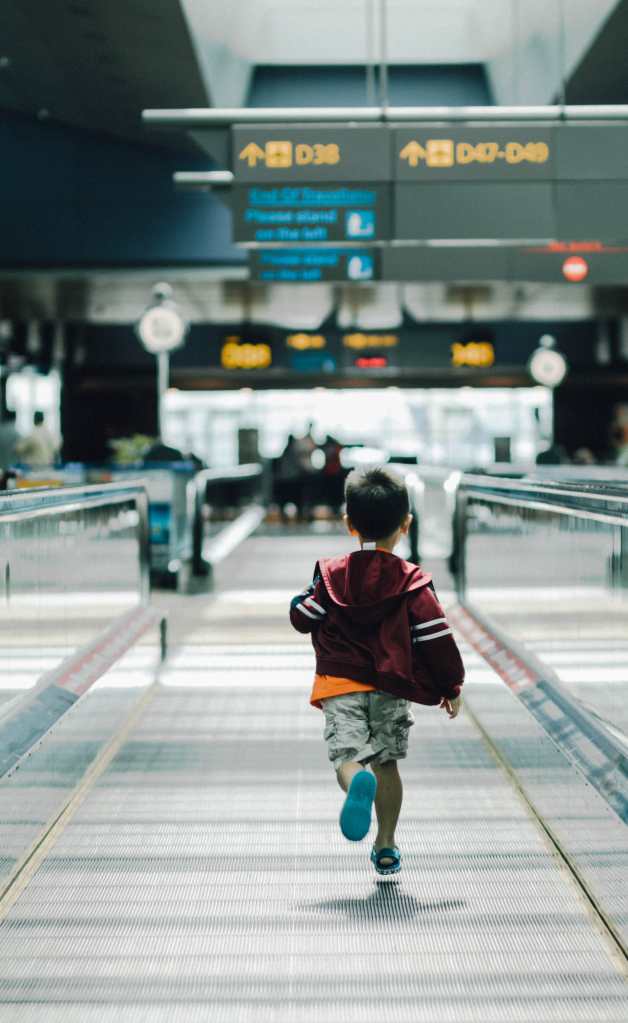
By contrast, the loss in convenience is a mystery to precisely no one. Apart from making them look forward to the comparatively wide-open spaces of economy class, all busses do for the passengers is to make their increasingly tighter connection times increasingly tighter. And even more so if they have to go through security again because of it, something that is thankfully becoming more and more of an exception. (Except if you’re going through London Stansted.)
(My extreme, absurd experience in this regard was one time when I was faced with a 45-minute connection with busses on both ends of the deal. After sprinting across two terminals, I made it to the new gate just as it was closing, only to get bussed back to the exact same plane with the exact same flight crew. Eliminate the busses and the transfer would have taken exactly zero seconds as opposed to the several years off my life expectancy that it actually did.)
Ironically, using busses should actually speed boarding up because it adds another layer of randomness to the boarding order. Pity about the added travel times and occasional gridlock it entails …
In the end, however, what really makes no sense whatsoever is when the airlines continue to insist on using their well-thought out, if not zoned-out, systems to board the bus. Why? What does your “loyalty” get you then?
First through the gate, but last off the bus to your complementary champagne …
 The Blog About Fog