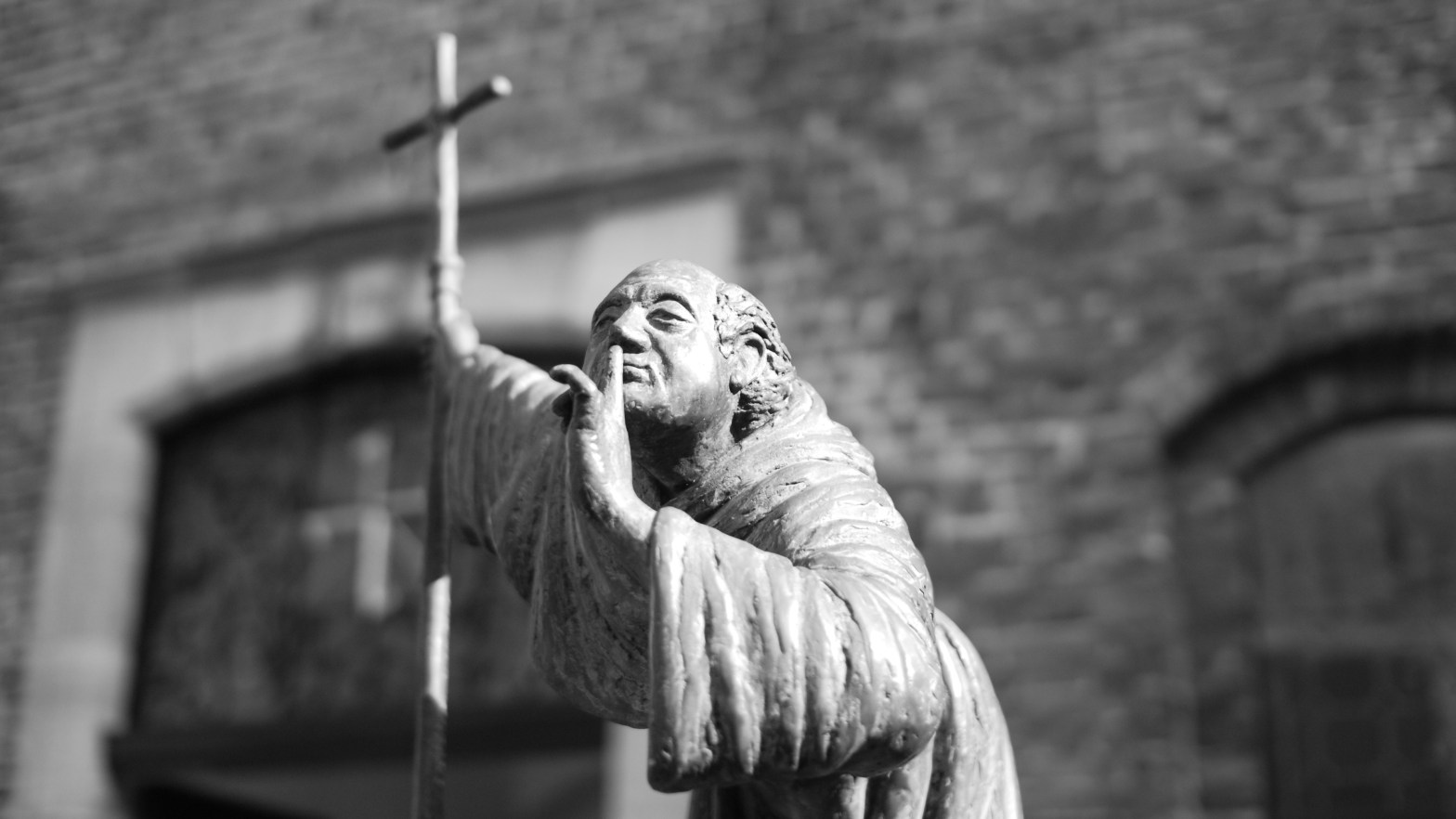
Most Germans will deny it, if only because they cannot pronounce the voiceless dental fricative (/θ/, one of the two “th” sounds), but they actually live in a theocracy, making it currently only the third western country together with the Vatican and the US to do so.
There are more than a few obvious signs pointing to this, the first being a virtual countrywide ban on dancing on Good Friday that I’ve railed on about before. However, this Tanzverbot is only the most famous restriction on what are known as “silent holidays” in Germany. These are mostly public holidays with religious roots where any number of otherwise normal activities are outlawed to promote reflection and maintain the solemnity of the day. Good Friday is the best known and most universal of the bunch, but there are others as well as “silent days” that don’t double up as public holidays. The list of banned activities varies from state to state and day to day, but generally includes dancing and musical events, circuses, public sporting events, and certain movies.

Yes, to prevent our thoughts on these days of contemplation from being led too far astray, the movie industry through its German self-regulatory rating body, the Freiwillige Selbstkontrolle der Filmwirtschaft (FSK), has been putting together a list of movies since at least the 1950s that are banned from being shown in theatres and on TV on the silent holidays. (You can, however, watch the films on Netflix and the other streamers in the throes of your little cabal for some unknown reason, further begging the question as to how something can be illegal only on certain days and then only in certain ways.) The List contains obvious smut like the 1974 Japanese anime film Heidi, Girl of the Alps together with a bunch of other similar pornos and slasher films that no one probably should ever watch, but not those stalwarts of religious purity and paragons of morality in the form of either of the SAW or Fifty Shades film series.
Could be that poor Heidi just needed a better upbringing. Too bad that the FSK also had Mary Poppins doing hard labour since 1995 as well.
Be that as it may, to promote that desired clarity of thought, feel free to ring the Church bells as long and as loud as you want on the “silent” holiday of your choice (and probably naked too while you’re at it given that Frankfurt’s highest regional court recently upheld a landlord’s right to sunbath nude in the courtyard of his building), but don’t you dare think about subverting anyone through any satanic Swiss-Shintoist cinema.

Many of these observations and ironies about The List are not original on my part. Hell, there’s even an entry in the US Library of Congress blog about it. Nevertheless, as infamous as The List is and given both its legal and moral ramifications, it is surprisingly hard to find. Buried somewhere on its website, the FSK does provide a list of movies that had been blacklisted between 1980 and 2015. However, on the same document, they themselves note that even this catalog is not accurate because of potential data-entry mistakes. (Apparently, this is how Heidi made the list, something the FSK goes to great pains to explicitly point out on the document. Wonder why …) In addition, they add that many of the movies that are legitimately on this list could have subsequently been taken off of it upon appeal as well as because of the changing ethics and norms in German society. (This latter shift is probably best illustrated by the fact that <1% of the movies released since 2020 made the list, compared to the high of 65.9% of all movies in the 1960s being silently banned.) Instead, the FSK say that more accurate results can be found through their website’s (extremely slow) search engine, but even here I found it impossible to find any movie that was on The List.
(A word of warning. For those wanting to hunt down The List, it’s not only impossible to find, but obviously also in German for which I apologize. Twice. First, most of the film titles might not be easily recognizable to non-German speakers. Second, German translations of film titles tend to be boringly factual. Painfully, boringly factual. For instance, the German title of Driving Miss Daisy, namely Miss Daisy und ihr Chauffeur, is really just a census of the film’s major characters, whereas the English title at least has a verb to give it some movement. The Shawshank Redemption comes out as Die Verurteilten (“the convicted” (plural)), which misses the point of the movie entirely. Or the German translations tend to overexplain the title, another variation on over-factualization. For instance, the straightforward Top Gun becomes Top Gun – Sie fürchten weder Tod noch Teufel (“they fear neither death nor the devil”). One of the few exceptions to all this is for the claymation film Chicken Run, where the German translation of Hennen Rennen has the same clever double meaning, but with an internal rhyme to boot! So there …)
In any case, if changes in society mean that movies can become watchable on the silent holidays, including movies with music and dancing (e.g., Dirty Dancing, which is officially not on The List and, as far as I can tell, never has been), then why continue outlawing music and dancing?
But, Heidi notwithstanding, this is to some extent all grown-up stuff. Instead, any good theocracy knows to get them while they are young by offering religion, sorry “religious studies”, in school.

And this is actually codified in law. German basic law (Grundgesetz) officially enshrines religious instruction as part of the public-school curriculum, albeit with some extra caveats on top of that here in Not-Bielefeld: there have to be 12 or more students belonging to the same religion, there’s a willing and qualified teacher in that religion, and the parents of those students under 14 approve of it all. Otherwise, the kids should go in the default class of ethics and norms, hopefully without any of the FSK‘s temporally flexible insights into it. However, the elementary school here in Not-Bielefeld where my daughters went was small (only two parallel classes for each grade) and there were no teachers qualified to teach ethics and norms. (Ironic that. One can teach religion, but know nothing about ethics …) Thus, parental approval be damned, it was religion for all and learning important, general religious concepts like the Lord’s Prayer and the Ten Commandments. Other religions? That they even existed was something left for the very last grade in elementary school.
I have nothing against religion being taught in schools, including all the death, mayhem, and other assorted human-rights violations it was responsible for historically. It just shouldn’t be in elementary schools and also not-so-secret advertising for any particular one. Religious instruction? I believe they already have something called churches for that. (Or are those too busy providing “evolution instruction” these days?) Despite their internal redundancies and obviously plagiarized content, I can sort of accept the teaching of the Ten Commandments because there are universal moral and ethical principles underlying them that go beyond any single religion, if not religion as a whole. But the Lord’s Prayer? Granted, knowing it could win you $200 in Jeopardy, but still …

The problem here is that elementary-school kids tend to idolize their teachers to the point of believing anything they say over their boring old parents. A case in point was when my eldest daughter came home from school one day and told me that I had been saying “clothes” wrong all this time. Instead of my monosyllabic “klowz”, her English teacher told her that the correct pronunciation was the disyllabic “klow-THEZ” and with that emphasis. (The irony here is, of course, beautiful insofar as the northern German, non-native English speaking teacher is indirectly telling the born and bred, native English speaking Canadian how to speak his own language. Technically, she was right, at least up to that extra syllable. Clothes does indeed possess the second “th” sound, the voiced dental fricative (/ð/), but non-technically, this is English we’re talking about. If we want to voice the voiceless fricative and silence the voiced one, well, that’s our God-given right, isn’t it?) I imagine (read: sincerely hope) that the teacher was simply overemphasizing that fricative so that her students wouldn’t be condemned to saying “zis” and “zat” for ze rest of zeir lives, but who know-THEZ?
Now, I say “tend to idolize” because then there’s my youngest daughter. I didn’t know it until years later but she actually got permanently kicked out of her religion class for continually asking how evolution and the Big Bang fit into the whole scheme of things. (Or, in other words, not taking the gospel truth as the gospel truth.) So instead of learning about (a single) religion, she got to watch TV in school for an hour. For years. Pedagogically more than a little suspect but then so was the entire religion class to start with, wasn’t it?
And, finally, there’s the bottom line …
Theocracies cost money to run and the churches have the German taxpayers right where they want them. In many countries, churches are charitable entities and so pay no income tax despite raking in untold amounts of money via donations and, more importantly, through all the property and businesses they own. The inherent contradiction of this situation is finally being realized such that there are debates also starting in some of these same countries as to whether or not to end this tax-exempt status for the churches.
But in Germany?

Not only is there no debate, but in all German states except, ironically enough, the very religious Bavaria, the government actually directly funds the poor, destitute churches by having its tax offices collect a special church tax from the devout among the taxpayers. And there’s no debate there either: depending on which state you live in, an additional 8-9% of your income tax automatically goes to your church (apparently with a 3% handling fee for the tax office) if you’ve been christened or baptized, even if it was against your future will by your good-meaning parents.
And there is some serious money at stake here too. For instance, that 8-9% worked out to some 9.2 billion Euros in 2010 (and, by extension, up to 276 million Euros for the tax office), contributing in no small measure to the net worth of the German Catholic Church, which is estimated to be anywhere between $26 billion and 430 billion Euros. Even the more conservative of those two numbers (conservative because we are talking about the Catholic Church here), makes the German Catholic Church on its own the fourth richest religious institution in the world and is more than ample to place it on the Forbes 2000 list and in the top 35 of the wealthiest German companies ahead of, for instance, that little known shoe company called adidas.
Despite these embarrassing riches, there are separate reports of the tax office / churches investigating the religious background of foreigners who have moved to Germany to ensure they aren’t dodging their tax burden like the churches are. In the end, the only way out of paying the church tax involves some degree of pain, either in the form of dying or surrendering about 30 EUR and filling out the requisite paperwork to formally leave the church.

And even then the churches have found a way to tax the non-devout in the form of “special church money” (besonderes Kirchgeld) based on the joint gross income of those couples living in mixed marriages. Thus, the non-religious person indirectly pays taxes to the church for having fallen in love with a devout person who, in turn, actually pays taxes twice (presumably as punishment for marrying the heathen in the first place) because they also have to pay their normal church taxes. This all apparently only comes into play when the devout person has no to little income of their own. Or, in other words, is poor, and so belongs to exactly one of those demographics in society that the churches are supposed to be helping out.
And yet despite being a paying customer, whether directly or indirectly, my Catholic wife is still officially forbidden from taking Holy Communion or even going to confession because we only married in the eyes of a civil servant and not God. But, thankfully, because we are talking about charitable organizations here (at least in the tax sense of the word), all these church taxes are fully tax deductible …
 The Blog About Fog