I have a confession to make …
For years now, I’ve been throwing organic waste in with the normal trash, a crime minimally punishable here in Germany by a stern and very long-winded lecture from the neighbours. Befitting the times, my excuse is simple: I blame Big Government.
The waste, of course, is dog poop, something that I’ve rallied on about before. I’ve had my dog for nearly five years now and, depending on how many cats she’s eaten, she poops about 3-4x a day. (A joke. She’s half Australian Shepherd so she’d rather herd cats than eat them. But she also knows how impossible that is so she just leaves them alone. But squirrels?) Altogether, that means we’re rapidly approaching 6500 bags of decomposable organic waste in the local landfill that is doing precisely not that.
The problem is two-fold insofar as neither dog poop nor biodegradable plastic bags are allowed in the organic waste here in Not-Bielefeld. In fact, animal poop of all kinds is outlawed for hygienic reasons. Fair enough. There can be some pretty nasty things in dog poop and, on it’s own, it doesn’t appear to be the natural fertilizer that many intuitively think it should be. But, after standing outside for two weeks in the summer sun, the organic-waste containers of my building complex are literally crawling with mould and maggots so that you really couldn’t see the poop for the fleas anymore anyway. Also, when properly treated, dog poop does indeed seem to make good compost.
Biodegradable plastic is also out because it apparently degrades too slowly (even for northern Germans) and too incompletely, thereby impacting on the quality of the compost. And, let’s face it, who wants rotten compost? But, do you know what is allowed instead? Wood. Admittedly, the wood has to be cut down to size, but we’re still talking about the same stuff that they make houses out of in North America and that IKEA uses in all its products. (Except its hot dogs. Love them IKEA hot dogs.) Sounds like we should be using the longer lasting biodegradable plastic for our houses in the future, doesn’t it? Instead, the suggestion is to use paper for the organic waste, which makes sense insofar as it really is nothing more than cut-down wood.
But, of course, highly impractical for dog poop, even if it were allowed in the first place.
To be fair, Not-Bielefeld is, at least in part, erring on the side of caution. A lot of the things that are listed as being biodegradable, like wood in the case of North American houses, really aren’t. So there are a lot of products out there, and many brands of plastic (poop) bags among them, cashing in on the environmental movement by simply slapping the terms “organic” or “biodegradable” on the packaging or choosing product names that hint at it. Now I have no idea about the actual process that Not-Bielefeld subjects its organic waste to and whether or not it cannot handle truly biodegradable plastic bags, but I can understand them banning all plastic bags to avoid the fake biodegradable ones gumming up the works.
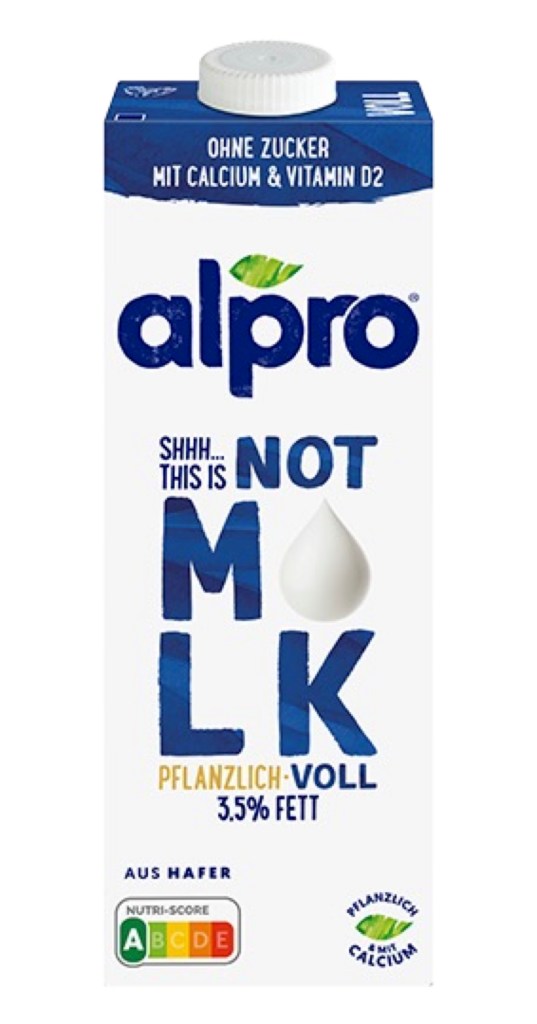
An analogous, but still opposite, example of truth in advertising is milk. The recent increases in both environmental awareness and health consciousness means that there are a lot of milk alternatives out there: soy milk, oat milk, low-fat milk, and even hemp milk, among many others. But, unlike those companies that actually do produce biodegradable plastic (poop) bags, the milk industry possesses a powerful and well-funded lobby to help ensure that milk means milk. And the latter has been the case in Europe since 2017, forcing the plant-based milk alternatives, with some clever exceptions, to use the word “drink” on their packaging instead. Ostensibly, this is all to prevent the consumer from getting confused from what the milk industry sees as deceptive labelling. Curiously, however, American consumers seem less prone to this same confusion and, if truly honest labelling were the goal, then milk should really be marketed as modified cow sweat.
And somehow through it all, coconut milk can still be sold as such in Europe. Apparently the fact that coconuts and mammals are both hairy is sufficient for those judges on the EU Court of Justice.
Anyway, let’s forget about all that “crap” and get back to the real stuff. Most importantly, why the big to-do about doggie doo on my part in the first place?
Part of it, I guess, is that it just bugs me on a personal level. I’ve already mentioned the irony of entombing a biodegradable substance in plastic for the rest of eternity. Before Not-Bielefeld’s plastic ban came into effect, I actually did manage to find a company that apparently sells certified biodegradable poop bags. (At a premium price, of course.) But there’s no point in buying them anymore because now they’ll just end up in the local landfill doing nothing. Sure, I could still use bags made from recycled plastic to ease both my carbon footprint and my environmental conscience, but, in the end, it still means that a recyclable product in a recycled bag will also be doing just as little in the landfill. There has to be a better option.
Then in “researching” this blog entry, you realize how much scaremongering seems to be going on. The consensus is that dog poop is dangerously toxic thanks to all the extra parasites and bacteria it contains, including the much feared E. coli and other faecal coliform bacteria. 23 million of those bacteria per gram of poop in fact! There are even insinuations that this makes dog poop smellier than the roses we deposit in the toilet each day as well as claims that it is different from the poop of wild animals both because of the sheer number of dogs and because of all the manufactured food we give them. But you know what? There’s also about two million coyotes pooping around the US, including an estimated 800 000 in Texas. That’s still way less than the number of dogs in the Lone Star State (estimated to be about 7.2 million), but still a lot of dangerous faecal potential. And human poop also counts as a biohazard, regardless of whether or not you also eat a lot of the same mass-produced, manufactured junk we give to our dogs. Like other mammals, our intestines also naturally contain E. coli (which count towards the 13 million faecal coliform bacteria present per gram in our poop) and dogs can also become equally sick from the few pathogenic strains of it out there. More to the point, when was the last time you ever heard of anyone becoming seriously ill, let alone dying, from coming into contact with dog poop? Hell, I was always more scared healthwise of my own kids, which as every parent knows are just bipedal Petri dishes. (Kids in general, not just mine.)

(By contrast, there doesn’t seem to be anywhere near as much of a stink raised when it comes to cat poop. Strange that because that stuff must be about as toxic as dog poop given that cats are also carnivores that have a different microbiome to humans. Many owners also allow their cats to roam freely such that the latter are also much more likely than dogs to make a meal of some parasite infested wild bird or rodent to give that extra dangerous kick to their poop. However, cats do tend to bury their poop, leading to the ostrich-like solution of out of sight, out of mind. (Or from the perspective of the cat: out of behind, out of sight.) Why dog poop has to be buried with similar safety precautions as for nuclear waste (if at all …), whereas cats can just flick some dirt over theirs remains an open question however …)
And then there’s all the misinformation on top of that, like the report on how dogs in the US today produce more faecal waste than Americans did in 1959, which is amazing when you consider that there were still about twice as many Americans then as American dogs now. Even more amazing is that the calculation is based on the assumption that the average dog poops about 3x more in weight per day (340 g) than the average human (128 g). (Fortunately, there’s the good ol’ CBC and David Suzuki to put things right: a more reasonable 500 g for a 70-kg person assuming 30 ml of poop for every kilogram of body weight. And, if you think that last number is a little weirdly overly scientific, consider that there’s an actual scientific study showing that all mammals, regardless if you’re a cat or an elephant (or probably also a human without a smartphone or a newspaper), take about 12 seconds on average to poop. Took five people to figure that one out …) Or then there’s the handy dandy poop-o-meter that lets you calculate how much of your life you’ve spent cleaning up after your dog assuming that you spend 20 minutes a day doing it. Or about 33x longer than it took your dog to do it …
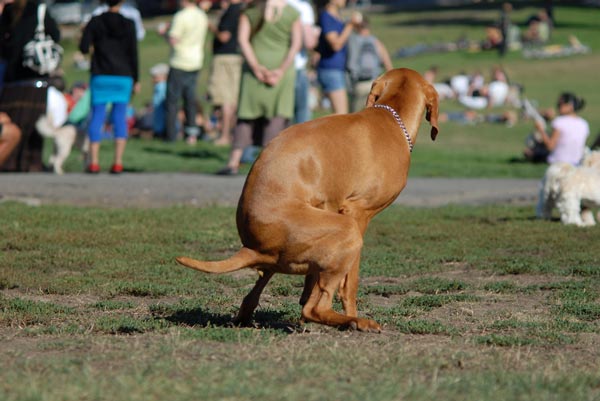
The other part of this rant comes from the fact this is indeed an environmental problem and a bigger one that most people, including myself before writing this, probably realize. And probably a needless one at that. There are a lot of dogs—some 90 million in 2017 in the US alone—and they produce a lot of refuse. If you crunch the estimates on this webpage, it works out to about 4% of the solid waste in your average landfill. And not everyone picks up after their dog either. Even if that’s slightly less crap than the average infomercial tries to push on you each night, we don’t have a good way to get rid of it.
Landfills we already know about and I suspect there are quite a few cities like Not-Bielefeld where dog poop similarly can’t go in with the organics. Which leaves the toilet. Sounds a little crazy, but it is actually suggested by quite a few websites (and contradicted by quite a few others), all on the authority of the US Environmental Protiection Agency. (This might be news to the EPA, however. I’ve only ever found this recommendation on a single document of theirs and one that is incredibly hard to find without google and knowing the exact quote to search for.) And why not? After all, if our biohazardous poop can go in there, why not theirs? Admittedly, dogs are a little harder to toilet train than three-year olds, but there are flushable poop bags if you’re willing to fork out for them at about 4x the already premium price of a truly biodegradable one.
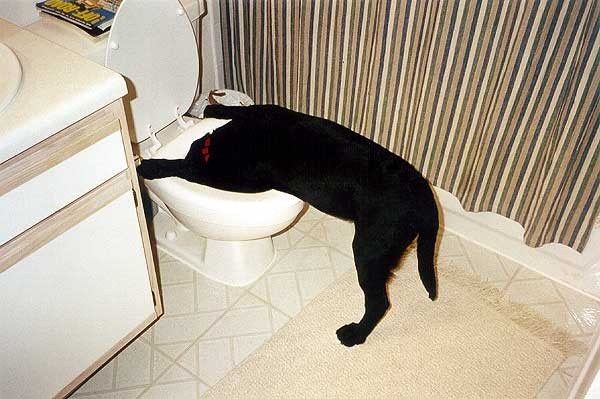
But, of course, you have to believe that the EPA really does advocate this, that those “flushable” poop bags really are flushable, and that this all isn’t really just another big infomercial …
 The Blog About Fog