
With Northern Germany’s annual attempt at winter being upon us again (dark, drizzly, not really cold, definitely not snowy), my thoughts at this time of year always turn not to Christmas (which to this Canadian requires snow), but to how the chain of responsibility inevitably seems to be tied to the ankle of the average citizen.
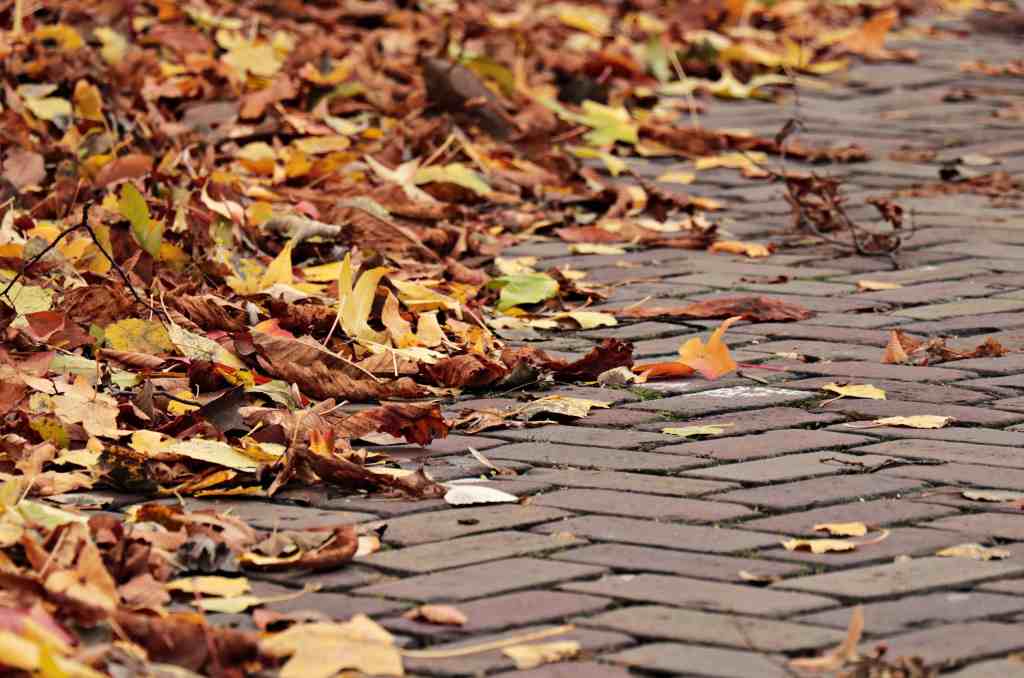
You see, “dark and drizzly” tends to mean “bloody slippery” here in Not-Bielefeld, mostly because of all the leaves on the ground. And, here in Not-Bielefeld there are always a lot of leaves on the ground come autumn. The solution is as obvious as it is onerous: keep raking up the leaves. This is certainly expected of the average homeowner. However, both the City and the University of Not-Bielefeld often write their own free passes here by simply posting signs (often with an overabundance of exclamation marks) warning that the private property that you intend to traverse is not cleared in the winter and so you do so at your own risk.
There’s any number of things that is oh so wrong with these signs …
For starters, when does land paid for and largely used by the public suddenly become private property? And why do I have to clear my truly private property that perhaps no one except the mail carrier has to use? Can you imagine the outcry (and fines) if I dared put up a similar sign? I readily admit that both the University and especially the City have a lot more property to clear, but then they also have much better equipment than my neighbour—some schmo with a leaf blower at 6:30 AM—to do it.
And speaking of signs …
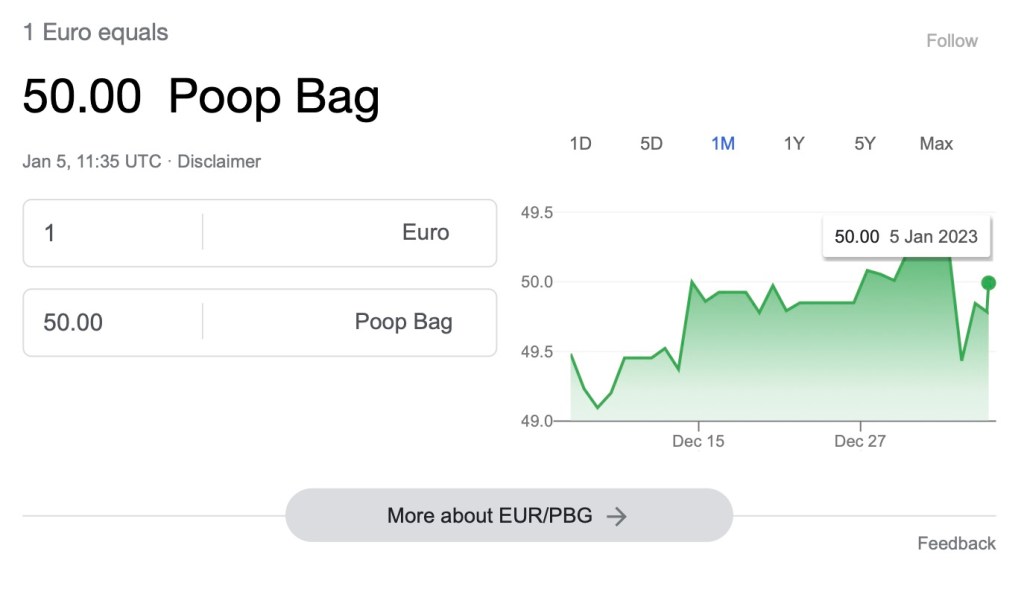
At a park not far from my house, the city has put up a sign stating that you need to pick up after your dog or risk a fine of 50 EUR. (Or, as was pointed out so helpfully, about the same cost as 2500 poop bags, thereby giving poop bags about the same buying power as the Dominican Peso, the Ethiopian Birr, the Macedonian Denar, or the Mauritius Rupee, among others.) And, just so you get the message, the exact same sign is repeated no less than five times every five meters or so. But, strangely enough, despite the universality of the warning and fine, the sign is not present in any other park in Not-Bielefeld that I’ve been too, suggesting that the job order to “just put up these six signs” was given at the very end of someone’s working day.
Another park, however, does proactively go the extra 1.6 km by occasionally supplying free poop bags for you to pick up after your dog. No signs (probably because of the nonsensical conversion rate from Euros to poop bags in this case), just the bags. Oh and a massive guilt trip, with each bag saying in no less than five different ways that using them will help to protect the environment.
As always, I get it. No one likes to step in dog shit, not even dogs. But actively promoting that encasing a biodegradable product in plastic to spend the rest of eternity in an anoxic landfill is more environmentally friendly than simply leaving it in an ecological setting? Makes you wonder how the Earth ever survived long enough until humans came along to save it. Sort of adds an extra justification to shooting wolves too. Not only are they eating all our livestock, but they’re also destroying nature when all the inedible bits of the cows and sheep come out the other end. C’mon! There’s more crap on the outside of the bag than could ever fit inside it.
.jpg)
Instead, what’s really missing from this whole discussion is garbage cans. Tell me to pick up after my dog? Fine. But at least give me somewhere to throw the bag away. I don’t have any real data to back this up other than me sometimes carrying dog poop around for half an hour or more, but I strongly suspect that there are more public mailboxes in Not-Bielefeld than there are public trash cans. And those few trash cans that do exist are usually overflowing with poop bags even though they are located along the main roads or exactly those places you tend to avoid when you go walking with your dog.
(And putting the poop bags into someone’s private garbage can is completely out of the question. Germans are insanely protective of their garbage cans. As in stupidly insanely protective. For example, at our housing unit, I once asked whether we could combine our 11 individual garbage cans into one big one for the entire unit. They looked at me as if I was as insane in general as they were about their bins in particular. Not only would each of us not have our own garbage can anymore, but the single large garbage can, despite being as inconveniently located in the back of the complex like the 11 smaller ones, would simply serve as an open invitation for others to deposit their trash in it as well.)
And speaking of overflowing rubbish …
Even the University has gotten into the swing of things. Some years ago, they replaced the aging, outdoor garbage cans at our campus with sets of shiny new ones all colour-coded for the different flavours of trash that exist today (plastics, organics, paper, and, well, garbage). Fast-forward to today where now only a single outdoor set remains, presumably because the University discovered that convenience costs money and more garbage cans means more costs in emptying them. As an added bonus, the single set was often overflowing as a result, which provided helpful examples of which trash went where for those who couldn’t remember the colour combinations.
And speaking of cost-cutting …
As a result of the war in the Ukraine shutting down natural-gas supplies from Russia to Europe, many German municipalities put emergency energy plans in place so that our natural-gas reserves would hopefully hold out for the entire winter. (Part of these plans apparently being instituted years ago in the form of global warming so as to make this past winter one of the warmest ever on record so far.) One of the more cutting-edge initiatives included in many plans was to turn off the hot water for the showers at public swimming pools and sport clubs.

Problem is that this solution doesn’t do so much for saving energy as it does for saving the municipalities money. Let’s face it, no one really uses public showers because they enjoy the feeling of lukewarm water dribbling onto them. Instead it’s much more of a case of trying to wash all the chlorine (read urine) or sweat off of you before changing back into clean clothes. Turning off the taps doesn’t make all those excretory products suddenly disappear. It merely forces everyone to shower at home on their own dime, which suddenly buys a lot less hot water than it used to.
To top it off, much of the hue and cry about the energy crisis seems to have been completely overblown. BloombergNEF estimates that Europe’s natural-gas reserves in combination with reduced demand are normally sufficient to endure the coldest winter Europe has faced in the past 30 years, not the increasingly warmer ones that we are actually having. In fact, the reserves in Europe were so full in late October of last year, that the price of natural gas actually dropped below zero for some time. Naturally these lower costs were passed automatically on to the end consumer just like they were early on in the pandemic when the price of oil also went negative.
So, as it turns out, the buck always seems to get passed down to the average citizen, but the bucks always seem to flow the other way …
 The Blog About Fog