Going a little bit controversial on this one probably. But then, “live by the pen, die by the sword” has pretty much been a constant throughout human history, now hasn’t it?
At the outset, however, I want to point out that this entry has less to do with the question of animal rights per se as to the sometimes haphazard, “idiosyncratic” way that admin deals with them. I also want to stress that I am all in favour of animal rights (although, as a left-hander, I find the concept of “rights” to be terminologically exclusionary, if not morally offensive in this day and age). However, I’m also pragmatic about the entire issue as well. Every day, untold numbers of animals (and plants) are eaten by untold numbers of other animals (and plants). And, if you want to get really creepy about it, there are numerous cases in nature where animals (and plants) actively manipulate other animals for their own benefit and with little to no regard for the other animal.

(Need an example? One of the intermediate stages in the life cycle of the Lancet Liver Fluke, Dicrocoelium dendriticum, changes the behaviour of the ants that it infects as intermediate hosts so that instead of these ants spending their evenings in front of the colony TV like they normally would, they climb up blades of grass to spend the night there. This does absolutely nothing for the ant except to increase its chances of being eaten by some grazing animal, the final host of the fluke. Even worse, if the ant is not eaten, it resumes its normal behaviour the next day before again perching on another blade of grass the next night. And on and on it goes until the ant finally does meet its untimely (i.e., nocturnal) end. And this is only one of several examples of animals being turned into zombies in nature. In that list, there’s even a fungus that does a similar trick to the ants …)
In any case, humans, as animals (not plants), belong to this cycle, with or without zombies. We simply have to re-learn to use as much of as few animals (and plants) as absolutely necessary and to minimize their suffering in the process. (And part of this process is realizing that a buck ninety nine for your favorite fast-food hamburger is unrealistic, if not downright unethical.) Not having been a dog owner for that long, I was quite surprised when I discovered that you can buy dried pig’s ears and noses for your favourite furball to munch on. What a great idea! They’re definitely not my first choices for parts of the pig to eat and compensate for those parts that are.
I try to apply this principle in teaching our undergrad comparative anatomy courses. (That principle being using as much of the animal as possible, not feeding the students pig’s ears or turning them into zombies. (Although the latter does occur by accident sometimes during my lectures.)) Students double up on specimens wherever possible (in non-corona times at least) and the only vertebrates they ever see are fish and rats. The fish are also not just any fish, but restaurant-grade rainbow trout that would otherwise be landing on some dinner plate here in the Not-Bielefeld Greater Metropolitan Area. That way the students not only learn something about fish / vertebrate anatomy, but can also take the filets home afterwards to see what their science tastes like. And the rats are only for the advanced course where there are far fewer students and, where possible, are the unwanted leftovers from the physiologists in the department.
Ok, so where is all this meandering background information heading?
Basically, to ensure the rights of the animals, there are a lot of protocols to adhere to in the University of Not-Bielefeld (and rightly so), whether for research or teaching purposes, and so a lot of forms to fill out. Cue admin (and wrongly so).

But, to paraphrase George Orwell, some animals are more equal than others. You see, only certain animals are subject to those protocols and paperwork. Those animals are basically any vertebrate (so the fish and the rats), but also any cephalopod (e.g., an octopus) or decapod crustacean (e.g., crabs or lobsters) because the latter two groups apparently can clearly sense pain as well as any vertebrate (see footnote 119 on page 163 here).
Naturally, setting any boundary for pain reception or sentience is incredibly gray (even that same footnote casts doubts on it being limited to those three groups), but the gray becomes even muddier when one realizes that it’s not just that only certain animals are subject to the protocols, but then also only under certain conditions. Remember the fish and the rats? We receive them in exactly the same deceased state, just that the fish come from a fish farm and the rats come from the University’s animal house. This difference, however, is enough so that, despite fish also being vertebrates, only the rats are subject to all the paperwork, red tape, and year-end reviews.

And those year-end reviews are sort of like the zombie ants: once you get infected by having done one, you have to keep filling them out year after year until you die. Seriously. For the past two years, we haven’t done the advanced comparative anatomy course because of the corona pandemic. Thus, no rats. Nevertheless, I still have to fill in the form to officially say “no rats”. And this year, this wasn’t even possible because the new version of the spreadsheet didn’t accept the number zero as a valid entry! Nevertheless, I was instructed that I still had to return the form after filling out all the relevant fields that I could.
Or, in other words, my name and address …
(However, to be absolutely accurate about this, I actually still have to return the form because the spreadsheet is in a forbidden file format and so my e-mail gets rejected by the University of Not-Bielefeld servers. Safety first everyone.)

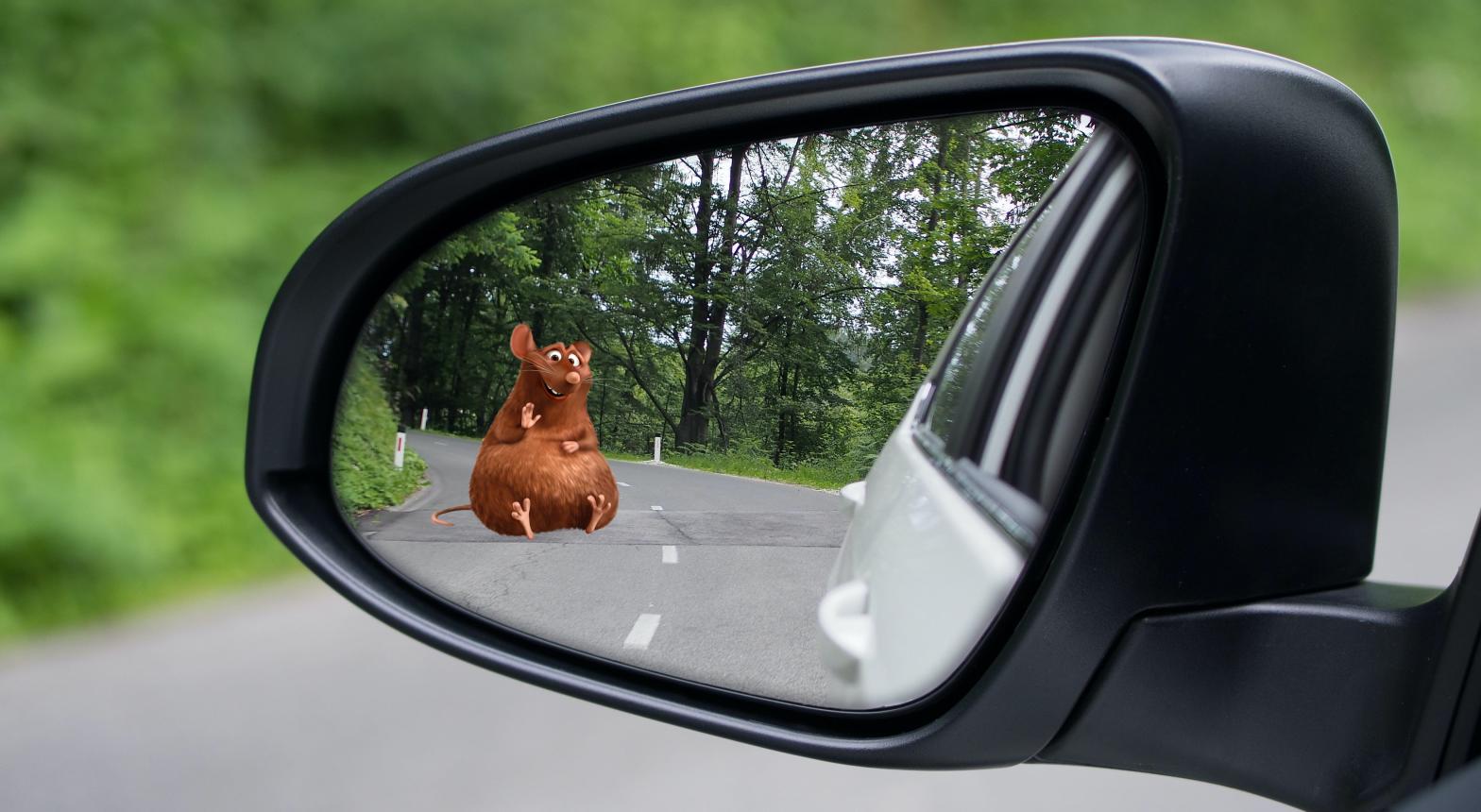
Now, like the fish, these aren’t just any rats, but RATS. As in Émile-from-Ratatouille-style lardballs. You literally have to cut through layers upon layers of fat to see anything interesting. I foolishly once asked if it would be possible to get normal-sized rats and nearly fainted when I was told that it was. I then really fainted when I was informed how much additional paperwork this involved. You see, apparently maintaining normal-sized rats counts as animal experimentation (= paperwork) because doing so would mean not giving them access to food 24/7. For admin-types, this, together with the lack of exercise facilitated by their overly small cages (made even smaller by their overly large sizes), would seem to be a rat’s natural habitat out in the wild.
The fish-rat dichotomy also extends to birds. A few years back I had an undergrad student who was interested in sequencing the DNA of a group of birds to investigate their evolutionary history. Now, the easiest, least invasive way to sequence the DNA of a bird is from its blood and the easiest, least invasive way to get the blood is to remove almost any feather because some blood will remain at the tip of the shaft. Because this method is not non-invasive (but still the least invasive; a very invasive alternative being a venous puncture behind the eye), it counts as animal experimentation with all the requisite paperwork. (General rule: if the animal feels pain, you will too.)

But then comes the non-sequitur. This student was also a breeder who kept several different species from this group of birds at home, which is one of many in which the males and females are virtually impossible (for us) to distinguish from one another by just looking. The only sure-fire way to do it is to sequence their DNA by, you guessed it, plucking a few of their feathers. Now even though both questions use exactly the same methodology and provide exactly the same amount of pain to the bird, there is no paperwork involved at all in sequencing the DNA to determine a bird’s sex because this is a “breeding measure” and not animal experimentation. You can pluck the bird bald like a chicken to see what sex it has (even if bald birds barely breed), but the second you use one of those same feathers to answer another question, it’s an experiment.
It would thus appear that whereas a little bit of physical suffering is just fine for sex, for science it’s a different matter altogether. (Unless, of course, we’re talking about sex between two skinny rats.)
Just goes to show how unsexy science still is …
 The Blog About Fog