
This entry probably deals more with bureaucracy (a system) than admin (the people and institutions indentured to that system) per se, but I’m hoping that only admin types (together with their lawyers, both of whom I’m also hoping aren’t reading this blog) would take me to task for this.
(More to the point: my blog, my rules …)
After being a lifelong, devout cat person, I took over a nine-year-old female Australian Shepherd mix some two years ago now. (Although there is a very legitimate and accepted term for “female dog” , even I’m not crazy enough in this day and age to use it here. (And, if you think that word is bad, look up the one for an adult female dog of reproductive age, which to me sounds like one of the greatest sounding insults of all time.)) Having owned cats for a number of years, I thought it would be equally simple with a dog, with the notable exception that the dog would actually care what I said: feed the dog regularly, clean up its poop, and take it to the vet every once in a while. (A strategy which, come to think about it, worked pretty well with my kids too.)
Nope …
At least here in Germany, if not in many other places, it’s nowhere near that simple: you need to officially register your dog, officially pay taxes for your dog, and officially take out special third-party liability insurance for your dog. And, just because it’s so much fun the first time around, you have to officially register your dog twice. Duly and properly registered here in Not-Bielefeld doesn’t cut it and you also have to do it provincially. No one tells you about this (definitely not Not-Bielefeld and God forbid they do it on your behalf) and the provincial authority in charge of it definitely does zero advertising about it, so most dog owners don’t know about it. I only found out by accident over a year after I got my dog, but the only time most dog owners will find out about it is when their singly-registered dog is involved in some kind of accident and they have to pay a penalty of up to 10 000 EUR because it should have been doubly-registered.
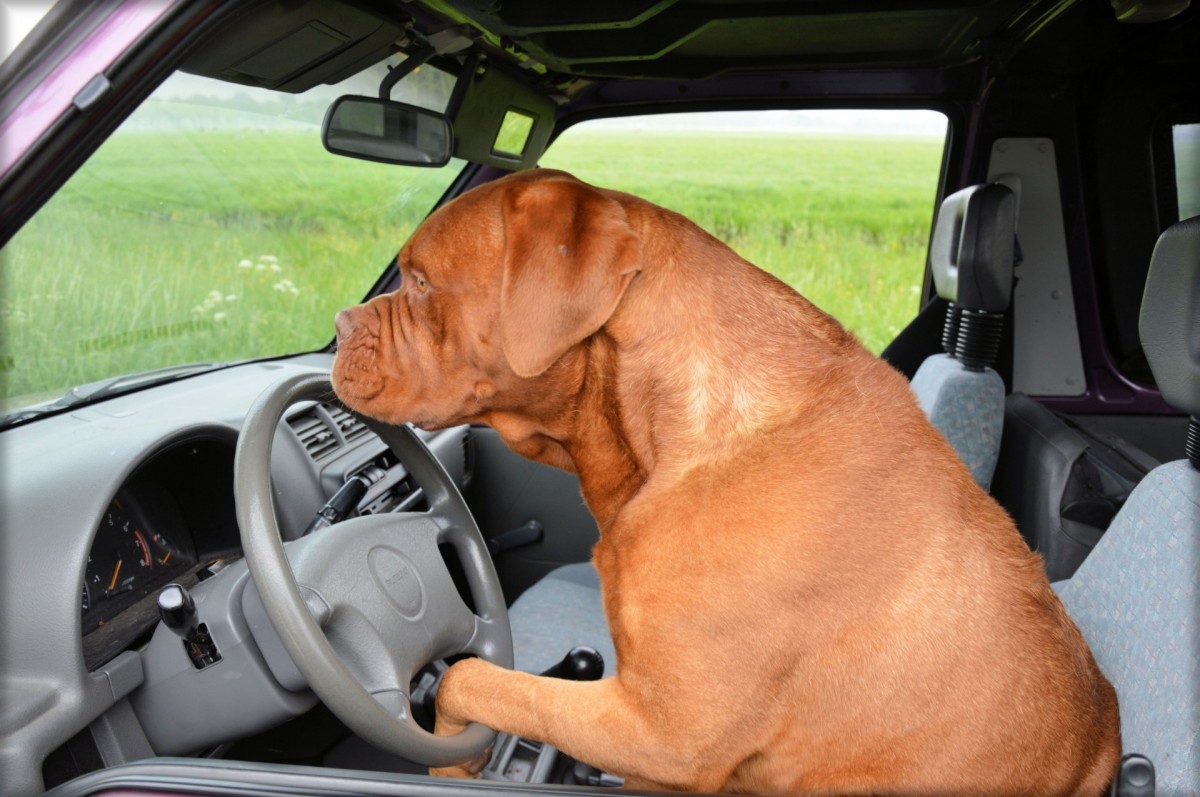
And all that is just on the dog side of things. Dog owners also have to have a doggie driver’s license to prove that they can properly navigate their dog or something. As always, I am not making this up and not least in that it really is called a dog driver’s license. (I actually managed to sidestep the license because I took my dog over from my best friend. The fine print attached to the license indicated that it was only mandatory for first-time dog owners or, more importantly, for first-time human owners for the dog. In any case, Not-Bielefeld took my registration money without questions and I wasn’t giving any extra answers.)
It’s not just the admin types who have it against dogs, but often the general public as well. It never ceases to amaze me how often I get told to put my dog on a leash, even though this isn’t required in most of Not-Bielefeld. Ok, I understand leashes and can see when they’re necessary. But, with my dog that’s hardly ever the case. Australian Shepherds are renowned “velcro dogs” (in a non-pathological way) and mine, snoring at my feet as I type this, is usually never further than five meters away from me. We’re usually out and about here in the suburbs, which here in Not-Bielefeld are the very definition of not hectic. She always stays on the sidewalk and doesn’t chase after birds or cats or postal carriers, although squirrels à la Pixar’s Up! are admittedly sometimes touch-and-go. I’m always constantly looking out for her (and cops) and she tends to listen very obediently when I get her out of the way of bicycles, joggers, or postal carriers and especially postal carriers on bicycles. (I should point out that my dog being so well trained has absolutely nothing to do with me. I got her that way. Being part Australian Shepherd also makes her the smarter of the two of us. By half.) Even so, I always have her leash with us and do put her on it when it’s crowded, chaotic, or otherwise dangerous either for her or those around us. Like I said, I get it.
Anyway, what never ceases to amaze me even more are some of the answers I get when I respond asking why I should put her on a leash. Four of the better ones:
- Because dogs are potentially dangerous.
The obvious one, right?
No question about it: dogs have those big teeth and some dogs like to use them. But, admin has its bite too. In the UK, it’s estimated that there are about 740 dog attacks per 100 000 people each year. (Amazingly, the equivalent stats are not available for Germany.) This makes dogs about half as dangerous as admin, with a reported office injury rate in the UK of 1334 cases per 100 000 employees. (And that’s only to the admin-types themselves, not the recipients of their handiwork.) But, you never hear about anyone talking about putting admin on a short leash, now do you?
- Because my dog finds it unfair that yours runs around without a leash. (As relaxed as most dog owners are, this one still comes up a lot.)
Wait. What? Really?!
I won’t bet the farm on this one (even if I had one), but I’m pretty darn certain that dogs don’t have a sense of justice and not just because they tend to be cool with pretty much everything. (Cats, on the other hand, very definitely do. They usually find most things to be hideously unfair to them.) But, on the oddball chance that they did, then wouldn’t my well-trained dog find it unfair in reverse to have to wear a leash because your badly trained one can’t go without one?
- Because of the Hinterlassenschaften.
Hinterlassenschaften (which people here really do say; did I ever mention that Germans like big, long words?) is a euphemism that vaguely translates out as “objects that are left behind” or, in plain ol’, George-Carlin-approved English, crap. (In this context. It can also refer to what deceased people leave behind for their relatives. But that also might be crap.) My normal response here is to stare at the person all bewildered and ask them all surprised if that means that my dog won’t crap anymore when she’s on a leash. (Except that I don’t say crap. And I definitely don’t say Hinterlassenschaften.)
- Because of the Brut- und Setzzeit.
The Brut- und Setzzeit is a multi-month period beginning each April during which special measures are taken to ensure that wild animals (but mostly birds here in the city) have a chance to raise their offspring in relative peace and quiet. Again, I get this. Cities are screwing up life for most wild animals so that some (any) form of compensation is desperately needed. What I don’t get is that the restrictions also don’t apply to cats. (And explicitly not so.) Or joggers. Or bicyclists. Or pretty much anything other than dogs who, for some reason, have to be chained up within an inch of their owners over the course of these many, many months.
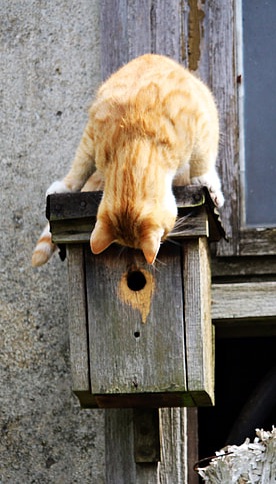 No, seriously. Many dogs, especially the hunting breeds, will eat birds, no question. But many others won’t. (Mine included. If it isn’t some over-priced, former meat product of questionable quality (or human junk food of even more questionable quality) out of a plastic bag, she’s just not interested.) But, really, which is the far bigger threat to a bird, especially the fat, fuzzy ones that can’t fly yet, a ground-dwelling dog or a tree-climbing cat? (Just to help you along here, it’s estimated that outdoor cats (including strays) kill about 2.4 billion birds per year in the United States alone. Even if that estimate is off by a factor of 10, that’s still nearly one bird for each American citizen each year or about what the much more polite Canadian cats eat each year. And that’s just birds.) Here in Not-Bielefeld, they also have at least one annual race that takes place in a wooded area right in the middle of the Brut- und Setzzeit. But, apparently birds, like mothers in maternity wards everywhere, don’t get their feathers in a twist when hundreds, if not thousands, of joggers careen past them. Nevertheless, the inviolability of the Brut- und Setzzeit is so unquestionably ingrained here in Germany that people have stopped to scold me about my dog running off-leash when we’re walking along a relatively busy road.
I’m not trying to argue that dogs are angels. Not in the least. (Except mine. Of course.) But, if your stated goal is to protect wildlife, then being at least remotely consistent about it is not a bad place to start.
What I guess I don’t understand here in general is why dogs always seem to be getting the short end of the administrative stick. The Brut- und Setzzeit story is just an extreme example of it. Less extreme, but more general examples are that dogs are not allowed to go off-leash in most parks and woods in and around Not-Bielefeld and they are absolutely forbidden on school grounds at any time. (Even at eight in the evening in the middle of the holidays when there’s zero students and even fewer teachers around.) By contrast, cats can do whatever they please. However, cats, being cats, will always do whatever they damn well please anyway. They don’t need government support for this and, being cats, really don’t care either if they get it or not. But we give it to them anyways: in late 2019, the EU executive reiterated that its policy of freedom of movement extends to cats, supporting their “unalienable right to roam” and effectively killing any thought of a cat leash law in Europe. Those are 2.4 billion American birds, after all. Fine, but how about maybe a cat “little bell around the neck” law?
But, then, even when the system actually tries to help dogs, it still somehow goes wrong.
For instance, during the coronavirus pandemic in Summer 2020, the German government found the time to debate a proposed law for 2021 mandating that dog owners had to walk their dogs for at least an hour at least twice a day. Ok, as serious and awful as the pandemic still is, it’s not the absolute end of the world (numbers-wise we’re still way behind the 1918 Spanish Flu and the world didn’t end then either) and normal, day-to-day life still has to continue. But, you’d think it would be a bigger priority for the government to discuss some financial aid to the restaurateurs and artists and the many other segments of the society that were really hit hard by the pandemic instead of telling these same people how often they need to walk their dogs each day (or else). I mean, they’re all out of business now anyway because the government is prioritizing Hinterlassenschaften like this. What else do they have to do besides walk their dogs?
Again, the reasoning behind all this is perfectly understandable. Dogs need their exercise, even if they’re roped up and denied the freedom of movement cats have while doing so. But why does it have to be legislated and not just, say, recommended? The second it becomes a law, you have to decide on rigid limits for it as well as how to enforce it. (The impossibility of the latter usually forms the key argument against any sort of law designed to herd in cats.) And, by limits, I mean this two times one hour per day. A lot of people have already made a lot of good counterarguments here. For instance, two hours a day might be too much for some older dogs and an hour outside in the baking hot summer humidity is not ideal for human nor beast. And, my own take on this, what if the dog just plain and simple doesn’t want to? My dog is great at this and she’s part Australian Shepherd (albeit an older one now), a breed that needs activity. Sometimes when I think we’re going out for a long walk, she’ll just go halfway down the block, leave her little Hinterlassenschaften behind (which is sort of a bilingual repetitive redundancy, I think) and that’s it. Really. That’s. It. She’ll just sit there on the sidewalk channelling her inner cat, pointing her snout skywards and will not budge until I turn around and start heading for home again. And this doesn’t just happen when the weather here in Not-Bielefeld is at its winter’s finest: cold (well, cool, says this Canadian), dark, drizzly, … Nope. She’ll do it in lovely T-shirt weather in the summer too. Now, how do I explain that to the cops? Or to the neighbours? Or to whoever is supposed to be keeping tabs on how often and how long we go for walks each day?
But, to mix clichés, it would seem that a dog’s life is not the cat’s meow …
 The Blog About Fog